Hybrid Solar Wind System Market Size, Share & Industry Analysis, By Component (Solar PV Modules, Wind Turbines, Battery Energy Storage Systems (BESS), Inverters & Power Converters, and Energy Management Systems (EMS)), By Source (Solar-Wind-Battery Hybrid, Solar-Wind Only, and Solar-Wind-Diesel Hybrid), By Application (Utility-Scale Power Generation, Commercial & Industrial (C&I), Rural Electrification, and Telecom Infrastructure), By End User (Utilities & IPPs, Commercial & Industrial Facilities, Government & Public Infrastructure, and Telecom Operators), and Regional Forecast, 2026-2034
 Download Free Sample
 Hybrid Solar Wind System Market Overview
 Listen to Audio Version
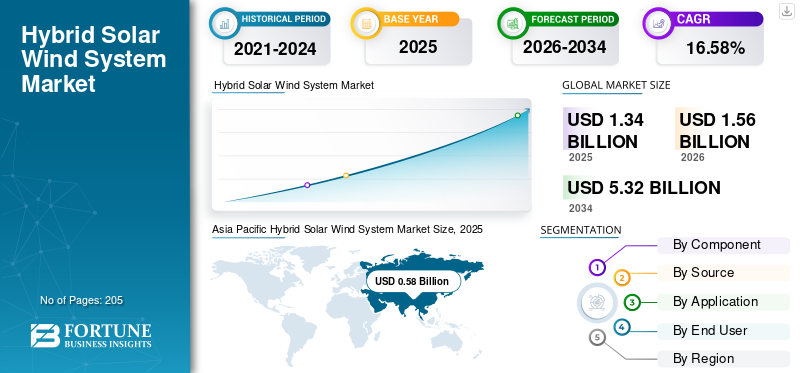
The global hybrid solar wind system market size was valued at USD 1.34 billion in 2025. The market is projected to grow from USD 1.56 billion in 2026 to USD 5.32 billion by 2034, exhibiting a CAGR of 16.58% during the forecast period. Asia Pacific dominated the hybrid solar wind system market with a market share of 43.28% in 2025.
A hybrid solar wind system combines solar photovoltaic (PV) panels and wind turbines within a single power generation infrastructure to produce cleaner and more reliable electricity. These systems leverage the complementary nature of combined solar and wind resources, helping reduce power supply variability and improve energy output throughout the day and across seasons.
The market is witnessing a strong trend toward the integration of battery energy storage systems (BESS) with renewable generation assets. Utilities and independent power producers are increasingly deploying solar, wind, and storage within a single project to improve energy dispatchability, reduce intermittency, and maximize renewable energy solutions adoption. Hybrid solar wind systems help reduce dependence on fossil fuels by providing a reliable, low-carbon electricity supply through the complementary generation of solar and wind energy.
NextEra Energy, Inc., Iberdrola, S.A., and ENGIE SA held the majority of the market share due to their broad portfolios and strong brand reputations.
Download Free sample to learn more about this report.
HYBRID SOLAR WIND SYSTEM MARKET TRENDS
Emergence of Multi-Technology Renewable Energy Parks and Co-Located Infrastructure is the Key Market Trend
The market share is increasingly witnessing the development of multi-technology renewable energy parks that combine solar PV, wind generation, battery energy storage systems, and, in some cases, green hydrogen production facilities within a single integrated ecosystem. Developers are focusing on co-locating renewable assets to maximize land utilization, optimize transmission infrastructure, and improve overall project economics. This approach allows operators to generate electricity from complementary renewable resources while reducing grid congestion and minimizing curtailment risks.
Advancements in digital monitoring platforms, artificial intelligence-based forecasting tools, and automated energy management systems are enabling more efficient operation of hybrid assets. Utilities and independent power producers are also increasingly pursuing round-the-clock renewable energy supply contracts, encouraging the deployment of diversified renewable generation portfolios.
- For instance, in January 2026, Adani Green Energy Limited announced progress on expanding its integrated renewable energy portfolio through the development of large-scale hybrid solar-wind projects in India. The initiative focuses on combining solar PV, wind generation, and energy storage capabilities within renewable energy parks to improve power reliability and optimize transmission infrastructure utilization.
MARKET DYNAMICS
MARKET DRIVERS
Download Free sample to learn more about this report.
Increasing Demand for Firm and Dispatchable Renewable Energy Supply is Driving Market Growth
The growing demand for firm and dispatchable renewable electricity is a major driver accelerating the adoption of hybrid solar wind systems globally. As renewable energy sources penetration increase, utilities, grid operators, and corporate energy consumers are seeking solutions that can deliver more consistent power generation while reducing dependence on fossil-fuel-based backup generation. Hybrid solar wind systems leverage the complementary generation profiles of solar and wind resources, enabling higher capacity utilization and improved power availability across different times of the day and seasons. This capability is becoming increasingly valuable as power systems integrate larger shares of variable renewable energy. This is anticipated to drive the global hybrid solar wind system market growth during the forecast period.
- For instance, in January 2026, ReNew Energy Global advanced multiple hybrid solar-wind projects integrated with battery energy storage in India to supply round-the-clock renewable electricity. The initiative is designed to improve generation consistency, increase capacity utilization, and provide reliable, clean power for utilities and commercial customers.
|
Rank |
Market Driver |
Relative Impact on Market Growth |
Market Growth Contribution (USD Billion) |
2026-2028 |
2029-2031 |
2032-2034 |
|
1 |
Renewable Energy Targets, Incentives, and Decarbonization Policies |
High |
1.30 |
High |
High |
High |
|
2 |
Growing Electrification of Remote and Off-Grid Areas |
High |
1.05 |
High |
High |
Medium |
|
3 |
Declining Costs of Solar PV, Small Wind Turbines, and Battery Storage |
Medium-High |
0.88 |
Medium |
High |
High |
|
4 |
Rising Demand for Reliable Power from Commercial and Industrial Users |
Medium |
0.68 |
Medium |
Medium |
High |
|
5 |
Expansion of Microgrids and Distributed Energy Systems |
Medium-Low |
0.55 |
Low |
Medium |
High |
|
6 |
Others |
Low |
0.34 |
Low |
Low |
Low |
|
Total |
4.80 |
MARKET RESTRAINTS
High Initial Capital Investment and Complex Project Development Requirements to Hamper Market Growth
Market growth is restrained by the high upfront capital investment required for project development and infrastructure integration. Hybrid systems involve the deployment of multiple generation technologies, advanced control systems, power conversion equipment, and often energy storage solutions, resulting in higher project complexity and development costs.
- For instance, in March 2026, ACWA Power announced the financial close of a large integrated renewable energy project combining solar generation and battery energy storage in Saudi Arabia. The development highlighted the substantial capital investment required for hybrid renewable infrastructure, advanced grid integration, and energy storage systems.
|
Rank |
Market Restraint |
Impact on Market Growth |
Market Size Reduction (USD Billion) |
2026-2028 |
2029-2031 |
2032-2034 |
|
1 |
High Initial Capital Investment and Financing Constraints |
High |
0.42 |
High |
Medium |
Low |
|
2 |
Grid Integration, Land Acquisition, and Permitting Challenges |
Medium |
0.29 |
Medium |
Medium |
Medium |
|
3 |
Energy Storage Limitations and Hybrid-System Integration Complexity |
Medium-Low |
0.21 |
Medium |
Medium |
Low |
|
4 |
Others |
Low |
0.12 |
Low |
Low |
Low |
|
Total |
|
|
1.04 |
|
|
|
MARKET OPPORTUNITIES
Repowering and Hybridization of Existing Renewable Energy Assets to Create New Opportunities
A significant opportunity in the market lies in the repowering and hybridization of existing standalone solar and wind power plants. Across major renewable energy markets, a large installed base of solar and wind projects already has established land rights, grid connections, substations, and transmission access. Developers are increasingly exploring the addition of complementary renewable generation assets at these sites to improve capacity utilization and increase energy output without requiring entirely new infrastructure investments.
- For instance, in February 2026, Iberdrola expanded its renewable asset optimization strategy by integrating additional solar capacity with existing wind farms in Spain. The initiative leverages existing grid connections, substations, and transmission infrastructure to increase energy output and improve asset utilization.
MARKET CHALLENGES
Grid Integration and Renewable Resource Coordination Complexity are Key Market Challenges
One of the key challenges facing the market is the complexity associated with integrating multiple renewable generation sources into existing power grids while maintaining operational stability and efficiency. Solar and wind resources exhibit different generation patterns that vary by location, season, and weather conditions, requiring sophisticated forecasting, scheduling, and control mechanisms.
- For instance, in April 2026, ENGIE expanded the deployment of AI-enabled energy management and forecasting platforms across its hybrid renewable portfolio to optimize the coordination of solar, wind, and battery storage assets. The initiative improves real-time power scheduling, grid integration, and operational stability, addressing the growing challenge of managing multiple renewable generation sources while maintaining a reliable electricity supply.
Segmentation Analysis
By Component
Solar PV Modules Dominated Market Due to Cost Competitiveness
Based on component, the market is classified into solar PV modules, wind turbines, battery energy storage systems (BESS), inverters & power converters, energy management systems (EMS), and others.
In 2025, solar PV modules dominated the market share. The declining costs of solar PV modules are attributed to its excellent scalability, and extensive adoption across utility-scale and distributed energy projects that have made solar PV modules the dominant component in hybrid solar-wind systems. Solar modules are generally easier and faster to deploy than wind turbines. They can be integrated into a variety of project configurations, making them a preferred component in hybrid renewable installations.
The battery energy storage systems (BESS) segment is expected to grow at a CAGR of 18.62% in the coming years.
To know how our report can help streamline your business, Speak to Analyst
By Source
Solar-Wind-Battery Hybrid Segment Led Market as It Offers Enhanced Reliability Through Energy Storage
In terms of source, the market is classified into solar-wind-battery hybrid, solar-wind only, solar-wind-diesel hybrid, and others.
The solar-wind-battery hybrid segment accounted for the largest hybrid solar wind system market share in 2025, as it offers stable, reliable, and dispatchable renewable power compared to standalone solar-wind configurations. The integration of battery energy storage systems enables excess electricity generated during periods of high solar irradiation or strong wind conditions to be stored and utilized during peak demand periods or when renewable generation declines. This improves overall system efficiency, reduces energy wastage, and enhances power quality.
The solar-wind only segment is expected to grow at the highest CAGR of 16.82% over the forecast period.
By Application
Utility-Scale Power Generation Led Market Due to Large-Scale Renewable Deployment Demand
On the basis of the application, the market is classified into utility-scale power generation, commercial & industrial (C&I), rural electrification, telecom infrastructure, and others.
In 2025, utility-scale power generation dominated the market. The growing development of large renewable energy projects designed to supply electricity directly to national grids and bulk power consumers is driving the utility-scale power generation demand.
The commercial & industrial (C&I) segment is expected to grow at a CAGR of 16.59% over the forecast period.
By End User
Utilities & IPPs Segment Led Market Due to Large Renewable Project Investments
On the basis of end user, the market is classified into utilities & IPPs, commercial & industrial facilities, government & public infrastructure, telecom operators, and others.
In 2025, the utilities & IPPs segment dominated the global market. These organizations are increasingly deploying hybrid projects to meet rising electricity demand, achieve renewable energy targets, and improve the reliability of clean power generation. Hybrid solar wind systems enable utilities and IPPs to maximize energy production from available land and transmission infrastructure while improving generation profiles across varying weather conditions. Furthermore, the segment is set to hold a 60.05% share in 2026.
- For instance, in February 2026, NextEra Energy continued expanding its portfolio of utility-scale hybrid renewable projects across the U.S. by integrating solar, wind, and battery energy storage systems. The initiative is designed to supply reliable, clean electricity to utilities and corporate customers while improving transmission utilization, demonstrating the increasing adoption of Hybrid solar wind systems by utilities and independent power producers (IPPs).
The commercial & industrial facilities segment is expected to grow at a CAGR of 16.21% over the forecast period.
Hybrid Solar Wind System Market Regional Analysis
By geography, the market is categorized into North America, Europe, Asia Pacific, Latin America, and the Middle East & Africa.
Asia Pacific
Asia Pacific Hybrid Solar Wind System Market Size, 2025 (USD Billion)
To get more information on the regional analysis of this market, Download Free sample
Asia Pacific accounted for the largest share of revenues in 2024, valued at USD 0.50 billion, and USD 0.58 billion in 2025. Asia Pacific leads the market as utilities and IPPs rapidly expand hybrid solar-wind projects through government-backed renewable energy programs, competitive auctions, and large-scale clean energy investments.
Japan Hybrid Solar Wind System Market
Japan is projected to generate USD 0.05 billion in revenue in 2026, accounting for approximately 3.75% of global revenues.
China Hybrid Solar Wind System Market
China’s market is expected to reach nearly USD 0.26 billion in 2026, accounting for 19.66% of global revenues.
India Hybrid Solar Wind System Market
India’s market is projected to reach USD 0.18 billion in 2026, accounting for around 11.02% of global revenues.
North America
In 2026, North America is expected to reach USD 0.31 billion, ranking third globally. The region is driven by utility-scale hybrid renewable deployments, with U.S. utilities and independent power producers increasingly integrating solar, wind, and battery storage to deliver reliable, clean electricity and optimize grid infrastructure.
U.S. Hybrid Solar Wind System Market
In 2026, the U.S. is projected to reach USD 0.26 billion, accounting for approximately 17.04% of global revenues.
Europe
Europe is projected to record a 16.91% growth rate during the projection period, the second-highest globally, reaching USD 0.42 billion in 2026. Europe is expanding hybrid solar-wind deployments through utility-led renewable energy parks and long-term clean energy procurement programs that support grid decarbonization and energy security.
U.K. Hybrid Solar Wind System Market
The U.K. market is expected to reach USD 0.08 billion in 2026, accounting for roughly 4.93% of global revenues.
Germany Hybrid Solar Wind System Market
Germany's market is projected to reach USD 0.10 billion in 2026, accounting for approximately 7.18% of global revenues.
Latin America and Middle East & Africa
Both Latin America and the Middle East & Africa are expected to grow moderately in the coming years. The Latin America market is predicted to reach USD 0.09 billion in 2026. Utilities and IPPs across Latin America and the Middle East & Africa are increasingly investing in hybrid renewable energy projects to improve grid reliability, diversify power generation, and support national clean energy transition strategies.
GCC Hybrid Solar Wind System Market
In 2026, the GCC market is expected to reach USD 0.03 billion, accounting for 2.59% of global revenues.
COMPETITIVE LANDSCAPE
Key Industry Players
Partnerships, Business Expansion, and Technological Advancements to Enhance Market Share of Key Players
In 2025, NextEra Energy, Inc., Iberdrola, S.A., and ENGIE SA held the majority of the global market share. This share is attributed to the targeted growth strategies focused on strengthening their product portfolio, technical capability, expanding manufacturing presence, and other areas.
- For instance, in April 2026, NextEra Energy Resources secured a record 4 GW of new long-term renewable and storage contracts in the first quarter of 2026, comprising approximately 2.2 GW of solar, 1.3 GW of battery storage, and 0.5 GW of wind.
Other major players in the hybrid solar wind system industry include Enel Green Power S.p.A., EDF Renewables, Adani Green Energy Limited, and others. These companies are expected to prioritize new product launches and collaborations to increase their global market share during the forecast period.
LIST OF KEY HYBRID SOLAR WIND SYSTEM COMPANIES PROFILED
- NextEra Energy, Inc. (U.S.)
- Iberdrola, S.A. (Spain)
- ENGIE SA (France)
- Enel Green Power S.p.A. (Italy)
- EDF Renewables (France)
- Adani Green Energy Limited (India)
- ReNew Energy Global plc (India)
- ACWA Power Company (Saudi Arabia)
- Ørsted A/S (Denmark)
- TotalEnergies SE (France)
KEY INDUSTRY DEVELOPMENTS
- April 2026: Enel Green Power advanced several renewable energy developments featuring hybrid solar-wind configurations integrated with battery storage technologies. The company focused on maximizing renewable energy production from existing infrastructure by deploying complementary generation assets within the same project locations.
- March 2026: Tesla expanded its Megapack energy storage deployments across utility-scale renewable energy projects in North America and Australia. The expansion was aimed at addressing growing solar and wind curtailment challenges by enabling excess renewable generation to be stored and dispatched during periods of higher demand.
- February 2026: Ørsted continued diversifying its renewable energy portfolio by evaluating opportunities to integrate solar generation and energy storage technologies alongside existing renewable assets. The company focused on improving renewable energy utilization and enhancing project economics through multi-technology renewable developments.
- February 2026: Iberdrola expanded its hybrid renewable energy strategy by advancing solar-wind projects integrated with battery storage systems in Spain and other European markets. The company focused on optimizing renewable energy output through digital asset management platforms and advanced forecasting technologies.
- January 2026: ENGIE accelerated the deployment of hybrid renewable projects combining solar, wind, and energy storage assets across key international markets. The company emphasized integrated renewable energy hubs capable of delivering more reliable and flexible power generation.
REPORT COVERAGE
The hybrid solar wind system market report provides a detailed assessment of all market segments, highlighting key drivers, trends, opportunities, restraints, and challenges shaping industry growth. It also covers technological advancements, market trends, major industry developments, market share analysis, and comprehensive profiles of leading companies.
Request for Customization to gain extensive market insights.
Report Scope & Segmentation
| ATTRIBUTE | DETAILS |
| Study Period | 2021-2034 |
| Base Year | 2025 |
| Estimated Year | 2026 |
| Forecast Period | 2026-2034 |
| Historical Period | 2021-2024 |
| Growth Rate | CAGR of 16.58% from 2026 to 2034 |
| Unit | Value (USD Billion) |
| Segmentation | By Component, Source, Application, End User, and Region |
| By Component |
|
| By Source |
|
| By Application |
|
| By End User |
|
| By Region |
|
Frequently Asked Questions
Fortune Business Insights says that the global market value stood at USD 1.34 billion in 2025 and is projected to reach USD 5.32 billion by 2034.
In 2025, the market value in Asia Pacific stood at USD 0.58 billion.
The market is expected to exhibit a CAGR of 16.58% during the forecast period of 2026-2034.
The solar PV modules segment led the market by component.
Increasing demand for firm and dispatchable renewable energy supply is driving market growth.
NextEra Energy, Inc., Iberdrola, S.A., and ENGIE SA are some of the prominent players in the market.
Asia Pacific dominated the market in 2025.



- 2021-2034
- 2025
- 2021-2024
- 205
Get 30-60 hrs Free Customization
Expand Regional and Country Coverage, Segments Analysis, Company Profiles, Competitive Benchmarking, and End-user Insights.



















Related Reports
-
US +1 833 909 2966 ( Toll Free )
-
Get In Touch With Us