Agricultural Adjuvants Market Size, Share and Industry Analysis By Type (Activator Adjuvants, Utility Adjuvants, Others), By Application (Herbicides, Insecticides, Fungicides, Others), By Crop (Cereals, Oilseeds, Fruits & Vegetables, Other Crops), and Regional Forecast 2026-2034
 Download Free Sample
(Offer valid till 15th Aug 2026)
KEY MARKET INSIGHTS
 Listen to Audio Version
- The global agricultural adjuvants market is projected to reach $7.18 billion by 2034, growing from $4.27 billion in 2025 and $4.52 billion in 2026, reflecting a compound annual growth rate (CAGR) of 5.96% during the forecast period.
- Growth of the market is driven by the rising demand for crop protection chemicals and growing concerns over pesticide drift and environmental contamination.
- Agricultural adjuvants have become essential tools in modern farming, enhancing spray coverage, pesticide stability, and absorption efficiency particularly for post-emergence herbicide applications.
- North America currently leads the global agricultural adjuvants market, accounting for 44.52% of the market share in 2025, driven by rapid formulation innovations and high adoption of advanced crop protection practices.
The global agricultural adjuvants market size was valued at USD 4.27 billion in 2025 and is projected to grow from USD 4.52 billion in 2026 to USD 7.18 billion by 2034, exhibiting a CAGR of 5.96% during the forecast period. North America dominated the agricultural adjuvants market with a market share of 44.52% in 2025.
The global agricultural adjuvants market is undergoing a critical transformation. Commercial farming enterprises continuously optimize agrochemical applications to secure higher yields. These performance-enhancing additives improve the efficacy and absorption of crop protection chemicals. They dramatically enhance the targeted delivery of herbicides, insecticides, and fungicides.
Institutional market analysis indicates steady expansion of the global agricultural adjuvants market size. An escalating need to maximize output on diminishing arable land drives this growth. Operators must also navigate increasingly strict environmental regulatory frameworks. Consequently, market trends show a decisive pivot toward sustainable, bio-based activator adjuvants.
These bio-based options offer superior spray retention without contributing to groundwater toxicity. Simultaneously, pesticide resistance among weed and insect populations intensifies rapidly. This forces agribusinesses to integrate complex utility adjuvants to stabilize tank mixtures. This strategic shift mitigates harmful spray drift and reduces total application costs.
Key findings reveal that activator adjuvants maintain the dominant market share globally. Their unparalleled compatibility with active ingredients drives this commercial dominance. Furthermore, the herbicide application segment captures the highest revenue proportion. This is fueled by intensive weed management requirements across massive cereal operations.
The growing demand for crop protection chemicals is the key factor driving the global market. Increased awareness about the potential implications of aberrant usage of pesticides on the environment has received closer attention in the recent decade. This factor is fueling demand for agricultural adjuvants and thus boosting the market revenue. During the application of crop protection chemicals, the drift of spray drops (due to weather conditions, application technology, and physical & chemical properties of pesticides) has led to contamination of water bodies across various regions.
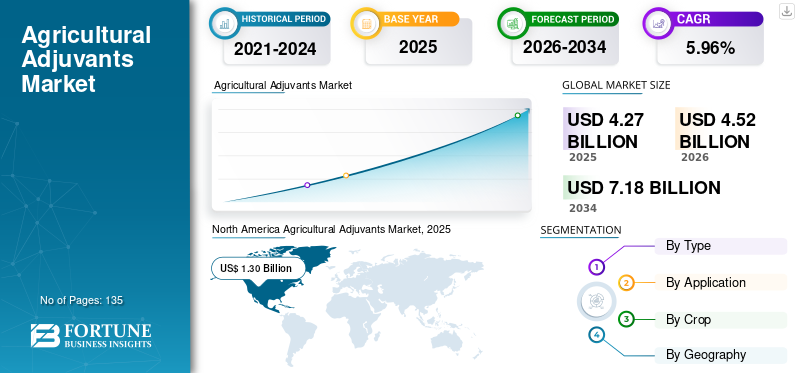
Download Free sample to learn more about this report.
Global Agricultural Adjuvants Market Overview
Market Size:
- 2025 Value: USD 4.27 billion
- 2026 Value: USD 4.52 billion
- 2034 Forecast Value: USD 7.18 billion, with a CAGR of 5.96% from 2026–2034
Market Share:
- North America led the agricultural adjuvants market with a 44.52% share in 2025, driven by demand for sustainable crop protection and formulation innovations.
- By type, the activator adjuvants segment is projected to hold a 78% share in 2025.
- By application, the herbicides segment is expected to generate USD 2.36 billion in revenue by 2025.
Key Country Highlights:
- The U.S. market is projected to reach USD 2.51 billion by 2032.
- Japan is expected to reach USD 161.89 million by 2025.
- China is forecast to witness a CAGR of 7.12%, while Europe is anticipated to grow at a CAGR of 4.49% during the forecast period.
- Brazil is expected to experience strong growth due to adoption of advanced cultivation technologies and expansion in crop protection chemical usage.
Key Market Dynamics
Market Trends
Download Free sample to learn more about this report.
According to PAN Europe, 7% of the groundwater stations in European countries reported excessive levels for one or more pesticides. Therefore, PAN Europe works on the contamination of European freshwater systems by pesticides, giving particular emphasis to the effects of endocrine-disrupting pesticides on aquatic ecosystems.
The agricultural adjuvants industry is heavily self-regulated, and the formulations are considered “trade secrets.” However, the majority of adjuvant products are the same or vary by minor changes in components or the combination of products having different functionalities. The U.S. Environmental Protection Agency (EPA) regulates adjuvant formulations, but it does not stringently regulate the manufacture and use of adjuvant products.
Current institutional analysis highlights several structural trends redefining corporate strategies. The most prominent trajectory involves the integration of precision agriculture technologies. Massive industrial farming operations increasingly deploy sophisticated drone networks. They use autonomous GPS-guided machinery to execute highly targeted chemical applications.
This hardware modernization fuels demand for ultra-low volume utility adjuvants. These chemicals function flawlessly within advanced aerial spraying systems. They prevent clogging in sensitive mechanical spray nozzles. Another compelling industry trend is the rapid commercial maturation of sustainable formulations.
Intense regulatory scrutiny mounts regarding groundwater contamination globally. Leading multinational chemical manufacturers prioritize green chemistry initiatives accordingly. These companies continuously introduce biodegradable organosilicone derivatives. Advanced natural seed oil surfactants now match legacy synthetic petrochemical performance.
Furthermore, rising adoption of biological crop protection programs creates novel prerequisites. Vendors strategically reformulate legacy adjuvants to guarantee biochemical compatibility. These additives must protect fragile live microbial biopesticides. Harmonizing synthetic additives with sensitive biological organisms secures lucrative defensive positioning.
The adjuvants play a key role in controlling these variables to improve overall pesticide effectiveness. Some of the more commonly used adjuvants include drift retardants, wetter-spreaders, stickers, buffers, and foam retardants. Research studies revealed that agricultural adjuvants cost around US$ 0.75-1.0 per acre, in addition to herbicides, and help improve the percent absorption of spray by 50-85%. Lack of strict regulations and limited awareness among crop producers about the benefits of using spray adjuvants are some of the inhibiting factors for the agricultural adjuvants market growth.
Market Drivers
The primary demand driver is the urgent imperative to optimize crop yields. Diminishing arable land forces this strategic agricultural shift. As global populations expand, agribusinesses face immense pressure to maximize hectare productivity. Enhanced efficacy of agrochemicals becomes absolutely critical for survival.
Agricultural adjuvants provide this optimization by improving pesticide penetration. They ensure expensive formulations remain on waxy plant surfaces. Consequently, commercial operations adopt these additives to guarantee return on investment. Another fundamental driver is the escalating prevalence of pesticide-resistant weeds.
Conventional chemical applications frequently fail against these resilient biological threats. Agronomists must utilize highly concentrated spray mixtures to compensate. Adjuvants act as indispensable catalysts by breaking down tough plant cuticles. This facilitates deeper active ingredient absorption during application.
Furthermore, stringent environmental regulations compel operators to adopt drift control adjuvants. These formulations ensure highly targeted chemical applications in volatile weather. They help massive farming conglomerates comply with rigid sustainability mandates. Ecological compliance pressures propel sustained capital investment across this sector.
Market Restraints
The agricultural adjuvants market faces formidable institutional restraints. These challenges inhibit universal adoption despite robust structural growth. The increasingly fragmented regulatory environment is a primary obstacle. Governing bodies mandate comprehensive toxicological evaluations for novel synthetic formulations.
Navigating this compliance apparatus escalates research and development expenditures. It delays critical product launches and strains middle-market chemical manufacturers. Additionally, extreme volatility in petrochemical raw material pricing disrupts profit margins. Traditional activator adjuvants rely heavily upon petroleum-derived surfactants.
Sudden geopolitical supply chain disruptions cause elevated downstream production costs. Consequently, agribusinesses often resist adopting premium auxiliary chemicals during macroeconomic distress. Furthermore, a persistent knowledge gap artificially limits product penetration. This lack of awareness impacts emerging regional economies heavily.
Rural cultivators frequently miscalculate complex tank mixing ratios without sophisticated training. This causes catastrophic crop phytotoxicity or diminished pesticide efficacy. This pervasive operational ignorance necessitates massive vendor investments in education. These localized initiatives depress short-term corporate profitability and restrain market capitalization.
Market Opportunities
Strategic market opportunities remain exceptionally lucrative for innovative chemical vendors. The rapid proliferation of customized adjuvant formulations represents a profound opportunity. Institutional investors identify massive capitalization whitespace within emerging tropical economies. Extreme humidity necessitates the deployment of highly specialized rainfastness polymers there.
Agrochemical manufacturers developing resilient localized formulations will capture disproportionate market share. They can easily dominate underserved developing agricultural regions. Additionally, commercial cannabis and specialty horticulture markets offer substantial monetization channels. These high-value botanical sectors demand extraordinarily precise application methodologies.
They require pristine biochemical profiles to satisfy stringent pharmaceutical-grade regulations. Formulation scientists possess distinct competitive advantages by offering bespoke organic adjuvants. These specialized chemicals maximize cannabinoid yields without introducing hazardous synthetic residues. Furthermore, strategic corporate partnerships utilizing artificial intelligence present vast untapped potential.
Cloud-based analytical platforms process massive agricultural datasets instantaneously. This allows executive boards to formulate predictive tank mixture protocols dynamically. Vendors can directly integrate proprietary adjuvant chemistry data into agronomy software. This strategy secures defensive subscription revenue streams within a rapidly expanding ecosystem.
Agricultural Adjuvants Market Segmentation
By Type
Activator Adjuvants:
Activator Adjuvants command the largest market share globally. This segment includes surfactants, oil concentrates, and ammonium salts. These chemicals enhance agrochemical absorption directly through plant cuticles. Surfactants modify droplet surface tension to increase leaf contact area.
Oil concentrates disrupt epicuticular wax layers effectively. This action accelerates chemical trans-laminar movement into the plant structure. Demand stems from the widespread adoption of post-emergence herbicides. These herbicides require rapid penetration to achieve maximum biological efficacy.
Commercial farming operations heavily favor activator chemistry. They deploy these formulations to combat herbicide-resistant weeds aggressively. Consequently, leading manufacturers continuously innovate bio-based activator variants. This innovation complies with strict global environmental safety mandates.
Agricultural producers prioritize these chemicals to maximize yield outcomes. Synthetically derived surfactants face increasing regulatory pressure globally. Therefore, manufacturers focus capital on natural seed oil derivatives. This transition ensures long-term market growth for activator variants.
The market analysis predicts sustained dominance for this segment. Farmers must use activator adjuvants with modern systemic pesticides. Failing to use them drastically reduces expensive chemical performance. This economic reality guarantees consistent institutional demand.
Utility Adjuvants:
Utility Adjuvants represent a vital, rapidly growing industry segment. These compounds modify the physical characteristics of spray mixtures. However, they do not directly alter agrochemical biological activity. Key functional classes include drift control and buffering agents.
High-volume tank-mixing practices propel robust market growth for utility formulations. Modern high-speed spraying equipment mandates drift control additives. These chemicals prevent off-target movement and avoid regulatory penalties. Furthermore, hard water conditions drive steady buffering agent adoption.
Complex multi-pesticide tank mixes are now standard practice globally. Utility adjuvants remain essential operational components for these mixtures. They prevent chemical antagonism and ensure uniform spray application. This segment will experience accelerated growth through precision agriculture integration.
Aerial drone spraying creates new use cases for utility chemicals. These drones require highly specialized ultra-low volume application mixtures. Utility adjuvants prevent mechanical nozzle clogging during these flights. They also reduce droplet evaporation in hot weather climates.
Governmental drift reduction mandates heavily support utility segment growth. Regulatory agencies aggressively fine farmers for off-target chemical drift. Drift control agents offer cheap insurance against these severe penalties. Consequently, their market outlook remains highly favorable.
Others:
The Others segment encompasses highly specialized niche chemistry. This includes drift-retardants, stickers, and specialized deposition aids. These formulations cater to extreme weather conditions and specific requirements. Stickers prevent chemical wash-off during unexpected rainfall events.
This action safeguards expensive fungicide investments in humid environments. Deposition aids ensure uniform droplet distribution throughout dense crop canopies. This maximizes chemical coverage for premium specialty crop producers. Growth is accelerated by growers seeking tailored, climate-specific solutions.
Although accounting for a smaller total market share, margins remain high. Advanced specialty formulations yield significant profit margins for formulators. These specialized chemicals address highly complex localized agronomic challenges. Demand will stabilize as extreme weather events become more frequent.
Specialty chemical manufacturers prioritize these complex blends for diversification. Generic manufacturers cannot easily replicate these highly specific formulations. This provides robust intellectual property protection for innovative vendors. The niche focus guarantees a highly defensible market share.
By Application
Insecticides:
"Insecticides to Emerge as Most Attractive Product Type due to Growing Demand in the Asia Pacific"
Several adjuvant products available in the marketplace are mainly intended to offer a resolution of spray-mix incompatibilities resulting from the combination of one or more agrochemicals. Activator adjuvants, especially surfactants, the activator adjuvants segment is expected to hold a 78% share in 2025.
Insecticides constitute a major application segment experiencing steady market growth. Modern systemic insecticides require precise cuticular penetration. This achieves rapid pest knockdown and lasting crop protection. Adjuvants facilitate deep leaf penetration efficiently. This protects active ingredients from photodegradation caused by intense sunlight. Furthermore, wetting agents ensure complete coverage on waxy plant stems. Insect pests frequently harbor in these difficult-to-reach physical locations. Rising pest pressures drive expanding adjuvant utilization everywhere.
Warming global climate patterns support elevated insect populations globally. Agrochemical companies actively develop specialized adjuvant-insecticide co-formulations. These mixtures maximize biological efficacy consistently. They simultaneously minimize total active ingredient application volumes required. Regulatory agencies restrict the use of highly toxic insecticides. Farmers must use safer, but less potent, chemical alternatives. Specialized adjuvants boost the performance of these weaker chemicals. This creates strong market growth for the insecticide segment.
The Brazil market is projected to witness strong growth during the projected period between 2019 and 2026 due to the growing crop protection chemicals market, along with the strong adoption trend of improved technologies in crop cultivation.
To know how our report can help streamline your business, Speak to Analyst
Herbicides:
"Adjuvant application is projected to continue to dominate with herbicide application"
The herbicides segment accounts for the largest share among applications, as they are a major group of crop protection chemicals used in agriculture. Post-emergence herbicide effectiveness is significantly influenced by plant factors such as age, size, and growing conditions. Hence, adjuvants, specifically surfactants, are generally used with the herbicide spray solution to improve the effectiveness of post-emergence herbicides. The herbicide segment is projected to generate USD 2.36 billion in revenue by 2025.
The Herbicides segment holds the overwhelmingly dominant market share. Broad-spectrum weed control represents massive operational expenditure globally. Systematic overuse of glyphosate has accelerated weed resistance worldwide. Consequently, growers utilize sophisticated activator adjuvants routinely. These adjuvants restore chemical efficacy against tough-to-kill broadleaf weeds. Post-emergence herbicide sprays rely universally on surfactant technology. This combination achieves adequate foliar uptake immediately after application. Additionally, no-till farming systems rapidly expand worldwide.
This drastically increases reliance on herbicide-adjuvant combinations. Farmers must manage cover crops and baseline weed populations completely. They do this before planting cash crops annually. Herbicide adjuvants guarantee maximum yield protection for large-scale operations. This segment will maintain absolute market dominance indefinitely. Rising global temperatures accelerate weed growth rates significantly. Farmers must apply herbicides more frequently to maintain control. This behavioral shift drives continuous high-volume adjuvant consumption globally.
Fungicides:
The fungicides segment represents a high-value growth sector. Fungal pathogens spread rapidly across humid, high-density crop canopies. Unchecked fungal infections threaten catastrophic commercial yield losses. Utility and activator adjuvants significantly enhance fungicide spreadability. They improve rainfastness on vulnerable foliar surfaces dramatically. In cereal and fruit production, preventative fungicide sprays are mandatory. Growers rely on deposition aids to penetrate dense plant canopies. Furthermore, fungal resistance to triazole chemistries forces operational changes.
Growers must integrate specialized adjuvants to optimize active chemical coverage. This ensures maximum curative and protective disease control efficacy. The market analysis predicts sustained growth for fungicide adjuvants. Rising humidity levels globally will necessitate continuous fungal management. Premium crops require perfect cosmetic appearance for retail sale. Fungal blemishes destroy the commercial value of fruits and vegetables. Frequent fungicide applications are absolute necessities for these growers. Adjuvants secure this massive financial investment effectively.
By Crop
Cereals:
Cereals command the largest market share globally. This broad category includes staple grains like wheat, corn, and rice. Industrial cereal production relies on extensive chemical protection regimes. These regimes secure optimal harvest volumes annually.
Broad-acre cereal operations utilize automated boom sprayers continuously. These machines require drift control and activator adjuvants for efficient delivery. Heavy weed competition in corn dictates continuous chemical intervention. This intervention lasts throughout the entire growing season.
The immense scale of global cereal acreage ensures baseline demand. Formulators supply massive volumes of cost-effective surfactant formulations. Cereal cultivation forms the financial backbone of the agricultural adjuvants industry. This fundamental dynamic guarantees sustained segment revenue generation.
Global food security mandates maximize cereal grain production. Governments subsidize agrochemical inputs to ensure stable food supplies. This macroeconomic support bolsters the cereals market outlook greatly. Massive institutional farming conglomerates dominate this specific crop segment.
Oilseeds:
Oilseeds represent an exceptionally lucrative operational segment. Key crops include soybeans, canola, sunflowers, and oil palm. Soybean production drives immense consumption of non-ionic surfactants. Growers also utilize massive quantities of crop oil concentrates.
Overlapping weed resistance issues plague soybean ecosystems continuously. This necessitates complex tank mixes featuring multiple adjuvant chemistry types. Canola crops require specialized stickers to preserve chemical treatments. The waxy leaf surfaces of canola reject untreated aqueous sprays.
Continuous global demand for vegetable oils sustains capital investment. Livestock feed protein requirements also drive intense oilseed cultivation. Oilseed protection platforms rely absolutely on premium adjuvant integration. The segment shows immense market growth potential long-term.
Biodiesel production demands massive volumes of soybean and canola oil. This industrial demand keeps oilseed commodity prices highly profitable. Farmers readily invest in premium adjuvants to protect these valuable crops. This dynamic ensures strong continuous demand for chemical vendors.
Fruits & Vegetables:
The Fruits & Vegetables segment demonstrates the highest market growth rate. High-value horticultural production demands flawless aesthetic crop quality. Excellent yield parameters are mandatory for commercial viability. Orchard crops require frequent fungicide treatments throughout the cultivation cycle.
Organosilicone super-wetters are widely adopted in this segment. Their unmatched spreading capabilities penetrate hard-to-wet leaf structures efficiently. Furthermore, strict regulatory standards govern chemical residue levels. This drives growers toward high-efficiency adjuvants rapidly.
These adjuvants reduce active chemical ingredient application rates. However, they do not sacrifice essential pest control performance. This high-margin sector rewards advanced formulation chemistry continuously. Precision application remains essential for these delicate premium crops.
Greenhouse and hydroponic cultivation methods expand rapidly worldwide. These controlled environments require highly specialized wetting agents. The enclosed spaces necessitate extremely low-toxicity chemical profiles. Formulators who supply these niche products capture dominant market share.
Other Crops:
The Other Crops segment encompasses fiber crops like cotton. It also includes plantation crops like sugarcane and forage pastures. Cotton production relies on specialized defoliants paired with strong activator adjuvants. This combination prepares crops for efficient mechanical harvesting.
Sugarcane fields require robust residual herbicide-adjuvant applications. These manage dense perennial weeds under extremely humid conditions. Pasture weed management utilizes selective herbicides blended with utility adjuvants. This protects forage quality for commercial livestock grazing.
Regional Analysis
North America Agricultural Adjuvants Market Analysis
"North America and Europe dominate the agricultural adjuvants market"
North America, followed by Europe, are the two largest markets for agricultural adjuvants at present, and they are expected to account for a significant proportion of the global market in the forecast period as well. Stringent regulations on the use of crop protection chemicals to protect the environment from hazardous effects are driving the market in North America, and Europe is anticipated to grow at a CAGR of 4.49% during the forecast period.
The North American agricultural adjuvants market retains a substantial global revenue share due to high mechanization and advanced farming practices. Commercial operators heavily prioritize yield optimization through precision agriculture tools. Stringent EPA environmental regulations mandate drift reduction, accelerating demand for specialized utility adjuvants across large-scale row crops. Consequently, institutional investors view this mature regional market as a highly defensive, high-value capital allocation sector for continuous agrochemical innovation overall.
United States Agricultural Adjuvants Market
The United States agricultural adjuvants market commands significant domestic demand driven by extensive corn and soybean cultivation. Overlapping weed resistance issues force growers to adopt post-emergence herbicide tank mixes featuring activator surfactants. Furthermore, federal spray drift mitigation rules under environmental protection programs encourage adoption of drift retardants. Major chemical formulators continuously expand local distribution networks to capture recurring commercial agribusiness revenue streams nationwide effectively.
North America Agricultural Adjuvants Market, 2025
To get more information on the regional analysis of this market, Download Free sample
Asia-Pacific Agricultural Adjuvants Market Analysis
The Asia Pacific agricultural adjuvants market demonstrates the fastest regional growth trajectory globally. Surging food security needs and shrinking arable land accelerate agrochemical modernization across emerging economies. Governmental subsidies promote precision spraying, fueling widespread adoption of utility adjuvants designed for drone applications. Consequently, multinational chemical formulators heavily expand manufacturing capacity in the region to capture booming volume demand from broadacre farming operations expanding rapidly.
The market growth in Asia-Pacific is projected to witness strong growth due to the growing crop protection chemicals market. In addition to this, the increasing awareness among crop producers about the benefits of adjuvants with spray chemicals is another factor further driving the global market in these two regions.
Japan Agricultural Adjuvants Market
The agricultural adjuvants market in Japan is expected to reach USD 161.89 million by 2025. The Japan agricultural adjuvants market exhibits high technological sophistication driven by severe labor shortages and aging rural demographics. Farmers rely heavily on automated aerial drones and robotic equipment to execute crop protection. This specialized application environment necessitates advanced superspreading organosilicone surfactants and antidrift utility agents. Consequently, Japanese agrochemical formulators prioritize ultraconcentrated high-efficiency adjuvant solutions that maximize active ingredient performance across specialty crop farms nationwide. high-efficiency
China Agricultural Adjuvants Market
China is projected to witness a strong CAGR of 7.12% during the forecast period. The China agricultural adjuvants market commands significant global market share, functioning as both a massive consumption zone and major chemical manufacturing hub. National agricultural policies promote chemical usage reduction through enhanced spray efficiency. Rapid deployment of unmanned aerial spraying vehicles creates immense demand for specialized drift control and deposition additives. Domestic formulators actively scale biobased surfactant production to meet expanding local and export market requirements.
Europe Agricultural Adjuvants Market Analysis
The European agricultural adjuvants market prioritizes sustainability and strict environmental compliance under tight regulatory frameworks. Tightening toxicological restrictions on synthetic coformulants push chemical vendors toward biobased and biodegradable organosilicone alternatives. European growers aggressively adopt precision application tools to lower total pesticide volume. Consequently, high-performance utility adjuvants that enhance rainfastness and deposition capture expanding market share across key agricultural production zones throughout the continent.
Germany Agricultural Adjuvants Market
The Germany agricultural adjuvants market represents a technologically advanced chemical sector focused on precision formulation standards. National environmental policies strongly regulate water protection zones, incentivizing drift control additives that prevent ecological contamination. Domestic chemical manufacturers continuously invest in green chemistry research to develop plant-derived surfactants. Commercial farm operations demand validated efficiency, making Germany a benchmark for regulatory compliance and premium adjuvant formulation adoption nationwide.
United Kingdom Agricultural Adjuvants Market
The United Kingdom agricultural adjuvants market focuses on optimizing crop yields within intensive cereal and oilseed production systems. Persistent weed management challenges, particularly blackgrass resistance, necessitate highly effective activator surfactant tank mixes. Following post Brexit regulatory restructuring, British growers emphasize input cost efficiency and application efficacy. Chemical distributors maintain strong commercial partnerships with farm cooperatives, driving consistent adoption of multifunctional adjuvant packages nationwide.
Latin America Agricultural Adjuvants Market Analysis
The Latin America agricultural adjuvants market represents an essential growth destination driven by large-scale soybean, corn, and sugarcane export operations. Intense tropical pest pressure and unpredictable rainfall require high volumes of methylated seed oils and organosilicone wetters to ensure pesticide rainfastness. Brazil serves as the primary regional market driver, with expanding acreage and severe weed resistance forcing agribusinesses to utilize premium activator adjuvants continuously.
Middle East & Africa Agricultural Adjuvants Market Analysis
The Middle East & Africa agricultural adjuvants market exhibits steady expansion as regional farming practices modernize. Arid climatic conditions and acute water scarcity mandate specialized wetting agents and evaporation control utility adjuvants to maximize irrigation efficiency. Commercial plantation development in Sub-Saharan Africa and high-tech greenhouse projects in Gulf states generate expanding opportunities for specialized agrochemical formulation vendors regionally.
Agricultural Adjuvants Industry Competitive Landscape
The global agricultural adjuvants industry exhibits a moderately consolidated market structure anchored by established multinational chemical corporations and specialized formulation developers. Leading global vendors, including BASF SE, Croda International Plc, Clariant AG, Evonik Industries AG, Syensqo, Nouryon, and Huntsman Corporation, dictate primary market share through extensive global distribution networks and deep technical formulation portfolios. These tier-one chemical manufacturers differentiate their market positioning by offering proprietary activator surfactants, methylated seed oils, and specialty organosilicone super spreaders engineered for seamless compatibility with complex pesticide active ingredients across broad agricultural markets worldwide.
Competitive strategies are increasingly centered on sustainability and strict regulatory compliance. Major players are aggressively transitioning from legacy synthetic surfactants toward biobased, biodegradable coformulants derived from renewable plant oils and sugar glucosides. This shift allows tier-one formulators to satisfy stringent European and North American environmental mandates while capturing premium market margins. Concurrently, regional players and agile agricultural technology startups capture niche market share by developing specialized drift reduction agents and microemulsion adjuvants optimized specifically for ultra-low-volume unmanned aerial vehicle spray systems. These innovative product offerings provide crucial operational flexibility for modern precision farming operations globally and regionally.
Strategic partnerships and joint ventures serve as key growth mechanisms across the ecosystem. Leading adjuvant manufacturers collaborate closely with global agrochemical giants like Corteva Agriscience and Syngenta to co-develop tank mix adjuvant packages tailored for newly registered herbicide and fungicide molecules. Furthermore, strategic integration with digital farming platforms and precision hardware providers enables vendors to offer algorithmic dosing recommendations to commercial growers. Mergers and acquisitions remain frequent, as established chemical providers routinely acquire boutique biotechnology firms to integrate sustainable surfactant intellectual property rapidly. High capital requirements for regulatory testing, combined with proprietary formulation chemistry, create substantial entry barriers, preserving the dominant market share of established suppliers globally and long-term.
List of top Agricultural Adjuvants Companies
- BASF SE
- Clariant AG
- Akzo Nobel N.V.
- Huntsman Corporation
- Helena Agri-Enterprises
- Stepan Company
- DowDuPont
- Wilbur-Ellis
- Drexel Chemical
- Nufarm
- Other key players
Agricultural Adjuvants Industry Developments:
In March 2026, Clariant announced the launch of new specialty formulation technologies, including Dispersogen PSL 100, at the CAC 2026 exhibition in Shanghai. Designed for complex crop protection formulations, this high-performance polymeric dispersant and adjuvant technology improves particle size stability and allows formulators to combine multi-active biologicals with hard-water-tolerant chemical systems seamlessly.
Agricultural Adjuvants Industry Developments
- In April 2025, Nouryon announced the global launch of Adsee Flex 960, a patented tank-mix adjuvant debuted at the ISAA Symposium in Rio de Janeiro. The product utilizes an optimized blend of specialized surfactants and colloidal silica to improve crop performance by significantly enhancing the target deposition, leaf adhesion, and rainfastness of active pesticide ingredients.
- In March 2025, Clariant announced the introduction of its Synergen Soil and Synergen Guard 100 adjuvant lines aimed at biological crop protection and sustainable soil management. Synergen Soil optimizes soil moisture distribution and water-use efficiency, while Synergen Guard 100 provides a nano-emulsion rainfastness booster formulated with renewable wax to protect biocontrol agents on foliar surfaces.
- In May 2026, Corteva Agriscience announced the expansion of its crop protection portfolio with advanced spray adjuvant technologies designed for commercial row crops. These targeted adjuvant packages improve pesticide adhesion, rainfastness, and application efficiency to assist growers in achieving superior weed and disease control.
- In March 2026, BASF SE introduced a bio-based agricultural adjuvant platform specifically compatible with precision spraying applications. Designed to support sustainable farming practices, this bio-surfactant platform enhances active ingredient spray deposition on targeted foliage while mitigating off-target chemical drift and environmental runoff.
Report Coverage
Request for Customization to gain extensive market insights.
According to the EPA, adjuvants are chemicals added to a pesticide by users to improve the pesticide's efficiency. Adjuvants are added to a pesticide product (in-formulation) or pesticide spray mixture (tank-mix) to enhance the pesticide’s performance and/or the physical properties of the spray mixture. A spray of crop protection chemicals is mainly affected by various physical variables such as pesticide stability, solubility, compatibility, foaming, droplet size, suspension, surface tension, coverage, volatilization, penetration, and others.
The report provides qualitative and quantitative insights on the agricultural adjuvants industry and a detailed analysis of agricultural adjuvants market share and growth rate for all possible segments in the market. The global market is segmented by type, application, and crop type. On the basis of type, the global market is categorized into activator adjuvants and utility adjuvants.
Herbicides, insecticides, fungicides, and others are the key applications covered in the study. Various crop types included in the report are cereals, oilseeds, fruits and vegetables, and other crops. Geographically, the market is segmented into four major regions, which are North America, Europe, Asia Pacific, and the Rest of the World. The regions are further categorized into countries.
Along with this, the report provides an elaborative analysis of the market dynamics and competitive landscape. Various key insights provided in the report include an overview of related markets, recent industry developments such as mergers & acquisitions, the regulatory scenario in key countries, and key industry trends.
SEGMENTATION
|
ATTRIBUTE |
DETAILS |
|
Study Period |
2021-2034 |
|
Base Year |
2025 |
|
Estimated Year |
2026 |
|
Forecast Period |
2026-2034 |
|
Historical Period |
2021-2024 |
|
Unit |
Value (USD Billion) |
|
Growth Rate |
CAGR of 5.96% from 2026 to 2034 |
|
By Type |
|
|
By Application |
|
|
By Crop |
|
|
By Geography |
|
Frequently Asked Questions
According to Fortune Business Insights, the global agricultural adjuvants market size was valued at USD 4.27 billion in 2025 and is projected to reach USD 7.18 billion by 2034.
The market is projected to grow at a CAGR of 5.96% during the forecast period (2026-2034).
Agricultural adjuvants are substances added to pesticides or fertilizers to enhance their effectiveness, stability, and application. They help improve spray coverage, reduce drift, and increase absorption in plants, ultimately improving crop protection results.
Key growth drivers include the rising demand for effective crop protection, increased use of herbicides and insecticides, and growing concerns about pesticide drift and environmental contamination. Innovation in formulations is also a major contributor to market expansion.
North America dominated the market with a 44.52% share in 2025, driven by technological advancements and high adoption of crop protection practices in the U.S. The U.S. market is expected to reach USD 2.51 billion by 2032.
The market is primarily segmented into activator adjuvants (like surfactants) and utility adjuvants (such as buffers and drift control agents). Activator adjuvants currently hold the largest market share due to their crucial role in enhancing pesticide performance.
Herbicide application leads the market due to the widespread use of post-emergence herbicides. Adjuvants like surfactants are essential in these formulations, improving absorption and effectiveness under variable plant and environmental conditions.
Challenges include high product costs, lack of awareness among farmers, and limited regulatory oversight, especially in developing regions. In some cases, adjuvant formulations are treated as trade secrets, creating transparency issues in the market.
Leading companies include BASF SE, Clariant AG, Akzo Nobel N.V., Helena Agri-Enterprises, DowDuPont, Stepan Company, and Nufarm. These companies are investing in product innovation and expanding their global presence to cater to the growing demand.



- 2021-2034
- 2025
- 2021-2024
- 135
-
(Offer valid till 15th Aug 2026)
Get 30-60 hrs Free Customization
Expand Regional and Country Coverage, Segments Analysis, Company Profiles, Competitive Benchmarking, and End-user Insights.














Related Reports
-
US +1 833 909 2966 ( Toll Free )
-
Get In Touch With Us