Retail Cloud Market Size, Share & Industry Analysis, By Model Type (Infrastructure as a Service, Platform as a Service and Software as a Service), By Deployment (Public, Private and Hybrid Cloud), By Solution (Supply Chain Management, Workforce Management, Customer Management, Reporting & Analytics, Data Security, Omni-Channel), By Enterprise Size (Small & Medium and Large Enterprise) and Regional Forecast, 2026-2034
 Download Free Sample
 KEY MARKET INSIGHTS
 Listen to Audio Version
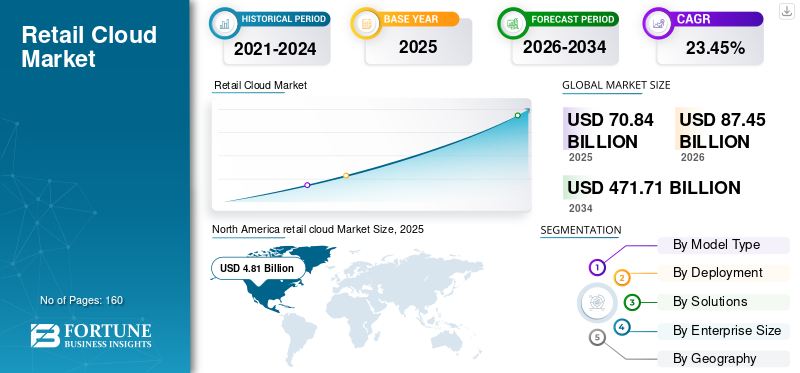
- The global retail cloud market is projected to reach $471.71 billion by 2034, growing from $70.84 billion in 2025 and $87.45 billion in 2026, reflecting a compound annual growth rate (CAGR) of 23.45% during the forecast period.
- Adoption of retail cloud solutions is expanding rapidly as retailers leverage AI, IoT, and predictive analytics to optimize supply chain operations, workforce management, and personalized marketing.
- Cloud infrastructure has become essential for omni-channel retailing, enabling businesses to unify customer data across physical and digital touchpoints for a seamless shopping experience.
- North America currently leads the global retail cloud market, accounting for 40.45% of the market share in 2025, driven by major e-commerce expansion and early adoption of cloud services.
The global retail cloud market size was valued at USD 70.84 billion in 2025 and is projected to grow from USD 87.45 billion in 2026 to USD 471.71 billion by 2034, exhibiting a CAGR of 23.45% during the forecast period. North America dominated the global market with a share of 40.45% and was valued at USD 4.81 billion in 2025.
The global Retail cloud market is undergoing a profound transformation as commercial enterprises accelerate digital infrastructure investments to support advanced omnichannel commerce capabilities. Functioning as the operational backbone for modern commerce, the retail cloud ecosystem enables merchants to scale operations, manage vast data repositories, and orchestrate complex supply chain networks with unprecedented agility. Our rigorous institutional analysis indicates that the Retail cloud market size is expanding robustly, driven primarily by the strategic imperative to deploy artificial intelligence, real-time predictive analytics, and unified commerce architectures across geographically dispersed enterprise footprints.
Currently, the Retail cloud market growth trajectory reflects a decisive shift from legacy on-premises data centers toward flexible, scalable, and highly secure cloud environments. Organizations are aggressively adopting Software as a Service applications and Infrastructure as a Service platforms to modernize legacy infrastructure. This transition allows retailers to reduce total cost of ownership while enhancing system resilience and dynamic resource provisioning. Furthermore, shifting consumer behavioral paradigms require hyper-personalized engagement strategies, forcing organizations to leverage robust cloud computing frameworks to process high-velocity consumer data safely and in compliance with stringent global regulatory frameworks.
Major findings reveal that large enterprises dictate the primary Retail cloud market share, although small and medium enterprises demonstrate accelerated adoption rates. The prevailing Retail cloud market trends highlight the rapid proliferation of hybrid deployment models, balancing stringent data privacy mandates with the computational flexibility of public environments. As legacy systems reach technical obsolescence, capital allocation toward advanced cloud-native solutions represents a non-negotiable strategic priority for forward-looking executive boards. Ultimately, institutional investors and enterprise strategy leaders must recognize that competitive viability in the modern retail ecosystem fundamentally depends upon robust, scalable, and secure cloud infrastructure architectures, positioning the market for sustained, compounding institutional expansion over the next decade, ensuring optimized long-term commercial success and elevated corporate shareholder financial returns.
With the introduction of advanced technology, the retail industry is adopting advanced solutions. The retail industry is moving its business applications and infrastructure resources to different service architectures of the cloud, which include platform as a service, software as a service, and Infrastructure as a service.
The retail industry is in revolution stage where power has shifted from retailers to consumers. The growing adoption of smartphones and social media platforms has shifted power from retailers to consumers. Consumers are influencing product trends through social media platforms and reviews from all over other websites.
Download Free sample to learn more about this report.
Retail Cloud Market Key Takeaways
 Global Market Size & Forecast
- 2025 Market Size: USD 70.84 billion
- 2026 Market Size: USD 87.45 billion
- 2034 Forecast Market Size: USD 471.71 billion
- CAGR: 23.45% (2026–2034)
 Market Share
- North America dominated the market with a 40.45% share in 2025.
- The software as a service (SaaS) segment is expected to hold the largest market share among deployment models.
- The medium enterprises segment is projected to register a 17.7% CAGR during the forecast period.
 Key Regional Highlights
Asia Pacific
Asia Pacific is projected to witness significant growth during the forecast period, driven by rapid cloud adoption across the retail sector.
North America
North America generated USD 4.81 billion in 2025, maintaining its leading market position.
Europe
Europe is expected to experience steady growth, supported by increasing investments in digital retail transformation.
U.S.
U.S. market is projected to witness steady growth during the forecast period.
Japan
Japan market is projected to witness steady growth during the forecast period.
Read More

Key Market Dynamics
Market Drivers
“Rapid advancements in disruptive technologies (c intelligence and IoT)”
Artificial Intelligence (AI) offers retailers the capability to streamline in-store operations, effectively manage their new inventory, and improve supply chain management. Besides this, AI provides a personalized experience and precise marketing strategies which help retail enterprises attract and retain customers. Improved customer experience and support are key strategies that will benefit the retail industry from AI technology.
The primary demand driver accelerating the Retail cloud market is the critical enterprise requirement for omnichannel commerce integration. Global retailers face unprecedented pressure to unify disparate physical and digital sales channels into cohesive consumer experiences. Traditional on-premises data architectures lack the dynamic computational elasticity required to synchronize inventory, process high-velocity transactions, and deliver personalized promotions simultaneously. Consequently, institutional operators are aggressively migrating core operations toward agile cloud environments to achieve real-time operational visibility.
Another fundamental catalyst is the exponential proliferation of commercial data streams across the retail value chain. Organizations require advanced data storage and processing capabilities to power predictive analytics and artificial intelligence applications. Cloud infrastructure provides the necessary computational bandwidth to analyze consumer behavioral patterns, optimize pricing strategies, and forecast demand fluctuations accurately.
Download Free sample to learn more about this report.
According to a recent study by IBM Corporation named “The coming AI revolution in retail and consumer products,” This report stated that AI-driven automation in the consumer products and retail industry is expected to rise from 40% of companies to more than 80% of companies in the near future. Further, in-store shopping is more popular among retailers.
“Increasing focus on the Omni-channel experience”
Omni-channel retailing describes a communication model that enables customers to interact with multiple sales and media channels. Omni-channel links all communication channels between the enterprise and the customers to create a single unified experience. According to a Salesforce study, 73% of shoppers opt for multiple channels during their shopping journeys. This drives retailers to focus on enhancing the Omnichannel experience. The Brightpearl MCM Omni Study states that out of ten, eight companies say that the company has an omnichannel strategy. Also, currently, 8% of companies that do not have an omnichannel strategy indicate that their company has plans to invest in Omnichannel technologies.
Market Restraints
Despite profound expansion trajectories, the Retail cloud market faces formidable structural restraints that impede universal adoption. Foremost among these challenges are stringent data localization and privacy regulations mandated by international jurisdictions. Enterprises operating globally must navigate an increasingly fragmented regulatory environment, encompassing policies like the General Data Protection Regulation and regional privacy frameworks. Maintaining continuous compliance across diverse geographic operations dramatically increases operational complexity and administrative overhead, deterring rapid cloud migration for resource-constrained organizations.
Additionally, entrenched legacy infrastructure architectures present a significant barrier to seamless cloud integration. Many established retail institutions rely upon heavily customized, monolithic on-premises systems that manage mission-critical operational processes. Disentangling these complex digital environments to facilitate cloud integration requires substantial upfront capital expenditure and introduces severe business continuity risks. Consequently, executive boards often demonstrate extreme hesitation regarding comprehensive digital modernization initiatives.
Data security vulnerabilities further exacerbate institutional reluctance toward public cloud utilization. High-profile cybersecurity breaches targeting commercial networks have amplified concerns regarding the protection of proprietary corporate assets and sensitive consumer financial data. Threat vectors expanding across interconnected cloud ecosystems necessitate sophisticated security protocols that continuously demand specialized cybersecurity talent. These persistent structural challenges collectively restrain total market capitalization potential across emerging international regional markets today.
Market Trends
Current institutional analysis highlights several pivotal Retail cloud market trends reshaping enterprise technology strategies globally. The most prominent trajectory involves the aggressive integration of generative artificial intelligence capabilities directly within native cloud environments. Major hyperscale providers continuously embed advanced machine learning algorithms into commercial applications, allowing merchants to automate complex merchandising decisions and personalize digital shopping interfaces autonomously. This algorithmic operationalization represents a fundamental paradigm shift away from traditional reactive analytics toward predictive commercial modeling.
Another compelling industry trend is the rapid maturation of serverless computing architectures across the commercial retail landscape. Serverless deployment frameworks allow organizations to bypass direct infrastructure management, optimizing computational resource allocation instantaneously based upon fluctuating consumer demand. This architectural evolution dramatically reduces computational waste during off-peak operational periods while guaranteeing digital resilience during high-traffic promotional events.
Furthermore, edge computing integration is gaining substantial momentum as physical brick-and-mortar locations evolve into intelligent data generation nodes. By processing localized consumer data closer to physical store networks, enterprises minimize latency and enhance real-time localized inventory synchronization. These converging technological advancements fundamentally redefine competitive positioning, forcing commercial operators to adopt sophisticated digital strategies that fully leverage modern architecture advancements across massive global enterprise business network environments starting immediately today.
Market Opportunities
Strategic market opportunities within the global digital retail sector remain exceptionally lucrative for vendors delivering specialized functional capabilities. The expansion of headless commerce architectures creates profound commercial opportunities for independent software vendors focused upon modular backend infrastructure. Retailers increasingly abandon rigid legacy platforms, seeking decoupled technological frameworks that allow rapid frontend user interface modifications without disrupting core transactional databases. Consequently, institutional investors identify composable commerce application programming interfaces as a massive growth vector.
Additionally, augmented reality and immersive spatial computing paradigms present untapped monetization channels. Forward-looking cloud providers possess distinct advantages by offering scalable computational rendering power required to support virtual storefronts and three-dimensional digital product visualization seamlessly. As commercial metaverse applications mature, foundational cloud infrastructure will command premium valuation multiples.
Furthermore, sustainability initiatives offer substantial commercial whitespace. Global regulatory pressure regarding corporate environmental governance requires comprehensive carbon footprint tracking across complex retail supply chains. Cloud solutions designed specifically to monitor environmental metrics, optimize logistics routing, and reduce physical waste demonstrate exceptional enterprise demand. By addressing these critical compliance and operational requirements, specialized technology vendors can secure highly defensive revenue streams while capturing outsized long-term structural market capitalization within this rapidly expanding global institutional technology ecosystem environment dynamically moving forward.
Market Segmentation Analysis
By Model Type Analysis
In terms of model type, the market is divided into infrastructure as a service, platform as a service, and software as a service. In the global retail cloud market, the software as a service Segment is expected to grow during the forecast period. This is owing to the need to maintain competitiveness in the competitive industry, provide Segment is expected to grow during the forecast period. The retail industry is adopting software as a service to overcome challenges, be innovative, and compete more aggressively.
Software as a Service currently commands the overwhelmingly dominant revenue share within the broader commercial ecosystem. This dominance stems directly from the rapid deployability and minimal upfront capital expenditure associated with subscription-based software delivery models. Retailers aggressively utilize these solutions to bypass complex internal software development cycles, immediately accessing sophisticated functionality like enterprise resource planning and point-of-sale management. The model dramatically reduces internal administrative burdens, allowing commercial operators to focus internal engineering talent upon proprietary strategic initiatives rather than maintaining foundational databases.
Infrastructure as a Service represents the critical foundational layer supporting the broader modernization ecosystem. This segment experiences robust institutional demand driven by large-scale enterprise migrations away from rigid physical data centers. By virtualizing computational storage and processing power, merchants gain unprecedented elasticity during peak seasonal shopping events. Institutional operators increasingly rely upon these foundational networks to construct customized digital architectures capable of processing massive analytical workloads autonomously. The inherent scalability protects organizations against sudden traffic surges that traditionally trigger catastrophic systemic failures during critical promotional periods.
Platform as a Service serves as the vital developmental bridge between foundational infrastructure and consumer-facing applications. This specific segment demonstrates accelerated adoption among technologically sophisticated enterprises requiring customized application development environments. By utilizing managed development frameworks, retail software engineers can rapidly iterate proprietary digital commerce tools without managing underlying server configurations. This capability proves particularly crucial for organizations developing highly differentiated mobile applications or specialized inventory tracking algorithms.
Further, platform as a service and infrastructure as a service contribute to the market growth. Cloud solutions help build an enhanced communication medium between suppliers, manufacturers, and customers. Software as a service is being used by small and medium enterprises to manage on-premises applications and infrastructure. With the increasing adoption of software as a service and platform as a service, the retail cloud industry is projected to grow in the near future.
By Deployment
By Deployment, the institutional landscape divides into Public, Private, and Hybrid Cloud architectures.
Public Cloud:
The Public Cloud segment historically generated the largest total addressable market valuation. Hyperscale technology vendors operate massive global server networks, offering computational resources at exceptionally competitive economies of scale. Retail enterprises prioritize public environments for non-sensitive operational workloads, capitalizing upon the virtually infinite computational elasticity available on demand. This deployment model fundamentally accelerates international market expansion, allowing merchants to launch digital storefronts across new geographic territories instantaneously without constructing localized physical data centers.
Private Cloud:
Private Cloud architectures maintain substantial strategic relevance among elite enterprise organizations managing highly sensitive proprietary assets. Stringent international regulatory frameworks frequently mandate strict data localization, forcing merchants to process consumer financial information within isolated networks. Private deployments provide organizations with absolute systemic control, ensuring maximum cryptographic security and customized architectural configuration. While this model demands significantly higher capital expenditures and dedicated internal engineering talent, it remains an absolute operational necessity for conglomerates prioritizing absolute operational sovereignty.
Hybrid Cloud:
Hybrid Cloud deployments represent the fastest-expanding segment across the contemporary commercial landscape. This architectural approach brilliantly synthesizes the cost-effective scalability of public environments with the rigorous security protocols of private networks. Institutional retail organizations increasingly utilize hybrid structures to orchestrate complex operational workloads dynamically. For example, enterprises process volatile consumer-facing frontend digital traffic through public networks while securely executing underlying financial transactions across private infrastructure. This sophisticated architectural duality optimizes corporate technological expenditures while guaranteeing uncompromising adherence to stringent international data privacy mandates globally.
By Solution Analysis
Based on the solution, the scope of study is segmented into supply chain management, workforce management, customer management, reporting & analytics, data security, omnichannel, and others.
Supply Chain Management:
Supply Chain Management solutions command extraordinary institutional attention following years of unprecedented global logistical volatility. Commercial operators urgently deploy advanced analytical software to achieve real-time synchronization across international manufacturing hubs, distribution facilities, and physical retail locations. These sophisticated platforms utilize predictive algorithms to anticipate localized inventory shortages, automatically rerouting shipments to maximize corporate profitability.
Workforce Management:
Workforce Management applications represent another critical investment vector driven by persistent international labor shortages. Modern cloud-native workforce platforms leverage advanced machine learning to optimize employee scheduling based upon predictive foot traffic analytics. By precisely aligning human capital resources with anticipated consumer demand, merchants significantly reduce operational overhead while simultaneously improving in-store customer service levels.
Customer Management:
Customer Management software remains an absolutely foundational pillar supporting contemporary commercial strategies. Enterprises heavily invest in centralized relationship management platforms to consolidate fragmented consumer behavioral data across diverse interaction points. This unified analytical visibility enables merchants to execute hyper-personalized promotional campaigns, thereby maximizing customer lifetime value and systemic brand loyalty. The ability to process vast consumer data streams autonomously represents a mandatory capability for maintaining durable competitive positioning.
Reporting & Analytics:
Reporting & Analytics solutions provide the critical business intelligence necessary to navigate rapidly shifting macroeconomic environments. Institutional leaders demand real-time dashboard visibility regarding margin performance, inventory turnover velocity, and localized sales trajectories. Cloud-based analytical platforms process massive datasets instantaneously, allowing executive boards to make highly informed strategic adjustments rapidly.
Data Security:
Data security and reporting & analytics segments are anticipated to surge during the forecast period. Demand for report analytics is growing as it supports the retail industry in formulating marketing strategies and smart advertising. Big giants, Amazon and eBay, are using smart advertising to know product preferences of customers and shopping behavior. Also, many retail stores use data analytics to know customer in-store experience, brand preference, shopping behavior during festival times, discounted offers, and others. Where, recently Amazon has started using predictive analytics to predict customers' next purchases, under which category, and others.
Omni-Channel:
Omni-Channel solutions unify disparate operational technologies to deliver seamless consumer experiences. These comprehensive platforms synchronize digital e-commerce inventory with physical store availability instantaneously. Shoppers expect frictionless transitions between mobile browsing and physical purchasing, making omnichannel orchestration software a non-negotiable requirement for modern commercial viability.
By Enterprise Size Analysis
By Enterprise, the scope includes small & medium enterprises and large enterprises.
Small & Medium Enterprise:
Among these, the small and medium enterprises segment is anticipated to grow at a CAGR of 17.7% during the forecast period. In the retail industry, small & medium enterprises are deploying cloud-based solutions to stay competitive. Also cloud based solution allows enterprises to reinvest time & resources into sales, product, marketing, and other sales-generating areas.
Small & Medium Enterprises represent the most aggressive vector of proportional technological adoption. Historically constrained by limited capital resources, these organizations previously struggled to deploy sophisticated enterprise software. However, the proliferation of cost-effective subscription-based delivery models has radically democratized access to advanced technological capabilities. Smaller merchants now utilize modular cloud applications to achieve operational efficiencies previously reserved exclusively for massive global conglomerates. This unprecedented technological accessibility fundamentally disrupts traditional competitive hierarchies, allowing agile emerging brands to challenge established legacy retailers directly across digital commerce channels globally.
To know how our report can help streamline your business, Speak to Analyst
Large Enterprise:
Furthermore, large enterprises are contributing to the industry growth. In the retail industry, the trend of merging digital operations and in-store operations with cloud-based solutions will provide opportunities for the market. Large enterprises have been leveraging digital capabilities to assist changing customer preferences and provide a positive impact on the retail cloud industry.
Large Enterprises historically generated the vast majority of total industry capital expenditure. These massive multinational conglomerates operate exceptionally complex global supply chains requiring immense computational processing power. Their digital transformation initiatives represent multi-year strategic programs involving the comprehensive restructuring of legacy global data architectures. Consequently, these organizations partner directly with top-tier hyperscale technology vendors to construct highly customized, secure, and globally scalable operational frameworks.
REGIONAL ANALYSIS
North America Retail Cloud Market Analysis
North America is anticipated to dominate the market share throughout the forecast period. This dominance is mainly due to the adoption of cloud-based solutions in the retail industry, in developed countries such as the U.S. and Canada. Furthermore, in the U.S., there is increasing investment in new technology and mobile technology. Moreover, the growth of the e-commerce industry in the U.S is led by Amazon, which is anticipated to play a major role in the adoption of cloud solutions.
North America retail cloud Market Size, 2025
To get more information on the regional analysis of this market, Download Free sample
The North America regional commercial ecosystem aggressively dominates the global technology landscape, driven primarily by massive institutional capital allocation toward advanced omnichannel infrastructure. Major multinational corporate entities heavily leverage scalable foundational computing frameworks to optimize complex operational logistics. Furthermore, favorable regulatory environments and robust digital connectivity infrastructure perpetually accelerate sustained enterprise expansion, cementing the geographic sector as the premier institutional innovation benchmark recognized globally today.
United States Retail Cloud Market
The United States represents the largest independent national market, characterized by intense hyperscaler competition and sophisticated corporate technological integration. Domestic enterprises aggressively prioritize artificial intelligence deployment and predictive merchandising analytics to navigate severe consumer volatility. Substantial venture capital investments continuously fund emerging software providers, fortifying a remarkably dynamic competitive environment that dictates broader international strategic deployment trends and comprehensive operational modernization initiatives expanding systematically worldwide.
Europe Retail Cloud Market Analysis
European institutional technology markets demonstrate steady structural growth heavily influenced by stringent governmental data sovereignty mandates. Regulatory frameworks like the General Data Protection Regulation force commercial operators to adopt complex hybrid deployment models. Despite substantial administrative compliance burdens, prominent regional conglomerates increasingly recognize advanced computing modernization as an absolute strategic necessity to maintain durable competitive positioning against highly aggressive international omnichannel disruptors advancing continuously today.
Germany Retail Cloud Market
Germany functions as the primary technological anchor for continental European digital operations. The national corporate landscape features extensive advanced manufacturing integration and sophisticated supply chain digitization initiatives. Domestic commercial leaders prioritize highly secure private infrastructure environments to protect proprietary corporate information reliably. Consequently, institutional software vendors targeting German enterprises must emphasize exceptional operational resilience, compliance transparency, and rigorous systemic security protocols to succeed commercially here.
United Kingdom Retail Cloud Market
The United Kingdom maintains a highly sophisticated digital commerce environment characterized by exceptional mobile transaction penetration rates. British retail enterprises aggressively leverage advanced software applications to orchestrate seamless customer loyalty programs and predictive inventory management networks. The geographic market serves as a critical strategic entry point for international vendors, presenting lucrative expansion opportunities despite macroeconomic fluctuations impacting broader commercial discretionary consumer spending environments significantly today.
Asia-Pacific Retail Cloud Market Analysis
Asia-Pacific demonstrates the fastest collective structural expansion trajectory globally, fueled by massive population demographics and surging digital smartphone proliferation. Regional commercial entities rapidly bypass legacy on-premises infrastructure, opting directly for flexible digital architectural deployments. Intense systemic competition among domestic technology providers accelerates localized innovation cycles, allowing emerging regional merchants to achieve unprecedented operational scale utilizing exceptionally cost-effective scalable digital software platforms and integrated network environments.
Japan Retail Cloud Market
Japan showcases steady market maturation driven by critical demographic shifts and severe national labor shortages. Corporate retail organizations increasingly rely upon automated robotic logistics and comprehensive digital management frameworks to offset workforce limitations effectively. While historical reliance upon customized legacy networks previously hindered rapid migration, contemporary institutional sentiment strongly favors advanced operational digitization to maintain strict profitability thresholds amid challenging macroeconomic demographic business constraints today.
China Retail Cloud Market
China represents an exceptionally unique digital commerce environment dominated primarily by indigenous hyperscale technology conglomerates. The domestic regulatory apparatus mandates strict geographic data localization, completely neutralizing foreign infrastructural penetration. Chinese commercial enterprises pioneer highly sophisticated social commerce integrations and rapid localized supply chain synchronized networks. Consequently, the national market operates as an isolated yet immensely powerful incubator for advanced autonomous consumer technological operational infrastructure globally.
Latin America Retail Cloud Market Analysis
Latin America emerges as a vital opportunistic growth frontier driven by rapidly expanding internet accessibility and accelerating digital payment adoption. Institutional enterprises across the region actively invest in sophisticated mobile commerce platforms to reach underserved consumer demographics. While economic volatility and fragmented logistical networks present persistent operational risks, strategic deployment of agile structural software solutions remains absolutely fundamental to sustained corporate market modernization initiatives regionally.
Middle East & Africa Retail Cloud Market Analysis
The Middle East and Africa geographic sector exhibits highly bifurcated modernization patterns. Wealthy urban commercial centers aggressively implement advanced artificial intelligence frameworks to support luxury digital retail experiences. Conversely, emerging frontier markets utilize foundational lightweight mobile applications to formalize fragmented traditional supply chains. This structural dichotomy requires technology vendors to offer highly adaptable, scalable product portfolios addressing diverse institutional requirements.
Cloud-based solutions are gaining popularity in the retail industry of China, India, and Japan. Alibaba Cloud identifies small and medium enterprises in India as one of the main investment countries for cloud solutions. The company also invested in some of the industries such as retail, entertainment, logistics, and others. Internet and digitalization penetration have led to the adoption of advanced solutions in the retail sector.
Retail Cloud Industry Competitive Landscape
“Market leaders such as Amazon Web Services and Alibaba would focus on strengthening their position with respect to providing retail Cloud solutions. “
Amazon Web Services is actively working on providing cloud solutions to the retail industry to fulfil their specific requirements. Furthermore, the company is focused on strengthening its product portfolio and expanding its geographic presence. At present, the top ten retail cloud players dominate, holding nearly half of the global market share. The dominance of key players is dependent on their expenditure on research & development for advanced technology solutions, and innovative strategic partnerships and acquisitions.
The competitive landscape of the Retail cloud market remains intensely consolidated among prominent global hyperscale providers, yet simultaneously fragmented across specialized application layers. Tier-1 infrastructure vendors, including Amazon Web Services, Microsoft Azure, and Google Cloud, command the foundational infrastructure domain. These major global vendors continuously expand their respective market shares by offering heavily integrated data management ecosystems, advanced machine learning computational frameworks, and robust cybersecurity protocols. Their strategic positioning relies upon immense capital deployment, allowing them to construct extensive global data center networks that smaller competitors simply cannot replicate.
Conversely, the application and software environment remains highly dynamic, characterized by fierce competition among entrenched enterprise resource planning leaders like SAP, Oracle, and Salesforce, alongside agile emerging players. These software-focused organizations fiercely contest the customer relationship management and omnichannel orchestration segments. To maintain defensive positioning, legacy vendors frequently execute strategic acquisitions of innovative niche startups, thereby absorbing disruptive technologies before they achieve scale. This aggressive consolidation strategy allows established players to rapidly integrate modular functionalities, such as automated workforce management algorithms or predictive supply chain analytics, into comprehensive operational suites.
Strategic partnerships form a critical mechanism for market penetration. Foundational infrastructure providers routinely establish deep alliances with specialized software vendors and global system integrators to deliver turnkey digital transformation solutions. This collaborative ecosystem strategy significantly accelerates enterprise deployment timelines. Emerging players must differentiate themselves by offering highly specialized, composable architectures that solve granular industry pain points seamlessly.
Ultimately, competitive survival in this rigorous institutional environment requires continuous innovation, absolute data security reliability, and the strategic agility to forge complementary alliances. These fundamental operational imperatives guarantee optimal corporate performance, ensuring comprehensive value delivery across an increasingly demanding and technologically sophisticated global enterprise consumer base. Consequently, institutional operators maintain robust financial trajectories worldwide during this complex digital transition phase happening internationally right now.
LIST OF KEY COMPANIES PROFILED IN RETAIL CLOUD MARKET:
- Alibaba Group
- AWS
- Baidu
- Cisco Systems Inc.
- Fujitsu
- IBM Corporation
- Infor
- JDA Software Group
- Microsoft Corporation
- Oracle Corporation
- SAP SE
Key Industry Developments:
In January 2026:
Google Cloud unveiled Gemini Enterprise for Customer Experience (CX) at the NRF 2026 conference, partnering with major retailers such as Kroger, Papa John's, and Woolworths. The company leverages its latest Gemini AI models and prebuilt configurable agents to bring shopping and customer service together on a single intelligent interface. As retailers adopt this agentic solution, it helps them shift from simple chatbots to active problem-solving, managing the entire customer lifecycle from product discovery to post-purchase resolution.
In January 2026:
SAP SE announced a new generation of AI-enhanced retail innovations, including the Retail Intelligence solution within SAP Business Data Cloud. With this launch, SAP provides an AI retail operating system that harmonizes real-time data from sales, inventory, and suppliers. The company leverages AI-generated demand simulations and agentic commerce to help retailers optimize inventory and improve forecast accuracy, enabling seamless omnichannel engagements without adding operational complexity. In November 2025, Amazon Web Services (AWS) expanded its retail cloud partnerships to unlock agentic AI-powered customer service for brands like Petco and Traeger, highlighted during the re: Invent 2025 conference. With this collaboration, retailers are migrating toward transformational execution of unified retail commerce strategies. AWS leverages Amazon Connect and generative AI technologies to automate contact center insights, accelerate associate productivity, and create highly personalized customer experiences regardless of the channel.
In May 2026:
IBM Corporation enhanced its retail consulting practice by integrating Salesforce Data Cloud and Agentforce capabilities to orchestrate complex enterprise operations. With this advancement, IBM helps retailers unify customer data in real time and bridge the gap between front-office engagement and back-office systems like SAP or mainframes. The company leverages AI agents orchestrated through watsonx and Einstein to automate personalized offers, service interactions, and inventory-aware recommendations across every consumer touchpoint. In August 2026, Oracle Corporation rolled out the 2026 enhancements to its Merchandising Foundation Cloud Service (MFCS) to support modern retail agility. With this update, Oracle modernized its Retail Reference Model to include more AI-assisted workflows, cleaner user experiences, and stronger REST service support. As retailers transition from older on-premises systems to this SaaS architecture, it helps them make faster, data-driven decisions across inventory, suppliers, finance, and digital commerce channels.
Report Coverage
Request for Customization to gain extensive market insights.
This report provides an elaborate analysis of the global retail cloud market dynamics and competitive landscape. The report offers insights into recent industry developments, such as mergers & acquisitions, the regulatory scenario in crucial countries, and macro and microeconomic factors. In addition to this, it offers price trend analysis, SWOT analysis, and discusses key industry trends, competitive landscape, and company profiles.
Report Scope & Segmentation
|
ATTRIBUTE |
DETAILS |
|
Study Period |
2021-2034 |
|
Base Year |
2025 |
|
Forecast Period |
2026-2034 |
|
Historical Period |
2021-2024 |
|
Unit |
Value (USD Billion) |
|
Segmentation |
By Model Type
|
|
By Deployment
|
|
|
By Solution
|
|
|
By Enterprise Size
|
|
|
By Geography
|
Frequently Asked Questions
As per our study, the global Retail Cloud market held a revenue of US$ 87.45 Bn in 2026 and it is anticipated to grow at a CAGR of 23.45% during the forecast period (2026 -2034).
The hybrid cloud is expected to be a leading segment in the retail cloud market during forecast period. Enterprises are adopting hybrid cloud solutions to improve operational efficiency and deliver service at less time. There is increasing investment for cloud based solutions where enterprises are investing in hybrid cloud solutions which is combination of on-premises, private cloud and third-party, public cloud services.
Rapid advancements in disruptive technologies (Artificial intelligence and IoT) and increasing focus on the Omni-channel experience will fuel market growth in the near future. The retail industry is adopting artificial intelligence technology and IoT to improve customer in-store and online shopping experience
Amazon web services, Alibaba, SAP SE, and Google are top players in the retail cloud market. These players are deploying both inorganic and organic strategies to drive their revenue growth in the industry.
North America is expected to hold the highest market share in the Retail Cloud market. This domination is mostly owing to the rising demand for AI technology, cloud based solutions and IoT in the U.S. and Canada.
Some of the upcoming opportunities for the retail cloud market includes advancements in cloud-based analytics, growing technology integration of in-store operations with unified digital service platforms and rapidly increasing adoption rate of Hybrid cloud technology.
Some of the key players in the market such as Amazon web Service, Alibaba, Oracle, Microsoft cooperation are focused on strengthened its product portfolio of retail cloud based solutions. Further, these companies are also investing and building infrastructure in few of the countries to offer cloud based solutions in the market.



- 2021-2034
- 2025
- 2021-2024
- 160
Get 30-60 hrs Free Customization
Expand Regional and Country Coverage, Segments Analysis, Company Profiles, Competitive Benchmarking, and End-user Insights.




















Related Reports
-
US +1 833 909 2966 ( Toll Free )
-
Get In Touch With Us