LLM Fine-Tuning Services Market Size, Share & Industry Analysis, By Service Type (Custom Model Fine-Tuning Services, Dataset Preparation & Curation Services, Data Annotation & Human Feedback Services, Model Evaluation & Benchmarking Services, and Others), By Deployment Mode (Cloud-Based, On-Premises, and Hybrid), By Model Type (Open-Source LLMs, Proprietary LLMs, General-Purpose LLMs, Industry-Specific LLMs, and Others), By End-Use Industry (BFSI, IT & Telecommunications, Healthcare & Life Sciences, Retail & E-commerce, and Others), and Regional Forecast, 2026 – 2034
 Download Free Sample
 LLM Fine-Tuning Services Market Size and Future Outlook
 Listen to Audio Version
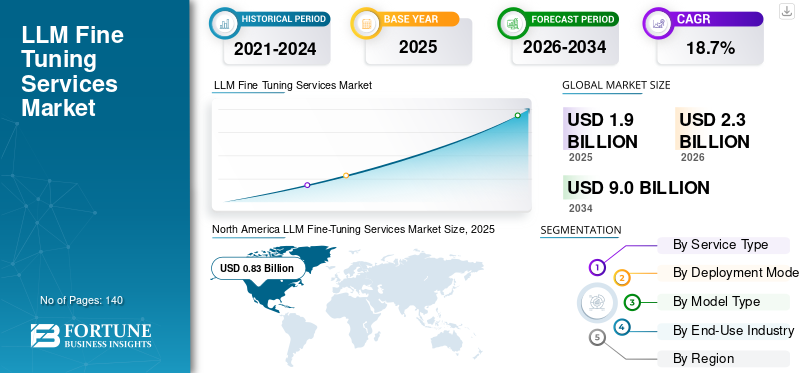
The global LLM fine-tuning services market size was valued at USD 1.9 billion in 2025. The market is projected to grow from USD 2.3 billion in 2026 to USD 9.0 billion by 2034, exhibiting a CAGR of 18.7% during the forecast period. North America dominated the LLM fine-tuning services market with a market share of 43.68% in 2025.
LLM fine-tuning services comprise specialized AI customization, optimization, and deployment solutions designed to adapt pre-trained large language model architectures for enterprise-specific workflows, domain intelligence, regulatory requirements, and industry-focused automation applications across commercial and institutional environments. These services support the integration of proprietary enterprise datasets, supervised fine tuning pipelines, parameter-efficient-fine-tuning (PEFT) frameworks, reinforcement learning from human feedback (RLHF), retrieval-enhanced training architectures, model evaluation systems, and inference optimization tools to improve contextual accuracy, response reliability, operational efficiency, and domain-specific performance across enterprise AI deployments. LLM fine-tuning services enable organizations to customize a base model into a fine tuned model using specific data and enterprise training data to support customer service automation, enterprise knowledge management, code generation, legal documentation, financial analysis, healthcare workflows, multilingual communication, and industry-specific AI copilots while improving data privacy, governance compliance, and model alignment with internal business processes. The fine-tuning process helps model learn enterprise-specific operational patterns and improves deployment performance across real world business environments. Rising enterprise adoption of generative AI, increasing demand for domain-specific AI models, growing deployment of open-source LLM ecosystems, and expanding focus on sovereign AI infrastructure are accelerating adoption of LLM fine-tuning services globally, particularly across technologically advanced economies such as the U.S., China, the U.K., Germany, India, and Japan.
- For instance, in March 2026, the U.S. National Institute of Standards and Technology (NIST) expanded enterprise AI risk management guidance frameworks. This supports secure deployment, monitoring, evaluation, and governance practices for customized generative AI and fine-tuned language model implementations across regulated industries.
Accenture plc, IBM Corporation, Tata Consultancy Services Limited, Infosys Limited, Capgemini SE, Cognizant Technology Solutions Corporation, Deloitte Touche Tohmatsu Limited, PwC, HCL Technologies Limited, EPAM Systems, Inc., Databricks, Inc., Hugging Face, Inc., DataRobot, Inc., Scale AI, Inc., and C3.ai, Inc. are among the major companies operating in the market.
Download Free sample to learn more about this report.
LLM Fine Tuning Services Market Key Takeaways
 Global Market Size & Forecast
- 2025 Market Size: USD 1.9 billion
- 2026 Market Size: USD 2.3 billion
- 2034 Forecast Market Size: USD 9.0 billion
- CAGR: 18.7% (2026–2034)
 Market Share
- North America dominated the market with a 43.68% share in 2025.
- The custom model fine-tuning services segment held the largest market share.
- The IT & telecommunications segment accounted for the largest market share, driven by the early adoption of generative AI and enterprise AI applications.
 Key Regional Highlights
Asia Pacific
Asia Pacific generated USD 0.53 billion in 2025.
North America
North America generated USD 0.83 billion in 2025, maintaining its leading market position.
Europe
Europe is projected to witness steady growth during the forecast period.
U.S.
U.S. market is projected to reach USD 0.70 billion by 2026.
Japan
Japan market is projected to reach USD 0.09 billion by 2026.
Read More

LLM FINE-TUNING SERVICES MARKET TRENDS
Rising Enterprise Demand for Domain-Specific and Multimodal AI Models is Transforming LLM Fine-Tuning Services Market
Demand for LLM fine-tuning services is increasingly being driven by the growing need for enterprise-specific AI models capable of delivering higher contextual accuracy, industry-aligned outputs, and secure deployment across regulated operational environments. As organizations expand the adoption of generative AI across customer support, enterprise knowledge management, legal documentation, software development, healthcare workflows, financial analysis, and multilingual automation, enterprises are increasingly prioritizing customized large language models trained on proprietary datasets, domain-specific terminology, and internal operational knowledge. The market is witnessing rising demand for parameter-efficient fine-tuning (PEFT), reinforcement learning from human feedback (RLHF), low-rank adaptation (LoRA), and multimodal model optimization services that improve inference efficiency, reduce hallucinations, strengthen governance compliance, and enable deployment across cloud, hybrid, and on-premises AI infrastructures. This shift is moving LLM fine-tuning services from experimental AI customization toward scalable enterprise-grade AI engineering and operational intelligence deployment. In North America, Europe, and Asia Pacific, enterprise AI adoption is increasingly supporting demand for industry-specific LLMs capable of addressing data privacy requirements, sovereign AI initiatives, multilingual processing needs, and workflow-specific automation use cases, particularly across BFSI, healthcare, government, telecommunications, and manufacturing sectors.
- For instance, in February 2026, IBM Corporation expanded enterprise generative AI customization capabilities through enhanced domain-specific fine-tuning and governance tooling within its watsonx AI platform. The platform supports enterprise demand for secure, industry-aligned large language model deployment across regulated business environments.
MARKET DYNAMICS
MARKET DRIVERS
Download Free sample to learn more about this report.
Rising Integration of Generative AI in Enterprise Workflows to Drive Market Growth
The market is increasingly being driven by the growing integration of generative AI across enterprise workflows, customer engagement systems, software development operations, knowledge management platforms, and industry-specific automation environments. As enterprises seek to improve contextual accuracy, reduce hallucinations, strengthen data privacy, and align large language models with internal business processes, demand for customized AI models and fine-tuning services is increasing across global markets. LLM fine-tuning services are becoming a critical component within enterprise AI deployment ecosystems as organizations increasingly require proprietary dataset integration, multilingual model adaptation, parameter-efficient fine-tuning (PEFT), reinforcement learning from human feedback (RLHF), inference optimization, and governance-aligned model customization to support operational scalability and competitive differentiation. Financial institutions, healthcare providers, IT companies, manufacturers, retailers, and government organizations are increasingly adopting fine-tuned LLMs to improve workflow automation, enterprise search, compliance documentation, software engineering productivity, and AI-powered decision support systems.
- For instance, in January 2026, Microsoft Corporation expanded enterprise generative AI customization capabilities across Azure AI services, supporting increasing enterprise demand for secure domain-specific LLM fine-tuning and scalable AI deployment across regulated business environments.
MARKET RESTRAINTS
High GPU Infrastructure Costs and Data Privacy Concerns to Limit Market Expansion
The growth of the market is constrained by high GPU infrastructure costs, limited availability of high-quality proprietary datasets, and increasing enterprise concerns related to data privacy, model governance, and regulatory compliance. Fine-tuning large language models often requires advanced AI engineering expertise, scalable computing infrastructure, continuous monitoring, and secure enterprise deployment environments, creating cost and implementation barriers for many organizations. In addition, rapid evolution of foundation models, prompt engineering tools, and retrieval-augmented generation (RAG) frameworks is reducing dependency on full-scale model fine-tuning in some enterprise use cases. Concerns surrounding model explainability, hallucination risks, intellectual property exposure, and benchmarking inconsistencies also continue to create deployment complexity across regulated industries globally.
MARKET OPPORTUNITIES
Expansion of Industry-Specific AI Models and Sovereign AI Infrastructure Creating Long-Term Market Opportunities
A major opportunity emerging within the LLM fine-tuning services market is the increasing demand for industry-specific AI models, multilingual enterprise automation, and sovereign AI infrastructure across commercial and government environments. As enterprises move beyond generic AI applications, demand is increasing for customized large language models capable of supporting regulated workflows, proprietary enterprise knowledge, local language processing, and sector-specific operational requirements. This is creating substantial opportunities for service providers offering parameter-efficient-fine-tuning (PEFT), multimodal model optimization, synthetic data generation, AI governance frameworks, and private enterprise AI deployment solutions across BFSI, healthcare, manufacturing, legal, and public-sector environments. The opportunity is especially strong in sovereign AI initiatives and private enterprise AI infrastructure, where organizations require secure, explainable, and locally deployable generative AI systems.
- For instance, in April 2026, Databricks announced expanded AI agent engineering and domain-specific model customization capabilities within the Databricks Data Intelligence Platform to support enterprise generative AI deployment and industry-focused LLM optimization across regulated business environments.
MARKET CHALLENGES
Rapid Evolution of Foundation Models to Hinder Product Adoption
One of the major challenges affecting the LLM fine-tuning services market is the rapid evolution of foundation models, changing enterprise AI deployment strategies, and lack of standardized model evaluation frameworks across industries. Service providers must continuously adapt fine-tuning methodologies, optimization pipelines, governance controls, and deployment architectures to support evolving enterprise AI requirements, multimodal capabilities, and regulatory expectations. At the same time, enterprises expect customized LLMs to deliver higher accuracy, explainability, security, and operational scalability across complex business environments. This creates operational pressure for providers to improve model benchmarking, inference optimization, hallucination mitigation, and enterprise integration capabilities while managing rising GPU infrastructure costs, data privacy concerns, and fast-changing generative AI ecosystems globally.
Segmentation Analysis
By Service Type
Custom Model Fine-Tuning Services Segment Led the Market Owing to Growing Enterprise Demand for Private Ai Deployment
By service type, the market is segmented into custom model fine-tuning services, dataset preparation & curation services, data annotation & human feedback services, model evaluation & benchmarking services, deployment & integration services, and monitoring, optimization & support services.
Custom model fine-tuning services held the largest market share as these services remain the most commercially critical and widely adopted component across enterprise generative AI deployment workflows. Enterprises across BFSI, healthcare, IT & telecommunications, retail, legal services, manufacturing, and government sectors increasingly utilize custom LLM fine-tuning services to adapt foundation models using proprietary enterprise datasets, industry-specific terminology, multilingual content, and workflow-specific operational requirements. Compared with supporting services such as dataset curation or benchmarking, custom fine-tuning services have broader applicability across customer support automation, enterprise knowledge management, software development copilots, financial analysis, legal documentation, and AI-driven workflow automation, making them the primary revenue-generating segment within the ecosystem. Their adoption is further supported by growing enterprise demand for private AI deployment, higher contextual accuracy, reduced hallucination risks, and improved governance alignment across enterprise AI applications.
- For instance, in May 2026, IBM Corporation expanded watsonx AI customization capabilities with enhanced enterprise model tuning and domain adaptation features designed to support industry-specific generative AI deployment across regulated enterprise environments.
Monitoring, optimization & support services are expected to witness the highest growth rate of 22.5%, driven by increasing enterprise demand for continuous model performance monitoring, hallucination mitigation, inference optimization, governance compliance, AI observability, and post-deployment operational management. The segment is gaining strong momentum as enterprises increasingly require scalable lifecycle management solutions to maintain accuracy, security, explainability, and operational efficiency across continuously evolving large language model deployments.
To know how our report can help streamline your business, Speak to Analyst
By Deployment Mode
Cloud-Based Segment Led the Market Owing to its Benefits
By deployment mode, the market is segmented into cloud-based, on-premises, and hybrid.
Cloud-based held the largest market share as enterprises increasingly prefer scalable cloud AI infrastructure for large language model customization, deployment, monitoring, and enterprise workflow integration. Organizations across BFSI, healthcare, retail, IT & telecommunications, and manufacturing sectors widely utilize cloud-based LLM fine-tuning services to access high-performance GPU infrastructure, scalable model training environments, API-based deployment frameworks, and managed AI orchestration platforms without significant upfront infrastructure investment. Compared with on-premises deployment, cloud-based environments offer faster implementation, lower operational complexity, easier scalability, continuous model updates, and stronger integration with enterprise AI ecosystems, making them the most commercially established deployment category.
The hybrid segment is expected to witness the highest growth rate of 19.8%, driven by increasing enterprise demand for secure AI deployment architectures that combine cloud scalability with private infrastructure control.
By Model Type
Open-Source LLMs Segment Led the Market Owing to Growing Enterprise Preference for Customizable and Cost-Efficient AI Models
By model type, the market is segmented into open-source LLMs, proprietary LLMs, general-purpose LLMs, industry-specific LLMs, and multimodal LLMs.
Open-source LLMs held the largest market share as enterprises increasingly prefer customizable, transparent, and cost-efficient large language model ecosystems for enterprise AI deployment and domain-specific workflow automation. Organizations across BFSI, healthcare, IT & telecommunications, manufacturing, legal services, and government sectors widely utilize open-source LLMs to support proprietary dataset integration, multilingual model adaptation, private AI deployment, and industry-specific fine-tuning workflows.
Multimodal LLMs are expected to witness the highest growth rate of 23.7%, driven by increasing enterprise demand for AI systems capable of processing text, images, audio, video, and structured enterprise data within unified generative AI workflows.
By End-Use Industry
IT & Telecommunications Segment Led the Market Owing to Early Adoption of Generative AI by Enterprises
By end-use industry, the market is segmented into BFSI, IT & telecommunications, healthcare & life sciences, retail & e-commerce, media & entertainment, education, legal services, manufacturing, government & public sector, and automotive & transportation.
IT & telecommunications held the largest market share as enterprises within the sector remain among the earliest and largest adopters of generative AI, enterprise copilots, multilingual automation, software engineering assistants, and AI-driven customer engagement platforms. IT service providers, cloud companies, telecom operators, and digital platform providers increasingly utilize LLM fine-tuning services to customize large language models for enterprise knowledge management, code generation, customer support automation, intelligent search, and workflow optimization applications.
Healthcare & life sciences is expected to witness the highest growth rate of 20.9%, driven by increasing demand for AI-powered clinical documentation, medical knowledge management, healthcare workflow automation, pharmaceutical research support, and patient communication systems.
LLM Fine-Tuning Services Market Regional Outlook
By geography, the market is categorized into Europe, North America, Asia Pacific, South America, and the Middle East & Africa.
North America
North America LLM Fine-Tuning Services Market Size, 2025 (USD Billion)
To get more information on the regional analysis of this market, Download Free sample
The North America market dominated the market, accounting for over USD 0.83 billion in revenue in 2025, supported by strong enterprise AI adoption, advanced cloud infrastructure, and rising deployment of generative AI across enterprise workflows in the U.S., Canada, and Mexico. Regional demand is strongly influenced by increasing adoption of custom LLM fine-tuning services, enterprise AI copilots, multilingual automation platforms, and domain-specific generative AI models across BFSI, healthcare, IT & telecommunications, retail, manufacturing, and government sectors. The region benefits from a mature AI ecosystem, strong hyperscaler presence, high enterprise cloud penetration, growing open-source LLM adoption, and increasing investments in private AI infrastructure, sovereign AI initiatives, and enterprise AI governance frameworks.
U.S. LLM Fine-Tuning Services Market
The U.S. is expected to dominate the market, reaching USD 0.70 billion by 2026, driven by the country’s strong hyperscaler ecosystem, advanced enterprise AI infrastructure, large software industry, and high adoption of generative AI across commercial operations. Demand for the product remains particularly strong across technology companies, financial institutions, healthcare providers, retailers, and government organizations that increasingly require customized large language models for workflow automation, enterprise knowledge management, software development, customer engagement, and AI-powered decision support systems. The country also demonstrates strong demand for cloud-based deployment, multimodal AI systems, and industry-specific LLM customization as enterprises increasingly integrate generative AI into operational and customer-facing business environments.
Europe
The Europe market is driven by growing AI adoption by enterprises, increasing sovereign AI initiatives, and rising demand for secure and regulation-compliant generative AI deployment across the U.K., Germany, France, Italy, Spain, BENELUX, Nordics, and other European markets. Regional demand is closely associated with enterprise data privacy requirements, multilingual AI deployment, industry-specific workflow automation, and increasing adoption of open-source LLM ecosystems. Europe remains one of the most important consumption markets for LLM fine-tuning services as enterprises, governments, financial institutions, healthcare providers, and industrial organizations increasingly utilize customized AI models, enterprise copilots, and private generative AI infrastructure to support operational efficiency, compliance management, and digital transformation initiatives.
U.K. LLM Fine-Tuning Services Market
The U.K. market is estimated to reach around USD 0.12 billion in 2026, representing roughly 5.2% of global sales.
Germany LLM Fine-Tuning Services Market
Germany’s market is projected to reach approximately USD 0.10 billion in 2026, equivalent to around 4.6% of global sales.
Asia Pacific
Asia Pacific remains the significant growing market, generating revenue of USD 0.53 billion in 2025 globally. Within the region, China and Japan are projected to reach approximately USD 0.22 billion and USD 0.09 billion, respectively, in 2026. Regional market expansion is strongly associated with growing enterprise demand for domain-specific AI models, multilingual automation systems, AI-powered customer engagement platforms, and sovereign AI initiatives across commercial and government sectors. Demand is also supported by increasing adoption of open-source LLM ecosystems, enterprise workflow automation, software development copilots, and AI-driven operational optimization across BFSI, IT & telecommunications, manufacturing, healthcare, and retail industries.
China LLM Fine-Tuning Services Market
China’s market is projected to remain the dominant in the Asia Pacific region, with 2026 revenues standing at around USD 0.22 billion, representing roughly 9.7% of global sales.
Japan LLM Fine-Tuning Services Market
The Japan market is estimated to reach around USD 0.09 billion in 2026, accounting for roughly 4.0% of the global sales.
India LLM Fine-Tuning Services Market
The India market is estimated to reach around USD 0.12 billion in 2026, accounting for roughly 5.3% of global sales.
Middle East & Africa
The Middle East & Africa market is driven by rising enterprise AI adoption, sovereign AI initiatives, and growing deployment of generative AI across GCC countries, South Africa, Israel, North Africa, and Rest of MEA. Demand is closely linked to government digital transformation programs, multilingual AI development, enterprise automation, and increasing adoption of AI-powered customer engagement platforms across banking, telecommunications, healthcare, and public-sector environments. GCC countries lead regional consumption due to strong AI infrastructure investments and sovereign AI model development, while Israel benefits from a mature AI startup ecosystem and advanced enterprise technology adoption.
GCC LLM Fine-Tuning Services Market
The GCC market is projected to reach around USD 0.04 billion in 2026, representing roughly 1.9% of the global sales.
South America
The South America market is driven by rising enterprise AI adoption, growing cloud infrastructure investments, and increasing deployment of generative AI across Brazil, Argentina, Chile, Colombia, and other regional markets. Demand for the product is primarily associated with IT service providers, financial institutions, telecom operators, retailers, healthcare organizations, and government agencies seeking customized large language models, enterprise workflow automation, multilingual AI systems, and AI-powered customer engagement solutions.
Brazil LLM Fine-Tuning Services Market
The Brazil market is projected to reach around USD 0.03 billion in 2026, representing roughly 1.2% of the global sales.
COMPETITIVE LANDSCAPE
Key Industry Players
Major Players Focus on Investment in AI Orchestration Platforms to Support Workflow Automation
The LLM fine-tuning services market is moderately fragmented, with competitive positioning shaped by capabilities in enterprise AI customization, parameter-efficient fine-tuning (PEFT), multilingual model adaptation, synthetic data engineering, model evaluation, inference optimization, and cloud-native generative AI deployment. Leading companies including Accenture plc, IBM Corporation, Tata Consultancy Services Limited, Infosys Limited, Capgemini SE, Cognizant Technology Solutions Corporation, Deloitte Touche Tohmatsu Limited, HCL Technologies Limited, Databricks, Inc., Hugging Face, Inc., Scale AI, Inc., and DataRobot, Inc. maintain strong market positions through enterprise AI expertise, scalable deployment frameworks, industry-specific AI solutions, and integrated generative AI engineering platforms supporting commercial and government organizations globally.
Competitive differentiation is increasingly influenced by the ability to provide secure enterprise AI deployment, multimodal model customization, governance-aligned AI workflows, scalable cloud integration, AI observability, and industry-specific generative AI optimization. Companies are continuously investing in AI orchestration platforms, vector database integration, enterprise copilots, sovereign AI infrastructure, model benchmarking tools, and enterprise-grade lifecycle management solutions to support workflow automation, operational efficiency, and domain-specific AI deployment across global industries.
- For instance, in April 2026, Accenture expanded its AI Refinery platform capabilities with additional industry-specific generative AI services and enterprise model customization solutions designed to accelerate large-scale AI transformation initiatives globally.
LIST OF KEY LLM FINE-TUNING SERVICES COMPANIES PROFILED
- Accenture plc (Ireland)
- IBM Corporation (U.S.)
- Tata Consultancy Services Limited (India)
- Infosys Limited (India)
- Capgemini SE (France)
- Cognizant Technology Solutions Corporation (U.S.)
- Deloitte Touche Tohmatsu Limited (U.K.)
- HCL Technologies Limited (India)
- Databricks, Inc. (U.S.)
- Hugging Face, Inc. (U.S.)
KEY INDUSTRY DEVELOPMENTS
- March 2026: IBM Corporation expanded watsonx AI capabilities with enhanced enterprise model tuning, governance automation, and domain-specific generative AI customization features for regulated industries.
- January 2026: Databricks announced new AI agent engineering and enterprise LLM optimization capabilities within the Databricks Data Intelligence Platform to support scalable generative AI deployment.
- October 2025: Infosys Limited launched enhanced generative AI integration and domain-specific LLM customization services designed to accelerate enterprise workflow automation and AI-driven operational efficiency initiatives globally.
- July 2025: Accenture plc expanded its AI Refinery platform with additional industry-specific generative AI solutions and enterprise AI orchestration services for large-scale business transformation projects.
- April 2025: Hugging Face introduced expanded enterprise support services for open-source large language model customization, benchmarking, and secure deployment workflows across commercial AI environments.
REPORT COVERAGE
The global LLM fine-tuning services market analysis includes a comprehensive study of the market size & forecast by all the market segments included in the report. It includes details on the market dynamics and market trends expected to drive the market over the forecast period. It provides information on key aspects, including an overview of technological advancements, the regulatory environment, and product launches. Additionally, it details partnerships, mergers & acquisitions, and key industry developments and prevalence by key regions. The global market research report also provides a depth competitive landscape with information on the market share and profiles of key operating players.
Request for Customization to gain extensive market insights.
Report Scope & Segmentation
| ATTRIBUTE | DETAILS |
| Study Period | 2021-2034 |
| Base Year | 2025 |
| Estimated Year | 2026 |
| Forecast Period | 2026-2034 |
| Historical Period | 2021-2024 |
| Growth Rate | CAGR of 18.7% from 2026-2034 |
| Unit | Value (USD Billion) |
| Segmentation | By Service Type, Deployment Mode, Model Type, End-Use Industry, and Region |
| By Service Type |
|
| By Deployment Mode |
|
| By Model Type |
|
| By End-Use Industry |
|
| By Region |
|
Frequently Asked Questions
According to Fortune Business Insights, the global market value stood at USD 1.9 billion in 2025 and is projected to reach USD 9.0 billion by 2034.
In 2025, North America’s market value stood at USD 0.83 billion.
The market is expected to exhibit a CAGR of 18.7% during the forecast period (2026-2034).
By end-use industry, the IT & telecommunications segment led the market.
Rising integration of Generative AI in enterprise workflows is a key factor driving market growth.
Accenture plc, IBM Corporation, Tata Consultancy Services, Infosys, Capgemini, Databricks, Hugging Face, and Cognizant are the top players in the market.
North America held the largest market share in 2025.



- 2021-2034
- 2025
- 2021-2024
- 140
Get 30-60 hrs Free Customization
Expand Regional and Country Coverage, Segments Analysis, Company Profiles, Competitive Benchmarking, and End-user Insights.











Related Reports
-
US +1 833 909 2966 ( Toll Free )
-
Get In Touch With Us