Medical Polymers Market Size, Share & Industry Analysis, By Type (Fibers & Resins, Medical Elastomers, and Others), By Manufacturing Technology (Injection Molding, Extrusion Tubing, Compression Molding, and Others), By Application (Medical Devices & Equipment, Medical Packaging, and Others), and Regional Forecast, 2026-2034
 Download Free Sample
(Offer valid till 15th Aug 2026)
Medical Polymers Market Size and Future Outlook
 Listen to Audio Version
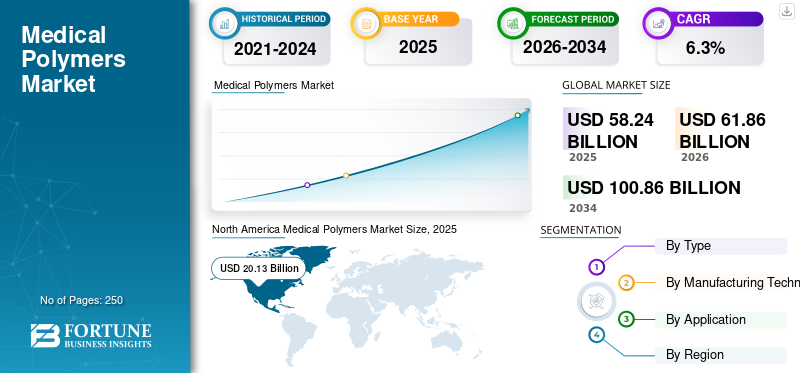
The global medical polymers market size was valued at USD 58.24 billion in 2025. The market is projected to grow from USD 61.86 billion in 2026 to USD 100.86 billion by 2034, exhibiting a CAGR of 6.3% during the forecast period. North America dominated the global market with a market share of 34.56% in 2025.
Medical polymers are specialized polymeric materials designed for healthcare applications requiring high biocompatibility, sterilization resistance, chemical stability, and mechanical performance. These materials include engineering resins, fibers, elastomers, and specialty polymers used in medical devices, surgical instruments, implants, drug delivery systems, and pharmaceutical packaging. Compared to traditional materials such as metals and glass, medical polymers offer advantages including lightweight construction, design flexibility, corrosion resistance, and cost-effective manufacturing. Rising healthcare expenditure, increasing surgical procedures, and expanding demand for minimally invasive medical devices are significantly driving market growth. Furthermore, technological advancements in polymer formulations and manufacturing processes are improving product performance and patient safety. As healthcare systems continue to emphasize infection prevention, medical innovation, and sustainable healthcare products, demand for polymers is expected to increase steadily, thus strengthening the long-term outlook of the global market. The major companies operating in the market are BASF SE, SABIC, Covestro, Celanese, and Momentive Performance Material, and others.
Download Free sample to learn more about this report.
Medical Polymers Market Trends
Single-Use Medical Products and High-Performance Polymer Innovations are Reshaping Industry Dynamics
The market is evolving with the increasing adoption of single-use medical products aimed at reducing healthcare-associated infections. Manufacturers are developing advanced polymers with enhanced biocompatibility, sterilization resistance, and chemical durability to meet stringent regulatory standards. High-performance engineering polymers are increasingly replacing metals in lightweight medical devices and surgical instruments. Additionally, the growing use of recyclable and bio-based medical polymers reflects the industry's focus on sustainability. Expanding demand for wearable medical devices, minimally invasive surgical equipment, and drug delivery systems is further accelerating material innovation. These healthcare advancements and material developments continue to reshape market demand, thus supporting sustained industry growth.
MARKET DYNAMICS
MARKET DRIVERS
Download Free sample to learn more about this report.
Increasing Medical Procedures and Healthcare Modernization Sustaining Market Growth
The primary driver of the medical polymers market growth is the increasing number of surgical procedures and expanding healthcare services globally. Growing prevalence of chronic diseases, rising hospital admissions, and increasing use of minimally invasive procedures are boosting demand for medical devices and disposable healthcare products. Medical polymers provide superior design flexibility, lightweight properties, and compatibility with sterilization methods, making them ideal for modern healthcare applications. Furthermore, rapid pharmaceutical industry expansion is driving demand for medical-grade packaging materials. Improvements in healthcare infrastructure and growing public health investments further reinforce consumption. These healthcare and demographic factors collectively sustain robust market demand, thus supporting continuous growth.
MARKET RESTRAINTS
Regulatory Compliance and Environmental Concerns Limiting Market Expansion
The market faces challenges from stringent regulatory approval processes governing material safety, biocompatibility, and sterilization performance. Compliance with international healthcare standards increases product development costs and extends commercialization timelines. Additionally, growing concerns regarding plastic waste generated by disposable medical products are encouraging stricter environmental regulations. Volatility in petrochemical feedstock prices may also affect manufacturing costs. These regulatory and environmental challenges create operational constraints, hence moderating market expansion in certain regions.
MARKET OPPORTUNITIES
Healthcare Infrastructure Expansion and Aging Population Creating Long-Term Growth Potential
Growing investments in healthcare infrastructure across emerging economies present significant opportunities for medical polymer manufacturers. Rising demand for advanced diagnostic equipment, disposable medical supplies, and implantable devices is increasing polymer consumption. The expanding elderly population and increasing prevalence of chronic diseases are driving demand for orthopedic implants, cardiovascular devices, and drug delivery systems. Additionally, advancements in 3D printing technologies are creating opportunities for customized medical components produced from specialty polymers. Increasing pharmaceutical production and biologics packaging further strengthen market prospects. As healthcare accessibility and technological innovation continue to improve worldwide, demand for high performance medical grade polymers is expected to rise steadily, therefore supporting long-term market expansion.
MARKET CHALLENGES
Waste Management and Material Qualification Requirements Influencing Industry Development
Managing medical plastic waste while maintaining strict infection-control standards remains a significant challenge for manufacturers. Developing recyclable or bio-based alternatives without compromising product performance requires substantial investment in research and development. Furthermore, ensuring consistent polymer quality and compliance with evolving medical regulations demands rigorous testing and certification. Increasing pressure to reduce environmental impact while maintaining affordability presents additional challenges. These technical and regulatory complexities influence product development strategies, therefore shaping competitive dynamics within the market.
RESEARCH AND DEVELOPMENT TRENDS
Research activities are focused on developing advanced biocompatible polymers, antimicrobial materials, and recyclable medical-grade plastics. Innovations in high-performance engineering polymers, bio-based materials, and additive manufacturing are enabling improved functionality across medical devices, implants, and pharmaceutical packaging while supporting sustainability objectives.
Segmentation Analysis
By Type
Fibers And Resins Segment Held the Largest Market Share Owing to its Wide Range Of Applications
Based on type, the market is segmented into fibers and resins, medical elastomers, and others.
The fibers and resins segment held the largest market share in 2025. The fibers & resins segment accounted for the largest share of the medical polymers market due to its extensive use across a wide range of healthcare applications. Medical-grade polymers such as polypropylene (PP), polyethylene (PE), polyvinyl chloride (PVC), polystyrene (PS), and engineering resins are widely utilized in syringes, IV components, catheters, surgical instruments, diagnostic equipment, and pharmaceutical packaging. Their excellent mechanical strength, chemical resistance, sterilization compatibility, and cost-effectiveness make them the preferred choice for high-volume medical manufacturing. Increasing production of disposable medical products and expanding healthcare infrastructure worldwide continue to drive demand. Furthermore, continuous advancements in medical-grade resin formulations are improving product performance and regulatory compliance. These advantages are expected to help fibers & resins maintain their leading position throughout the forecast period.
The medical elastomers segment is expected to witness significant growth owing to increasing demand for flexible, durable, and biocompatible materials across healthcare applications. Medical-grade silicones, thermoplastic elastomers (TPE), thermoplastic polyurethane (TPU), thermoplastic vulcanizates (TPV), and similar materials are widely used in tubing, catheters, respiratory masks, seals, gaskets, wearable devices, and medical packaging. These elastomers provide superior flexibility, patient comfort, and resistance to repeated sterilization, making them ideal for advanced medical applications. The segment is growing with a CAGR of 6.1% during the forecast period.
By Manufacturing Technology
Injection Molding Segment Held the Largest Share Owing to High-volume Production of Medical Devices
Based on manufacturing technology, the market is segmented into injection molding, extrusion tubing, compression molding, and others.
The injection molding segment held the largest share of the market in 2025 and is anticipated to register the highest CAGR during the forecast period. Injection molding is widely used in the production of medical devices such as syringes, surgical instruments, and implantable devices. It allows high-volume production, precise control over product dimensions, and enables the creation of complex shapes with a high degree of repeatability. This segment is foreseen to capture 41% of the market share in 2025.
The extrusion tubing segment is anticipated to grow at a considerable rate during the forecast period. Extrusion tubing involves forcing medical-grade polymers through a die to create tubes used in catheters, IV lines, and other medical devices. The segment is growing with a CAGR of 6.3% during the forecast period.
By Application
To know how our report can help streamline your business, Speak to Analyst
Medical Devices and Equipment Segment Held the Largest Market Share Owing to Increasing Investment in Healthcare Industry
Depending on the applications, the market is segmented into medical devices & equipment, medical packaging, and others.
Medical devices & equipment accounted for the largest share of the market owing to the increasing production of diagnostic devices, surgical instruments, implantable products, and wearable healthcare equipment. Medical polymers are extensively used due to their lightweight properties, biocompatibility, chemical resistance, and compatibility with various sterilization methods. Rising healthcare expenditure and continuous investments in hospital infrastructure across emerging economies such as China, India, Brazil, and South Africa are further accelerating the adoption of polymer-based medical devices. Additionally, growing demand for minimally invasive procedures and portable diagnostic technologies continues to strengthen the segment. These healthcare advancements and expanding medical device manufacturing activities are expected to maintain the segment's leading position throughout the forecast period.
The medical packaging segment is expected to witness robust growth due to increasing pharmaceutical production and stringent requirements for sterile, safe, and durable packaging solutions. Medical polymers are widely utilized in blister packs, bottles, vials, IV bags, protective films, and medical device packaging due to their excellent barrier properties, chemical stability, and sterilization compatibility. Rising production of biologics, vaccines, injectable drugs, and specialty pharmaceuticals is further driving demand for high-performance packaging materials. Additionally, growing emphasis on product safety, extended shelf life, and regulatory compliance is encouraging the adoption of advanced medical-grade polymers. This segment is likely to grow with a significant CAGR of 6.0% during the forecast period.
MEDICAL POLYMERS MARKET REGIONAL OUTLOOK
By region, the global market is segmented into North America, Europe, Asia Pacific, Latin America, and the Middle East & Africa.
North America
North America Medical Polymers Market Size, 2025 (USD Billion)
To get more information on the regional analysis of this market, Download Free sample
The market in North America was valued at USD 20.13 billion in 2025 and accounted for the largest medical polymers market share. The growth is due to the advanced healthcare infrastructure, strong medical device manufacturing base, and high healthcare expenditure in the region. The U.S. dominates regional demand through extensive production of disposable medical products, diagnostic equipment, implants, and pharmaceutical packaging. Growing adoption of minimally invasive procedures and increasing investments in advanced medical technologies continue to support polymer consumption. The presence of major polymer manufacturers and medical device companies further strengthens regional growth. Additionally, stringent regulatory standards encourage continuous innovation in high-performance and biocompatible medical polymers. These technological advancements and healthcare investments continue to reinforce North America's leadership in the global market.
To know how our report can help streamline your business, Speak to Analyst
U.S. Medical Polymers Market
The U.S. market in 2025 reached a valuation of USD 18.03 billion, accounting for approximately 31.0% of regional revenues. Growth is driven by advanced medical device manufacturing, increasing minimally invasive procedures, and strong demand for high-performance medical-grade polymers.
Europe
Europe represents a mature market supported by advanced healthcare systems and a well-established medical device industry. Germany, France, the U.K., Italy, and Switzerland are major contributors due to strong production of diagnostic equipment, surgical instruments, and pharmaceutical packaging. The region's aging population continues to increase demand for implants, prosthetics, and long-term healthcare products. Additionally, stringent EU medical regulations encourage development of high-quality medical-grade polymers. Growing emphasis on sustainable healthcare materials and recyclable polymers is further driving innovation. These healthcare and manufacturing strengths continue to support steady market expansion across Europe.
Germany Medical Polymers Market
Germany’s market reached a valuation of USD 3.96 billion in 2025, accounting for approximately 6.8% of regional demand. Expansion is supported by its robust medical technology industry, rising production of precision healthcare equipment, and growing demand for biocompatible polymer materials.
Asia Pacific
Asia Pacific is the fastest growing region in the market due to expanding healthcare infrastructure, increasing healthcare expenditure, and rapid growth of domestic medical device manufacturing. China, India, Japan, and South Korea are investing heavily in hospitals, pharmaceutical production, and medical technology development. Rising population, growing prevalence of chronic diseases, and increasing government support for local medical manufacturing continue to boost demand for medical polymers. Competitive manufacturing costs and expanding exports of medical devices further strengthen the region's position. These healthcare investments and industrial developments continue to accelerate market growth across Asia Pacific.
China Medical Polymers Market
Based on Asia Pacific’s strong contribution and China’s position as the leading country in the regional market, the China market was valued at USD 6.23 billion in 2025, accounting for approximately 10.7% of regional revenues. Growth is fueled by rapid expansion of domestic medical device manufacturing, increasing healthcare expenditure, and government initiatives promoting local production of medical products.
Latin America
Latin America is experiencing gradual growth in the market, driven by expanding healthcare infrastructure and increasing pharmaceutical production. Brazil and Mexico account for the majority of regional demand due to growing investments in hospitals, medical devices, and healthcare services. Rising awareness of infection prevention and increasing use of disposable medical products continue to support polymer consumption. Local manufacturing capabilities are also improving to reduce dependence on imports. These healthcare improvements and industrial investments are expected to sustain steady market growth across the region.
Brazil Medical Polymers Market
Brazil market reached a valuation of USD 1.67 billion in 2025, accounting for approximately 2.9% of regional demand. Demand is driven by expanding healthcare infrastructure, increasing pharmaceutical production, and rising consumption of disposable medical products.
Middle East & Africa
The Middle East & Africa market is witnessing steady growth due to increasing healthcare modernization and investments in hospital infrastructure. GCC countries are expanding healthcare facilities, pharmaceutical manufacturing, and medical tourism, thereby increasing demand for medical devices and packaging materials. Rising incidence of chronic diseases and improving healthcare accessibility further support polymer consumption. Although domestic manufacturing remains limited in several countries, imports and government healthcare initiatives continue to strengthen market demand. These modernization efforts and healthcare investments are expected to support gradual expansion of the regional market.
GCC Medical Polymers Market
The GCC market reached a valuation of USD 0.84 billion in 2025, accounting for approximately 1.4% of regional demand. Growth is supported by the expansion of medical device manufacturing for export, increasing foreign investments, and rising demand for polymer-based healthcare products.
COMPETITIVE LANDSCAPE
KEY INDUSTRY PLAYERS
Innovation in Medical-Grade Polymers and Global Expansion Strengthening Market Competition
The global market is characterized by the presence of established players such as BASF SE, SABIC, Covestro AG, Celanese Corporation, and Momentive Performance Materials, along with several regional manufacturers specializing in medical-grade materials. Competition is primarily driven by continuous innovation in high-performance, biocompatible, and sustainable polymer solutions to meet evolving healthcare requirements and stringent regulatory standards. Leading companies are investing in the development of recyclable and bio-based medical polymers while expanding their manufacturing capabilities and distribution networks across emerging markets. In addition, strategic collaborations with medical device manufacturers and healthcare companies are strengthening product portfolios and market reach. The combination of strong global brands, advanced material technologies, and specialized application expertise continues to intensify competition, therefore reinforcing the market position of established manufacturers.
List of Key Medical Polymers Companies Profiled
- BASF SE (Germany)
- SABIC (Saudi Arabia)
- Covestro AG (Germany)
- Celanese Corporation (U.S.)
- Evonik Industries AG (Germany)
- Arkema (France)
- Syensqo (Belgium)
- Kuraray Co., Ltd. (Japan)
- Momentive Performance Material (U.S.)
- ExxonMobil Mobil Corporation (U.S.)
KEY INDUSTRY DEVELOPMENTS
- April 2026: Evonik and Higuchi opened a new Open Pharma Lab in Yokohama, Japan, giving local formulators hands-on access to EUDRAGIT polymers and oral drug delivery system solutions. This expands Evonik’s regional innovation network in Asia for pharmaceutical polymer-based drug delivery applications.
- February 2026: SABIC debuted new biocompatible SILTEM HU resins and a new family of polycarbonate copolymers certified under UL746G at MD&M West 2026. The materials are positioned for medical-grade thermoplastic applications, including medical tubing, drug delivery, patient testing, surgery, and fluoropolymer-alternative medical device uses.
- January 2026: Covestro officially launched Dureflex MA5000, a thermoplastic polyurethane film on paper carrier designed for high-performance medical applications such as IV securement dressings, CGM overpatches, scar management dressings, medical wearables, and flexible printed electronics.
- December 2025: SABIC introduced LNP ELCRES NPCRX9612U resin, the first grade in a new family of polycarbonate copolymer resins formulated without fluorine or PFAS. The biocompatible resin is designed for medical device applications such as insulin pumps, diagnostic imaging devices, and monitors requiring resistance to harsh healthcare disinfectants.
- September 2025: Evonik launched clinical-grade VECOLLAN recombinant collagen for use in clinical studies, supporting medical device development in applications such as orthopedics, medical aesthetics, and sports medicine.
- November 2024: SABIC opened a USD 170 million ULTEM resin manufacturing facility in Singapore, expanding production of high-performance ULTEM thermoplastic resin in Asia Pacific. The facility supports high-tech end-use sectors including healthcare and strengthens regional supply capability for advanced specialty polymers.
- February 2024: Celanese announced the commercial launch of Glaukos’ iDose TR using Celanese VitalDose EVA for sustained drug release in glaucoma treatment, supporting the use of medical-grade EVA polymers in implantable drug-delivery applications.
REPORT COVERAGE
The medical polymers market report provides detailed market analysis and focuses on crucial aspects such as leading companies, sources, applications, and products. Also, the report offers insights into market trends and dynamics and highlights vital industry developments and market outlook. In addition to the factors mentioned above, the report encompasses various factors that have contributed to the growth of the market over recent years.
Request for Customization to gain extensive market insights.
Report Scope & Segmentation
| ATTRIBUTE | DETAILS |
| Study Period | 2021-2034 |
| Base Year | 2025 |
| Estimated Year | 2026 |
| Forecast Period | 2026-2034 |
| Historical Period | 2021-2024 |
| Growth Rate | CAGR of 6.3% from 2026-2034 |
| Unit | Value (USD Billion), Volume (Million Ton) |
| Segmentation | By Type, By Manufacturing Technology, By Application, and By Region |
| By Type |
|
| By Manufacturing Technology |
|
| By Application |
|
| By Region |
|
Frequently Asked Questions
Fortune Business Insights says that the global market worth was USD 58.24 billion in 2025 and is projected to reach USD 100.86 billion by 2034.
In 2025, the market size stood at USD 20.13 billion.
Growing at a CAGR of 6.3%, the market will exhibit steady growth during the forecast period.
By application, the medical devices & equipment segment led the market in 2025.
BASF SE, SABIC, Covestro, Celanese, and Momentive Performance Material are some of the top players in the market.
North America held the largest market share in 2025.



- 2021-2034
- 2025
- 2021-2024
- 250
-
(Offer valid till 15th Aug 2026)
Get 30-60 hrs Free Customization
Expand Regional and Country Coverage, Segments Analysis, Company Profiles, Competitive Benchmarking, and End-user Insights.


















Related Reports
-
US +1 833 909 2966 ( Toll Free )
-
Get In Touch With Us