Synoptophore Market Size, Share & Industry Analysis, By Product Type (Manual Synoptophores, Motorized/Automated Synoptophores, and Accessories & Components), By Application (Strabismus Diagnosis, Binocular Vision Assessment, Amblyopia & Vision Therapy, and Others), By End-user (Hospitals, Ophthalmology Clinics, Academic & Research Institutes, and Others), and Regional Forecast, 2026-2034
 Download Free Sample
 Synoptophore Market Size and Future Outlook
 Listen to Audio Version
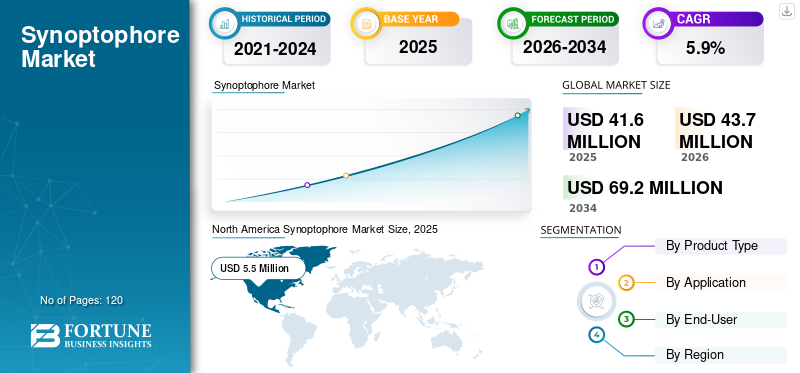
The global synoptophore market size was valued at USD 41.6 million in 2025. The market is projected to grow from USD 43.7 million in 2026 to USD 69.2 million by 2034, exhibiting a CAGR of 5.9% during the forecast period. North America dominated the synoptophore market with a market share of 13.22% in 2025.
A synoptophore is an ophthalmic diagnostic and therapeutic instrument used to assess and manage binocular vision disorders, primarily strabismus, amblyopia, diplopia, fusion abnormalities, and ocular muscle imbalance. The device helps ophthalmologists and orthoptists measure deviation angles, evaluate sensory fusion, detect suppression, and support vision therapy through controlled binocular stimulation. The market growth is attributed to the rising prevalence of pediatric eye disorders, increasing awareness regarding early strabismus diagnosis, and expanding demand for non-invasive ophthalmic assessment tools. In addition, increasing adoption of orthoptic evaluation in eye clinics, hospitals, and vision therapy centers is also expected to have a positive impact on the market growth.
Many key industry players, such as Haag-Streit Group, Nanjing Redsun Optical, Luminopia, Inc., NovaSight Ltd., and Bynocs operating in the market, are focusing on developing various innovative technologies to offer better products with improved accuracy and efficiency.
Download Free sample to learn more about this report.
SYNOPTOPHORE MARKET TRENDS
Shift Toward Digital and Integrated Ophthalmic Diagnostics is One of the Important Market Trends
A key trend in the market is the broader shift toward digital, integrated, and workflow-efficient ophthalmic diagnostics. Although traditional synoptophores remain widely used, eye care facilities are increasingly adopting connected diagnostic platforms, digital documentation, and advanced imaging systems. This trend is influencing demand for instruments that improve examination accuracy, patient workflow, and clinical documentation.
- For instance, in September 2025, Haag-Streit launched Elara 900 and Refractor 900, reinforcing industry movement toward advanced diagnostic systems and streamlined ophthalmic workflows.
MARKET DYNAMICS
MARKET DRIVERS
Download Free sample to learn more about this report.
Rising Incidence of Strabismus and Binocular Vision Disorders to Drive Market Growth
The increasing burden of strabismus, amblyopia, diplopia, and binocular vision anomalies is driving demand for synoptophore devices. Synoptophores remain important in orthoptic practice, as they help evaluate fusion potential, ocular deviation, suppression, and abnormal retinal correspondence. The device is particularly valuable in pediatric ophthalmology, where early diagnosis can improve treatment outcomes and reduce long-term visual impairment. Increasing eye screening programs, growing awareness among parents, and rising referrals to ophthalmology clinics are supporting device adoption.
- According to data published by NCBI in 2026, an estimated 2% to 5% of the global population suffers from strabismus. Also, in the U.S., the prevalence of the disease in children lies between 3% and 4%.
MARKET RESTRAINTS
High Cost and Limited Availability of Trained Orthoptists to Restrain Market Growth
The synoptophore market growth is restrained by the relatively high cost of advanced ophthalmic diagnostic equipment and the limited availability of trained professionals capable of performing orthoptic assessments. Synoptophore testing requires clinical expertise to interpret deviation angles, fusion grades, suppression, and stereopsis results accurately. In smaller clinics and low-resource settings, ophthalmologists may prefer simpler screening tools or prism-based tests due to lower cost and easier handling. Furthermore, limited reimbursement for orthoptic evaluation in certain countries can reduce adoption. These factors may restrict wider use, especially in emerging markets where access to specialized eye care remains uneven.
MARKET OPPORTUNITIES
Expansion of Pediatric Eye Care and Vision Therapy Centers to Offer Substantial Market Opportunities
The expansion of pediatric ophthalmology services, vision therapy centers, and specialty eye clinics presents a strong opportunity for synoptophore manufacturers. Rising awareness regarding early diagnosis of squint, amblyopia, and binocular vision dysfunction is encouraging parents and healthcare providers to seek specialized eye examinations. Synoptophore systems are increasingly used in clinics that provide both diagnostic and therapeutic support, making them valuable for long-term patient management. Emerging markets in Asia Pacific, the Middle East, and Latin America are also investing in ophthalmic infrastructure, creating opportunities for affordable synoptophore systems, accessories, slides, and replacement components.
- For instance, according to the Government of U.K., an estimated 10.7 million patients visited outpatient appointments for vision during the financial year 2025.
MARKET CHALLENGES
Operational Complexity and Patient Cooperation to Offer Considerable Challenge to Market Growth
Synoptophore examinations can be challenging, as they require patient cooperation, especially among young children, elderly patients, and individuals with poor attention span or neurological limitations. Accurate testing depends on the patient’s ability to understand instructions, fixate properly, and respond to visual stimuli. This can affect repeatability and make examination time longer compared with simpler screening methods. In addition, device calibration, slide selection, operator training, and interpretation of sensory and motor fusion results increase operational complexity. These challenges may limit adoption in general eye care practices and favor use mainly in specialized ophthalmology and orthoptic clinics.
Segmentation Analysis
By Product Type
Continuous Demand for Replacement Parts is Projected to Accelerate Accessories & Components Segment Growth
Based on the product type, the market is divided into manual synoptophores, motorized/automated synoptophores, and accessories & components.
The accessories & components segment held the largest synoptophore market share in 2025 due to continuous demand for replacement parts, slides, illumination components, eyepieces, lenses, chin rests, mechanical arms, and calibration accessories. In addition, unlike the main device, accessories require periodic replacement, maintenance, and customization based on clinical use. Orthoptic clinics and ophthalmology centers frequently require different picture slides for simultaneous perception, fusion, stereopsis, suppression testing, and amblyopia therapy. The segment also benefits from installed-base replacement demand, as existing synoptophore units remain in use for several years. This recurring consumption pattern supports higher revenue contribution from accessories and components.
The motorized/automated synoptophores segment is anticipated to rise with a CAGR of 5.9% over the forecast period.
To know how our report can help streamline your business, Speak to Analyst
By Application
Considerable Prevalence of Ocular Deviation Boosted Strabismus Diagnosis Segment Growth
Based on application, the market is segmented into strabismus diagnosis, binocular vision assessment, amblyopia & vision therapy, and others.
In 2025, the strabismus diagnosis segment held 48.6% of the global market. The segment growth is attributed to higher adoption of synoptophores in ocular deviation, fusion potential, suppression, diplopia, and abnormal retinal correspondence in patients with squint. The device enables ophthalmologists and orthoptists to measure horizontal, vertical, and torsional deviations under controlled binocular conditions. Its diagnostic importance is particularly high in pediatric ophthalmology, where early detection of strabismus can help prevent amblyopia and long-term binocular vision impairment. Synoptophore testing also supports pre-surgical assessment and post-surgical follow-up, making it a core diagnostic tool in strabismus management and orthoptic evaluation.
The amblyopia & vision therapy segment is anticipated to rise with a CAGR of 6.3% over the forecast period.
By End-User
Substantial Patient Visits to Ophthalmology Clinics Fueled Segment Growth
Based on end-user, the market is segmented into hospitals, ophthalmology clinics, academic & research institutes, and others.
In 2025, the ophthalmology clinics segment held the highest market share, owing to the high patient volume for squint, amblyopia, diplopia, and binocular vision disorders in outpatient eye care settings. Clinics are often the first point of diagnosis for pediatric and adult ocular alignment problems and require compact, durable, and cost-effective diagnostic instruments. Synoptophores are well suited for ophthalmology clinics, as they support both assessment and therapy within the same setup. In addition, specialized eye clinics and orthoptic centers increasingly use synoptophore systems for regular follow-up, vision therapy, and pre-surgical evaluation, supporting segment dominance. Furthermore, the segment is set to hold a 45.5% share in 2026.
The hospitals segment is projected to grow at a CAGR of 6.0% during the forecast period.
Synoptophore Market Regional Outlook
By geography, the market is categorized into Europe, North America, Asia Pacific, Latin America, and the Middle East & Africa.
North America
North America Synoptophore Market Size, 2025 (USD Million)
To get more information on the regional analysis of this market, Download Free sample
North America held the substantial share in 2024, valued at USD 5.2 million, and also maintained the leading share in 2025, with USD 5.5 million. The regional growth is attributed to strong healthcare infrastructure, a high rate of ocular conditions, and a strong focus on research & development activities.
U.S. Synoptophore Market
Based on North America’s strong contribution and the U.S. dominance within the region, the U.S. market can be analytically approximated at around USD 5.5 million in 2026, accounting for roughly 12.6% of global sales.
Europe
Europe is projected to record a CAGR of 5.3% in the coming years and reach a valuation of USD 9.0 million in 2026. The region is estimated to witness considerable market growth due to technological advancements and a robust emphasis on early disease detection.
U.K. Synoptophore Market
The U.K. market in 2026 is estimated at around USD 1.0 million, representing roughly 2.4% of global revenues.
Germany Synoptophore Market
Germany’s market is projected to reach approximately USD 1.7 million in 2026, equivalent to around 3.9% of global sales.
Asia Pacific
Asia Pacific is estimated to reach USD 22.1 million in 2026 and secure the dominant position in the market. Asia Pacific is expected to register strong growth in the market due to rapidly developing infrastructure, extensive pediatric population, and growing disposable incomes.
Japan Synoptophore Market
The Japan market in 2026 is estimated at around USD 6.2 million, accounting for roughly 14.2% of global revenues.
China Synoptophore Market
China’s market is projected to be one of the largest worldwide, with 2026 revenues estimated at around USD 9.6 million, representing roughly 21.9% of global sales.
India Synoptophore Market
The Indian market in 2026 is estimated at around USD 1.4 million, accounting for roughly 3.3% of global revenues.
Latin America and Middle East & Africa
The Latin America and Middle East & Africa regions are expected to witness moderate growth in this market space during the forecast period. The Latin America market is set to reach a valuation of USD 4.3 million in 2026. In the Middle East & Africa, the GCC is set to reach a value of USD 1.0 million in 2026.
South Africa Synoptophore Market
The South African market is projected to reach around USD 0.4 million in 2026, representing roughly 0.98% of global revenues.
COMPETITIVE LANDSCAPE
Key Industry Players
Strong Focus on Technological Developments Coupled with Product Launches by Key Players to Boost Market Progress
The global synoptophore market holds a semi-consolidated market structure, constituting prominent players such as Haag-Streit Group, Nanjing Redsun Optical, Luminopia, Inc., NovaSight Ltd., and Bynocs. The significant global market share of these companies is attributed to numerous strategic activities, including distribution collaborations and implementation of new programs.
- For instance, in September 2025, Haag-Streit launched Elara 900 and Refractor 900 at ESCRS 2025, strengthening its ophthalmic diagnostic portfolio and supporting advanced eye examination workflows.
Other notable players in the global market are OCULUS Optikgeräte GmbH, Caterna Vision GmbH, Shanghai 66 Vision Tech Co., Ltd., and Inami & Co., Ltd. These companies are expected to prioritize collaborations to increase their global market share during the forecast period.
LIST OF KEY SYNOPTOPHORE COMPANIES PROFILED
- Haag-Streit Group (Switzerland)
- Nanjing Redsun Optical (Germany)
- Luminopia, Inc. (U.S.)
- NovaSight Ltd. (Israel)
- Bynocs (India)
- OCULUS Optikgeräte GmbH (Germany)
- Caterna Vision GmbH (Germany)
- Shanghai 66 Vision Tech Co., Ltd. (China)
- Inami & Co., Ltd. (Japan)
- Takagi Seiko Co., Ltd. (Japan)
KEY INDUSTRY DEVELOPMENTS
- July 2025: Topcon Healthcare partnered with OKKO Health to advance home-based vision monitoring, supporting digital visual function assessment and patient engagement.
- March 2025: Haag-Streit collaborated with BioMedix at APAO 2025 in India, showcasing diagnostic, imaging, simulation, and surgical ophthalmic technologies.
- March 2025: RadiusXR, Glaukos, and Topcon Healthcare launched Inspire, a next-generation visual field solution designed to expand digital vision testing access.
- May 2024: Reichert launched the Tono-Vera tonometer in the U.S., expanding its diagnostic ophthalmic instrument portfolio for clinical eye care settings.
- November 2023: AMETEK Reichert partnered with SBM Sistemi to distribute ocular surface and dry eye assessment technologies in the U.S.
REPORT COVERAGE
The global synoptophore market analysis includes a comprehensive study of the market size & forecast by all the market segments included in the report. It includes details on the market dynamics and market trends expected to drive the market over the forecast period. It provides information on key aspects, including an overview of technological advancements, the regulatory environment, and product launches. Additionally, it details partnerships, mergers & acquisitions, as well as key industry developments and investments by key regions. The global market research report also provides a detailed competitive landscape with information on the market share and profiles of key operating players.
Request for Customization to gain extensive market insights.
Report Scope & Segmentation
| ATTRIBUTE | DETAILS |
| Study Period | 2021-2034 |
| Base Year | 2025 |
| Estimated Year | 2026 |
| Forecast Period | 2026-2034 |
| Historical Period | 2021-2024 |
| Growth Rate | CAGR of 5.9% from 2026 to 2034 |
| Unit | Value (USD Million) |
| Segmentation | By Product Type, Application, End-User, and Region |
| By Product Type |
|
| By Application |
|
| By End-User |
|
| By Region |
|
Frequently Asked Questions
According to Fortune Business Insights, the global market value stood at USD 41.6 million in 2025 and is projected to reach USD 69.2 million by 2034.
In 2025, the market value in North America stood at USD 5.5 million.
The market is expected to exhibit a CAGR of 5.9% during the forecast period of 2026-2034.
By product type, the accessories and component segment led the market.
The rising incidence of strabismus and binocular vision disorders is driving market expansion.
Haag-Streit Group, Nanjing Redsun Optical, Luminopia, Inc., NovaSight Ltd., and Bynocs are the major players in the global market.
North America dominated the market in 2025.



- 2021-2034
- 2025
- 2021-2024
- 120
Get 30-60 hrs Free Customization
Expand Regional and Country Coverage, Segments Analysis, Company Profiles, Competitive Benchmarking, and End-user Insights.













.webp)






Related Reports
-
US +1 833 909 2966 ( Toll Free )
-
Get In Touch With Us