Automotive Electronic Brake Force Distribution System Market Size, Share & Industry Analysis, By Component (Electronic Control Unit (ECU), Wheel Speed Sensors, Brake Modulator, and Others), By Vehicle Type (Hatchback & Sedan, SUV, LCV, and HCV), By Propulsion Type (ICE and EV), By Technology (Standalone EBD System, Integrated ABS-EBD System, EBD with Electronic Stability Control, and Others), By Brake Type (Disc Brakes and Drum Brakes), and Regional Forecast, 2026–2034
 Download Free Sample
(Offer valid till 15th Aug 2026)
Automotive Electronic Brake Force Distribution System Market Size and Future Outlook
 Listen to Audio Version
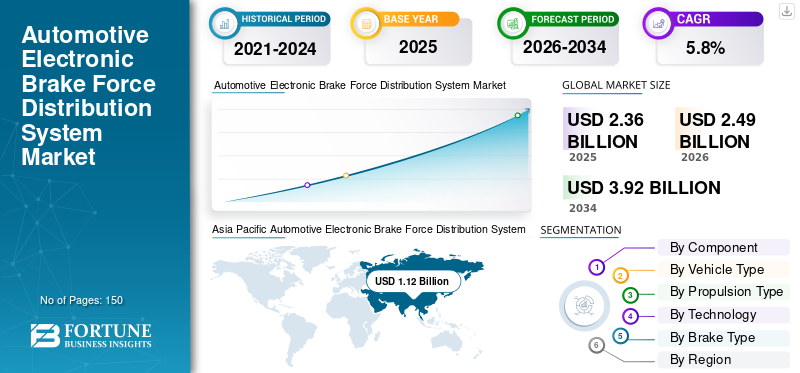
The global automotive electronic brake force distribution system market size was valued at USD 2.36 billion in 2025. The market is projected to grow from USD 2.49 billion in 2026 to USD 3.92 billion by 2034, exhibiting a CAGR of 5.8% during the forecast period. Asia Pacific dominated the global market with a market share of 47.46% in 2025.
The automotive Electronic Brake Force Distribution (EBD) system refers to the industry focused on electronic braking technologies that automatically distribute brake force among vehicle wheels based on load, speed, road condition, and braking intensity. EBD enhances vehicle stability, reduces stopping distance, and prevents wheel lock-up. The market includes electronic control units, wheel speed sensors, brake modulators, and integrated ABS-EBD systems used across passenger and commercial vehicles.
Major players in the market include Bosch, Continental AG, ZF Friedrichshafen AG, Denso Corporation, Hyundai Mobis, and HL Mando Corporation, competing through advanced braking control algorithms, ABS-EBD integration, electronic stability enhancement, sensor accuracy, and safety-focused vehicle braking solutions.
Key drivers of the global market include rising demand for advanced automotive safety systems, increasing adoption of ABS-integrated braking technologies, and stricter road safety regulations. Growing vehicle production, higher consumer preference for stability and shorter braking distance, and expansion of electronic control systems in passenger and commercial vehicles further support market growth.
Download Free sample to learn more about this report.
AUTOMOTIVE ELECTRONIC BRAKE FORCE DISTRIBUTION SYSTEM MARKET TRENDS
Integration of EBD with ABS, ESC, and ADAS to Shape Market Trend
A major trend in the market is the integration of EBD with broader vehicle safety and control systems. Instead of operating as a standalone braking feature, EBD is increasingly combined with anti-lock braking systems, electronic stability control, traction control, hill-start assist, and advanced driver assistance systems. This integrated approach improves vehicle control during cornering, sudden braking, slippery road conditions, and uneven load distribution. Automakers are focusing on centralized electronic architectures where braking data is shared with multiple vehicle systems in real time. The trend supports better safety performance, software-based calibration, predictive braking response, and enhanced driving comfort. This shift is making EBD an important part of modern active safety platforms.
MARKET DYNAMICS
MARKET DRIVERS
Download Free sample to learn more about this report.
Rising Adoption of Advanced Vehicle Safety Systems to Drive EBD Demand
The growing emphasis on vehicle safety is a key driver for the automotive electronic brake force distribution system market growth. EBD improves braking efficiency by automatically adjusting brake force between front and rear wheels based on load, speed, and road conditions. As consumers increasingly prefer vehicles equipped with advanced safety features, automakers are integrating EBD with anti-lock braking systems and electronic stability control as standard or value-added features. Rising road accident concerns, stricter safety regulations, and growing awareness of active safety technologies are further accelerating adoption. Passenger cars, SUVs, light commercial vehicles, and heavy-duty vehicles are increasingly using EBD to improve braking balance, reduce stopping distance, and enhance vehicle stability during emergency braking situations.
MARKET RESTRAINTS
High System Integration and Maintenance Cost to Restrain Market Growth
The higher cost associated with automotive electronic components can restrain the growth of the market, especially in price-sensitive vehicle segments. EBD requires electronic control units, wheel speed sensors, brake modulators, wiring, software calibration, and integration with ABS or stability control systems. These components increase vehicle manufacturing costs compared with conventional braking systems. In developing markets, entry-level vehicle buyers often prioritize affordability over advanced safety technologies, limiting faster adoption. Maintenance and repair costs may also be higher due to the need for skilled technicians and diagnostic equipment. Component failure in sensors or brake control modules can affect braking performance, making reliability and service accessibility important concerns for automakers and fleet operators.
MARKET OPPORTUNITIES
Expansion of Electric and Connected Vehicles to Create Growth Opportunity
The rapid expansion of electric and connected vehicles presents a strong opportunity for the market. Electric vehicles require precise braking control due to battery weight distribution, regenerative braking, and instant torque delivery. EBD helps balance braking force between axles and improves coordination between friction braking and regenerative braking systems. As automakers develop software-defined vehicles, EBD can be integrated with advanced driver assistance systems, vehicle stability control, and connected diagnostics. This creates opportunities for suppliers offering intelligent braking software, compact electronic control units, and sensor-based braking solutions. Growing investment in EV platforms, autonomous mobility, and smart safety systems will support wider EBD adoption across premium, mass-market, and commercial electric vehicles.
MARKET CHALLENGES
Sensor Reliability and Calibration Complexity to Challenge Market Expansion
Ensuring consistent sensor reliability and accurate system calibration remains a key challenge for the market. EBD depends on real-time data from wheel speed sensors, brake pressure sensors, vehicle load inputs, and electronic control units. Any sensor malfunction, software error, or incorrect calibration can affect brake force distribution and vehicle stability. The challenge becomes greater across different vehicle types, road conditions, payload levels, and regional driving environments. Automakers must conduct extensive testing to ensure EBD performs safely in wet, icy, uneven, or high-speed braking conditions. Suppliers also need to meet strict quality standards while keeping system costs competitive. This increases development complexity and lengthens validation cycles for new braking platforms.
Segmentation Analysis
By Component
Advanced Brake Pressure Control and Safety Integration Propels Brake Modulator Segmental Dominance
Based on component, the market is categorized into electronic control unit (ECU), wheel speed sensors, brake modulator, and others.
The brake modulator segment dominates the automotive electronic brake force distribution system market share due to its critical role in regulating hydraulic brake pressure across wheels during different load and road conditions. It enables accurate brake force distribution, prevents wheel lock-up, and supports smooth coordination with ABS and stability control systems. Growing adoption of advanced braking technologies in passenger cars, SUVs, and commercial vehicles strengthens demand for efficient modulators. Automakers prioritize reliable brake modulation to improve vehicle stability, reduce stopping distance, and meet safety expectations, sustaining the segment’s leading position.
The Electronic Control Unit (ECU) segment is projected to expand at a CAGR of 6.2% over the forecast period. Rising integration of software-driven braking logic, ABS-EBD coordination, and advanced vehicle safety platforms is increasing ECU demand across modern ICE and electric vehicles.
By Vehicle Type
Rising SUV Penetration and Safety Feature Adoption Boosts SUV Segmental Dominance
Based on vehicle type, the market is categorized into hatchback & sedan, SUV, LCV, and HCV.
The SUV segment dominates the market due to rising global demand for utility vehicles, higher vehicle weight, and strong adoption of advanced braking and stability systems. SUVs require efficient brake force management to maintain stability during sudden braking, cornering, and varying load conditions. Their growing penetration across urban, family, premium, and off-road vehicle categories encourages automakers to integrate ABS-EBD and electronic stability technologies as standard features, sustaining the segment’s leading market share.
The hatchback & sedan segment is projected to expand at a CAGR of 6.0% over the forecast period. High production volumes, affordability, and widespread use in personal mobility and ride-hailing fleets support steady EBD adoption across this segment.
To know how our report can help streamline your business, Speak to Analyst
By Propulsion Type
Established Vehicle Production Base and Mandatory Safety Integration Bolsters ICE Segmental Dominance
Based on propulsion type, the market is categorized into ICE and EV.
The ICE segment dominates the market and the growth is driven by the large global production and operating base of petrol and diesel vehicles. ICE vehicles across hatchbacks, sedans, SUVs, LCVs, and HCVs widely use ABS-integrated EBD systems to improve braking balance, reduce wheel lock-up risk, and enhance vehicle stability. Mature supply chains, regulatory safety requirements, and widespread adoption of electronic braking technologies in conventional vehicles continue to support strong demand. High replacement volumes and broad aftermarket servicing further reinforce the segment’s leading position.
The EV segment is projected to expand at a CAGR of 7.8% over the forecast period. Rising electric vehicle adoption, battery-weight distribution needs, and regenerative braking integration are increasing demand for precise electronic brake force control systems.
By Technology
Seamless ABS Integration and Enhanced Braking Stability Supports Integrated ABS-EBD System Segmental Dominance
Based on technology, the market is categorized into standalone EBD system, integrated ABS-EBD system, EBD with electronic stability control, and others.
The integrated ABS-EBD system segment dominates the market and is supported by its ability to combine anti-lock braking and brake force distribution in one coordinated safety platform. This integration helps prevent wheel lock-up while adjusting brake pressure between front and rear wheels based on vehicle load, speed, and road conditions. Automakers widely prefer ABS-EBD systems for passenger cars, SUVs, and commercial vehicles as they improve braking stability, reduce stopping distance, and support compliance with active safety expectations. Mature advanced braking technology availability and cost-effective integration further strengthen the segment’s leading position.
The EBD with electronic stability control segment is projected to expand at a CAGR of 6.5% over the forecast period. Increasing adoption of stability control systems, premium vehicle safety packages, and software-driven braking platforms is supporting demand for advanced EBD-ESC integration.
By Brake Type
Superior Heat Dissipation and Braking Performance Drives Disc Brakes Segmental Dominance
Based on brake type, the market is categorized into disc brakes and drum brakes.
The disc brakes segment dominates the market due to their strong braking efficiency, faster response, and superior heat dissipation compared with drum brakes. Disc brakes are widely used in passenger cars, SUVs, premium vehicles, and front-wheel braking applications, where precise brake pressure control is essential. Their compatibility with ABS-EBD, electronic stability control, and advanced safety systems strengthens adoption. Growing consumer preference for safer, smoother, and more responsive braking performance further supports the segment’s leading position.
The drum brakes segment is projected to expand at a CAGR of 5.5% over the forecast period. Cost-effectiveness, durability, and continued use in entry-level vehicles, rear-wheel applications, and commercial vehicles support steady demand for EBD-compatible drum braking systems.
Automotive Electronic Brake Force Distribution System Market Regional Outlook
By geography, the market is categorized into Europe, North America, Asia Pacific, Latin America, and the Middle East & Africa.
Asia Pacific
Asia Pacific Automotive Electronic Brake Force Distribution System Market Size, 2025 (USD Billion)
To get more information on the regional analysis of this market, Download Free sample
Asia Pacific dominates the market due to high vehicle production, expanding passenger car sales, and strong demand for affordable safety technologies. China, India, Japan, and South Korea support large-scale adoption through growing SUV penetration, rising road safety awareness, and increasing integration of ABS-EBD systems in mass-market vehicles. Rapid urbanization, expanding middle-class ownership, and strong OEM manufacturing bases further strengthen regional demand. Electric vehicle growth also encourages advanced electronic braking integration across new platforms.
China Automotive Electronic Brake Force Distribution System Market
The market is estimated at around USD 0.70 billion in 2026, supported by high vehicle production, expanding EV sales, stricter safety standards, and rising integration of ABS-EBD systems in mass-market vehicles.
Japan Automotive Electronic Brake Force Distribution System Market
The market is estimated at around USD 0.15 billion in 2026, driven by advanced automotive engineering, strong hybrid vehicle penetration, and growing demand for compact, reliable, and electronically controlled braking systems.
North America
North America holds the second-largest market share and is projected to grow at a CAGR of 5.3% over the forecast period. The region benefits from high adoption of advanced vehicle safety systems, strong SUV and pickup truck sales, and mature automotive technology integration. Automakers increasingly equip vehicles with ABS-EBD, stability control, and driver assistance systems to enhance braking performance. The U.S. remains the major contributor, supported by safety-focused regulations, premium vehicle demand, and replacement demand from a large vehicle parc.
U.S. Automotive Electronic Brake Force Distribution System Market
The U.S. market is estimated at around USD 0.43 billion in 2026, driven by large SUV and pickup sales, advanced safety feature adoption, and strong OEM focus on electronic braking technologies.
Europe
Europe represents the third-largest market supported by strict vehicle safety standards, strong premium vehicle production, and high penetration of electronic braking technologies. Germany, France, the U.K., Italy, and Spain contribute significantly due to established automotive manufacturing and consumer preference for safety-equipped vehicles. The region’s focus on advanced driver assistance systems, electric mobility, and vehicle stability control supports steady EBD adoption.
U.K. Automotive Electronic Brake Force Distribution System Market
The U.K. market is estimated at around USD 0.07 billion in 2026, driven by strict vehicle safety standards, rising premium car adoption, and growing integration of ABS-EBD systems across passenger vehicles.
Germany Automotive Electronic Brake Force Distribution System Market
The market is estimated at around USD 0.12 billion in 2026, supported by strong automotive manufacturing, high safety technology penetration, premium vehicle production, and increasing adoption of integrated braking control systems.
Middle East & Africa
The Middle East & Africa market is expanding steadily due to rising vehicle ownership, infrastructure development, and growing demand for SUVs and commercial vehicles. Harsh driving conditions, high temperatures, desert terrain, and long-distance travel increase the need for reliable braking performance and vehicle stability. UAE and Saudi Arabia lead adoption through premium vehicle sales and safety feature penetration. In Africa, gradual fleet modernization and increasing passenger vehicle imports support long-term EBD system demand.
UAE Automotive Electronic Brake Force Distribution System Market
The UAE market is estimated at around USD 0.06 billion in 2026, supported by premium vehicle demand, SUV preference, harsh driving conditions, and rising adoption of advanced vehicle safety technologies.
Latin America
Latin America shows moderate growth in the market, supported by rising passenger vehicle demand, improving safety awareness, and expanding adoption of ABS-integrated braking systems. Brazil and Mexico remain key markets due to established automotive manufacturing, export-oriented production, and growing SUV sales. Cost sensitivity limits rapid adoption in entry-level vehicles, but regulatory improvements and consumer preference for safer vehicles are encouraging wider EBD integration. Aftermarket servicing and fleet renewal also support gradual regional expansion.
Brazil Automotive Electronic Brake Force Distribution System Market
Brazil’s Market is estimated at around USD 0.05 billion in 2026, driven by domestic vehicle production, improving safety regulations, growing passenger vehicle demand, and wider use of ABS-integrated braking systems.
COMPETITIVE LANDSCAPE
Key Industry Players
Advanced Safety Integration and OEM Partnerships to Strengthen Competitive Positioning
The automotive electronic brake force distribution system market is moderately consolidated, with leading players competing through advanced braking technologies, electronic control integration, sensor accuracy, and partnerships with global vehicle manufacturers. Major companies such as Bosch, Continental AG, ZF Friedrichshafen AG, Denso Corporation, Hyundai Mobis, and Mando Corporation focus on developing integrated ABS-EBD, ESC-compatible braking modules, and software-driven control systems. Their strong OEM relationships, global production networks, and continuous investment in vehicle safety technologies help them maintain competitive advantages across passenger cars, SUVs, and commercial vehicles.
Competition is increasingly shaped by the shift toward electric, connected, and software-defined vehicles. Suppliers are focusing on compact electronic control units, reliable brake modulators, advanced wheel speed sensors, and intelligent braking algorithms that improve stopping performance and vehicle stability. Companies are also strengthening their product portfolios through R&D, localization, and collaboration with automakers to meet regional safety standards and cost requirements. As automakers prioritize active safety integration, players offering scalable, cost-efficient, and EV-ready braking solutions are expected to gain stronger market positioning.
LIST OF KEY AUTOMOTIVE ELECTRONIC BRAKE FORCE DISTRIBUTION SYSTEM COMPANIES PROFILED IN REPORT
- Robert Bosch GmbH (Germany)
- Continental AG (Germany)
- ZF Friedrichshafen AG (Germany)
- Hitachi Astemo, Ltd. (Japan)
- ADVICS Co., Ltd. (Japan)
- HL Mando Corporation (South Korea)
- Hyundai Mobis Co., Ltd. (South Korea)
- Brembo S.p.A. (Italy)
- Akebono Brake Industry Co., Ltd. (Japan)
- Knorr-Bremse AG (Germany)
- Haldex AB (Sweden)
- Aisin Corporation (Japan)
- Denso Corporation (Japan)
- Nissin Kogyo Co., Ltd. (Japan)
- WABCO/ZF Commercial Vehicle Solutions (Germany)
KEY INDUSTRY DEVELOPMENTS
- March 2026: Hyundai Mobis showcased its next-generation integrated braking system at its Swedish winter testing facility for global automakers, highlighting improved braking stability, cold-weather validation, and advanced safety performance for future electronic brake control platforms.
- November 2025: Hyundai Mobis unveiled 50 new mobility technologies at Tech Bridge 2025, strengthening its electrification and module businesses and supporting future integration of braking, steering, safety, and vehicle control technologies.
- October 2025: Akebono announced brake technology exhibits for Japan Mobility Show 2025, including high-performance braking innovations and future mobility displays, reinforcing its focus on advanced braking components for evolving vehicle safety platforms.
- September 2025: Solaris secured its first automotive electronic brake force distribution system order for Gdańsk, Poland, covering 30 zero-emission buses, including 12-meter and articulated Urbino 18 models, expected to be operational by September 2026.
- July 2025: ZF unveiled a full-spectrum brake-by-wire portfolio for electrified and autonomous vehicles, with its Integrated Brake Control unit managing braking, ESC, and driving dynamics as a compact universal electronic control platform.
- May 2025: Akebono Brake Corporation expanded its ProACT, EURO, and Severe Duty product lines, increasing coverage for over 7 million vehicles and strengthening its braking aftermarket presence across passenger and commercial applications.
- November 2024: ZF Commercial Vehicle Solutions India opened an Electronic Stability Control test track in Chennai, complementing its ABS test facility and enabling advanced braking, stability, agility, and handling validation for vehicle safety systems.
REPORT COVERAGE
The global automotive electronic brake force distribution system market analysis provides an in-depth study of market size and forecast by all the market segments included in the report. It includes details on the market dynamics and market trends expected to drive the market during the forecast period. It offers information on the technological advancements, new product launches, key industry developments, and details on partnerships, mergers & acquisitions. The report also encompasses a detailed competitive landscape, including market share and profiles of key operating players.
Request for Customization to gain extensive market insights.
Report Scope & Segmentation
| ATTRIBUTE | DETAILS |
| Study Period | 2021-2034 |
| Base Year | 2025 |
| Estimated Year | 2026 |
| Forecast Period | 2026-2034 |
| Historical Period | 2021-2024 |
| Growth Rate | CAGR of 5.8% from 2026-2034 |
| Unit | Value (USD Billion) |
| Segmentation | By Component, By Vehicle Type, By Propulsion Type, By Technology, By Brake Type, and By Region |
| By Component |
|
| By Vehicle Type |
|
| By Propulsion Type |
|
| By Technology |
|
| By Brake Type |
|
| By Region |
|
Frequently Asked Questions
Fortune Business Insights says that the global market value stood at USD 2.36 billion in 2025 and is projected to reach USD 3.92 billion by 2034.
In 2025, the Asia Pacific’s market value stood at USD 1.12 billion.
The market is expected to exhibit a CAGR of 5.8% during the forecast period.
The ICE segment leads the market by propulsion type.
Rising adoption of advanced vehicle safety systems to drive the market.
Asia Pacific held the largest market share in 2025.



- 2021-2034
- 2025
- 2021-2024
- 150
-
(Offer valid till 15th Aug 2026)
Get 30-60 hrs Free Customization
Expand Regional and Country Coverage, Segments Analysis, Company Profiles, Competitive Benchmarking, and End-user Insights.




















Related Reports
-
US +1 833 909 2966 ( Toll Free )
-
Get In Touch With Us