Automotive Refinish Coatings Market Size, Share & Industry Analysis, By Product Type (Primer, Basecoat, Clearcoat, Specialty Coatings, and Others), By Resin/Chemistry (Polyurethane, Acrylic, Alkyd, and Others), By Technology (Water-Borne, Solvent-Borne, and Others), By Vehicle Type (Passenger Vehicles, Commercial Vehicles, and Others), and Regional Forecast, 2026-2034
 Download Free Sample
 Automotive Refinish Coatings Market Size and Future Outlook
 Listen to Audio Version
The automotive refinish coatings market size was valued at USD 11.20 billion in 2025. The market is projected to grow from USD 12.14 billion in 2026 to USD 16.45 billion by 2034, at a 3.9% CAGR during the forecast period. Asia Pacific dominated the global market with a market share of 34.73% in 2025.
Automotive refinish coatings refer to coating systems used for repairing, repainting, and restoring the exterior finish of vehicles after collision damage, surface wear, scratches, dents, fading, or cosmetic deterioration. These coatings include primers, basecoats, clearcoats, fillers, sealers, hardeners, and specialty coatings applied by body shops, dealership repair centers, fleet workshops, and aftermarket repair facilities. The materials are valued for color matching, gloss retention, adhesion, corrosion protection, UV resistance, durability, and the ability to restore vehicles to an OEM-like finish.
The market growth is driven by a large vehicle population, high collision repair frequency, and a well-established aftermarket ecosystem. Body shops and repair centers across the country rely on advanced refinish coatings to meet quality, durability, and color-matching standards.
Furthermore, the market comprises several major players, including Axalta Coating Systems LLC., PPG Industries, Inc., BASF SE, and The Sherwin-Williams Company.
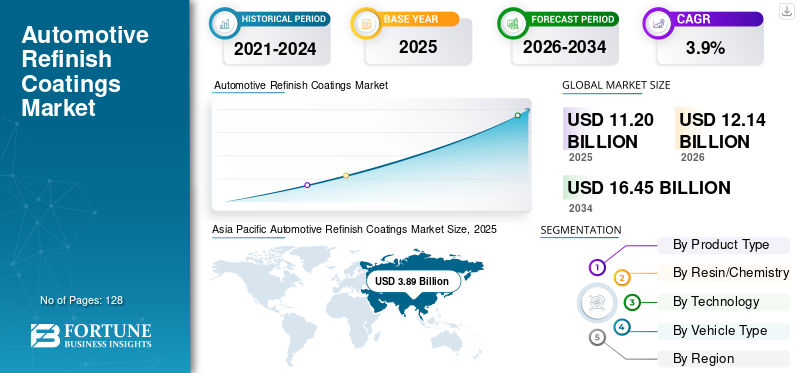
Download Free sample to learn more about this report.
Automotive Refinish Coatings Market Key Takeaways
 Global Market Size & Forecast
- 2025 Market Size: USD 11.20 billion
- 2026 Market Size: USD 12.14 billion
- 2034 Forecast Market Size: USD 16.45 billion
- CAGR: 3.9% from 2026-2034
 Market Share
- Asia Pacific dominated the automotive refinish coatings market with a 34.73% share in 2025.
- The basecoat segment accounted for the largest market share of 38.3% in 2025.
- The polyurethane segment held the largest market share of 59.9% in 2025.
 Key Regional Highlights
North America
North America reached USD 3.03 billion in 2025.
Asia Pacific
Asia Pacific was valued at USD 3.89 billion in 2025 and is projected to reach USD 4.20 billion in 2026.
Europe
Europe reached a market value of USD 2.69 billion in 2025.
U.S.
The U.S. market is estimated to reach USD 2.74 billion in 2026.
Japan
Japan is projected to reach USD 0.69 billion in 2026.
Read More

AUTOMOTIVE REFINISH COATINGS MARKET TRENDS
Growing Demand for Specialty Finishes, Customization, and Advanced Color-Matching Solutions is Significant Market Trends
Growing demand for specialty finishes, vehicle customization, and advanced color-matching solutions is creating significant value opportunities for the market. Vehicle owners are increasingly focusing on exterior appearance, personalization, and premium aesthetics, which is expanding demand beyond basic repair coatings. Specialty finishes such as metallic, pearlescent, matte, satin, tinted clearcoat, tri-coat, high-gloss, and special-effect coatings require more advanced refinish systems, skilled application, and higher-value coating materials. This creates opportunities for coating manufacturers to offer differentiated products with better margins compared to standard refinish systems.
Customization is also gaining traction among individual vehicle owners, used-car dealers, premium workshops, motorsport users, and fleet operators seeking unique branding or improved resale appeal. Partial repainting, color refreshment, bumper refinishing, panel blending, and decorative refinishing are increasingly being adopted to improve vehicle appearance without full replacement. This supports demand for specialized basecoats, clearcoats, toners, additives, and effect pigments.
MARKET DYNAMICS
MARKET DRIVERS
Download Free sample to learn more about this report.
Rising Vehicle Repair and Collision Frequency is Driving Market Growth
A major driver for automotive refinish coatings market growth is continuous rise in vehicle repair and collision incidents worldwide. Growth in the global vehicle population has increased exposure to road accidents, minor damages, and wear-related repairs, directly boosting demand for refinish coatings. Aging vehicles require periodic repainting to maintain appearance and corrosion resistance, supporting aftermarket activity. Insurance-backed repair claims further ensure steady coating consumption through authorized body shops. Additionally, even low-impact collisions often require refinishing for aesthetic restoration. Urban traffic congestion and higher vehicle utilization intensify repair frequency. As repair standards improve, body shops increasingly adopt high-performance coatings, strengthening market growth fundamentals.
MARKET RESTRAINTS
Stringent Environmental and Regulatory Compliance Requirements Can Restrict Market Expansion
Strict environmental regulations act as a key restraint for the market, particularly regarding emissions and hazardous substance usage. Regulatory bodies impose limitations on volatile organic compound levels, increasing formulation complexity and compliance costs for manufacturers. Smaller body shops face challenges aligned with adapting to compliant coating systems due to equipment upgrade requirements and training needs. Additionally, regulatory pressure can slow adoption in cost-sensitive regions. Compliance testing, certification processes, and reformulation timelines also add operational constraints. These regulatory barriers can limit short-term market flexibility despite long-term sustainability benefits.
MARKET OPPORTUNITIES
Shift Toward Advanced and Sustainable Coating Technologies is Creating Lucrative Growth Opportunities
The growing shift toward environmentally responsible and high-efficiency coatings presents significant opportunities for the market. Water-borne and low-emission technologies are gaining acceptance as repair facilities modernize operations. Manufacturers investing in faster curing, improved durability, and superior color accuracy are gaining competitive advantages. Training programs, digital color-matching tools, and premium coating systems further expand value-added offerings. Sustainability-driven innovation allows suppliers to align with regulations while meeting performance expectations, unlocking new growth avenues.
MARKET CHALLENGES
High Cost Sensitivity Among Repair Facilities Can Hamper Market Growth
Cost pressure remains a major challenge for the market, particularly for small and mid-sized body shops. Premium coatings and compliant systems often involve higher upfront material and equipment costs. Fluctuating raw material prices further affect supplier margins and pricing stability. Repair facilities balancing quality expectations with cost constraints may delay upgrades. Managing affordability while maintaining performance standards continues to be a critical challenge shaping competitive strategies.
Segmentation Analysis
By Product Type
Basecoats Segment Dominated as it Offers Exterior Aesthetics and Desired Color to Automobiles
Based on product type, the market is segmented into primer, basecoat, clearcoat, specialty coatings, and others.
The basecoat segment accounted for the largest automotive refinish coatings market share in 2025. The segment's growth is driven by the critical role of basecoats in restoring vehicle color, shade, metallic effect, and overall visual appearance after collision repair or repainting. Basecoats are widely used across passenger cars, commercial vehicles, dealership repair centers, and independent body shops, as they form the main color layer in refinish systems. Furthermore, the segment held a 38.3% share in 2025.
The clearcoat segment is expected to grow significantly, driven by its essential role in providing gloss, UV protection, chemical resistance, weather durability, and long-term finish protection to repaired vehicle surfaces. The segment is projected to grow at around a 3.7% CAGR during the
By Resin/Chemistry
Acrylic Resin Segment to Dominate Due to Increasing Demand from Automotive
By resin/chemistry, the market is categorized into polyurethane, acrylic, alkyd, and others.
The polyurethane segment accounted for the largest share in 2025. The segment's growth is driven by its strong use in clearcoats, topcoats, and high-performance refinish systems where durability, gloss retention, chemical resistance, weatherability, and abrasion resistance are significant. Polyurethane-based coatings are widely preferred in professional collision repair as they help deliver OEM-like finish quality and long-lasting exterior protection. Furthermore, the segment held a 59.9% share in 2025.
The acrylic segment is also expected to grow favorably over the projected period. The segment's demand is driven by its use in basecoats, primers, topcoats, and repair coatings where color clarity, ease of application, quick drying, and surface appearance are key requirements. Acrylic resins are valued for their balance between performance, processability, and cost efficiency, making them suitable for both professional and general refinish applications. The segment is expected to grow at around a 3.8% CAGR over the forecast period.
By Technology
Solvent-borne Technology Dominates Due to its Ease of Application and Wide Product Availability
By technology, the market is categorized into water-borne, solvent-borne, and others.
The solvent-borne segment accounted for the largest share in 2025. The segment's growth is driven by its strong use across regions where solvent-borne systems remain preferred for ease of application, wide product availability, faster handling, and compatibility with established body-shop practices. These coatings are widely used in basecoats, primers, and clearcoats, particularly in markets with less stringent VOC regulations or where repairers prioritize familiar application methods. Furthermore, the segment held a share of 52.7% in 2025.
The water-borne segment is also expected to grow favorably over the projected period. The segment is gaining traction due to stricter environmental regulations, lower VOC emissions, and increasing adoption by organized body shops and dealership repair networks. The segment is expected to grow at around a 4.2% CAGR over the forecast period.
By Vehicle Type
Passenger Cars Leads Due to Large Global Passenger Car parc
By vehicle type, the market is categorized into passenger vehicles, commercial vehicles, and others.
The passenger vehicles segment accounted for the largest share in 2025. The segment's growth is driven by the large global passenger car parc, high frequency of private vehicle ownership, rising used-car transactions, and recurring collision and cosmetic repair activity. Passenger cars are more exposed to daily commuting, parking damage, minor dents, scratches, bumper scuffs, and weather-related paint deterioration, which creates steady demand for refinish coatings. Furthermore, the segment held a 73.3% share in 2025.
The commercial vehicles segment is expected to grow significantly over the projected period. The segment's growth is driven by repair and repainting needs across light commercial vehicles, trucks, vans, buses, logistics fleets, service vehicles, and other business-use vehicles. The segment is expected to grow at around a 3.5% CAGR over the forecast period.
Automotive Refinish Coatings Market Regional Outlook
By geography, the market is categorized into North America, Europe, Asia Pacific, South America, Australia, Middle East, and Africa.
Asia Pacific
Asia Pacific Automotive Refinish Coatings Market Size, 2025 (USD Billion)
To get more information on the regional analysis of this market, Download Free sample
Asia Pacific held the dominant share in 2025, valued at approximately USD 3.89 billion, and is expected to maintain its leading share in 2026, valued at around USD 4.20 billion. The region’s dominance is mainly supported by its large vehicle parc, expanding middle-class vehicle ownership, rising road traffic, and strong aftermarket repair activity across China, India, Japan, South Korea, and Southeast Asia. Growing used-car transactions, increasing vehicle retention, and rapid expansion of independent garages and organized repair networks are also strengthening refinish coating demand.
China Automotive Refinish Coatings Market
In 2026, the China market is estimated to reach USD 2.31 billion. China's market growth is supported by rising premium vehicle ownership, used-car refurbishment, EV repair complexity, and increasing adoption of digital color-matching systems in urban body shops. Hence, China remains the anchor market for regional refinish coating consumption.
To know how our report can help streamline your business, Speak to Analyst
India Automotive Refinish Coatings Market
The India market in 2026 is estimated at around USD 0.24 billion, representing approximately 2.0% of global market revenue.
Japan Automotive Refinish Coatings Market
Japan market is projected to reach approximately USD 0.69 billion in 2026, accounting for about 5.6% of global sales.
Australia
Australia accounted for a significant share of the market in 2025. Although smaller in scale, the region represents a stable and relatively mature refinish market, supported by high vehicle ownership, insurance-based collision repair, and strong body-shop standards. Demand is concentrated in passenger vehicles, light commercial vehicles, and fleet maintenance applications. Harsh sunlight, coastal exposure, dust, and long-distance driving also support repainting, clearcoat repair, and exterior restoration needs.
North America
North America is also a significant contributor and reached USD 3.03 billion in 2025. The market's growth is driven by a large and aging vehicle parc, high vehicle miles traveled, insurance-led collision repair activity, and strong penetration of organized body-shop chains. The U.S. remains the key demand contributor, driven by frequent repair claims, high vehicle ownership, used-vehicle refurbishment, and consumer preference for maintaining exterior appearance and resale value.
U.S. Automotive Refinish Coatings Market
In 2026, the U.S. market is estimated to reach USD 2.74 billion. The country’s leadership is supported by its large vehicle parc, high miles driven, strong insurance-led collision repair ecosystem, and well-developed network of independent body shops, dealership repair centers, and multi-shop operators.
Europe
Europe is expected to experience steady growth in the coming years. During the forecast period, the European region is projected to grow at approximately 3.1%, and it reached a valuation of USD 2.69 billion in 2025. The region has a mature vehicle repair ecosystem, supported by strict quality expectations, high insurance penetration, established body-shop networks, and a strong regulatory focus on low-VOC coating technologies.
U.K. Automotive Refinish Coatings Market
The U.K. market in 2026 is estimated at around USD 0.35 billion, representing approximately 2.9% of global market revenue.
Germany Automotive Refinish Coatings Market
Germany’s market is projected to reach approximately USD 0.55 billion in 2026, accounting for about 4.5% of global sales.
South America
South America is experiencing steady growth. The South America market in 2025 was at USD 0.62 billion in valuation. The region’s demand is mainly supported by Brazil, Argentina, Chile, and Colombia, where vehicle ownership, used-car repair, and informal-to-organized body-shop transition are creating steady refinish coating consumption. A large share of vehicles in operation is older, which supports repainting, panel repair, and cosmetic restoration demand.
Brazil Automotive Refinish Coatings Market
Brazil’s market will reach approximately USD 0.44 billion in 2026, equivalent to around 3.7 % of global sales.
Middle East
The Middle East region is gradually expanding, supported by high vehicle usage, harsh climatic conditions, premium vehicle ownership, and repair needs linked to heat, sand, UV exposure, and road abrasion. GCC countries, particularly Saudi Arabia and the UAE, are key demand centers due to higher vehicle spending, organized workshops, and strong aftermarket service networks.
UAE Automotive Refinish Coatings Market
UAE is expected to reach USD 0.06 billion by 2026, accounting for approximately 0.5% of global revenues.
Africa
The Africa market is relatively small but supported by a growing vehicle parc, high use of imported used vehicles, and rising need for repair and repainting across South Africa, Egypt, Nigeria, Kenya, and Morocco. Demand is largely driven by older vehicles, road-condition-related damage, informal repair activity, and gradual expansion of professional body shops in urban areas.
South Africa Automotive Refinish Coatings Market
South Africa is expected to reach USD 0.08 billion by 2026, accounting for approximately 0.7% of global revenues.
COMPETITIVE LANDSCAPE
Key Industry Players
Key Players Are Strengthening Waterborne Coating Systems to Maintain Their Positions in Market
The market includes a mix of global paint and coatings companies, automotive refinish specialists, industrial coating producers, regional paint manufacturers, and distribution-led refinish brands that supply primers, basecoats, clearcoats, fillers, putties, thinners, hardeners, and complete repair systems for passenger cars, commercial vehicles, fleets, and collision repair centers. Competition is shaped by product durability, color accuracy, OEM approvals, waterborne and solvent-borne technology range, VOC compliance, drying speed, repair productivity, brand acceptance among body shops, technical training, digital color tools, distributor reach, and the ability to provide localized application support.
Leading companies differentiate through premium refinish brands, digital paint-matching platforms, advanced basecoat and clearcoat systems, training programs, low-emission coating technologies, and strong relationships with collision repair networks. Axalta Coating Systems LLC., PPG Industries, Inc., AkzoNobel N.V., BASF SE, and The Sherwin-Williams Company are among the key players, supported by their established refinish portfolios, global brand presence, technical service capabilities, and product systems designed to improve repair quality, cycle time, and workshop efficiency.
LIST OF KEY AUTOMOTIVE REFINISH COATINGS COMPANIES PROFILED
- 3M (U.S.)
- BASF SE (Germany)
- PPG Industries, Inc. (U.S.)
- NIPPON PAINT, GROUP AUTO REFINISH (India)
- The Sherwin-Williams Company (U.S.)
- Axalta Coating Systems LLC (U.S.)
- AkzoNobel N.V. (Netherlands)
- Berger Paints India Limited (India)
- Kansai Nerolac Paints Limited (India)
KEY INDUSTRY DEVELOPMENTS
- November 2025: AkzoNobel and Axalta announced an all-stock merger of equals to create a global coatings company with an enterprise value of approximately USD 25 billion. The merger is expected to strengthen the combined company’s position across automotive refinish, industrial coatings, and performance coatings by combining complementary technologies, brands, geographic reach, and customer networks.
- October 2025: BASF entered into a binding agreement with Carlyle and Qatar Investment Authority to sell its automotive OEM coatings, automotive refinish coatings, and surface treatment businesses. The transaction valued BASF Coatings at an enterprise value of around EUR 7.7 billion and is expected to reshape the competitive landscape by creating a more focused standalone coatings platform.
- May 2025: BASF Coatings announced the expansion of its biomass-balanced coatings portfolio into the North American automotive refinish market. The move followed earlier launches in Europe and Asia and included sustainable refinish solutions under the Glasurit Eco Balance and R-M eSense brands, supporting lower carbon footprint and circular-economy objectives.
- September 2024: BASF Coatings introduced new automotive refinish clearcoat product lines at Automechanika 2024, using its ChemCycling technology. The clearcoats are manufactured using recycled feedstock and marketed under the Glasurit and R-M brands, with the objective of improving body-shop productivity while supporting circular economy and lower CO₂ emission targets.
- September 2024: Axalta launched Axalta Irus Scan, a next-generation spectrophotometer for refinish customers. The technology measures paint color on vehicles and supports accurate color matching across waterborne and solventborne basecoat systems, helping repair shops improve productivity, reduce waste, and strengthen color-match consistency.
- September 2024: Axalta introduced Axalta Nimbus, an advanced cloud-based platform for automotive refinish customers. The platform was developed to improve body-shop productivity and performance by supporting connected digital workflows, enabling refinish customers to manage color, repair processes, and operational efficiency through a more integrated digital ecosystem.
- August 2024: PPG launched Envirobase High Performance Extreme Color in the U.S. automotive refinish market. The product was designed to simplify the mixing, spraying, and matching of OEM colors without requiring tinted clearcoats, while remaining compatible with PPG MoonWalk automated mixing systems to improve body-shop productivity.
REPORT COVERAGE
The global market analysis provides an in-depth study of market size & forecast by all the market segments included in the report. It includes details on market dynamics and trends expected to drive the market during the forecast period. It offers information on technological advancements, new product launches, key industry developments, and partnerships, mergers & acquisitions. The market research report also includes a detailed competitive landscape, providing market share and profiles of key players.
Request for Customization to gain extensive market insights.
Report Scope & Segmentation
| ATTRIBUTE | DETAILS |
| Study Period | 2021-2034 |
| Base Year | 2025 |
| Estimated Year | 2026 |
| Forecast Period | 2026-2034 |
| Historical Period | 2021-2024 |
| Growth Rate | CAGR of 3.9% from 2026 to 2034 |
| Unit | Value (USD Billion) Volume (Kiloton) |
| Segmentation | By Product Type, Resin/Chemistry, Technology, Vehicle Type, and Region |
| By Product Type |
|
| By Resin/Chemistry |
|
| By Technology |
|
| By Vehicle Type |
|
| By Region |
|
Frequently Asked Questions
Fortune Business Insights estimates that the global market size was USD 11.20 billion in 2025 and is projected to reach USD 16.45 billion by 2034.
Recording a CAGR of 3.9%, the market is slated to exhibit steady growth during the forecast period of 2026-2034.
The passenger vehicle type segment led the market.
Asia Pacific held the highest market share in 2025.
Axalta Coating Systems LLC., PPG Industries, Inc., Akzo Nobel N.V., BASF SE, and The Sherwin-Williams Company are some of the prominent players in the market.
The rising vehicle parc, aging vehicles, and increasing collision repair activities are driving market growth.
The growing adoption of waterborne/low-VOC coatings, faster-drying repair systems, digital color-matching tools, and expanding body-shop networks is expected to favor product adoption.



- 2021-2034
- 2025
- 2021-2024
- 128
Get 30-60 hrs Free Customization
Expand Regional and Country Coverage, Segments Analysis, Company Profiles, Competitive Benchmarking, and End-user Insights.


















Related Reports
-
US +1 833 909 2966 ( Toll Free )
-
Get In Touch With Us