Perovskite Solar Cells Market Size, Share & Industry Analysis, By Type (Rigid and Flexible), By Application (BIPV, Power Station, Transportation and Mobility, Consumer Electronics, and Others), By Structure Type (Planar PSC and Mesoporous PSC), By Technology (One-Step Method, Two-Step Method, Vapor-Assisted Method, Thermal Vapor Deposition, and Solution Processing), and Regional Forecast, 2026-2034
 Download Free Sample
 PEROVSKITE SOLAR CELLS MARKET SIZE AND FUTURE OUTLOOK
 Listen to Audio Version
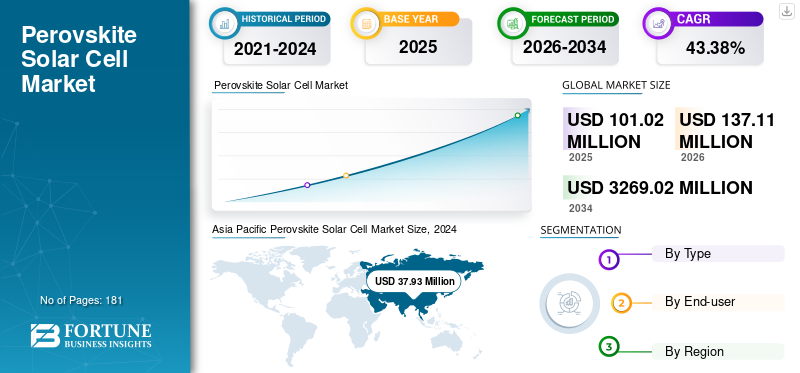
The perovskite solar cells market size was valued at USD 101.02 million in 2025. The market is projected to grow from USD 137.11 million in 2026 to USD 3,221.11 million by 2034, with a CAGR of 48.38% over the forecast period.
Perovskite solar cells (PSCs) are a photovoltaic (PV) technology that uses perovskite-structured semiconductor materials, typically hybrid organic-inorganic lead or tin halide compounds, as the light-absorbing layer to convert sunlight into electricity. The market is experiencing rapid growth due to the technology's potential to deliver high power conversion efficiency at significantly lower manufacturing costs than conventional silicon solar cells. Perovskite materials can be fabricated using low-temperature solution-based processes, enabling lightweight, flexible, semi-transparent, and Building-Integrated Photovoltaic (BIPV) applications. Increasing global investments in renewable energy, supportive government policies for decarbonization, and rising demand for next-generation solar technologies are accelerating research, pilot-scale production, and commercialization efforts. In addition, continuous advancements in device stability, tandem perovskite-silicon solar cells exceeding the efficiency limits of traditional silicon modules, and growing collaborations between research institutions and industry players are further driving market expansion across utility-scale, commercial, residential, and portable energy applications. The increasing adoption of renewable energy sources, particularly solar power, is driving significant growth of the market. The market is also gaining momentum with innovative alternative to traditional silicon-based solar cells. While silicon photovoltaic technology continues to dominate the solar industry, perovskite solar cells offer advantages such as higher theoretical efficiency, lightweight and flexible designs, semi-transparent modules, and lower manufacturing costs through solution-based processing.
Leading companies in the market include Oxford PV, Saule Technologies, Microquanta Semiconductor, Tandem PV, Swift Solar, and Hunt Perovskite Technologies. These companies are actively advancing the commercialization of perovskite solar technology by improving cell efficiency, enhancing long-term stability, and scaling manufacturing processes. Their strategic focus includes developing perovskite-silicon tandem solar cells, establishing pilot and commercial production lines, securing intellectual property, and collaborating with research institutes, universities, and photovoltaic manufacturers. Many of these are also investing in flexible, lightweight, and BIPV solutions to expand the application of perovskite technology in residential, commercial, utility-scale, and portable power sectors.
Download Free sample to learn more about this report.
PEROVSKITE SOLAR CELLS MARKET TRENDS
Rising Global Demand for High-Efficiency Solar Technologies is Emerging Market Trend
The growing global demand for high-efficiency solar technologies is a major trend in the market. As governments, utilities, and businesses seek to maximize electricity generation while reducing the cost per kilowatt-hour, perovskite solar cells have emerged as a promising alternative to conventional silicon photovoltaics due to their high power conversion efficiency and potential for low-cost manufacturing. Continuous advancements in perovskite-silicon tandem solar cells are enabling efficiencies beyond those achievable with standalone silicon cells, making the technology increasingly attractive for utility-scale, commercial, and residential applications. Furthermore, increasing investments in renewable energy, ambitious net-zero emission targets, and ongoing research to improve long-term stability and scalability are accelerating the commercialization and adoption of perovskite solar technologies worldwide.
In April 2025, Trinasolar and Oxford PV inked a sole patent licensing deal for the commercialization and production of perovskite-based photovoltaic goods in China. The cooperation demonstrates the sector's rising confidence in high-efficiency perovskite-silicon tandem solar technology and aims to accelerate the wide adoption of next-generation solar modules. Oxford PV declared that the deal highlights the sector's belief that perovskite photovoltaics are the next generation of high-efficiency solar power generation, thereby supporting rising global need for advanced solar technologies.
MARKET DYNAMICS
MARKET DRIVERS
Download Free sample to learn more about this report.
Growing Investments in Renewable Energy and Net-Zero Initiatives to Drive Market Growth
Growing investments in renewable energy and global net-zero emission initiatives are significantly accelerating perovskite solar cells market growth. Governments worldwide are increasing funding for clean energy technologies through incentives, research grants, and demonstration projects to achieve ambitious climate targets and reduce dependence on fossil fuels. Perovskite solar cells have emerged as a promising next-generation photovoltaic technology due to their high power conversion efficiency, low-temperature manufacturing processes, and compatibility with tandem solar cell architectures.
In September 2025, the U.S. Department of Energy (DOE) declared USD 71 million in funding via the Solar Energy Technologies Office (SETO). In order to strengthen government investment in renewable energy and net-zero goals, the funding supports projects concentrating on increasing the efficiency of devices, long-term durability, scalable manufacturing, and domestic solar supply chains. It is anticipated that this project would speed the commercialization of perovskite solar technologies and reinforce the sophisticated photovoltaic ecosystem.
|
Rank |
Market Drivers |
CAGR Contribution 2026-2034 |
Overall Impact |
2026-2028 |
2029-2031 |
2032-2034 |
|
1 |
Rapid advancement of perovskite-silicon tandem technology |
15.40% |
High |
High |
High |
High |
|
2 |
Increasing investments in commercialization and pilot manufacturing facilities |
13.30% |
High |
High |
High |
High |
|
3 |
Rising demand for high-efficiency and next-generation photovoltaic technologies |
11.60% |
Medium-High |
Medium |
High |
High |
|
4 |
Expansion of Building-Integrated Photovoltaics (BIPV), flexible and lightweight solar applications |
10.10% |
Medium-High |
Medium |
High |
High |
|
5 |
Low-cost manufacturing potential through solution processing and printing technologies |
8.70% |
Medium |
Medium |
Medium |
High |
|
6 |
Others |
5.70% |
Low |
Low |
Medium |
Medium |
|
Total positive CAGR contribution |
+64.80% |
MARKET RESTRAINTS
High Capital and Operating Costs to Restrain Market Growth
Despite their potential for low-cost production in the long term, perovskite solar cells currently face high commercialization and manufacturing costs due to the need for advanced materials, precision fabrication processes, encapsulation technologies, and extensive research and development. Transitioning from laboratory-scale prototypes to high-volume manufacturing requires significant investments in production infrastructure, quality control systems, and reliability testing. In addition, manufacturers must invest heavily in improving long-term stability, moisture resistance, and module durability to meet commercial performance standards. These factors increase the cost of bringing perovskite solar products to market and slow their adoption, particularly while competing with well-established crystalline silicon photovoltaic technologies that benefit from mature manufacturing ecosystems and economies of scale.
|
Market Restraints |
Negative CAGR Contribution 2026-2034 |
Overall Impact |
2026-2028 |
2029-2031 |
2032-2034 |
|
Limited long-term operational stability and durability |
6.30% |
High |
High |
High |
Medium |
|
Challenges in large-scale manufacturing and commercialization |
4.70% |
High |
High |
Medium |
Medium |
|
Lead toxicity concerns and regulatory compliance requirements |
3.60% |
Medium |
Medium |
Medium |
Medium |
|
Others |
1.82% |
Low |
Low |
Low |
Low |
|
Total positive CAGR contribution |
16.42% |
MARKET OPPORTUNITIES
Expanding Demand for Lightweight and Next-Generation Photovoltaic Solutions Offers Lucrative Market Opportunities
The expanding demand for lightweight and next-generation photovoltaic solutions is a key factor driving market growth. Unlike conventional crystalline silicon modules, perovskite solar cells can be fabricated into thin, lightweight, flexible, and semi-transparent formats, enabling deployment in applications where traditional solar panels are impractical. Their versatility makes them well suited for building-integrated photovoltaics (BIPV), vehicle-integrated photovoltaics (VIPV), portable electronics, wearable devices, aerospace systems, and Internet of Things (IoT) applications.
In July 2026, as part of its industrial and clean energy strategy, Japan is dramatically growing its investment in flexible, lightweight, and ultra-thin perovskite solar cells. Beyond traditional rooftop installations, photovoltaics can be used more widely by incorporating them into building facades, windows, cars, infrastructure, and even clothes, all of which can be made using printing techniques. The increased worldwide need for lightweight, next-generation photovoltaic solutions that can power a wider variety of applications and promote the deployment of renewable energy is reflected in the initiative.
MARKET CHALLENGES
Competition from Mature Silicon Photovoltaic Technologies to Hamper Market Growth
The widespread adoption of crystalline silicon photovoltaic technology remains a significant restraint to market growth. Silicon solar modules benefit from decades of technological advancement, well-established global manufacturing capacity, proven long-term reliability exceeding 25 years, and highly optimized supply chains that enable low production costs. In contrast, perovskite solar cells are still in the early stages of commercialization and continue to face challenges related to long-term stability, durability, large-scale manufacturing, and bankability. Many project developers, utilities, and investors prefer established silicon PV technologies due to their extensive field performance records, lower investment risk, and broad certification. As a result, the strong market position of mature silicon photovoltaic technologies is expected to slow the commercial adoption of perovskite solar cells until the technology demonstrates comparable reliability, scalability, and cost competitiveness.
Segmentation Analysis
By Type
Rigid Perovskite Solar Cells are Witnessing Strong Growth Due to their High Efficiency and Superior Durability
Based on the type, the market is classified into rigid and flexible.
Rigid segment dominated the market in 2025. Rigid perovskite solar cells offer higher durability, better environmental stability, and easier integration with existing silicon solar manufacturing lines compared to flexible perovskite cells. Rigid modules, typically fabricated on glass substrates, provide superior protection against moisture, oxygen, and mechanical stress, resulting in improved operational lifetime and reliability.
Flexible is the fastest-growing segment and is estimated to grow at a 60.60% CAGR during the forecast period. This is due to their unique combination of lightweight construction, mechanical flexibility, and compatibility with a wide range of non-traditional applications. Unlike rigid solar modules, flexible perovskite cells can be manufactured on thin plastic or metal substrates, enabling integration into curved and lightweight surfaces such as building facades, windows, electric vehicles, drones, consumer electronics, wearable devices, and portable power systems.
By Application
BIPV segment Dominates due to Lightweight, Semi-Transparent, and Customizable Nature of Perovskite Modules
By application, the market is categorized into BIPV, power station, transportation and mobility, consumer electronics, and others.
The BIPV segment dominated the market, accounting for 41.73% share in 2025. BIPV is also the fastest-growing segment in the market due to the technology's lightweight, semi-transparent, and aesthetically adaptable properties, which enable seamless integration into building facades, windows, skylights, and rooftops. Unlike conventional silicon modules, perovskite solar cells can be manufactured in customizable shapes and colors, making them ideal for modern energy-efficient buildings.
The power station segment is expected to grow with a CAGR of 47.38% over the forecast period. Power stations are witnessing strong growth as an application for perovskite solar cells due to the increasing deployment of high-efficiency perovskite-silicon tandem modules in utility-scale renewable energy projects. These modules can generate more electricity from the same installation area than conventional silicon panels, improving land utilization and reducing the Levelized Cost of Electricity (LCOE). Additionally, growing investments in utility-scale solar farms, grid decarbonization initiatives, and next-generation photovoltaic technologies are accelerating the adoption of perovskite solar cells for power generation applications.
By Structure Type
Planar PSC Segment is Dominating Due to its Simple Device Architecture and Lower Manufacturing Complexity
By structure type, the market is categorized into planar PSC and mesoporous PSC.
Planar PSC segment captured the largest perovskite solar cells market share in 2025. This is due to its simple device architecture, lower manufacturing complexity, and compatibility with scalable fabrication techniques such as solution processing and roll-to-roll printing. The planar structure enables high power conversion efficiencies while reducing production costs and facilitating easier integration into perovskite-silicon tandem solar cells. Continuous improvements in charge transport materials, interface engineering, and device stability are further accelerating the adoption of planar PSCs for commercial and utility-scale photovoltaic applications.
The mesoporous PSC segment is expected to grow with a CAGR of 46.79% over the forecast period. The segment is witnessing steady growth due to their high power conversion efficiency, enhanced charge transport, and improved device stability. The mesoporous scaffold facilitates efficient electron extraction and reduces charge recombination losses, resulting in better photovoltaic performance.
By Technology
To know how our report can help streamline your business, Speak to Analyst
Two-Step Method Dominates Due to its Superior Control Over Perovskite Crystal Formation
By technology, the market is segmented into one-step method, two-step method, vapor-assisted method, thermal vapor deposition, and solution processing.
Two-step method segment captured largest market share and accounted for 36.68% in 2025. This is due to its superior film quality, higher power conversion efficiency, improved reproducibility, and better control over crystal formation, making it the preferred approach for commercial-scale manufacturing and high-performance solar cells.
The thermal vapor deposition segment is predicted to grow with a CAGR of 52.44% during the forecast period. The thermal vapor deposition segment is growing due to its ability to produce highly uniform, high-purity perovskite films with excellent thickness control, resulting in improved device efficiency, reproducibility, and scalability for commercial manufacturing.
PEROVSKITE SOLAR CELLS MARKET REGIONAL OUTLOOK
By geography, the market is categorized into Europe, North America, Asia Pacific, Latin America, and Middle East & Africa.
ASIA PACIFIC
Asia Pacific Perovskite Solar Cells Market Size, 2025 (USD Million)
To get more information on the regional analysis of this market, Download Free sample
Asia Pacific is the dominant region in market. The market was valued at USD 48.85 million in 2025 and is expected to reach USD 68.32 million by 2026. This is due to substantial investments in renewable energy, strong government support for next-generation photovoltaic technologies, expanding solar manufacturing capacity, and the presence of leading research institutions and manufacturers in countries such as China, Japan, and South Korea.
China Perovskite Solar Cells Market
In 2025, the China market reached USD 43.86 million. China's market is growing rapidly due to the country's strong emphasis on commercializing next-generation photovoltaic technologies and leveraging its well-established solar manufacturing ecosystem. Chinese companies are actively scaling pilot and gigawatt-level production lines, supported by robust domestic supply chains for photovoltaic materials, equipment, and module manufacturing.
In March 2026, China's initial commercial perovskite-silicon tandem module was obtained by GCL Optoelectronics. GCL Optoelectronics secured a 1.2 MW commercial tender from China Huaneng for IEC-certified perovskite-silicon tandem PV modules, exhibiting over 25% efficiency and a 25-year performance warranty. This achievement represents a pivotal milestone in their commercial deployment efforts.
India Perovskite Solar Cells Market
The Indian market reached around USD 0.93 million in 2025, accounting for roughly 0.50% of the global market. The market in India is increasing as a result of the nation's ambitious goals for expanding renewable energy, growing investments in the production of domestic solar cells, and the government's strong emphasis on lessening its reliance on photovoltaic technologies brought in from abroad.
NORTH AMERICA
North America was valued at roughly USD 15.16 million in 2024 and reached USD 19.83 million in 2025. This market is growing due to its strong innovation ecosystem, extensive venture capital funding, and the presence of leading technology developers such as Oxford PV (U.S. operations), Tandem PV, Swift Solar, and Hunt Perovskite Technologies, which are accelerating the commercialization of high-efficiency tandem solar technologies.
U.S. Perovskite Solar Cells Market
The U.S. market stood at around USD 18.98 million in 2025. It is expanding as a result of quick commercialization of perovskite-silicon tandem technology by local innovators, significant venture capital investment, and substantial federal funding for next-generation photovoltaic research.
EUROPE
The Europe market in 2025 was valued at USD 29.80 million and is expected to reach USD 39.42 million by 2026. Europe's market is growing due to its strong focus on commercializing high-efficiency tandem photovoltaics through collaborative research, sustainability-driven regulations, and industrial partnerships. Unlike other regions that emphasize manufacturing scale or pilot deployment, Europe is concentrating on translating cutting-edge research into commercial products, supported by leading innovators such as Oxford PV, imec, CEA, Fraunhofer ISE, and Solliance.
U.K. Perovskite Solar Cells Market
The U.K. market in 2025 stood at around USD 8.92 million, representing roughly 20.69% of the regional market. This is due to its unique position as a global innovation hub for next-generation photovoltaic technologies. Unlike many countries that primarily focus on large-scale manufacturing, the U.K. leads in research commercialization, driven by world-renowned institutions such as the University of Oxford, Imperial College London, and the University of Cambridge.
Germany Perovskite Solar Cells Market
The Germany market in 2025 stood at USD 15.64 million, accounting for roughly 52.49% of the regional market. This market is growing due to its leadership in photovoltaic research, precision engineering, and pilot-scale commercialization of tandem solar technologies. The country is home to globally recognized research institutes such as Fraunhofer ISE, Helmholtz-Zentrum Berlin (HZB), and leading industrial innovators that are advancing high-efficiency perovskite-silicon tandem cells, scalable manufacturing processes, and long-term stability solutions.
LATIN AMERICA AND MIDDLE EAST & AFRICA
Latin America and Middle East & Africa stood at USD 1.34 million and USD 1.19 million, respectively, in 2025. Latin America’s market is growing due to the region’s high solar irradiation, large underserved and off-grid areas, and rising need for lightweight, low-cost photovoltaic solutions that can be deployed on remote buildings, agricultural facilities, telecom sites, and distributed microgrids
Middle East & Africa market is growing due to the region's exceptional solar resource potential, increasing investments in utility-scale renewable energy projects, and demand for photovoltaic technologies that can perform efficiently under high temperatures and intense sunlight. Unlike other regions focused on manufacturing or research leadership, Middle East & Africa market is driven by large-scale solar deployment, energy diversification strategies, and electrification initiatives in remote areas.
Saudi Arabia Perovskite Solar Cells Market
The Saudi Arabia market in 2025 stood at around USD 0.55 million, representing roughly 45.96% of the regional market. Saudi Arabia's market is growing due to the country's ambitious giga-scale renewable energy projects under Vision 2030 and its focus on adopting next-generation solar technologies to maximize energy output in harsh desert environments. Unlike other markets driven primarily by research or manufacturing, Saudi Arabia is leveraging perovskite solar cells to enhance the efficiency of utility-scale solar plants while supporting economic diversification and reducing dependence on oil. Growing investments through the Public Investment Fund (PIF), NEOM, and the National Renewable Energy Program (NREP) are creating strong opportunities for the future deployment of high-efficiency perovskite photovoltaic technologies.
COMPETITIVE LANDSCAPE
Key Industry Players
Key Players Are Boosting Competition by Scaling Gigawatt-Scale Manufacturing and Advancing Tandem Solar Technologies
Perovskite solar cell vendors are focusing on converting laboratory breakthroughs into commercially viable products by scaling pilot production, improving module stability, developing lead-management and encapsulation solutions, and securing certification for long-term field use. Companies are also forming licensing agreements and manufacturing partnerships, investing in perovskite-silicon tandem modules, and targeting differentiated applications such as lightweight panels, BIPV, portable power, and high-efficiency rooftop systems rather than competing only in conventional silicon module sectors.
In March 2025, at the Osaka–Kansai Expo, perovskite solar cell vendors demonstrated that the technology is expanding beyond conventional rooftop and utility-scale solar installations into smart infrastructure applications. Companies showcased lightweight, flexible perovskite modules integrated into Smart Poles featuring IoT-enabled lighting, AI-powered cameras, digital signage, and wireless charging, highlighting the growing commercial potential of perovskite solar cells in next-generation urban infrastructure and smart city ecosystems.
LIST OF KEY PEROVSKITE SOLAR CELLS COMPANIES PROFILED
- Oxford PV (U.K.)
- Saule Technologies (Poland)
- GCL Optoelectronics (China)
- Microquanta Semiconductor (China)
- UtmoLight Technology (China)
- Swift Solar (U.S.)
- Tandem PV (U.S.)
- Hunt Perovskite Technologies (U.S.)
- EneCoat Technologies (Japan)
- SolaEon Technology (China)
- Greatcell Solar (Australia)
- Energy Materials Corporation (EMC) (U.S.)
- Ossila (U.K.)
KEY INDUSTRY DEVELOPMENTS
- June 2026: Tandem PV revealed a perovskite-silicon tandem demonstration module with an efficiency of 30.4%, making it one of the most efficient modules for business applications ever. The company claims that its glass-over-silicon design works with a variety of silicon cell technologies, allowing for future performance enhancements without having to rebuild the entire module.
- February 2026: Ossila updated its "Highest Efficiency Perovskite Solar Cells" resource with the latest NREL-certified efficiency records, highlighting 27.3% efficiency for single-junction perovskite solar cells and 35.0% for perovskite-silicon tandem cells.
- December 2025: Saule Technologies announced sophisticated perovskite solar glass made for BIPV. Targeting sustainable and commercial building applications, the semi-transparent photovoltaic glass produces electricity while serving as building façades and windows.
- July 2025: GCL Optoelectronics completed a Series C2 financing round, raising approximately USD 28 million. The money will help commercialize perovskite solar modules, expand R&D into next-generation perovskite products, and support the industrialization of its GW-scale perovskite production base.
- July 2024: EneCoat Technologies, a Kyoto University spin-off company raised approximately (USD 35–37 million) in a Series C fundraising round. The investment will accelerate the development and commercialization of its proprietary film-type perovskite solar cells, expand pilot manufacturing, and strengthen applications in IoT devices, mobility, and Building-Integrated Photovoltaics (BIPV).
REPORT COVERAGE
The perovskite solar cells market analysis provides an in-depth study of the market size & forecast across all market segments included in the report. It contains details on the market dynamics and trends expected to drive the market in the forecast period. It offers information on technological advancements, new product launches, key industry developments, and partnerships, mergers & acquisitions. The market research report also includes a detailed competitive landscape, providing market share and profiles of key players.
Request for Customization to gain extensive market insights.
Report Scope & Segmentation
| ATTRIBUTE | DETAILS |
| Study Period | 2021-2034 |
| Base Year | 2025 |
| Forecast Period | 2026-2034 |
| Historical Period | 2021-2024 |
| Growth Rate | CAGR of 48.38% from 2026-2034 |
| Unit | Value (USD Million), Volume (MW) |
| Segmentation | By Type, By Application, By Structure type, By Technology, and Region |
| By Type |
|
| By Application |
|
| By Structure type |
|
| By Technology |
|
| By Region |
|
Frequently Asked Questions
Fortune Business Insights says that the global market value stood at USD 101.02 million in 2025 and is projected to reach USD 3,221.11 million by 2034.
The market is expected to grow at a CAGR of 48.38% during the forecast period.
The two-step method segment led the market by technology.
Rising demand for high-efficiency solar technologies is driving the market growth.
Oxford PV, GCL Optoelectronics, and Microquanta Semiconductor are among the top players in the market.
Asia Pacific held the largest share of the market.
Government support for next-generation solar technologies is expected to favor product adoption.



- 2021-2034
- 2025
- 2021-2024
- 101
Get 30-60 hrs Free Customization
Expand Regional and Country Coverage, Segments Analysis, Company Profiles, Competitive Benchmarking, and End-user Insights.



















Related Reports
-
US +1 833 909 2966 ( Toll Free )
-
Get In Touch With Us