Wasabi Market Size, Share & Industry Analysis, By Type (Wasabi Paste, Wasabi Sauce, Wasabi Powder, and Others), By Nature (Conventional and Organic), By End Use (Foodservice and Retail {Supermarkets/Hypermarkets, Convenience Stores, Specialty Stores, and Online Retail}), and Regional Forecast, 2026-2034
 Download Free Sample
(Offer valid till 15th Aug 2026)
Wasabi Market Overview
 Listen to Audio Version
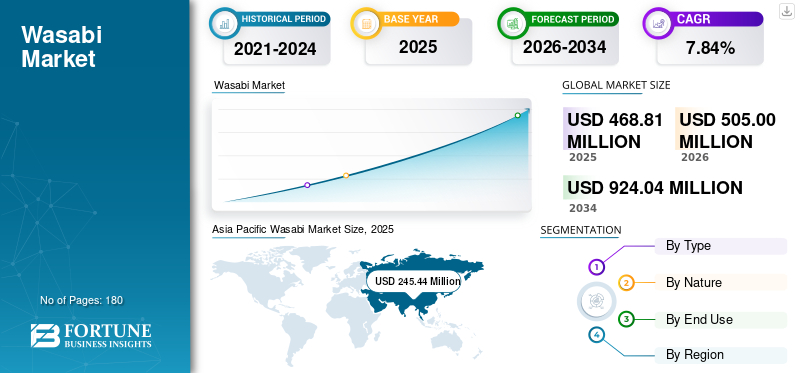
The wasabi market size was valued at USD 468.81 million in 2025. The market is projected to grow from USD 505.00 million in 2026 to USD 924.04 million by 2034, exhibiting a CAGR of 7.84% during the forecast period. Asia Pacific dominated the wasabi market with a market share of 52.35% in 2025.
Wasabi is a Japanese condiment derived from Wasabia japonica, a rhizome. It is widely utilized as one of the main sushi seasoning ingredients and known for its fresh vegetal notes and association with Japanese cuisine products. A few of the popular types of wasabi include wasabi sauce, wasabi flakes, and wasabi paste products. The main target end users of wasabi include hotels, condiment producers, and sushi restaurants, where it is recognized as one of the pivotal Asian food ingredients. The Asia Pacific and North America are considered the key regional consumers of wasabi. The surging demand for ready-to-use condiments and spicy flavor enhancers in Asian cuisine is driving market growth.
Companies such as Kikkoman Corporation, S&B Foods Inc., and Yutaka are prominent players in the market. New product launches are a pivotal strategy adopted by key players to improve their position.
Download Free sample to learn more about this report.
Wasabi Market Key Takeaways
 Global Market Size & Forecast
- 2025 Market Size: USD 468.81 million
- 2026 Market Size: USD 505.00 million
- 2034 Forecast Market Size: USD 924.04 million
- CAGR: 7.84% from 2026–2034
 Market Share
- Asia Pacific dominated the wasabi market with a 52.35% share in 2025.
- The wasabi paste segment dominated the market in 2025.
- The conventional segment held the largest market share in 2025.
 Key Regional Highlights
Asia Pacific
Asia Pacific reached USD 245.44 million in 2025, maintaining its leading position in the global market.
North America led the global market with a 49.53% share in 2025.
North America accounted for USD 105.04 million in 2025, ranking as the second-largest regional market.
Europe
Europe reached USD 72.72 million in 2025 and is projected to grow at a 6.96% CAGR during the forecast period.
U.S.
The U.S. market was valued at USD 83.57 million in 2025, representing approximately 17.83% of global market revenue.
Japan
The Japan market reached USD 129.55 million in 2025, accounting for approximately 27.63% of global market revenue.
Read More

WASABI MARKET TRENDS
Increasing Inclination toward Fusion-Style Wasabi Supports New Product Development
Fusion-style wasabi is considered a key trend in the global market, as foodservice operators/ manufacturers are utilizing wasabi outside its conventional use as a sashimi/sushi condiment. The strong association with Japanese cuisine, sharp flavor intensity, and distinct color make it appropriate for fusion applications such as seafood dips, snack seasonings, burger sauces, wasabi mayonnaise, and salad dressings. This trend is specifically significant in Europe and North America, where individuals are familiar with spicy condiments but often choose creamier and milder wasabi sauce. Moreover, this fusion-style sauce opens opportunities for innovation in rice bowls, seafood products, and sandwiches. In addition, it is gaining relevance in convenience and snack categories such as popcorn and coated nuts, where it caters to rising demand for cross-cultural and spicy flavors.
MARKET DYNAMICS
MARKET DRIVERS
Download Free sample to learn more about this report.
Expansion of Foodservice Outlets Fuels the Consumption of Wasabi
The expanding foodservice channel is a major driver, boosting the use of wasabi as pan Asian dining formats and sushi gain wider visibility across quick-service outlets and restaurants. Wasabi is widely utilized in such settings as it adds a recognizable Japanese flavor and freshness to sashimi, fusion dishes, rice platters, and sushi. Moreover, it is utilized to balance the richness of creamy dips, fatty fish, and fried foods, which makes it suitable for both fusion and traditional menus. In addition, the HoReCa operators are using wasabi to produce signature dips, toppings, and marinades that differentiate from standard condiments. Along with this, it supports portion control and reduces wastage in catering services and sushi counters. As a result, such foodservice outlet expansion escalates the sales of wasabi products, thus driving overall wasabi market growth.
MARKET RESTRAINTS
High Price and Restricted Availability of Authentic Wasabi Hinder Market’s Growth
One of the major hurdles in the market is the restricted availability and high price of authentic wasabi, specifically items produced from Wasabia japonica. Authentic wasabi needs particular growing conditions, including clean water, careful handling, and cool temperatures. Such requirements restrict scalability and make year-round production/supply challenging to achieve. As a result, the majority of commercial wasabi products utilize flavoring components, horseradish alternatives, starches, colorants, and mustard to mimic the original wasabi’s color and pungency. Although it enhances affordability, it can minimize product quality perceptions among individuals who are seeking authentic Japanese components. Thus, the above-mentioned factors impede the global market.
MARKET OPPORTUNITIES
Integration of Advanced Technologies in the Wasabi Sector Creates Growth Opportunities
The utilization of advanced technologies in the wasabi condiments industry opens growth opportunities. To manage leaf growth, the producers are adopting LED light optimization technologies. Since wasabi grows naturally in shaded environments, insufficient light can limit growth, while overexposure can disrupt plant growth. Adjustable light systems can support healthier plants and allow for control of light intensity. Dehydration and freeze-drying technologies are another popular method gaining huge popularity in the market. Via these techniques, the growers can retain color, flavor, and aroma. Moreover, milling and low-grinding technology are also being explored by businesses to retain the compounds responsible for the pungency and aroma of wasabi.
Segmentation Analysis
By Type
Wasabi Paste Dominated Market Due to its Stronger Flavor Intensity
Depending on the type, the market is segmented into wasabi paste, wasabi sauce, wasabi powder, and others.
The wasabi paste sector led the market in 2025. Compared with wasabi sauce/powder, paste doesn’t require preparation or mixing before use. This benefit makes it ideal for catering services and sushi counters that look for ready-to-use condiments. Moreover, this paste enhances portion control for quick service restaurants more than loose seasoning blends and powders. Another main advantage of this paste is its consistent texture, which is difficult to attain with dry blends. In addition, it has a prolonged shelf life, which drives the segment growth.
The wasabi sauce is projected to grow at a high CAGR of 10.40% over the forecast period.
To know how our report can help streamline your business, Speak to Analyst
By Nature
Conventional Segment Led Industry Owing to its Affordability
On the basis of nature, the market is divided into conventional and organic.
In 2025, the conventional segment held the largest wasabi market share. Conventional wasabi has a clear price benefit over organic wasabi products as it can be manufactured via large-scale sourcing and wider raw material availability. This regular condiment is widely available across Asian grocery stores, supermarkets, and e-commerce channels, whereas organic products remain more restricted. Moreover, conventional wasabi is highly preferred by foodservice operators due to its low purchase costs and stable supply. Moreover, the long shelf life and improved acceptance in price-sensitive markets further bolster the segment’s momentum.
The organic category is projected to grow at a high CAGR of 12.00% over the forecast period.
By End Use
Foodservice Leads the Market Due to Higher Out-of-Home Food Consumption
Based on end use, the market is segmented into foodservice and retail.
Foodservice dominated the industry. Foodservice channels utilize wasabi in large amounts as they are used in various servings across sushi and seafood restaurants. The foodservice operators not only utilize this product as a side condiment but also as a component in toppings, sauces, dips, and marinades. Moreover, it has a stronger influence on consumers as they introduce this Japanese condiment to individuals before they buy it for home use. Additionally, these outlets are well-suited for bulk sachets, bulk wasabi paste, powders, and flakes.
The retail segment is projected to grow at a high CAGR of 9.27% over the forecast period.
Wasabi Market Regional Outlook
By geography, the market is categorized into Europe, North America, Asia Pacific, South America, and the Middle East & Africa.
Asia Pacific
Asia Pacific Wasabi Market Size, 2025 (USD Million)
To get more information on the regional analysis of this market, Download Free sample
Asia Pacific dominates the market and reached USD 245.44 million by 2025. Augmented demand for sushi seasoning ingredients in the Japanese market and the flourishing premium culinary condiments sector drive the regional growth.
India Wasabi Market
The India market in 2025 was at USD 10.17 million, accounting for roughly 2.17% of the global market revenues.
China Wasabi Market
China's market is projected to be one of the largest worldwide and its revenues reached at USD 46.07 million in 2025, accounting for roughly 9.83% of global market sales.
Japan Wasabi Market
The Japan market in 2025 reached USD 129.55 million, accounting for approximately 27.63% of the global market revenues.
North America
North America reached a valuation of USD 105.04 million in 2025 and securing second position. The market in North America is expected to grow due to the increasing foodservice condiment demand and the high need for natural food additives.
U.S. Wasabi Market
Based on North America's strong contribution and the U.S. dominance within the region, the U.S. market was valued at USD 83.57 million in 2025, accounting for roughly 17.83% of global sales.
Europe
Europe reached USD 72.72 million in 2025, recording a growth rate of 6.96% in the coming years, and rank third. The rising demand for packaged food ingredients and the expanding processed spice market are propelling the regional potential.
Germany Wasabi Market
The German market in 2025 was at USD 16.33 million, representing roughly 3.48% of the global market revenues.
U.K. Wasabi Market
The U.K. market reached USD 18.77 million in 2025, equivalent to around 4.00% of the global market sales.
South America and Middle East & Africa
The South America and Middle East & Africa regions are expected to witness moderate growth in this market space during the forecast period. The South America market reached a valuation of USD 26.45 million in 2025. The rising number of private-label producers of wasabi and the awareness of authentic wasabi products are expected to drive demand. The Middle East & Africa market reached USD 19.16 million in 2025.
South Africa Wasabi Market
The South African market was at USD 7.08 million in 2025, representing roughly 1.51% of global revenues.
COMPETITIVE LANDSCAPE
Key Industry Players
Product Innovation Helps Brands to Improve their Market Position
The wasabi sector is moderately fragmented, with renowned Japanese condiment producers competing alongside regional specialty suppliers and Asian brands. Prominent players such as S&B Foods Inc., Yutaka, and Kikkoman Corporation are improving their position in the global market through new product launches and wide utilization in the foodservice sector. Moreover, the players should enter into collaborations or adopt promotional campaigns to upscale their penetration in the global market.
LIST OF KEY WASABI COMPANIES PROFILED
- S&B Foods Inc. (Japan)
- Kikkoman Corporation (Japan)
- Clearspring Ltd. (U.K.)
- Kinjirushi Wasabi Co., Ltd. (Japan)
- Eden Foods, Inc. (U.S.)
- Real Wasabi, LLC (U.S.)
- Yutaka (U.K.)
- House Foods Group Inc. (Japan)
- The Wasabi Company (U.K.)
- Tamaruya Honten Co., Ltd. (Japan)
KEY INDUSTRY DEVELOPMENTS
- March 2026: Acecook, an instant noodles producer in Japan, introduced a new wasabi-flavored soup through its brand, Soup Harusame. This product is available across the nation at USD 1.14.
- August 2025: Wasabi Co. Ltd, a fast-food chain in the U.K., released a new menu which features tender red-flamed chicken in Wasabi’s own fire sauce with crisp Asian slaw and red peppers.
- October 2023: Too Savage, a Dublin manufacturer of plant-based condiments, unveiled 100% natural wasabi mayo, produced using sustainably grown Irish wasabi.
- March 2021: The Kraft Heinz Company, an American multinational food company, revealed three limited edition condiments; Wasabioli, Hanch, and Heinz Tarchup for Canadians.
- May 2020: Frito-Lay, a U.S.-based food enterprise, announced the launch of shichimi pepper and wasabi-flavored snacks across Japan.
REPORT COVERAGE
The global wasabi market provides an in-depth study of the market size & forecast by all the market segments included in the market reports. The market forecast analysis includes details on the dynamics and trends expected to drive the market during the forecast period. The market analysis offers information on the technological advancements, new product launches, key industry developments, and details on partnerships, mergers & acquisitions. The industry forecast also encompasses a detailed competitive landscape with information on the market segmentation, market share, and profiles of key operating players.
Request for Customization to gain extensive market insights.
Report Scope & Segmentation
| ATTRIBUTE | DETAILS |
| Study Period | 2021-2034 |
| Base Year | 2025 |
| Estimated Year | 2026 |
| Forecast Period | 2026-2034 |
| Historical Period | 2021-2024 |
| Growth Rate | CAGR of 7.84% from 2026-2034 |
| Unit | Value (USD Million) |
| Segmentation | By Type, Nature, End Use, and Region |
| By Type |
|
| By Nature |
|
| By End Use |
|
| By Region |
|
Frequently Asked Questions
Fortune Business Insights says that the global market value stood at USD 468.81 million in 2025 and is projected to reach USD 924.04 million by 2034.
In 2025, the Asia Pacific market value stood at USD 245.44 million.
The market is expected to exhibit a CAGR of 7.84% during the forecast period of 2026-2034.
By nature, the conventional segment led the global market.
Expansion of foodservice outlets fuels the market growth.
Kikkoman Corporation, S&B Foods Inc., and Yutaka are among the key players in the market.
Asia Pacific held the largest share of the market.
Increasing inclination toward fusion-style wasabi supports new product development.



- 2021-2034
- 2025
- 2021-2024
- 180
-
(Offer valid till 15th Aug 2026)
Get 30-60 hrs Free Customization
Expand Regional and Country Coverage, Segments Analysis, Company Profiles, Competitive Benchmarking, and End-user Insights.




















Related Reports
-
US +1 833 909 2966 ( Toll Free )
-
Get In Touch With Us