Seafood Market Size, Share, and Industry Analysis, By Type (Fish, Crustaceans, Molluscs, and Others), By Form [Fresh and Processed (Canned, Chilled, and Frozen)], By Distribution Channel [B2C (Supermarkets/Hypermarkets, Convenience Stores & Specialty Stores, Online Sales Channel, and Others) and B2B], and Regional Forecast, 2026-2034
 Download Free Sample
(Offer valid till 30th Sep 2026)

KEY MARKET INSIGHTS
 Listen to Audio Version
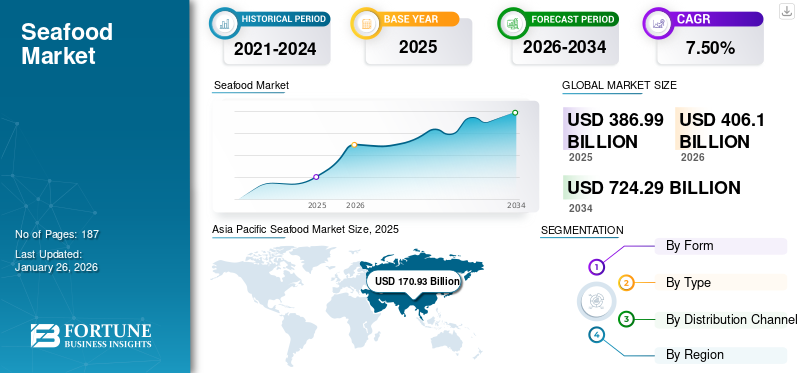
The global seafood market size was USD 386.99 billion in 2025 and is projected to grow from USD 406.10 billion in 2026 to USD 724.29 billion by 2034, exhibiting a CAGR of 7.50% during the 2026-2034 period. Asia Pacific dominated the seafood market with a market share of 44.17% in 2025.
The market is experiencing rapid growth, owing to the rising per capita consumption, increasing disposable income, and growing consumer inclination toward pescetarianism across the globe.
Over the years, a drastic shift has been observed in the consumption pattern of individuals toward a healthy diet, influencing the changes in consumer preferences. This global market share in the food industry is expected to increase in the upcoming years, as individuals mainly prefer seafood-based products over poultry and beef due to the equivalent amount of protein with fewer calories. Such shifting consumption patterns will fuel market growth.
The seafood industry consists of the farming, capture, trade, and selling of edible fish, crustaceans, molluscs, and other products harvested or farmed from the ocean or freshwater. The industry has a wholesale seafood market and retail trade in different forms, such as frozen, fresh, canned, and processed food. The industry is propelled by increasing demand for protein foods, health-conscious consumers, and increasing awareness of its nutritional value.
Download Free sample to learn more about this report.
Seafood Market Key Takeaways
 Global Market Size & Forecast
- 2025 Market Size: USD 386.99 billion
- 2026 Market Size: USD 406.10 billion
- 2034 Forecast Market Size: USD 724.29 billion
- CAGR: 7.50% from 2026–2034
 Market Share
- Asia Pacific dominated the seafood market with a 44.17% share in 2025.
- The fish segment is projected to account for a 54.97% market share in 2026.
- The fresh segment is projected to hold a 73.40% market share in 2026.
 Key Regional Highlights
Asia Pacific
Asia Pacific led the global market with USD 170.93 billion in 2025 and is projected to reach USD 180.36 billion in 2026.
Europe
Europe generated USD 106.49 billion in 2025 and is expected to grow to USD 111.06 billion in 2026.
North America
North America accounted for USD 68.61 billion in 2025 and is projected to reach USD 71.77 billion in 2026.
U.S.
The market is projected to reach USD 55.49 billion by 2026.
Japan
The market is projected to reach USD 22.03 billion by 2026.
Read More

Market Dynamics
Market Drivers
Market Share to Rise Due to Increasing Demand for Processed/Ready-to-Cook Seafoods
The demand for processed food in developing nations and higher consumption of convenience food among the working population and millennials have evolved due to lifestyle changes. Owing to rapid urbanization and busy lifestyles of consumers, the demand for products with longer shelf lives has increased. The trend of easy-to-cook products has significantly increased over the years due to the advancements in processing techniques, well-equipped cold storage chains, and drastic changes in dietary habits. In addition, the growing innovations in the product development, such as frozen, canned, and smoked seafood, offer lucrative opportunities for convenient cooking amid the busy schedules of individuals.
Market Growth to be Driven by Rising Inclination Toward Adoption of Pescetarianism
Seafood consumption across the globe has consistently increased over the past years. The improvement of living standards in developing countries, such as China, India, Brazil, and South Africa, and the health consciousness of some developed countries have contributed to this increase in consumption. The progress of globalization and the increased interest in health consciousness in recent years can cause drastic changes in fish consumption. Various consumers globally follow a pescetarian lifestyle, consuming fish and a vegetarian diet, owing to health-related factors. Fish, particularly salmon, herring, and trout, provide health benefits and nutritional value and are concentrated in omega-3 fatty acids. Omega-3s have always been recommended for their healthy-heart and brain-boosting benefits, increasing the consumption of seafood-based products. Moreover, the regular consumption of fishery products or following a pescetarian diet can help minimize the risk of health-related illnesses such as obesity, cardiovascular diseases, and others.
Market Restraints
Growing Inclination of Consumers Toward Plant-Based Meat Hampers Market Growth
The rise in veganism has led to an increase in plant-based food consumption. Consumers are increasingly becoming sensitive to the ecological footprint of seafood production, especially the issue of overfishing, habitat loss, and carbon footprints. Plant-based seafood is thus perceived as a sustainable option, especially with Generation Z and millennials, who are more environmentally conscious. According to the Good Food Institute, in 2023, the U.S. sold 215 million servings of plant-based meat and fish. Moreover, a rise in flexitarian consumers adversely affected the market for fish and other products, as these consumers are more inclined toward veggies, legumes, whole grains, and nuts and occasionally prefer meat. These factors are expected to hinder the market growth during the forecast period.
Market Opportunities
Growing Focus on Product Innovation to Pave Growth Prospects
Product innovation is the key to success in almost every industry, and the market is no exception. In mature markets such as Europe and the U.S., the demand for innovative products such as flavored canned seafood, uniquely packaged frozen seafood, and others is rising at a significant pace. In fact, some of the key players have already started capitalizing on these opportunities to generate higher revenue.
For instance, in June 2023, Bumble Bee Seafoods, an FCF Co. Ltd-owned brand, launched yellowfin canned tuna in three new flavors, including lemon & pepper, balsamic & herb, and basil pesto & roasted garlic.
Market Challenges
Overfishing and Depletion of Fish Stocks to Pose a Challenge for Market Growth
The growing demand for seafood has resulted in a rise in fishing operations globally, which has disrupted the balance of nature in the seas. Overfishing is one of the most important issues faced by the industry, as a large number of fish stocks are being overutilized beyond sustainable levels. This has resulted in the depletion of important species and ecosystems, hence threatening the long-term sustainability of the industry.
Seafood Market Trends
Market Value to Rise Due to Increase in Purchase of Premium Products
In recent years, the rising trend for premium and luxury products has gained prominence, owing to the growing health benefits, rising healthy eating habits of consumers, and increased income. Besides this, advancements in packaging technologies, such as active food packaging, vacuum packaging, and Modified Atmosphere Packaging (MAP), also play an important role in sustaining the quality attributes of the products. Such techniques further help preserve and control food pathogens' growth in fishery products and others. Moreover, to fulfil the rising demand for a variety of seafood, the countries are intensively working towards producing a sufficient number of products across the market. For instance, China's processors and farmers increasingly focus on domestic demand, while Western and other Asian producers supply species such as salmon, scallops, and lobster to consumers in China.
Download Free sample to learn more about this report.
Impact of U.S. Tariff
The U.S. tariffs will have a relatively strong impact on the seafood industry, particularly for major exporters such as Vietnam and India. The tariffs, which are up to levels of 26% or 46%, have caused price increases for certain seafood products, a threat of reduced consumption, especially in the U.S., and impacted supply chains. Exporters are expected to suffer a string of setbacks, ranging from reduced demand, the need to cut prices, and potential shifts in market leadership.
Segmentation Analysis
By Type
Fish Segment Holds the Largest Share Due to Various Health Benefits Driving Market Growth
Based on type, the market is segmented into fish, crustaceans, molluscs, and others.
Out of these, the fish segment is projected to dominate the market with a share of 54.97% in 2026, owing to its numerous health benefits. Fish and other fish-based products are a rich source of proteins, low in calories, and fatty acids such as omega-3 and crucial vitamins, as compared to poultry, thus making them a desirable choice of meat. Moreover, the rising demand for premium-quality fish products, attributed to their freshness and diversity, is expected to boost the market growth of the fishing business. Several restaurants and food chains are utilizing different types of fish, such as salmon, tuna, and sardines, in many culinary dishes to enhance the flavor and taste of the food. Nowadays, there has been a rise in the health-conscious population, owing to protein-rich and fat-free fish-based products, which also promotes segment growth.
The crustaceans segment is also experiencing stellar growth in the market, primarily due to the rising demand for species such as crabs, lobsters, and shrimps. Due to its higher utilization, the massive demand for crustaceans from the food service industry further fuels the segment expansion.
By Form
Fresh Segment Dominates Market Owing to Quality Attributes
Based on form, the market is bifurcated into fresh and processed.
The fresh segment is projected to dominate the market with a share of 73.40% in 2026 due to the high demand for natural and premium products across the market. This segment is witnessing a strong demand compared to processed forms, owing to flavor and overall quality attributes, and numerous health-imparting properties. In addition, fresh products contain high-quality nutrients, which are lost during processing. These factors are expected to fuel the market growth.
The processed segment is witnessing substantial growth in the market. The processed seafood segment is further divided into canned, chilled, and frozen. The rapid growth of restaurants and fast-food chains has significantly contributed to the growth in the consumption of processed seafood. The busy lifestyles of consumers due to the growth in employment opportunities have led to a growth in the consumption of ready-to-eat and ready-to-cook food. The convenience associated with ready-to-eat food has led to the high demand for processed seafood in the market, fueling the segment's growth.
To know how our report can help streamline your business, Speak to Analyst
By Distribution Channel
B2C Segment Holds a Major Market Share as It Offers a Variety of Products
On the basis of distribution channel, the market is bifurcated into B2B and B2C.
The B2C channel segment is projected to dominate the market with a share of 64.41% in 2026. The B2C segment is further divided into supermarkets/hypermarkets, convenience stores, online sales channel, and others.
Supermarkets/hypermarkets have become the utmost choice of consumers, as they offer a strong range of products, ranging from food & beverages to consumer goods, under a single roof. In addition, supermarkets are considered a convenient option for purchasing frozen or fresh seafood, as it can be easily stored, thus contributing to the maintenance of its quality attributes. Products such as Atlantic salmon, tuna, canned fish, sardine, and catfish are the most common types, which are preferred on a larger scale and are easily available in the retail channels.
The online retail segment is expected to grow significantly over the forecast period. The growth of e-commerce is essentially revolutionizing the distribution channels for seafood. There is a growing need for online seafood platforms that deliver fresh, live seafood to consumers' doorsteps.
The B2B segment refers to the distribution from the producers/manufacturers to the restaurants, food processors, and exporters/importers. The expanding global foodservice industry, such as hotels, restaurants, and other establishments, drives demand for seafood products across B2B channels, fueling the segment's growth.
SEAFOOD MARKET REGIONAL OUTLOOK
By region, the market is segregated into Asia Pacific, Europe, North America, South America, and the Middle East & Africa.
Asia Pacific
Asia Pacific Seafood Market Size, 2025 (USD Billion)
To get more information on the regional analysis of this market, Download Free sample
Asia Pacific contributed approximately USD 170.93 billion to the global market in 2025, accounting for 44.17% share, and is expected to reach USD 180.36 billion in 2026 and is expected to grow at a speedy growth rate over the next few years. Asia Pacific is known to be one of the biggest markets in the world, accounting for a large percentage of the world's seafood consumption. The rising population and increasing disposable incomes are the key drivers for market growth. China, Japan, Thailand, and South Korea are major consumers in this region. Key players in the market include Dongwon Industries Co., Ltd., Thai Union Group, Nippon Suisan Kaisha, Ltd., and others, which are actively involved in mergers and acquisitions, product innovation, and base expansion to maintain their competitive edge in the market. The Japan market is projected to reach USD 22.03 billion by 2026, the China market is projected to reach USD 101.48 billion by 2026, and the India market is projected to reach USD 15.07 billion by 2026.
To know how our report can help streamline your business, Speak to Analyst
Europe
The market in Europe reached USD 106.49 billion in 2025, representing 27.52% of total market revenue, and is projected to reach USD 111.06 billion in 2026. This can be attributed to the soaring demand from the population of every age. The rising working population and increased earnings further influence the products' purchasing patterns. The busy lifestyle and rising consumer awareness about the benefits of fresh and premium-quality products also favor the growth of this industry. The UK market is projected to reach USD 15.81 billion by 2026, while the Germany market is projected to reach USD 16.9 billion by 2026.
North America
In 2025, North America held 17.73% of the global market share, reaching a valuation of USD 68.61 billion, and is projected to grow to USD 71.77 billion in 2026. North America accounts for the third-largest share of the market. The regional growth can be credited to the increasing millennial population and escalating inclination toward convenience food. Manufacturers are working on expanding their production units in developed countries, such as the U.S. and Canada, which offer lucrative opportunities for the domestic players for collaboration. However, a steep decline in the sales of the products was observed due to the global outbreak of the COVID-19 pandemic. However, the market in North America partially recovered in the second half of the year 2020. The U.S. market is projected to reach USD 55.49 billion by 2026.
South America
South America holds a minor market share in the global market. Peru and Chile account for the majority of seafood consumption. According to the Food and Agriculture Organization of the United Nations (FAO) report, South America is expected to see a considerable increase in fish consumption in the coming years. The expanding aquaculture industry, coupled with the consumer shift toward convenient and sustainable seafood options, propels the market growth in the region.
Latin America
In 2025, Latin America generated USD 29.96 billion, contributing 7.74% to global market revenue, and is projected to grow to USD 31.5 billion in 2026.
Middle East & Africa
The Middle East & Africa region captured 2.84% of the global market in 2025, generating USD 10.99 billion in revenue, and is projected to reach USD 11.42 billion in 2026. The Middle East & Africa region is expected to be a promising market. The rising popularity of specialty restaurants, growing imports of seafood products, and increasing per capita consumption are some driving factors anticipated to fuel market growth. Major seafood-importing countries include UAE, Saudi Arabia, Kuwait, and Iran. The region’s religious practice, such as the Islamic dietary laws (Halal), has been influencing this market; thus, consumers prefer products certified as Halal and processed according to Islamic guidelines.
Competitive Landscape
Get comprehensive study about this report by, Download free sample copy
Key Market Players
Industry Players Focus on Research Activities for Launch of New Products
The global seafood market is highly competitive, with the presence of prominent and small players. Prominent players operating in the market include Nippon Suisan Kaisha Ltd, Maruha Nichiro, and Mowi ASA, among others. Companies are extensively focusing on increasing their customer base by collaborating with other large business stakeholders or via joint ventures. In addition, the determined focus on introducing sustainable products with essential nutrients further enhances market growth. Key players also focus on increasing their consumer base and market reach through merger and acquisition strategies. For instance, in April 2025, SalMar ASA, a Norwegian fish farm company, acquired the remaining shares in Wilsgård, a salmon-farming company. The acquisition would enhance SalMar's operational efficiency, bolster financial resilience, and reduce costs.
LIST OF KEY SEAFOOD COMPANIES PROFILED
- Nippon Suisan Kaisha Ltd. (Japan)
- Maruha Nichiro (Japan)
- Mowi ASA (Norway)
- Charoen Pokphand Foods Group (Thailand)
- Dongwon Group (South Korea)
- Marubeni Corporation (Japan)
- Mitsubishi Corporation (Japan)
- OUG Holdings (Japan)
- Thai Union Group Public Company Limited (Thailand)
- Trident Seafoods Corporation (U.S.)
KEY INDUSTRY DEVELOPMENTS
- December 2024: Echebastar-owned Alakrana brand launched two new frozen tuna products – nuggets and mini burgers, especially for kids in Spain. The new product was made with pure tuna as a base, without preservatives or colorants.
- November 2024: Japanese Consumers Cooperative Union (JCCU) collaborated with WWF (World Wildlife Fund) Indonesia, Coop Shrimp Processing Company, and WWF Japan for "Indonesia Shrimp Farming Improvement Project. The new project aimed to realize a sustainable shrimp farming industry.
- April 2024: Choice Canning, an Indian shrimp processor, began production trials at a new factory in the state of Andhra Pradesh. The new factory would have the capacity to process 70 metric tons of shrimp per day and double the company’s daily production to 140 metric tons.
- June 2023: Bumble Bee Seafoods expanded its line of pouched, canned, and kit-based tuna products with 12 new additions to their retail shelves. The new product range includes Bumble Bee Solid White Albacore Cans, Low-Sodium, Bumble Bee Pouched Wild-Caught Light Tuna in Water in a 3-Pack Format, Bumble Bee Pouched Wild-Caught Tuna in Teriyaki Flavor, with MSC-certified tuna, and others.
- May 2022: Nueva Pescanova announced the submission of their proposal for building a new commercial octopus in Puerto Las Palmas, Spain. The firm has been intensively working toward developing a method of octopus farming and lately, announced its successful raising, hatching, and incubation of vulgaris octopus’s five generations in a test facility.
REPORT COVERAGE
The seafood market research report includes quantitative and qualitative insights into the market. It also offers a detailed analysis of the market size and growth rate for all possible market segments. Various key insights presented in the report are an overview of related markets, competitive landscape, recent industry developments such as mergers & acquisitions, the regulatory scenario in critical countries, and key industry trends.
Request for Customization to gain extensive market insights.
Report Scope & Segmentation
|
ATTRIBUTE |
DETAILS |
|
Study Period |
2021-2034 |
|
Base Year |
2025 |
|
Estimated Year |
2026 |
|
Forecast Period |
2026-2034 |
|
Historical Period |
2021-2024 |
|
Growth Rate |
CAGR of 7.50% over 2026 to 2034 |
|
Unit |
Value (USD Billion) |
|
Segmentation |
By Type
|
|
By Form
|
|
|
By Distribution Channel
|
|
|
By Geography
|
Frequently Asked Questions
Fortune Business Insights says that the global market size was valued at USD 386.99 billion in 2025.
The market is projected to grow at a CAGR of 7.50% during the forecast period (2026-2034).
The fish segment leads the global market.
Rising demand for processed or ready-to-cook products and the growing inclination toward a pescetarian lifestyle are the prominent factors fueling the market growth.
Nippon Suisan Kaisha Ltd, Maruha Nichiro, and Mowi ASA are a few of the top players in the global market.
Asia Pacific dominated the seafood market with a market share of 44.17% in 2025.
Growing inclination toward plant-based meats is one of the major restraints for the market.



- 2021-2034
- 2025
- 2021-2024
- 187
-
(Offer valid till 30th Sep 2026)
Get 30-60 hrs Free Customization
Expand Regional and Country Coverage, Segments Analysis, Company Profiles, Competitive Benchmarking, and End-user Insights.




















Related Reports
-
US +1 833 909 2966 ( Toll Free )
-
Get In Touch With Us