Citric Acid Market Size, Share & Industry Analysis, By Form (Liquid and Powder), By Grade (Food Grade, Pharmaceutical Grade, and Industrial Grade), By Application (Food & Beverages {Bakery & Confectionery, Dairy, Ice Cream & Frozen Desserts, Sauces, Dressings & Condiments, Beverages, Processed Foods, and Others}, Pharmaceuticals & Nutraceuticals, Personal Care & Cosmetics, and Industrial Cleaning), and Regional Forecast, 2026–2034
 Download Free Sample
(Offer valid till 15th Aug 2026)
Citric Acid Market Size and Future Outlook
 Listen to Audio Version
The citric acid market size was valued at USD 3.97 billion in 2025. The market is projected to grow from USD 4.19 billion in 2026 to USD 6.81 billion by 2034, exhibiting a CAGR of 6.25% during the forecast period. Asia pacific dominated the citric acid market with a market share of 45.59% in 2025.
Citric acid is a widely used organic acid produced mainly through fermentation of carbohydrate-based raw materials such as corn glucose, starch sugar, cane sugar, and molasses. It is used as an acidulant, preservative and flavoring ingredient, pH regulator, buffering agent, and chelating agent across food, beverages, pharmaceuticals, personal care, cleaning, and industrial applications. The demand for citric acid is mainly driven by its high-volume use in carbonated drinks, fruit beverages, powdered drinks, confectionery, sauces, dairy products, processed foods, effervescent tablets, syrups, detergents, descalers, and water treatment formulations. The market is highly linked to global food processing, beverage manufacturing, pharmaceutical formulation, and industrial cleaning demand. China plays a critical role in global supply as it has large production capacity and remains the leading exporter of citric acid. The market outlook is positive as manufacturers are using citric acid in both conventional and bio-based product formulations. Growth is supported by rising demand for processed foods, clean-label formulations, increasing use of citric acid in cleaning products, and a shift toward safer, biodegradable ingredients in industrial applications.
Cargill, Incorporated, Archer Daniels Midland Company, COFCO Biotechnology Co., Ltd., Tate & Lyle PLC, RZBC Group Co. Ltd., and others are few prominent players in the market.
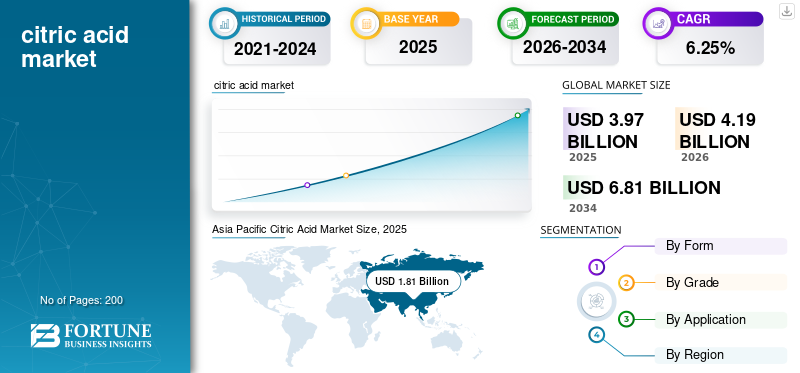
Download Free sample to learn more about this report.
Citric Acid Market Key Takeaways
 Global Market Size & Forecast
- 2025 Market Size: USD 3.97 billion
- 2026 Market Size: USD 4.19 billion
- 2034 Forecast Market Size: USD 6.81 billion
- CAGR: 6.25% from 2026-2034
 Market Share
- Asia Pacific dominated the citric acid market with a 45.59% share in 2025.
- The liquid form segment is projected to grow at the fastest CAGR of 6.67% during the forecast period.
- The pharmaceutical grade segment is expected to grow at the fastest CAGR of 7.51% during the forecast period.
 Key Regional Highlights
North America
North America accounted for USD 0.77 billion in 2025 and is projected to grow at a CAGR of 5.62% during the forecast period.
Asia Pacific
Asia Pacific reached USD 1.81 billion in 2025 and is expected to grow at the fastest CAGR of 7.17% during the forecast period.
Europe
Europe reached USD 0.88 billion in 2025 and is projected to grow at a CAGR of 5.10% during the forecast period.
U.S.
The U.S. market was valued at approximately USD 0.60 billion in 2025 and is expected to expand at a CAGR of 5.57% during the forecast period.
Japan
Japan is expected to witness steady growth during the forecast period.
Read More

Citric Acid Market Trends
Rising Demand for Clean-Label Food Products is an Emerging Market Trend
Rising demand for clean-label food products is driving a strong trend in the market, as manufacturers use familiar, multifunctional, and widely accepted ingredients in food and beverage formulations. Citric acid is naturally associated with citrus fruits and is widely used in food systems, which supports its use in clean-label beverages, sauces, fruit preparations, jams, confectionery, dairy alternatives, and convenience foods. It helps manufacturers reduce formulation complexity as one ingredient can provide acidity, pH control, flavor enhancement, and preservation support. This is important as consumers increasingly check ingredient lists and prefer products that appear simple, recognizable, and safe. The International Food Information Council's 2024 Food & Health Survey continued to track consumer attitudes toward food production, food safety, ingredients, and purchase decisions, underscoring the importance of ingredient transparency.
- For instance, the International Food Information Council (IFIC) 2024 Food & Health Survey covered 3,000 U.S. consumers. It continued tracking consumer attitudes toward food production, safety, ingredients, and purchasing decisions, showing that ingredient transparency remains a key food-choice issue.
MARKET DYNAMICS
Market Drivers
Download Free sample to learn more about this report.
Rising Processed Food & Beverage Demand to Drive Market Growth
Rising consumption of processed foods and beverages is one of the strongest drivers of citric acid market growth, as the ingredient is widely used in carbonated soft drinks, fruit drinks, powdered beverages, energy drinks, confectionery, sauces, dressings, dairy products, and processed foods. Citric acid enhances tartness, helps control pH, enhances fruit flavor, and supports product stability, making it highly important for large-volume food and beverage manufacturers. Increasing consumer demand for ready-to-drink beverages, convenience foods, packaged sauces, and shelf-stable products is increasing the use of citric acid product formulations across developed and emerging markets. The U.S. Department of Agriculture’s Food Expenditure Series shows the large value base of food consumption by tracking U.S. food spending by product, outlet, and purchaser, supporting the role of processed and prepared food systems in ingredient demand.
- According to the Observatory of Economic Complexity (OEC) the U.S. was largest global importer of citric acid in 2024, with imports valued at around USD 421 million, followed by Germany and India.
Market Restraints
Price Volatility and Availability of Alternative Acidulants to Hamper Market Growth
Price volatility is a major restraint for the market as production depends on raw materials such as corn starch, glucose, sugar, and molasses, along with energy, fermentation, drying, packaging, and freight costs. Any fluctuation in agricultural commodities, energy prices, or export freight directly affects manufacturer pricing and landed cost for import-dependent countries. The restraint becomes stronger when food and beverage manufacturers evaluate alternative acidulants such as malic acid, lactic acid, acetic acid, tartaric acid, fumaric acid, and phosphoric acid. These alternatives do not fully replace citric acid in all applications, but they can compete in beverages, confectionery, pickled foods, sauces, dairy products, and preservation systems depending on flavor profile and cost.
Market Opportunities
Shift to Sustainable and Bio-Based Ingredients in Industrial Application to Reshape Market Expansion
The shift toward sustainable and bio based ingredients is creating a strong opportunity for citric acid in industrial applications. Citric acid is fermentation-derived, biodegradable, and effective as a chelating agent, making it useful in industrial cleaning, detergents, dishwashing products, descalers, metal cleaning, textile processing, and water treatment. Manufacturers are increasingly looking for safer and more environmentally acceptable ingredients that can reduce dependence on harsher synthetic chemicals. Citric acid can bind calcium, magnesium, and metal ions, which supports its role in hard-water control, limescale removal, equipment cleaning, and industrial formulation performance. As sustainability requirements increase across household care and industrial cleaning, citric acid has stronger opportunity beyond food and beverages.
SEGMENTATION ANALYSIS
By Form
Powder Form to Dominate Owing to High Stability, Wider Application Base, and Ease of Handling
Based on form, the market is segmented into liquid and powder.
The powder form dominated the market in 2025. This is supported by its longer shelf life, easier transportation, lower storage complexity, and wide use across food & beverages, pharmaceuticals, nutraceuticals, personal care, detergents, and industrial applications. Powder citric acid is highly preferred in dry beverage mixes, confectionery, bakery mixes, effervescent tablets, powdered supplements, cleaning tablets, and detergent formulations as it offers better stability and controlled dosing. It is also easier for manufacturers to handle in bulk, especially where long-distance trade and storage are important. Since citric acid is heavily traded globally, the powder form benefits from lower logistics risk compared to liquid formulations.
The liquid form segment is projected to grow at the fastest CAGR of 6.67% during the forecast period, driven by increasing demand from large-scale beverage, sauce, dairy, cleaning, and industrial processing facilities. Liquid citric acid is preferred in continuous production lines as it allows faster blending, automated dosing, reduced dust handling, and better processing efficiency. Its adoption is increasing among beverage manufacturers, industrial cleaning producers, and water treatment applications where liquid formulations reduce preparation time and improve process consistency.
By Grade
Food Grade to Hold the Highest Share Due to Extensive Use of Critic Acids in Food & Beverage Applications
Based on grade, the market is segmented into food grade, pharmaceutical grade, and industrial grade.
The food grade segment held the largest citric acid market share in 2025, with a value of USD 2.54 billion. The strong use of citric acid as an acidulant, preservative, and flavoring ingredient, a pH regulator, and a flavor enhancer in beverages, confectionery, dairy products, sauces, dressings, frozen desserts, processed foods, and convenience foods drives demand for food-grade citric acid. The segment benefits from rising consumer demand for packaged foods, carbonated beverages, fruit drinks, powdered drinks, ready-to-eat meals, and clean label formulations. Food-grade citric acid is especially important in beverages as it provides tartness, improves flavor balance, and helps maintain product stability.
The pharmaceutical grade segment is expected to grow at the fastest CAGR of 7.51% during the forecast period. Growth is supported by the increasing use of citric acid in effervescent tablets, vitamin supplements, electrolyte powders, mineral citrate formulations, and other pharmaceutical products. Pharmaceutical-grade products also benefit from stricter quality requirements and higher value realization than food- and industrial-grade products.
To know how our report can help streamline your business, Speak to Analyst
By Application
Food & Beverages Segment to Dominate Due to Strong Demand from Processed Food and Beverage Manufacturing
Based on application, the market is segmented into food & beverages, pharmaceuticals & nutraceuticals, personal care & cosmetics, and industrial cleaning.
The food & beverages segment held the largest share of the market in 2025, valued at USD 2.41 billion. This is supported by wide usage in beverages, bakery & confectionery, dairy, ice cream & frozen desserts, sauces, dressings & condiments, processed foods, and other food applications. Citric acid is widely used in these products as it provides sourness, regulates pH, enhances flavor, improves preservation, and supports shelf-life stability. Within food & beverages, the beverages sub-segment holds the highest share, as citric acid is heavily used in carbonated drinks, fruit beverages, powdered drinks, flavored waters, energy drinks, and sports drinks. Rising consumption of processed foods, demand for convenience foods, and the expansion of ready-to-drink beverages continue to support the segment’s dominance.
The pharmaceuticals & nutraceuticals segment is projected to grow at the fastest CAGR of 7.68%. Citric acid is increasingly used in effervescent tablets, antacids, vitamin tablets, electrolyte powders, mineral supplements, syrups, and functional nutrition products. The segment is gaining momentum due to increasing health awareness, growing demand for supplements, and higher consumption of functional products.
Citric Acid Market Regional Outlook
Regionally, the report covers the global market analysis across North America, Europe, Asia Pacific, South America, and Middle East & Africa.
North America
Asia Pacific Citric Acid Market Size, 2025 (USD Billion)
To get more information on the regional analysis of this market, Download Free sample
North America accounted for USD 0.77 billion in 2025 and is projected to grow at a CAGR of 5.62%. The growth of the regional is supported by strong demand from food & beverages, pharmaceuticals, nutraceuticals, personal care, and industrial cleaning applications. The region has a large processed food and beverage manufacturing base, where citric acid is used as an acidulant, preservative and flavoring ingredient, pH regulator, and chelating agent. Demand is especially strong in carbonated beverages, fruit drinks, powdered beverages, confectionery, sauces, dressings, dairy products, effervescent tablets, electrolyte powders, and cleaning formulations. The U.S. is also highly import-dependent for citric acid, making the region sensitive to global supply, freight, and price movements. According to the World Integrated Trade Solution in 2024, the U.S. was the world’s largest importer of citric acid, with imports valued at about USD 425.0 million, confirming its large consumption base.
U.S. Citric Acid Market
The U.S. market was valued at approximately USD 0.60 billion in 2025 and is expected to expand at a CAGR of 5.57% during the forecast period. The U.S. dominates the North American market due to its large-scale beverage, processed food, pharmaceutical, nutraceutical, personal care, and household cleaning industries. Citric acid demand is supported by high usage in soft drinks, sports drinks, functional beverages, powdered drink mixes, bakery fillings, confectionery, sauces, supplements, antacids, and effervescent tablets. The U.S. regulatory framework also supports broad food use, as citric acid is affirmed as GRAS under 21 CFR 184.1033, where the FDA recognizes it as a direct food substance produced by fermentation.
Europe
The consumption of citric acid products in Europe is projected to reach USD 0.88 billion in 2025 and grow at a CAGR of 5.10% during the forecast period. Europe holds a significant share in the market, supported by strong demand from processed foods, beverages, confectionery, dairy products, pharmaceuticals, cosmetics, detergents, descalers, and industrial cleaning products. The region’s market growth is increasingly shaped by clean label, sustainability, and safer chemical formulation trends. Citric acid benefits from these shifts as it is widely accepted in food applications, bio based, biodegradable, and useful as a chelating agent in cleaning and water treatment products. Europe also has strong demand for citric acid in effervescent vitamins, mineral citrate supplements, oral care, skincare, and household cleaning formulations. However, the region is mature and exposed to price volatility as many European buyers depend on imported citric acid. According to World Integrated Trade Solution in 2024, the European Union imported about 245,815 tons of citric acid, while Germany alone imported about 148,269 tons, showing the region’s strong consumption dependence.
Germany Citric Acid Market
Germany accounted for approximately USD 0.21 billion in 2025. Germany is the leading market in Europe, supported by its large food processing, beverage, pharmaceutical, personal care, detergent, and industrial manufacturing base. Citric acid is widely used in Germany in carbonated drinks, fruit preparations, confectionery, dairy products, bakery ingredients, processed foods, effervescent tablets, cleaning products, and water treatment applications. The country’s strong industrial structure also supports demand for citric acid as a pH regulator and chelating agent in technical applications. According to the World Integrated Trade Solution in 2024, Germany was among the world’s largest citric acid importers, with imports valued at about USD 168.7 million, reflecting strong domestic formulation demand and import reliance.
Asia Pacific
Asia Pacific market reached USD 1.81 billion in 2025 and is the fastest-growing region, with a 7.17% CAGR during the forecast period. This is driven by a combination of production capacity, rising consumer demand, and expanding application usage across food, beverages, pharmaceuticals, personal care, detergents, and industrial applications. The region is structurally different from North America and Europe as it has both large manufacturing capacity and a large consumption base. China dominates global supply, while India, Japan, Australia, Southeast Asia, and other markets support demand through processed foods, beverages, supplements, cleaning products, and industrial applications. In 2024, China was the world’s largest exporter of citric acid, with exports valued at over USD 1.0 billion according to OEC, showing its central role in global supply.
China Citric Acid Market
China was valued at USD 0.92 billion in 2025. China is the most important country in the global market as it has large production capacity, integrated raw material availability, and strong export competitiveness. The country supplies citric acid to many food, beverage, pharmaceutical, and industrial markets globally. China’s domestic demand is also supported by its large processed-food, beverage, detergent, pharmaceutical, and personal-care industries.
India Citric Acid Market
India reached USD 0.27 billion in 2025. India is one of the fastest-growing markets in Asia Pacific, supported by rapid expansion in processed foods, beverages, pharmaceuticals, nutraceuticals, confectionery, and household cleaning products. Demand is increasing in fruit drinks, powdered beverages, sauces, jams, confectionery, dairy products, effervescent tablets, syrups, electrolyte powders, and cleaning formulations. India’s pharmaceutical and nutraceutical industries are particularly important as citric acid is used for pH control, taste masking, mineral citrate formulations, and effervescent delivery systems.
South America and Middle East & Africa
South America accounted for USD 0.26 billion in 2025, growing at a CAGR of 6.73%. South America is expected to grow steadily, supported by beverage consumption, fruit-based food products, confectionery, sauces, processed foods, pharmaceuticals, and household cleaning applications. The region’s demand pattern is strongly linked to soft drinks, powdered beverages, juice-based products, jams, dairy products, condiments, and shelf-stable foods. Brazil is the key market due to its large food and beverage industry, while Argentina, Colombia, Chile, and Peru also adds to demand from packaged foods, pharma, and cleaning products. Citric acid usage in South America is also supported by the region’s sugarcane and molasses availability, although refined citric acid demand still depends significantly on imports. Growth is expected to be moderate as currency volatility, inflation, import costs, and price sensitivity can affect procurement decisions by food and beverage manufacturers.
The Middle East & Africa market was valued at USD 0.28 billion in 2025 and is projected to expand at a CAGR of 4.76%. The market growth is supported by rising demand for beverages, powdered drinks, dairy products, processed foods, pharmaceuticals, personal care, household cleaning, and water treatment applications. Hot climatic conditions and urbanization support strong consumption of beverages and powdered drinks, while the expansion of packaged food and pharma distribution increases demand for citric acid formulations. GCC countries are important due to their high levels of import-based food processing, re-export trade, and demand for premium consumer goods.
South Africa Citric Acid Market
The South Africa market was valued at approximately USD 0.07 billion in 2025 and is projected to grow at a CAGR of 4.24% during 2026–2034. South Africa is one of the leading markets in Africa, supported by processed food, beverages, pharmaceuticals, personal care, detergents, and industrial cleaning applications. Citric acid is used in soft drinks, fruit beverages, confectionery, sauces, dairy products, supplements, cleaning products, descalers, and water treatment formulations. The country has a more developed food processing and retail structure than many other African markets, which supports relatively higher ingredient consumption.
COMPETITIVE LANDSCAPE
Key Industry Players
Increasing Capacity Expansion to Change the Market Competitive Landscape
The citric acid market is moderately consolidated, with a limited number of companies such as Cargill, Incorporated, Archer Daniels Midland Company, COFCO Biotechnology Co., Ltd., Tate & Lyle PLC, and RZBC Group Co. Ltd., leading product development and commercialization. Leading producers are focusing on improving fermentation efficiency, increasing production yields, strengthening food- and pharmaceutical-grade quality standards, and supplying application-specific citric acid products. For example, Jungbunzlauer positions itself as a producer of non-GMO citric acid ingredients for beverage, food, personal care, and home care applications, while Cargill supplies bulk citric acid in liquid and anhydrous forms in North America. Competitive advantage is expected to depend on low-cost production, consistent purity, secure raw-material sourcing, regulatory compliance, and the ability to serve high-growth applications such as clean-label foods, effervescent tablets, personal care, industrial cleaning, and bio-based chelating agent formulations.
Key Players in the Citric Acid Market
|
Rank |
Company Name |
|
1 |
Cargill, Incorporated |
|
2 |
Archer Daniels Midland Company |
|
3 |
COFCO Biotechnology Co., Ltd. |
|
4 |
Tate & Lyle PLC |
|
5 |
RZBC Group Co. Ltd. |
List of Key Citric Acid Companies Profiled
- Cargill, Incorporated (U.S.)
- Archer Daniels Midland Company (U.S.)
- RZBC Group Co. Ltd. (China)
- COFCO Biotechnology Co., Ltd. (China)
- Tate & Lyle PLC (U.K.)
- Jungbunzlauer Suisse AG (Switzerland)
- TTCA Co., Ltd (China)
- Citribel nv (Belgium)
- Gadot Biochemical Industries Ltd. (Israel)
- FBC Industries, Inc. (U.S.)
KEY INDUSTRY DEVELOPMENTS
- November 2025: Jungbunzlauer, one of the leading manufacturers of high-quality ingredients, acquired the production site in Thomson, Illinois, from International Flavors & Fragrances, Inc. This strengthens Jungbunzlauer’s North American manufacturing footprint and improves its ability to serve food, beverage, nutrition, personal care, and home care customers closer to demand centers.
- October 2025: Cargill Inc., one of the leading food ingredients manufacturers, invested more than USD 2 billion in fermentation infrastructure and partnerships. The investment supports large-scale fermentation, carbohydrate refining, and process efficiency to improve the economics and reliability of citric acid supply.
- October 2025: Jungbunzlauer AG, introduced its Tricalcium Citrate Excipient TCC TB demonstrated strong results in direct compression studies for pharmaceutical and nutraceutical tablet manufacturing. This development supports the higher-value citrate derivatives segment, especially in effervescent tablets, mineral supplements, nutraceuticals, and pharmaceutical formulations.
- November 2024: Jungbunzlauer AG, a global player in producing food ingredients, collaborated with the Technical University of Vienna (TU Wien) to support innovative research to optimize citric acid production by refining fungal strains at the newly opened Christian Doppler (CD) Laboratory.
REPORT COVERAGE
The market report analyzes the market in depth and highlights key aspects, including Citric Acid market trends, supply chain, market dynamics, prominent companies, investment in research and development, and end-use. In addition, the research report provides insights into the market and highlights significant industry developments.
Request for Customization to gain extensive market insights.
Report Scope & Segmentation
| ATTRIBUTE | DETAILS |
| Study Period | 2021-2034 |
| Base Year | 2025 |
| Estimated Year | 2026 |
| Forecast Period | 2026-2034 |
| Historical Period | 2021-2024 |
| Growth Rate | CAGR of 6.25% from 2026 to 2034 |
| Unit | Value (USD Billion) |
|
Segmentation |
By Form
|
|
By Grade
|
|
|
By Application
|
|
|
By Region
|
Frequently Asked Questions
Fortune Business Insights says that the global market was USD 3.97 billion in 2025 and is anticipated to reach USD 6.81 billion by 2034.
At a CAGR of 6.25%, the global market will exhibit steady growth over the forecast period.
By form, the powder segment led the market.
Asia Pacific held the largest market share in 2025.
Rising processed food & beverage demand to drive the market growth.
Cargill, Incorporated, Archer Daniels Midland Company, COFCO Biotechnology Co., Ltd., Tate & Lyle PLC, and RZBC Group Co. Ltd., are leading companies in the market.
Rising clean-label food products is a key market trend.



- 2021-2034
- 2025
- 2021-2024
- 200
-
(Offer valid till 15th Aug 2026)
Get 30-60 hrs Free Customization
Expand Regional and Country Coverage, Segments Analysis, Company Profiles, Competitive Benchmarking, and End-user Insights.




















-
US +1 833 909 2966 ( Toll Free )
-
Get In Touch With Us