Home Care Market Size, Share & Industry Analysis, By Type (Fabric Care, Surface Care, Dish Care, Air Care, & Others), By Product Formulation/Format (Liquid, Powder, Unit Dose/Capsules, Sprays & Aerosols, & Others), By End-User (Household and Commercial/Institutional), By Price Range (Value/Mass, Mid-range, & Premium), By Primary Claim (Cleaning, Disinfecting/Anti-bacterial, Stain Removal/Whitening, Deodorizing/Fragrance, Eco-friendly/Sustainable, and Multi-purpose), By Distribution Channel, and Regional Forecast, 2026-2034
 Download Free Sample
(Offer valid till 30th Sep 2026)

Home Care Market Size and Future Outlook
 Listen to Audio Version
The global home care market size was valued at USD 172.33 billion in 2025 and is projected to grow from USD 183.78 billion in 2026 to USD 280.03 billion by 2034, exhibiting a CAGR of 5.41% during the forecast period. Asia Pacific dominated the home care market with a market share of 31.40% in 2025.
Home care products, including dish care, fabric care, surface care, and others, play a crucial role in smoothly performing household activities. The changing consumer lifestyle and preference for sustainable hygiene products are creating new business growth opportunities for manufacturers in the home care industry. Furthermore, the rising prevalence of cardiovascular diseases and mobility disorders is creating demand for advanced home care medical devices. Manufacturers are focusing on expanding their refillable and concentrated liquid offerings to broaden sales from their home care product portfolio and establish a global market position. In 2026, Unilever Plc. achieved strong business growth in its home-based care products business division by eco-claims refill formats that fall under its “Clean Future” initiative.
Key players operating in the market include Unilever Plc., The Procter & Gamble Company, Reckitt Benckiser Group Plc., Henkel AG & Co. KGaA, and Colgate-Palmolive Company. Consistent product innovation, eco-transition, and e-commerce expansion efforts are primarily driving the revenue growth of these players.
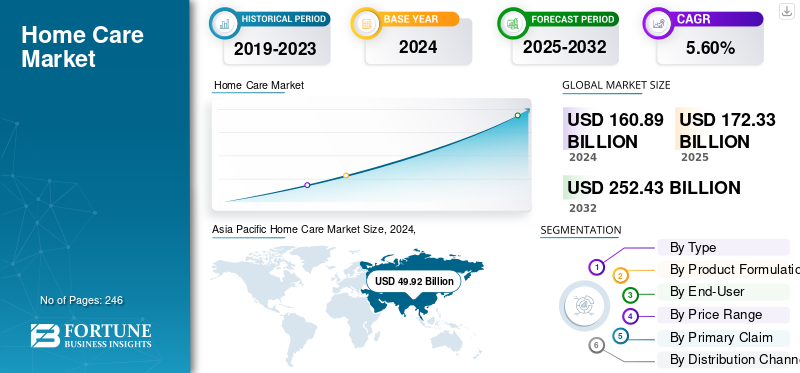
Download Free sample to learn more about this report.
Home Care Market KEY TAKEAWAYS
 Market Size & Forecast
- 2025 Market Size: USD 172.33 billion
- 2026 Market Size: USD 183.78 billion
- 2034 Forecast Market Size: USD 280.03 billion
- CAGR: 5.41% from 2026–2034
 Market Share
- Asia Pacific dominated the home care market with a 31.40% share in 2025.
- The fabric care segment is projected to hold a leading market share of 50.08% in 2026.
- The liquid segment is projected to hold a leading market share of 49.12% in 2026.
 Key Regional Highlights
Asia Pacific
Valued at USD 54.11 billion in 2025, driven by rapid urbanization, expanding e-commerce, and rising demand for branded home care products.
Europe
Valued at USD 49.29 billion in 2025, driven by increasing demand for eco-friendly formulations and supportive sustainability regulations.
North America
Valued at USD 39.55 billion in 2025, supported by growing demand for premium, convenient, and sustainable home care products.
U.S.
Projected to reach USD 33.64 billion by 2026, supported by strong demand for premium and fragrance-focused home care products.
Japan
Projected to reach USD 8.85 billion by 2026, driven by rising demand for premium and innovative home care products.
Read More

MARKET DYNAMICS
MARKET DRIVERS
Expanding Commercial and Institutional Infrastructural Facilities to Drive Market Growth
The growing infrastructure facilities related to the commercial and institutional sectors, including hotels, restaurants, and healthcare facilities, which require significant usage of surface cleaning and disinfectant products, are driving the global home care market growth. Hospitality settings essentially use dish care and surface cleaner items to maintain clean and hygienic bed occupancy rooms and dining areas. The rising number of international travelers and the evolving global tourism industry are favoring product revenue growth worldwide. According to the Dubai Department of Economy and Tourism (DET), Dubai, UAE, is expanding its commercial facilities, with hotel inventory expected to reach 154,016 rooms across 832 establishments in 2024, up from 150,291 rooms in 2023.
MARKET RESTRAINTS
Increased Competition from Private Label Manufacturers to Hamper the Market Growth
High competition from local industry manufacturers and private label brands offering products at discounted rates poses challenges to the key players’ product revenue growth, thereby restraining global market growth. Additionally, the growing number of household cleaning product retailers producing and promoting their own products at lower prices is intensifying market competition across many countries.
MARKET OPPORTUNITIES
Increasing Preference for Premium-based Home Products to Augment Product Demand
Due to their ease of use, sprays, liquids, and pods of home cleaning and air care items are gaining popularity over traditional product formats, including powders and bars. These formats are sold are premium prices, compared to traditional formats. Rising consumer demand for new formats of household care items is creating new business growth opportunities in the global markets. Furthermore, the rising number of upper-income household groups and their spending on products with superior functionality and sensory appeal is driving the global demand for home-based products.
MARKET CHALLENGES
Supply Chain Disruption and Volatility in Raw Material Prices to Impact Key Players’ Business Revenue Growth
Supply chain disruptions, including shipping delays, container shortages, and logistic instability due to incidents of war and natural calamities, are expected to pose challenges to key players conducting international business operations. In addition, volatility in raw material prices and fluctuating costs of surfactants, fragrance compounds, and resins are negatively impacting the production efficiencies of industry manufacturers.
HOME CARE MARKET TRENDS
Brands Aligning Their Home Product Launches with Wellness Positioning to Favor Market Growth
Consumers prefer scented, mood-enhancing, and stress-releasing home products. The increasing number of international brands promoting their products with aromatherapy and wellness positioning is positively contributing to global product revenue growth. In addition, the increasing number of brands producing scented products formulated with essential oils and nature-inspired fragrances that create a calm and fresh environment nearby is accelerating product demand among spa and hospitality consumers.
Download Free sample to learn more about this report.
Segmentation Analysis
By Type
High Demand for Detergent for Cloth Washing Activities Led the Fabric Care Segment
By type, the market is segregated into fabric care, surface care, dish care, air care, and others.
The fabric care segment exhibited a leading global home care market share of 50.08% in 2026. The widespread adoption of fabric care items, including detergents, fabric softeners, and other products, for daily laundry activities. The segment is projected to maintain its leading position throughout the forecast period from 2026 to 2034. Furthermore, the rising washing machine ownership rate and advancements in the development of liquid & concentrated detergents, unit-dose pods, and others are favoring the growth of fabric care product revenue.
To know how our report can help streamline your business, Speak to Analyst
The increasing need to maintain a hygienic kitchen environment and the adoption of efficient surface-cleaning surfactants and kitchen cleaning sprays are driving the dish care segment at the fastest CAGR of 6.94% during the forecast period of 2026-2034. Additionally, the increasing adoption of automatic dishwashers, which necessitate the extensive use of detergents, gels, and powders for dish cleaning, is driving segmental revenue growth.
By Product Formulation/Format
Versatility and Ease of Use of Liquid-Based Cleaning Products Led Dominance of the Liquid Segment
Based on product formulation/format, the market is categorized into liquid, powder, unit dose/capsules, sprays & aerosols, and others.
The liquid segment is projected to hold a leading global market share of 49.12% by 2026. Liquids are widely used across multiple home goods, including fabric care, dish care, and surface cleaning. The liquid segment’s leading share is attributed to the versatility, ease of use, and superior performance of liquid-based cleaning products compared to products in other formats. Additionally, the growing number of manufacturers introducing concentrated and refillable liquid formulations, which offer superior cleaning and care performance compared to their counterparts, is accelerating the segment’s growth.
Consumers use capsule and pod forms of products due to their pre-measured dosing, which simplifies cleaning routines. The rising adoption of modern dish care, fabric care, and air care appliances, along with advancements in the development of unit-dose pods using eco-friendly, water-soluble film technologies and fragrance-enhanced formulations, is expected to accelerate the unit-dose/capsule segment at the fastest rate of 8.68% during the forecast period of 2026-2034. Additionally, the increasing incidence of chronic diseases and consumer preference toward unit-dose formulations of air care products is favoring the segment’s growth.
By End-User
High Households’ Demand for Home Products & Utilities Led the Dominance of the Household Segment
Based on end-user, the market is bifurcated into household and commercial/institutional.
High household demand for home products and utilities, necessary for maintaining daily home care routines, led the household segment to hold a leading global market share of 89.20% in 2026. The segment is projected to maintain a leading position throughout the forecast period of 2026-2034. The rising demand for personalized care and wound care solutions, growing urbanization, and the increasing number of single-person households are favoring the growth of the household segment.
Rising infrastructural facilities related to hospitality settings, healthcare facilities, educational institutions, and public settings, which require the use of facility care goods, are driving the commercial/institutional segment at the fastest rate of 6.69% during the forecast period of 2026-2034. Additionally, the governmental implementation of cleanliness and hygiene standards has increased the demand for institutional cleaning products, thereby favoring the growth of the commercial/institutional segment.
By Price Range
Affordability and Broader Accessibility of Mass-produced Goods Led Dominance of the Value/Mass Segment
Based on price range, the market is segmented into value/mass, mid-range, and premium.
A large base of consumers prioritizes cost-effective cleaning products that fulfill their daily home hygiene needs. Broader affordability and accessibility to mass-produced products for consumers led the value/mass segment to hold a leading global market share of 53.79% in 2026. The segment is projected to maintain its leading position throughout the forecast period of 2026-2034. In addition, consistent supermarket and department store provision of discounted, value-priced home care staples, including liquid and powder detergents, is driving product revenues from this price range segment.
Rising demand from middle-income and upper-income household consumers for premium-priced, high-performance, sustainable, and convenient cleaning solutions accelerates premium segmental growth at the fastest rate of 6.37% during 2026-2034. In addition, the growing number of sustainable brands offering eco-friendly products, often at premium prices, drives segmental growth worldwide.
By Primary Claim
Significant Demand for Cleaning Products in Everyday Cleaning Needs Led Dominance of the Cleaning Segment
Based on the primary claim, the market is segmented into cleaning, disinfecting/antibacterial, stain removal/whitening, deodorizing/fragrance, eco-friendly/sustainable, and multi-purpose categories.
Consumers purchase cleaning products more frequently for their basic fabric, dish, and surface cleaning needs. High demand for cleaning products to meet everyday hygiene needs results in the cleaning segment holding a leading market share of 38.43% in 2026. In addition, the rising demand for stain & grease remover oils and liquids from manufacturing and other industrial facilities for equipment/machinery cleaning activities favors the growth of the cleaning segment.
Rising consumer spending on products that deliver enhanced sensory experiences and long-lasting scents is primarily accelerating the deodorizing/fragrance segment at the fastest rate of 8.54% during 2026-2034. Consistent manufacturers’ production of scented products equipped with aromatherapy-inspired formulations, essential oils, and other premium ingredients is positively contributing to the growth of the deodorizing and fragrance segment.
By Distribution Channel
Greater Availability of the Curated Product Selections Led the Specialty Stores Segment’s Dominance
Based on distribution channel, the market is segmented into supermarkets & hypermarkets, convenience/grocery stores, specialty stores/brand stores, online channels, pharmacy stores, wholesale stores, and others.
The wide availability of a greater assortment of products, ranging from mass to premium prices, at supermarkets resulted in the supermarkets & hypermarkets segment holding a leading global market share of 37.98% in 2026. In addition, the consistent provision of discounted products by supermarket shops is augmenting product demand and sales from these stores.
The rising adoption of online shopping for consumer products and the growing trend of personalized shopping experiences among consumers are driving the online/e-commerce segment at a rate of 6.77% during the forecast period of 2026-2034. Furthermore, increasing demand for subscription-based online home delivery services of staples favors the segment’s revenue growth.
Home Care Market Regional Outlook
By region, the market is categorized into North America, Europe, Asia Pacific, South America, and Middle East & Africa.
Asia Pacific
In 2025, the Asia Pacific market stood at USD 54.11 Billion, representing 31.40% of global demand, and is projected to grow to USD 58.39 Billion in 2026. Growing urbanization, a rising number of middle-income consumer groups, and expanding retail infrastructure facilities in China, India, and Southeast Asia are driving market growth in these countries. Furthermore, the growing number of e-commerce platforms offering branded products, combined with the increasing number of online shoppers, is favoring product revenue growth in the region.
Asia Pacific Home Care Market Size, 2025, (USD Billion)
To get more information on the regional analysis of this market, Download Free sample
The Japan market is estimated to reach USD 8.85 billion by 2026, and the India market is estimated to reach USD 11.97 billion by 2026.
The China market is estimated to reach USD 25.78 billion by 2026. Rapid urbanization, rising disposable incomes, and a strong shift toward modern retail and e-commerce have made China's market one of the biggest and fastest-growing in the Asia Pacific region. Particularly in the areas of fabric and surface care, consumers are increasingly switching from conventional powders to liquid and premium formats. The demand for disinfecting and fragrance-enhancing products has increased as a result of the pandemic's acceleration of growing hygiene awareness. While international brands are making significant investments in localization and eco-friendly product lines to capitalize on the changing consumer base, domestic players such as Blue Moon are aggressively growing. The widespread use of internet marketplaces including Tmall and JD.com further increases the size of the Chinese home healthcare market.
Europe
Europe contributed approximately USD 49.29 Billion to the global market in 2025, accounting for 28.60% share, and is expected to reach USD 52.14 Billion in 2026. The rising demand for home care goods with eco-friendly & sustainable formulations is generating significant product revenues across Europe. In addition, the imposition of regulations by governmental authorities on the sale of chemical-based products is creating new opportunities for companies to expand their business activities.
The UK market is estimated to reach USD 7.39 billion by 2026, while the German market is estimated to reach USD 9.1 billion by 2026.
North America
The market in North America reached USD 39.55 Billion in 2025, representing 22.95% of total market revenue, and is projected to reach USD 42.05 Billion in 2026. Increasing U.S. and Canadian consumer demand for premium, convenient, and fragrance-focused products, along with the emerging sustainability trend, is driving market growth in these countries. In addition, the growing expansion of retail shops offering goods at discounted rates is positively contributing to product sales growth in Canada and Mexico. The U.S. market is estimated to reach USD 33.64 billion by 2026.
South America
Over the forecast period of the global home healthcare market size, the market in the South America and Middle East & Africa regions is expected to witness a moderate growth rate from 2025 to 2032. The South America market generated USD 15.3 Billion in 2025, representing 8.88% of the global market landscape, and is expected to reach USD 16.14 Billion in 2026.
The Latin American market is primarily driven by price-sensitive consumers, who have a strong reliance on value and mass-market products, such as powders and basic liquid detergents. Urbanization and the expansion of retail infrastructure are gradually supporting the adoption of premium and eco-friendly formats. Brazil remains the dominant market, with growing demand in surface care and dish care categories.
Middle East & Africa
The Middle East & Africa market is expanding steadily, supported by urban population growth, rising hygiene awareness, and infrastructure development, especially in the GCC region. Value products still dominate demand, although premium and fragrance-led segments are gaining traction in urban centers such as Dubai and Riyadh. The market is also benefiting from the expansion of modern retail and increased institutional cleaning requirements. Middle East & Africa maintained a strong presence in the global market, reaching USD 14.08 Billion in 2025, accounting for 8.17% share, and is expected to reach USD 15.07 Billion in 2026.
COMPETITIVE LANDSCAPE
Key Industry Players
Consistent Efforts of Distribution Network Building and Portfolio Expansion to Maintain Market Position
The global market is characterized by the leading players, including The Procter & Gamble Company, Unilever Plc., Reckitt Benckiser Group Plc., Henkel AG & Co. KGaA, and Colgate-Palmolive Company. These companies focus on expanding their product portfolio and broadening their distribution network to strengthen product sales and maintain a global market position.
LIST OF KEY HOME CARE COMPANIES PROFILED
- The Procter & Gamble Company (U.S.)
- Unilever Plc. (U.K.)
- Reckitt Benckiser Group Plc. (U.K.)
- Henkel AG & Co. KGaA (Germany)
- Colgate-Palmolive Company (U.S.)
- Church & Dwight Co., Inc. (U.S.)
- The Clorox Company (U.S.)
- Kao Corporation (Japan)
- LG Household & Health Care Ltd. (South Korea)
- Blue Moon Group Holdings Limited (China)
KEY INDUSTRY DEVELOPMENTS
- October 2025: Henkel introduced a sustainable, water-saving aircraft cleaner, Bonderite C-AK DW 805 AERO, which removes grease and contaminants without requiring water rinsing, making it suitable for both aircraft and surface cleaning.
- April 2025: Unilever launched Cif Infinite Clean, a probiotic spray / bioscience-based cleaning product, in the U.K. The launch marks Unilever’s strategic push toward bioscience-driven, sustainable home care solutions, aiming to reduce chemical load while enhancing cleaning efficacy and surface protection over time.
- April 2025: Henkel launched new concentrated formulas for its All, Persil, and Snuggle liquid laundry lines, increasing the dose concentration by ~16% and incorporating 50% recycled plastic into the packaging.
- April 2025: Henkel unveiled Smartwash technology at CES 2025, an AI-driven, cartridge-based dosing system for laundry and dish care, aiming to transform the automated detergent dosing process.
- April 2024: Unilever launched Wonder Wash as its largest Home Care innovation, specifically designed for short-cycle laundry usage.
REPORT COVERAGE
The global home care market analysis provides an in-depth study of market insights, size, and forecast by all the market segments included in the report. In addition, the report on the home care market outlooks market dynamics and market trends expected to drive the market in the forecast period. It offers information on the technological advancements, new product launches, key industry developments, and details on partnerships, mergers & acquisitions. The home care market research report also encompasses a detailed competitive landscape with information on the market share and profiles of key operating players.
Request for Customization to gain extensive market insights.
Report Scope & Segmentation
| Attributes | Details |
|
Study Period |
2021-2034 |
|
Base Year |
2025 |
|
Estimated Year |
2026 |
|
Forecast Period |
2026-2034 |
|
Historical Period |
2021-2024 |
|
Unit |
Value (USD Billion) |
|
Growth Rate |
CAGR of 5.41% from 2026 to 2034 |
| By Type |
|
| By Product Formulation/Format |
|
| By End-User |
|
| By Price Range |
|
| By Primary Claim |
|
| By Distribution Channel |
|
| By Region |
|
Frequently Asked Questions
Fortune Business Insights says that the global market value stood at USD 183.78 billion in 2026 and is projected to reach USD 280.03 billion by 2034.
In 2025, the market value stood at USD 54.11 billion.
The market is expected to exhibit a CAGR of 5.41% during the forecast period of 2026-2034.
The fabric care segment led the market by type.
The expansion of commercial and institutional infrastructure facilities is driving the global market.
The Procter & Gamble Company, Unilever Plc., Reckitt Benckiser Group Plc., Henkel AG & Co. KGaA, and Colgate-Palmolive Company are some of the prominent players in the market.
Asia Pacific dominated the market in 2025.
The increasing preference for premium home products with newer formulation formats is expected to favor higher product adoption rates.



- 2021-2034
- 2025
- 2021-2024
- 246
-
(Offer valid till 30th Sep 2026)
Get 30-60 hrs Free Customization
Expand Regional and Country Coverage, Segments Analysis, Company Profiles, Competitive Benchmarking, and End-user Insights.



















Related Reports
-
US +1 833 909 2966 ( Toll Free )
-
Get In Touch With Us