Dehydrated Food Market Size, Share & Industry Analysis, By Product Type (Dehydrated Fruits, Dehydrated Vegetables, Dehydrated Seafood, Dehydrated Dairy Products, and Others), By Dehydration Technology (Spray-Dried, Freeze-Dried, Sun-Dried, Vacuum-Dried, and Others), By Nature (Conventional and Organic), By Application (Food Processing [Bakery & Confectionery, Ready Meals & Convenience Foods, Soups, Sauces & Seasonings, Dairy & Beverage Formulations, and Others], Nutraceuticals & Dietary Supplements, Foodservice/HoReCa, and Household/Retail Consumption), and Regional Forecast, 2026-2034
 Download Free Sample
(Offer valid till 15th Aug 2026)
Dehydrated Food Market Size & Industry Overview
 Listen to Audio Version
The global dehydrated food market size was valued at USD 76.27 billion in 2025. The market is projected to grow from USD 79.92 billion in 2026 to USD 113.86 billion by 2034, exhibiting a CAGR of 4.52% during the forecast period. Asia Pacific dominated the dehydrated food market with a market share of 35.99% in 2025.
Dehydrated food refers to food products in which moisture content is reduced through drying technologies such as sun drying, spray drying, freeze drying, vacuum drying, and air drying to extend shelf life, reduce microbial activity, improve storage stability, and lower transportation weight. The category includes dehydrated fruits, vegetables, seafood, dairy products, herbs, spices, meat-based ingredients, instant meal components, soup mixes, sauce ingredients, snack inclusions, and powdered food formulations.
The market is supported by strong consumer demand from food processing companies, ready-meal manufacturers, bakery and confectionery producers, dairy and beverage formulators, nutraceutical brands, foodservice operators, and retail consumers. Dehydrated ingredients are widely preferred as they retain usability over longer periods, reduce cold-chain dependency, simplify inventory management, and help manufacturers maintain year-round access to seasonal raw materials.
The global market is supported by leading companies and ingredient suppliers such as Nestlé S.A., Olam Food Ingredients, Van Drunen Farms, European Freeze Dry, and Sun-Maid Growers of California. They maintain active positions across dehydrated fruits, vegetables, dairy powders, freeze-dried inclusions, dried ingredients, and food formulation solutions.
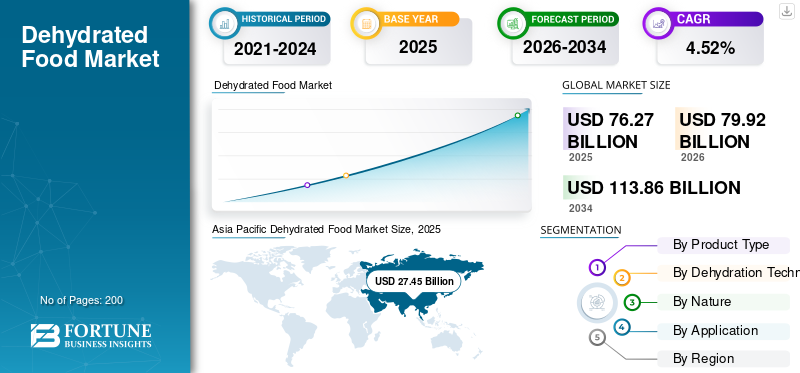
Download Free sample to learn more about this report.
Dehydrated Food Market Key Takeaways
 Global Market Size & Forecast
- 2025 Market Size: USD 76.27 billion
- 2026 Market Size: USD 79.92 billion
- 2034 Forecast Market Size: USD 113.86 billion
- CAGR: 4.52% from 2026–2034
 Market Share
- Asia Pacific dominated the dehydrated food market with a 35.99% share in 2025.
- The dehydrated fruits segment is projected to grow at the fastest CAGR of 6.07% during the forecast period.
- The freeze-dried segment is projected to grow at the fastest CAGR of 6.17% during 2026–2034.
 Key Regional Highlights
Asia Pacific
Asia Pacific Valued at USD 27.45 billion in 2025 and is projected to reach USD 45.53 billion by 2034, registering the fastest CAGR of 5.74%.
North America
North America Valued at USD 17.92 billion in 2025 and is projected to reach USD 24.97 billion by 2034.
Europe
Europe Valued at USD 19.85 billion in 2025 and is projected to reach USD 26.28 billion by 2034.
U.S.
Dominated the North American market with a value of approximately USD 13.87 billion in 2025.
Japan
Japan is expected to witness steady growth, driven by increasing demand for convenient and premium dehydrated food products.
Read More

Dehydrated Food Market Trends
Rising Demand for Shelf-stable, Lightweight, and Clean-label Food Ingredients to Shape Industry Trends
A major trend shaping the market is the shift from conventional preservation toward shelf-stable, clean-label, and formulation-friendly food ingredients. Food manufacturers are increasingly using dehydrated fruits, vegetables, seafood powders, dairy powders, and ready meals inclusions as these ingredients reduce water activity, improve storage life, and support enhanced product consistency across bakery, confectionery, soups, sauces, seasonings, beverages, dairy formulations, cereals, snacks, and meal kits.
Dehydrated vegetables are gaining strong relevance in soups, sauces, noodles, seasoning blends, instant meals, and institutional foodservice as they offer strong rehydration properties, lower wastage, and easier bulk handling. Dehydrated dairy products remain the largest product type due to the wide use of milk powder, whey powder, skimmed milk powder, and dairy ingredients across bakery, beverages, desserts, nutrition products, and processed foods.
- For instance, in August 2025, J&K Ingredients acquired certain intellectual property and related assets from NuTek Natural Ingredients, a company specializing in clean-label ingredient innovation. J&K stated that the deal strengthens its clean-label preservative and freshness technology platform for bakery and food applications.
MARKET DYNAMICS
Market Drivers
Download Free sample to learn more about this report.
Rising Need to Reduce Food Loss and Improve Shelf Stability is Fueling Market Growth
One of the strongest drivers for the global dehydrated food market growth is the need to reduce spoilage across highly perishable categories such as fruits, vegetables, dairy, seafood, and prepared foods. Dehydration reduces water activity, slows microbial growth, and improves product stability, which makes it useful for manufacturers, retailers, specialty stores, exporters, foodservice operators, and other distribution channels. Food loss is particularly relevant for fruits and vegetables as they are seasonal, moisture-rich, and highly exposed to post-harvest deterioration. Drying converts short-life raw materials into stable ingredients that can be used in soups, sauces, snacks, bakery products, breakfast cereals, dietary supplements, and retail packs.
- According to the UN Environment Programme (UNEP) 2024, 13.2% of food is lost globally after harvest and before retail, while a further 19% is wasted at retail, foodservice, and household levels, showing the scale of the wastage problem that preservation technologies can help address.
Market Restraints
Rehydration Quality, Nutrient Loss, and High Processing Cost Limit Wider Adoption
One major restraint for the global market is the difficulty of maintaining fresh-like taste, texture, aroma, color, and nutrition after drying. Some fruits and vegetables may darken, shrink, harden, lose volatile aroma compounds, or show weak rehydration performance depending on the drying method used. Seafood and dairy ingredients also require strict control of moisture, fat oxidation, flavor stability, and packaging conditions to avoid quality deterioration during storage.
Processing cost is another limitation, especially for freeze-dried and vacuum-dried products. Freeze-drying offers better quality retention but requires higher energy use, longer processing time, advanced equipment, and higher capital investment. As a result, freeze-dried products are more common in premium snacks, baby food, nutraceuticals, emergency foods, and high-value food ingredients rather than low-cost mass-market products.
Market Opportunities
Freeze-dried Snacks, Functional Powders, and Organic Dehydrated Foods to Create New Market Growth Potential
One major opportunity in the global market is the expansion of freeze-dried snacks, fruit and vegetable powders, organic dehydrated products, and nutrition-focused dried ingredients. Consumers are increasingly looking for convenient products that offer fruit, vegetable, protein, fiber, and natural ingredient positioning without refrigeration. This supports demand for freeze-dried berries, dried mango, apple chips, vegetable crisps, powdered greens, soup mixes, dairy-based nutrition powders, and clean-label snack inclusions.
- For instance, in November 2025, Balance of Nature launched a new Freeze-Dried Fruit Snacks product line under its Mouthwatering Snacks range. The products are available in four fruit varieties: Pineapple, Mango, Strawberry, and Banana. This launch reflects growing product development around simple-ingredient, shelf-stable fruit snacks.
SEGMENTATION ANALYSIS
By Product Type
Dehydrated Dairy Products Dominated Market Due to Their Strong Use in Bakery, Beverages, and Processed Food Formulations
Based on product type, the market is segmented into dehydrated fruits, dehydrated vegetables, dehydrated seafood, dehydrated dairy products, and others.
The dehydrated dairy products segment dominated the global dehydrated food market share. The segment was valued at USD 33.50 billion in 2025, owing to the wide use of milk powder, skimmed milk powder, whey powder, cream powder, and dairy blends in bakery, confectionery, beverages, desserts, nutrition products, sauces, and processed foods. Food manufacturers widely prefer dairy powders as they reduce cold-chain dependency, improve shelf life, support stable formulation performance, and help maintain consistent taste and texture in industrial food applications.
The dehydrated fruits segment is projected to grow at the fastest CAGR of 6.07% during the forecast period.
To know how our report can help streamline your business, Speak to Analyst
By Dehydration Technology
Spray-dried Segment Dominated Market as It Supports Large-scale Production
Based on dehydration technology, the market is segmented into spray-dried, freeze-dried, sun-dried, vacuum-dried, and others.
The spray-dried segment dominated the global market, valued at USD 35.12 billion in 2025, owing to its strong use in dairy powders, fruit powders, flavor carriers, beverage premixes, instant food mixes, and other powdered ingredient systems. Spray drying is widely used by food and beverage manufacturers as it supports large-scale production, cost-efficient drying, consistent particle size, improved solubility, and stable ingredient performance in industrial formulations.
The freeze-dried segment is projected to grow at the fastest CAGR of 6.17% during 2026-2034, driven by premiumization in snacks, functional foods, emergency foods, and high-value food ingredient applications.
By Nature
Conventional Segment Dominated Market Due to Wider Availability, Lower Cost, and Strong Use in Mass Food Processing
Based on nature, the market is segmented into organic and conventional.
The conventional segment dominated the global market in 2025, owing to its wider raw material availability, lower production cost, established sourcing networks, and high usage across mass-market processed foods, foodservice, institutional food supply, and industrial ingredient applications. Conventional dehydrated fruits, vegetables, dairy powders, seafood ingredients, herbs, spices, and seasonings are widely used by large food manufacturers that require consistent quality, predictable supply, and competitive pricing.
The organic segment is projected to grow at the fastest CAGR of 7.40% during 2026-2034, supported by rising consumer preference for minimally processed, chemical-free, traceable, and premium natural food ingredients, especially in North America and Europe.
By Application
Increased Consumption of Dehydrated Ingredients in Food Processing Applications Fueled Segment Growth
Based on application, the market is segmented into food processing, nutraceuticals & dietary supplements, foodservice/HoReCa, and household/retail consumption.
The food processing segment dominated the global dehydrated food market, valued at USD 44.83 billion in 2025, driven by the wide incorporation of dehydrated ingredients across bakery & confectionery, ready meals & convenience foods, soups, sauces & seasonings, dairy & beverage formulations, cereals, snacks, and other packaged food systems. Food manufacturers prefer dehydrated ingredients due to their longer shelf life, ease of handling, lower storage and transportation requirements, and ability to maintain consistent taste, texture, and nutrition across large-scale production. Within food processing, dairy & beverage formulations remained the largest sub-application, valued at USD 11.97 billion in 2025, supported by the broad application of milk powders, whey powders, fruit powders, beverage premixes, flavor carriers, and functional drink ingredients. The segment also benefits from rising demand for instant beverages, protein-enriched formulations, clean-label drink mixes, and convenient dairy-based products that require stable, easy-to-blend powdered inputs.
The nutraceuticals & dietary supplements segment is projected to grow at the fastest CAGR of 7.37% during 2026-2034, supported by growing use of fruit powders, vegetable powders, dairy proteins, botanical powders, and functional nutrition blends.
Dehydrated Food Market Regional Outlook
Regionally, the market is studied across North America, Europe, Asia Pacific, South America, and the Middle East & Africa.
Asia Pacific
Asia Pacific Dehydrated Food Market Size, 2025 (USD Billion)
To get more information on the regional analysis of this market, Download Free sample
Asia Pacific dominated the global market and was valued at USD 27.45 billion in 2025. The region is projected to reach USD 45.53 billion by 2034, growing at the fastest CAGR of 5.74%. Growth is driven by large-scale use of dehydrated vegetables, dairy powders, seafood ingredients, instant food components, dried fruits, seasoning blends, and convenience food ingredients across China, India, Japan, Australia, and the rest of Asia Pacific.
China Dehydrated Food Market
China dominated the Asia Pacific market, valued at approximately USD 11.48 billion in 2025, supported by large-scale processed food manufacturing, instant noodles, soups, sauces, seasonings, dehydrated vegetables, seafood powders, fruit snacks, and foodservice ingredients.
India Dehydrated Food Market
India was valued at approximately USD 5.20 billion in 2025. Growth is supported by strong agricultural production, increasing processed food consumption, rising use of dehydrated onions, garlic, vegetables, spices, dairy powders, ready meals, and foodservice ingredients.
North America
North America was valued at USD 17.92 billion in 2025 and is projected to reach USD 24.97 billion by 2034. The region is expected to grow at a CAGR of 3.73% in the coming years. Growth is driven by demand for dried fruits, dehydrated vegetables, dairy powders, snack inclusions, clean-label foods, camping foods, emergency foods, foodservice ingredients, and nutrition-focused powders across the U.S., Canada, and Mexico.
U.S. Dehydrated Food Market
The U.S. dominates the North American market, valued at approximately USD 13.87 billion in 2025, supported by strong consumption of dried fruits, powdered dairy ingredients, dehydrated vegetables, snack inclusions, shelf-stable meal components, and foodservice ingredients.
Europe
Europe was valued at USD 19.85 billion in 2025 and is projected to reach USD 26.28 billion by 2034. The region is expected to grow at a CAGR of 3.13% in the coming years. Growth is supported by established consumption of dried fruits, dehydrated vegetables, soup ingredients, bakery inclusions, dairy powders, organic food products, and premium snack ingredients.
Germany Dehydrated Food Market
Germany is the largest European country market, valued at approximately USD 4.19 billion in 2025, supported by strong demand for dried fruits, dehydrated vegetables, organic food ingredients, muesli inclusions, bakery ingredients, soups, sauces, dairy powders, and functional food formulations.
U.K. Dehydrated Food Market
The U.K. market was valued at approximately USD 3.34 billion in 2025, driven by demand for ready meals, instant soups, dried fruits, breakfast cereals, bakery inclusions, snack foods, and clean-label retail products. Private-label packaged food development and foodservice growth also support the use of dehydrated ingredients in cost-efficient and shelf-stable formulations.
South America and Middle East & Africa
South America was valued at USD 4.91 billion in 2025. Growth is driven by demand for dried fruits, dehydrated vegetables, dairy powders, seasonings, soups, sauces, and affordable shelf-stable foods across Brazil, Argentina, and the rest of South America.
The Middle East & Africa market was valued at USD 6.15 billion in 2025. Growth is supported by rising demand for shelf-stable foods, dried fruits, dehydrated vegetables, dairy powders, instant meals, soups, seasonings, and foodservice ingredients. The region’s hot climate, import dependence in several countries, and demand for convenience and long shelf-life foods make dehydrated foods important across retail, institutional supply, hospitality, and foodservice channels.
Brazil Dehydrated Food Market
Brazil dominated the South American market, valued at approximately USD 2.81 billion in 2025, supported by processed food production, dairy powders, dried fruits, dehydrated vegetables, soups, seasonings, sauces, and foodservice ingredients.
COMPETITIVE LANDSCAPE
Key Industry Players
Major Companies Focus on Freeze-dried Ingredients, Dairy Powders, and Food Processing Solutions to Strengthen Market Positions
The competitive landscape of the global dehydrated food market is shaped by raw material sourcing, drying technology, food safety standards, moisture control, shelf-life performance, rehydration quality, pricing, and industrial supply capability. Large diversified food companies are active in dairy powders, packaged foods, and shelf-stable ingredients. In contrast, specialized ingredient suppliers focus on freeze-dried fruits, vegetables, herbs, spices, seafood ingredients, and customized food processing solutions.
Companies are investing in clean-label dried ingredients, organic dehydrated products, freeze-dried inclusions for cereals and snacks, dehydrated vegetables for soups and sauces, fruit powders for beverages and nutraceuticals, and dairy powders for bakery, confectionery, and nutrition applications. Van Drunen Farms states that it is one of the largest U.S. growers, manufacturers, and suppliers of freeze-dried, drum-dried, IQF, and specialty products, while European Freeze Dry supplies freeze-dried food ingredients, packaged meals, pet treats, and commission drying services from facilities in Denmark and the U.K.
Key Players in the Dehydrated Food Market
|
Rank |
Company Name |
|
1 |
Nestlé S.A. |
|
2 |
Olam Food Ingredients |
|
3 |
Van Drunen Farms |
|
4 |
European Freeze Dry |
|
5 |
Sun-Maid Growers of California |
List of Key Dehydrated Food Companies Profiled
- Nestlé S.A. (Switzerland)
- Olam Food Ingredients (Singapore)
- Van Drunen Farms (U.S.)
- European Freeze Dry (U.K.)
- Sun-Maid Growers of California (U.S.)
- BCFoods, Inc. (U.S.)
- Döhler Group (Germany)
- Chaucer Foods Ltd. (U.K.)
- Mercer Foods, LLC / Thrive Freeze Dry (U.S.)
- Paradise Fruits Solutions GmbH & Co. KG (Germany)
KEY INDUSTRY DEVELOPMENTS
- May 2026: MicroDried expanded its EnWave REV technology use and planned a state-of-the-art dairy processing facility in Washington State. The expansion supports clean-label, nutrient-dense dairy and mochi ingredients, while MicroDried already operates vacuum-microwave drying lines for fruit and vegetable snack and ingredient production.
- August 2025: Glacial Freeze Dry acquired Foodynamics, a freeze-dry co-manufacturer, to expand capacity and accelerate production for brands at different stages of growth. Glacial positions itself as a private-label freeze-drying contract manufacturer using state-of-the-art freeze-dry technology.
- July 2025: Calbee America launched new packaging and flavors for Shrimp Chips, adding Chili Lime and Roasted Seaweed varieties. Although the product is a snack rather than dried seafood itself, it is relevant to the dehydrated seafood-adjacent segment as shrimp-based seasoning/flavor systems are commonly used in shelf-stable seafood snacks.
- July 2025: Food Empire announced plans to invest USD 37.0 million to expand its spray-dried soluble coffee manufacturing facility in Andhra Pradesh, India. The expansion is expected to begin in Q4 2025, be completed by the end of 2027, and increase facility capacity by about 60%.
- March 2025: BranchOut Food signed a definitive agreement with MicroDried, a supplier of dried fruit and vegetable ingredients. The agreement integrates BranchOut’s GentleDry dehydration technology into MicroDried’s ingredient portfolio and is expected to support large-scale production through BranchOut’s 50,000 sq. ft. Peru facility.
REPORT COVERAGE
The global dehydrated food market industry report analyses the market in depth and highlights crucial aspects such as global market trends, market dynamics, supply chains, prominent companies, investment in research and development, and end-use. Besides this, the report also provides insights into the global market analysis and highlights significant industry developments.
Request for Customization to gain extensive market insights.
Report Scope & Market Segmentation
| ATTRIBUTE | DETAILS |
| Study Period | 2021-2034 |
| Base Year | 2025 |
| Estimated Year | 2026 |
| Forecast Period | 2026-2034 |
| Historical Period | 2021-2024 |
| Growth Rate | CAGR of 4.52% from 2026 to 2034 |
| Unit | Value (USD Billion) |
|
Segmentation |
By Product Type
|
|
By Dehydration Technology
|
|
|
By Nature
|
|
|
By Application
|
|
|
By Region
|
Frequently Asked Questions
Fortune Business Insights says that the global market was valued at USD 76.27 billion in 2025 and is anticipated to reach USD 113.86 billion by 2034.
At a CAGR of 4.52%, the global market will exhibit steady growth over the forecast period.
By nature, the conventional segment led the market.
Asia Pacific held the largest market share in 2025.
The rising need to reduce food loss and improve shelf stability is driving the global market.
Nestle S.A., Olam Food Ingredients, Van Drunen Farms, European Freeze Dry, and Sun-Maid Growers of California are the leading players in the market.
Rising demand for shelf-stable, lightweight, and clean-label food ingredients is a key market trend.



- 2021-2034
- 2025
- 2021-2024
- 200
-
(Offer valid till 15th Aug 2026)
Get 30-60 hrs Free Customization
Expand Regional and Country Coverage, Segments Analysis, Company Profiles, Competitive Benchmarking, and End-user Insights.




















-
US +1 833 909 2966 ( Toll Free )
-
Get In Touch With Us