High Protein Flour Market Size, Share & Industry Analysis, By Source Type (Cereal-Based {Wheat and Oat}, Pulse & Legume-Based {Soy Flour and Chickpea Flour}, and Oilseed & Nut-Based {Almond Flour and Peanut Flour}), By Product Composition (Single-Source, Multi-Source Blend, and Protein-Fortified Blend), By Nature (Conventional and Organic), By Protein Concentration (10%-20%, 20%-<40%, and >40% Protein), By Form (Standard Powder and Ready-To-Use Mix), By Application (Bakery Products, Pasta & Noodles, and Meat Alternatives), and Regional Forecast, 2026-2034
 Download Free Sample
(Offer valid till 15th Aug 2026)
High Protein Flour Market Overview
 Listen to Audio Version
The global high protein flour market size was valued at USD 17.64 billion in 2025. The market is projected to grow from USD 19.58 billion in 2026 to USD 45.03 billion by 2034, exhibiting a CAGR of 10.97% during the forecast period. Asia Pacific dominated the high protein flour market with a market share of 103.68% in 2025.
The global market includes flours made from cereals, pulses, legumes, oilseeds, and specialty crops. These flours are designed to have more protein than regular flour while still working well in bakery, pasta, snacks, nutrition products, and food processing. These flour products help boost protein content and improve nutrition in foods, meeting the demand for protein-enriched options without changing the way people usually eat. The market is expanding as more people are interested in high protein diets, sports nutrition, weight management, products that help them feel full, and nutrition for healthy aging. Demand is highest in bakery, pasta, snacks, and convenience foods, where manufacturers can add more protein without losing taste, texture, or how well the products are made.
Companies such as Ardent Mills, ADM, Nisshin Seifun Group Inc., are the key players in the market. New product launch is the key strategy which is boosting market expansion and supporting the market growth.
Download Free sample to learn more about this report.
high protein flour market TRENDS
Multi-Source Blending, Functional Milling, and Clean-Label Protein Claims Reshape High Protein Flour Innovation
Companies are creating flours tailored for specific uses such as bakery, pasta, noodles, snacks, and nutrition products. More manufacturers are blending different high-protein flours, such as wheat, durum, oats, chickpea, lentil, pea, fava bean, soy, and seeds. This helps them balance protein content, dough performance, flavor, and amino acid quality. Heat-treated, toasted, and pregelled flours are becoming more popular. They help flours absorb more water, taste less raw or beany, and work better during processing. Brands often choose to boost protein using familiar flour ingredients instead of adding isolated protein powders. high protein flour market growth is supported by ready-to-use high protein flour options for bakeries and foodservice operators seeking consistent performance without extensive formulation work.
MARKET DYNAMICS
MARKET DRIVERS
Download Free sample to learn more about this report.
Protein-Enriched Daily Foods and Better-for-You Bakery Reformulation Accelerate Demand for High Protein Flour
High protein flour demand is increasing as food manufacturers are reformulating everyday products such as bread, pasta, noodles, cookies, snacks, wraps, pizza bases, and breakfast foods with higher protein content. High protein flour lets brands boost protein in familiar staple food products, instead of relying on protein powders or supplements. Cereal-based high protein flours work well with current bakery and pasta processes. Pulse and legume-based flours help with plant-based nutrition, add fiber, and support gluten free flour options. Increasing consumer demand for products supporting active nutrition, weight management, and healthy aging is pushing high protein flour into both mainstream and premium product development.
MARKET RESTRAINTS
Functional Performance Trade-Offs and Raw Material Cost Variability Limit Wider Adoption of High Protein Flour
The market faces challenges as increasing protein content can alter dough rheology, texture, taste, water absorption, and finished product quality. Manufacturers often encounter difficulties maintaining the softness of bread, elasticity of dough, machinability of bakery systems, and cooking characteristics of pasta when higher protein flours are incorporated at significant inclusion levels. Using pulse and legume flours can bring beany flavors, a darker color, or a denser texture, so recipes often need to be adjusted. High-protein ingredients usually cost more than regular flour, which puts extra pressure on the budgets of large bakeries and staple food producers.
MARKET OPPORTUNITIES
Protein-Fortified Staple Foods and Plant-Based Nutrition Expansion Create New Growth Opportunities
Significant opportunities are emerging as food manufacturers and health conscious consumers seek to increase protein content in everyday foods without requiring consumers to change consumption habits. High protein flour allows protein enrichment across bread, tortillas, pizza crusts, pasta, noodles, breakfast products, snacks, and baked goods while utilizing existing production infrastructure. Demand is particularly strong in plant-based nutrition, where pulse-, legume-, and blended protein flours help manufacturers improve protein density and amino acid profiles. Multi-source flour blends combining cereals, legumes, and specialty proteins are creating opportunities to balance functionality, nutrition, and sensory performance.
Segmentation Analysis
By Source Type
Strong Bakery Compatibility and Established Milling Infrastructure Propelled Leadership of Cereal-Based High Protein Flour Segment
By source type, the market is segmented into cereal-based high protein flour, pulse & legume-based high protein flour, oilseed & nut-based high protein flour, pseudo-cereal-based high protein flour, and others.
Cereal-based high protein flour segment held the largest high protein flour market share in 2025 as it fits mainstream bakery, pasta, noodle, snack, and processed food manufacturing systems. High-protein wheat and durum flours are especially important since they provide gluten strength, dough elasticity, water absorption, and structure-building performance needed in bread, pasta, pizza bases, wraps, and noodles. Cereal-based flours also benefit from established milling company infrastructure, large-scale sourcing, stable industrial specifications, and stronger familiarity among food manufacturers.
The pulse & legume-based high protein flour holds the second-largest market share, and is expected to grow at a CAGR of 5.34% during the forecast period. Pulse and legume-based high protein flours are the second most popular, as chickpea, lentil, pea, fava bean, lupin, and soy flours provide more protein, extra fiber, and strong plant-based nutrition benefits. These flours are common in gluten-free baking, pasta, noodles, snacks, meat alternatives, nutrition products, and clean-label recipes. They help boost protein and add variety where cereal flours alone may fall short. Food manufacturers prefer pulse and legume flour since it is easier to offer vegan, allergen-friendly, and high-fiber products, while also raising protein levels.
By Product Composition
Simpler Formulation Control and Familiar Ingredient Positioning Boosted Leadership of Single-Source High Protein Flour Segment
Based on product composition, the market is segmented into single-source high protein flour, multi-source high protein flour blend, and protein-fortified flour blend.
Single-source high protein flour segment accounted for the largest market share in 2025 as it allows manufacturers to maintain clearer ingredient identity, simpler labelling, and more predictable processing behavior. High-protein wheat variety, oat, chickpea, lentil, pea, soy, and other single-source flours are widely used where brands want protein enrichment without introducing complex multi-ingredient systems. Industrial bakery, pasta, snack, and nutrition product manufacturers prefer single-source flours as they are easier to qualify, standardize, source, and communicate on product labels. It also reduces formulation complexity by allowing manufacturers to adjust hydration, mixing time, dough strength, texture, and flavor around one primary ingredient base.
Multi-source high protein flour blend makes up the second-largest share of the market and is expected to grow at a CAGR of 5.18% during the forecast period. They allow manufacturers to combine the complementary benefits of cereals, pulses, legumes, oilseeds, and specialty protein sources within a single formulation. These blends are increasingly used in bakery products, pasta, snacks, protein-enriched foods, and nutrition-focused applications where a single flour source may not provide the desired balance of protein content, amino acid profile, dough performance, texture, and flavor.
By Nature
Cost Efficiency and Large-Scale Industrial Availability Led to Dominance of Conventional Segment
By nature, the market is segmented into conventional and organic.
The conventional segment led the global market in 2025 as it is easier to find, costs less, and can be sourced in large amounts for industry, compared to organic options. Food manufacturers who use high protein flour in products such as bread, pasta, noodles, pizza bases, snacks, biscuits, and bakery mixes need a steady supply, reliable prices, and consistent performance. Regular flours made from cereals, pulses, and legumes meet these needs better as they come from well-established farming, milling, and distribution systems.
Organic segment is another major segment that has a CAGR of 6.12% during the forecast period. As it meets the demand for clean-label, minimally processed, and certified natural ingredients. More premium bakery items, organic pasta, healthy snacks, baby foods, and natural retail products now use organic wheat, oat, chickpea, lentil, pea, soy, and specialty grain flours. Brands choose organic high protein flour to show ingredient transparency, highlight sustainability, and make higher-value product claims.
By Protein Concentration
Balanced Protein Enhancement and Strong Product Compatibility Led to 10%–20% Protein Segmental Dominance
By protein concentration, the market is segmented into 10%-20% protein, 20%-<40% protein, and >40% protein.
The 10%-20% protein segment accounted for the largest market share in 2025. It offers a practical balance between adding more protein and keeping the product functional. This range works well for bread, pasta, noodles, pizza bases, cookies, biscuits, wraps, snacks, and bakery mixes. It helps manufacturers boost nutrition without causing major processing problems. Flours in this range usually keep better dough handling, texture, taste, hydration, and machinability than higher-protein options.
The 20%-<40% protein segment accounted for the second largest share in 2025 and is expected to register a CAGR of 5.08% during the forecast period. It is used where manufacturers require stronger protein claims, improved nutritional density, and differentiation from standard flour-based products. This range is especially relevant in protein-enriched pasta, noodles, nutrition bars, sports-focused bakery, high-protein snacks, meat alternatives, and specialty mixes. Pulse, legume, soy, and blended flour systems are common in this concentration range as they can deliver higher protein levels than many conventional cereal flours.
By Processing Method
Longer Shelf-Life and Reduced Number of Microbes Led to Dominance of Conventional Milled Flour Segment
By processing method, the market is segmented into conventional milled flour, defatted flour,
heat-treated / toasted / pregelled flour, sprouted / fermented flour, and protein-fortified processing.
The conventional milled flour segment led the global market in 2025 as these processing methods help flours absorb more water, lower the number of microbes, change how starch behaves, make products last longer, and reduce the raw, grassy, or beany flavors often found in some pulse and legume flours.
Heat-treated / toasted / pregelled flour segment is another major segment that has a CAGR of 5.54% during the forecast period. It is the most widely used and efficient format in the bakery, pasta, noodle, snack, and food processing industries. Manufacturers choose powder flour as it works easily with their current mixing, batching, conveying, and dough-processing systems. They do not need special equipment or changes to their recipes. High-protein wheat, oat, chickpea, lentil, pea, soy, and blended flours are usually sold as powders as they are easy to store, transport, measure, and keep fresh for a long time.
By Application
High-Protein Reformulation in Everyday Baked Foods Bolstered Leadership of Bakery Products Segment
By application, the market is segmented into bakery products, pasta & noodles, snacks & savory products, breakfast & cereal products, meat alternatives & plant-based foods, nutritional & sports nutrition products, infant, toddler & clinical nutrition, pet food & animal nutrition and other food applications.
The bakery products segment led the global market in 2025 as it helps bakeries, foodservice operators, and smaller food manufacturers produce protein-enriched products with reduced formulation complexity. These mixes often combine high protein flour with functional ingredients such as starches, fibers, leavening agents, enzymes, stabilizers, or flavor-balancing components to improve dough handling, texture, and finished product consistency. They are especially useful in protein-enriched bread, pancakes, muffins, cookies, pizza bases, and bakery mixes where users may lack in-house formulation expertise.
Pasta & noodles segment is another major segment that has a CAGR of 5.73% during the forecast period. High protein flour is increasingly used to improve nutritional density in staple carbohydrate categories. Durum wheat, high-protein wheat, chickpea, lentil, pea, soy, and blended flours are used in pasta and noodle formulations to increase protein content while supporting satiety, plant-based nutrition, and better-for-you positioning. Manufacturers value high protein flour in these applications as pasta and noodles can carry stronger nutrition claims without requiring major changes in meal behavior.
To know how our report can help streamline your business, Speak to Analyst
By Form
Ease of Handling and Universal Processing Compatibility Led to Dominance of Standard Powder Flour Segment
By form, the market is segmented into standard powder flour, instantized / agglomerated flour, and ready-to-use high protein flour mix.
The standard powder flour segment led the global market in 2025. This form is the most widely used and efficient option for bakery, pasta, noodle, snack, and food processing industries. Manufacturers choose powder flour as it works easily with their current mixing, batching, conveying, and dough-processing systems. They do not need special equipment or changes to their recipes. High-protein wheat, oat, chickpea, lentil, pea, soy, and blended flours are usually sold as powders. This makes them easier to store, transport, measure, and keeps them fresh longer.
Ready-to-use high protein flour mix segment is another major segment that has a CAGR of 4.92% during the forecast period. It helps bakeries, foodservice operators, and smaller food manufacturers produce protein-enriched products with reduced formulation complexity. These mixes often combine high protein flour with functional ingredients such as starches, fibers, leavening agents, enzymes, stabilizers, or flavor-balancing components to improve dough handling, texture, and finished product consistency. They are especially useful in protein-enriched bread, pancakes, muffins, cookies, pizza bases, and bakery mixes where users may lack in-house formulation expertise.
By End User
Industrial Food Manufacturers Segment Led Owing to Large-Scale Reformulation Needs and Bulk Procurement
By end user, the market is segmented into industrial food manufacturers, commercial & artisanal bakeries, foodservice operators / HoReCa, retail / household consumers, and pet food & feed manufacturers.
The industrial food manufacturers segment led the global market in 2025. They use high protein flour in large quantities for bakery products, pasta, noodles, snacks, cereals, nutrition products, and convenience foods. These manufacturers need flour with consistent protein content, uniform particle size, predictable dough behavior, reliable water absorption, and steady supply to keep product quality high in large batches. High protein flour is especially important for manufacturers who are changing regular products into healthier, high-protein, plant-based, or more filling options.
Commercial & artisanal bakeries segment is another major segment that has a CAGR of 5.01% during the forecast period. They use high protein flour to create differentiated breads, cookies, muffins, pizza bases, pancakes, wraps, pastries, and health-focused baked goods. These users value high protein flour for its ability to support better-for-you positioning while maintaining craft, freshness, and product variety. Artisanal bakeries often use cereal-, pulse-, and blended high protein flours to develop premium breads, gluten-free baked goods, and plant-based bakery products.
high protein flour market Regional Outlook
By geography, the market is categorized into Europe, North America, Asia Pacific, South America, and the Middle East & Africa.
Asia Pacific
Asia Pacific High Protein Flour Market Size, 2025 (USD Billion)
To get more information on the regional analysis of this market, Download Free sample
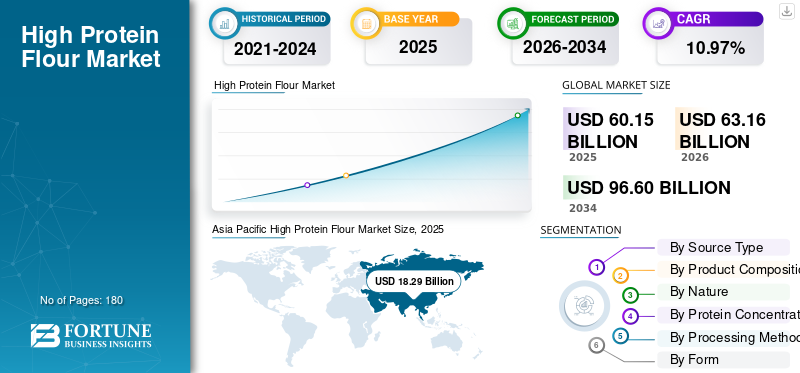
Asia Pacific is the leading region and was valued at USD 18.29 billion in 2025. The growth is driven by more people looking for protein-rich bakery items, noodles, pasta substitutes, snacks, breakfast mixes, and plant-based foods. China, India, Japan, South Korea, Australia, and those in Southeast Asia all add to the demand, each influenced by their own food traditions and local ingredients. Wheat and cereal-based flours remain important in bakery and noodles, while chickpea, lentil, pea, soy, mung bean, and rice-protein flour systems are gaining relevance in health-positioned foods. India’s familiarity with pulse flours gives it an advantage. In China and Southeast Asia, growth comes from noodles, bakery chains, and new snack recipes. The market’s growth relies on affordable prices, adapting flavors to local tastes, flour performance, and the ability to source ingredients regionally at scale.
India high protein flour market
The market was valued around USD 5.03 billion in 2025, accounting for roughly 8.36% of global market revenues.
China high protein flour market
China’s market was valued around USD 5.75 billion in 2025, representing roughly 9.56% of global market share. The market is expanding through protein-enriched bakery, noodles, steamed bread, snack products, breakfast foods, and plant-based food innovation. High-protein wheat flour remains the dominant ingredient as it integrates easily into noodles, buns, bakery products, and convenience foods that are widely consumed across the country. Soy, pea, mung bean, chickpea, and other legume-based flours are increasingly incorporated into health-positioned foods, protein snacks, and alternative protein formulations. Manufacturers are actively exploring high protein flour to address growing consumer interest in nutrition, satiety, and functional foods without requiring major dietary changes.
Japan high protein flour market
The Japanese market reached a valuation of around USD 1.24 billion in 2025, accounting for roughly 2.06% of global market revenues.
North America
The market in North America reached a valuation of USD 12.76 billion in 2025. North America is growing due to protein-rich bakery items, healthier snacks, pasta substitutes, breakfast foods, and new functional food ideas. The U.S. is leading demand in the region as bakeries, pasta brands, snack makers, and health-focused food companies update their products to include more protein. In Canada, demand is increasing due to more clean-label bakery products, a rise in plant-based foods, and greater availability of pulse flours. Suppliers who offer consistent flour quality, neutral flavors, and support for product applications are in a stronger position.
U.S. high protein flour market
In 2025, the U.S. market reached USD 9.33 billion. The U.S. market is well established, due to strong demand for protein-enriched bakery items, snacks, pasta alternatives, breakfast mixes, and functional foods. Food manufacturers use high-protein wheat, oat, chickpea, pea, lentil, almond, and soy flours to create new versions of breads, wraps, cookies, pancakes, pizza bases, protein bars, and healthier snacks. People’s interest in feeling full, managing weight, staying active, and eating fewer refined carbs is helping these products become more popular.
Europe
The European market reached a valuation of USD 15.39 billion in 2025. The market is influenced by long-standing bakery traditions, popular pasta dishes, a move toward clean-label products, and growing interest in plant-based nutrition. Germany, Italy, France, the U.K., Spain, and the Nordic countries are the main areas where demand is highest. High-protein wheat and durum flours help make bread, pasta, pizza bases, and other baked goods with the textures people expect. Flours made from pulses and legumes such as chickpeas, lentils, peas, and fava beans, are becoming more popular in gluten-free baking, protein-rich pasta, and plant-based foods. European manufacturers focus on using natural ingredients, and meeting nutrition claim regulations for added health benefits. The market grows fastest when high protein flour makes foods healthier while still delivering the traditional quality people expect.
Germany high protein flour market
The market in Germany reached USD 2.58 billion in 2025, representing roughly 5.24% of global market revenues. The market is driven by strong demand from bakeries, a preference for clean-label products, and interest in protein-rich breads, rolls, snacks, and plant-based foods. High-protein wheat and rye flours are still important since they work well in traditional breadmaking and help with dough structure, fermentation, and texture.
Pulse-based flours such as pea, chickpea, lentil, and fava bean are becoming more popular in gluten-free baking, protein pasta, and meat alternatives.
U.K. high protein flour market
The U.K. market demand reached USD 1.66 billion in 2025, equivalent to around 4.28% of global market sales.
South America and Middle East & Africa
South America’s market is developing through bakery products, pasta, snacks, breakfast foods, and nutrition-focused food reformulation. Brazil is the largest market due to its extensive bakery industry, growing health-conscious consumer base, and increasing demand for protein-enriched packaged foods. Argentina, Chile, and Colombia play a role in the market by focusing on bakery, pasta, and specialty nutrition products. Wheat-based high protein flour is still the most common since it fits well with current bread, biscuit, and pasta production. At the same time, flours made from soy, pea, chickpea, and other legumes are becoming more popular in plant-based and functional foods. The South America market in 2025 recorded USD 4.65 billion.
Middle East & Africa region reached a valuation of USD 9.06 billion in 2025. The market is emerging through bakery modernization, protein-enriched staple foods, premium health foods, and growing demand for functional nutrition products. The UAE, Saudi Arabia, South Africa, and Egypt are the primary markets due to expanding bakery industries, increasing health-conscious consumer segments, and rising adoption of protein-fortified foods. High-protein wheat flour is still the most common ingredient. It blends well into bread, flatbreads, pastries, pizza bases, and other bakery products that are important in local diets.
UAE high protein flour market
UAE market is set to grow at a CAGR of 4.69% during the forecast period. The UAE market is emerging through premium bakery, functional foods, protein-enriched snacks, health-focused breakfast products, and foodservice applications. High-protein wheat flour remains important in breads, pastries, pizza bases, wraps, and bakery mixes as it fits existing production systems and regional consumption habits. Pulse-based flours such as chickpea, lentil, and pea are gaining relevance in clean-label, plant-based, and high-fiber products.
COMPETITIVE LANDSCAPE
Key Industry Players
Protein-Enriched Bakery and Pasta Reformulation Intensifies Competition Among Cereal, Pulse, and Specialty Flour Suppliers
The global high protein flour market is fragmented. Companies compete based on protein content, central milling quality, gluten performance, neutral flavor, price, and how well the flour fits different uses. Wheat based high protein flour are ahead by offering high-protein wheat, durum, oat, and specialty grain flours that work well in traditional bakery and pasta production. Suppliers of pulse and legume flours compete by offering chickpea, lentil, pea, fava bean, and soy flours. These support plant-based, gluten-free, and clean-label protein claims. Blended flour developers are also becoming more competitive. They mix cereals with pulses or seeds to improve amino acid balance and how the flour performs. Suppliers with technical application support, stable sourcing, and customized flour specifications are better positioned to secure long-term industrial bakery, pasta, snack, and nutrition product contracts.
LIST OF HIGH PROTEIN FLOUR COMPANIES PROFILED IN REPORT
- Ardent Mills (U.S.)
- ADM (U.S.)
- Nisshin Seifun Group Inc. (Japan)
- GoodMills Group GmbH (Austria)
- Manildra Group (Australia)
- Roquette Frères (France)
- Ingredion Incorporated (U.S.)
- AGT Food and Ingredients Inc. (Canada)
- Limagrain Ingredients (France)
- Bay State Milling Company (U.S.)
KEY INDUSTRY DEVELOPMENTS
- September 2024: EQUII, the leader in complete protein innovation, announced a manufacturing and distribution partnership with Bridor, a French baking company, to supply premium protein-packed yeast flour to produce bakery products.
- February 2024: Amfora launched its initial commercial offerings of the first generation of the company’s ultra-high plant protein products. The first three products launched by the company include Amfora Ultra-High Protein Soy flour, Texturized Vegetable Protein, and Crisps.
- June 2023: Ardent Mills launched two new products, Ardent Mills Egg Replace and Ancient Grains Plus Baking Flour Blend, in the market. The company designed these innovative, cost-effective solutions to meet evolving consumer preferences for quality ingredients.
- March 2023: Aashirvaad launched high protein flour in the Indian market. The new product is named “Aashirvaad Atta with high protein”.
- February 2022: Benson Hill, Inc. launched TruVail, a new line of domestically sourced, non-GMO plant-based protein ingredients with unique sustainability benefits. The products sold under this brand include high-protein soy flour, a less processed equivalent to soy protein concentrate (SPC), and texturized proteins for broad use.
REPORT COVERAGE
The global high protein flour market report provides an in-depth study of market size & forecast by all the market segments included in the report. The market analysis includes details on the market dynamics and market trends expected to drive the market during the forecast period. It offers information on the technological advancements, supply chain, new product launches, key industry developments, and details on partnerships, mergers & acquisitions. The market forecast also encompasses detailed competitive landscape with information on the market segmentation, market share, and market research of profiles of key operating players.
Request for Customization to gain extensive market insights.
Report Scope & Segmentation
| ATTRIBUTE | DETAILS |
| Study Period | 2021-2034 |
| Base Year | 2025 |
| Estimated Year | 2026 |
| Forecast Period | 2026-2034 |
| Historical Period | 2021-2024 |
| Growth Rate | CAGR of 10.97% from 2026-2034 |
| Unit | Value (USD Billion) |
| Segmentation | By Source Type, By Product Composition, By Nature, By Protein Concentration, By Processing Method, By Form, By Application, By End User, and By Region |
| By Source Type |
|
| By Product Composition |
|
| By Nature |
|
| By Protein Concentration |
|
| By Processing Method |
|
| By Form |
|
| By Application |
|
| By End User |
|
| By Region |
|
Frequently Asked Questions
Fortune Business Insights says that the global market value stood at USD 60.15 billion in 2025 and is projected to reach USD 96.60 billion by 2034.
In 2025, the Asia Pacific’s market value stood at USD 18.29 billion.
The market is expected to exhibit a CAGR of 5.45% during the forecast period.
By application, bakery products segment led the global market in 2025.
Protein-enriched daily foods and better-for-you bakery reformulation accelerate demand for high protein flour.
Ardent Mills, ADM, and Nisshin Seifun Group Inc. are the top players in the market.
Asia Pacific held the largest market share in 2025.
Multi-Source blending, functional milling, and clean-label protein claims reshape high protein flour innovation.



- 2021-2034
- 2025
- 2021-2024
- 180
-
(Offer valid till 15th Aug 2026)
Get 30-60 hrs Free Customization
Expand Regional and Country Coverage, Segments Analysis, Company Profiles, Competitive Benchmarking, and End-user Insights.




















Related Reports
-
US +1 833 909 2966 ( Toll Free )
-
Get In Touch With Us