Software Defined Vehicles (SDV) Market Size, Share & Industry Analysis, By Automation Level (Level 1, Level 2, Level 3, Level 4, and Level 5), By Application (ADAS & Autonomous Driving, Infotainment & Connectivity, Powertrain & Battery Management, Telematics & Fleet Management, and OTA Software Updates), By Vehicle Type (Hatchback/Sedan, SUV, LCV, and HCV), By Level of Software Centralization (Distributed ECU-Based Architecture, Domain Controller Architecture, Zonal Architecture, and Centralized Vehicle Computing Architecture), and Regional Forecast, 2026–2034
 Download Free Sample
(Offer valid till 15th Aug 2026)
Software Defined Vehicle Market Size & Industry Overview
 Listen to Audio Version
The global Software Defined Vehicles (SDV) market size was valued at USD 62.57 billion in 2025. The market is projected to grow from USD 75.58 billion in 2026 to USD 307.74 billion by 2034, with a CAGR of 19.2% over the forecast period. Asia Pacific dominated the software defined vehicle market with a market share of 43.68% in 2025.
Software defined vehicles are vehicles whose core functions, performance, safety, connectivity, infotainment, diagnostics, and user experience are controlled and upgraded via software. They use centralized computing, sensors, cloud connectivity, artificial intelligence, and over-the-air updates to add features, improve efficiency, enhance safety, and extend vehicle value throughout the vehicle’s lifecycle. Growing EV adoption, demand for connected mobility, ADAS expansion, OTA software updates, and centralized vehicle computing are driving market growth. Automakers are shifting from hardware-led platforms to software-led architectures to reduce development cycles, enable recurring revenue, improve safety, and support personalized digital experiences across passenger and commercial vehicles.
Major players include Tesla, Volkswagen CARIAD, Mercedes-Benz, NVIDIA, Qualcomm, and Bosch. The key trend is platform consolidation of SDV, with OEMs and investments by suppliers for vehicle operating systems, zonal architectures, AI-based Advanced Driver Assistance Systems (ADAS), cloud-connected cockpits, OTA updates, and software monetization.
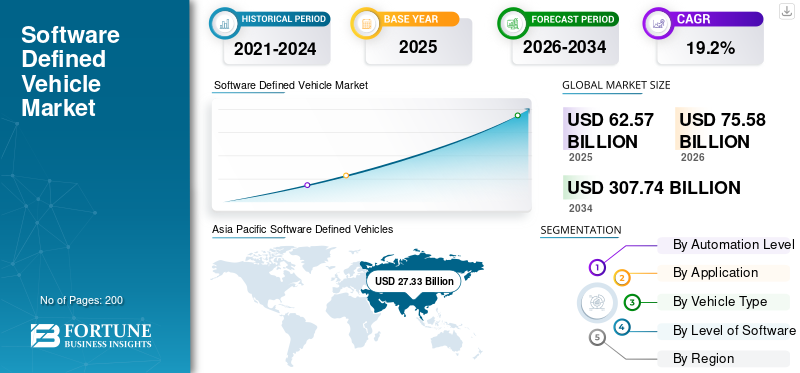
Download Free sample to learn more about this report.
Software Defined Vehicle Market Key Takeaways
 Global Market Size & Forecast
- 2025 Market Size: USD 62.57 billion
- 2026 Market Size: USD 75.58 billion
- 2034 Forecast Market Size: USD 307.74 billion
- CAGR: 19.2% from 2026–2034
 Market Share
- Asia Pacific dominated the Software Defined Vehicles market with a 43.68% share in 2025.
- Level 4 (high automation) segment is projected to grow at a 31.2% CAGR.
- Powertrain & battery management segment is projected to grow at a 22.1% CAGR.
 Key Regional Highlights
North America
North America is driven by connected vehicles, ADAS adoption, EV penetration, and autonomous driving investments.
Europe
Europe is advancing through stringent safety regulations, vehicle electrification, cybersecurity, and software-centric architectures.
Asia Pacific
Asia Pacific leads the market due to high vehicle production, rapid EV adoption, and investments in autonomous and connected mobility.
U.S.
The market is expected to reach USD 14.21 billion in 2026, supported by strong connected vehicle and autonomous technology adoption.
Japan
The market is expected to reach approximately USD 4.54 billion in 2026, driven by investments in software-defined and connected vehicles.
Read More

SOFTWARE DEFINED VEHICLES (SDV) MARKET TRENDS
Shift from Distributed ECUs To Centralized Computing Architectures to Reshape Vehicle Design
Automakers are moving from many distributed ECUs toward domain-, zonal-, and central compute /centralized-computing architectures to simplify wiring, reduce complexity, and enable faster software deployment. This trend supports vehicle-wide updates, common software platforms, and scalable feature development across models. It also allows OEMs to integrate ADAS, cockpit, powertrain, connectivity, and remote diagnostics into fewer high-performance computing units. In March 2025, BMW stated that its Neue Klasse would use four superbrains and a zonal wiring harness architecture which is 30% lighter and uses 600 fewer meters of cable.
MARKET DYNAMICS
MARKET DRIVERS
Download Free sample to learn more about this report.
Expanding ADAS and Connected Services Accelerates the SDV Adoption
ADAS, connected cockpit, and cloud-linked vehicle services are increasing the software value per vehicle. Consumers now expect navigation, voice assistants, real-time diagnostics, remote features, driver assistance, and continuous improvements after purchase, boosting the Software Defined Vehicles (SDV) market growth. OEMs are also using software platforms to generate recurring revenue from subscriptions and feature activation. Commercial fleets are adopting telematics and predictive maintenance to reduce downtime and improve utilization. In December 2024, GM said it would prioritize advanced driver assistance systems and build on Super Cruise, which was offered on more than 20 GM models and logged over 10 million miles per month.
MARKET RESTRAINTS
High Software Development Cost and Integration Complexity to Restrict Adoption
SDV development requires a large investment in operating systems, middleware, cybersecurity, validation, cloud based infrastructure, semiconductor platforms, and skilled software engineering. Traditional automakers face challenges integrating legacy ECUs with new centralized platforms, while ensuring functional safety, cybersecurity, and regulatory compliance. Delays or software defects can increase warranty costs and reduce customer trust, slowing down the adoption amongst lower-cost vehicles in emerging markets. In 2025, UNECE Regulation 155 emphasized processes for monitoring, detecting, and responding to cyberattacks and vulnerabilities, increasing the compliance burden for connected vehicle platforms.
MARKET OPPORTUNITIES
OTA-Enabled Feature Monetization Opens New Revenue Streams
OTA software updates enable automakers to sell upgrades, unlock features, improve safety functions, and extend vehicle lifecycle value without physical service visits. This enables subscription-based ADAS, V2X communication, infotainment enhancements, range optimization, performance upgrades, and fleet software services. Suppliers also gain opportunities in OTA platforms, cybersecurity, cloud management, and vehicle operating systems. In March 2026, Volvo Cars launched its largest OTA update, rolling out a new user experience to millions of customers.
MARKET CHALLENGE
Cybersecurity, Software Recalls, and Data Governance to Intensify Execution Risk
As vehicles become software-driven and cloud-connected, they face higher exposure to cyberattacks, software bugs, data privacy concerns, and update failures. Automakers must secure vehicle networks, continuously validate software, protect user data, and maintain traceable software update systems. Any failure can affect safety, brand reputation, and regulatory approval. The challenge grows as vehicles integrate third-party apps, AI assistants, OTA updates, and autonomous features. In 2025, the UK Vehicle Certification Agency stated that UNECE R155 covers cybersecurity management systems and R156 covers vehicle software update management systems.
Segmentation Analysis
By Automation Level
Increasing Integration of Advanced Driver Assistance Functions Strengthens Leadership of Level 2 (Partial Automation)
Based on automation level, the global market is segmented into Level 1 (Driver Assistance), Level 2 (Partial Automation), Level 3 (Conditional Automation), Level 4 (High Automation), and Level 5 (Full Automation).
Level 2 (Partial Automation) dominates the global market due to the widespread deployment of adaptive cruise control, lane centering, automatic emergency braking, and traffic-assist systems across passenger vehicles. Automakers increasingly integrate multiple ADAS functions into mainstream models, making Level 2 the most commercially viable and regulatory-ready automation category. The combination of enhanced safety, affordability, and consumer acceptance continues to support its leading position.
The Level 4 (high automation) segment is projected to grow at a CAGR of 31.2% over the forecast period. In April 2025, Mercedes-Benz expanded the availability of its DRIVE PILOT Level 3 automated driving system in Germany, highlighting the automotive industry's progress toward higher levels of automation.
By Application
Expanding Demand for Vehicle Safety and Autonomous Functionality to Fuel ADAS Software Segment’s Dominance
Based on application, the market is segmented into ADAS & autonomous driving, infotainment & connectivity, powertrain & battery management, telematics & fleet management, and OTA software updates.
ADAS & autonomous driving is the dominant segment, driven by increasing demand for vehicle safety, driver assistance technologies, autonomous functionality, and intelligent mobility solutions. These software platforms require substantial computing power, sensor fusion, artificial intelligence, and continuous software updates, making them the highest-valued application within SDVs. Growing regulatory emphasis on collision avoidance and vehicle safety further accelerates the adoption.
The powertrain & battery management segment is projected to grow at a CAGR of 22.1% over the forecast period. The UNECE Regulation No. 156 requires vehicle manufacturers implementing software updates, including Over-the-Air (OTA) updates to maintain an approved Software Update Management System (SUMS). This regulation has become a foundational requirement for SDV deployment in multiple automotive markets.
By Vehicle Type
Strong Penchant for Premium Features and Advanced Connectivity Drives Software Integration in SUV
Based on vehicle type, the market is segmented into hatchback/sedan, SUV, LCV, and HCV.
SUVs account for the largest share and is projected to grow at a CAGR of 21.4% over the forecast period. This is owing to strong consumer demand for premium features, advanced connectivity, digital cockpits, OTA updates, and sophisticated ADAS functions. Manufacturers frequently introduce new software architectures, centralized computing systems, and autonomous-driving features first on SUV platforms owing of their higher profit margins and technology-oriented customer base. The increasing popularity of electric SUVs further enhances software content per vehicle. In March 2025, Hyundai unveiled its next-generation software-centric electric SUV platform featuring advanced OTA capabilities and integrated vehicle computing systems.
The HCV segment is projected to grow at a CAGR of 19.0% over the forecast period, making it the second-fastest-growing segment. In March 2025, Volvo Trucks introduced enhanced software based services for its heavy-duty truck portfolio, expanding connected fleet capabilities, predictive maintenance, and remote vehicle management through its digital services platform.
To know how our report can help streamline your business, Speak to Analyst
By Level of Software Centralization
Usage of Legacy Vehicle Electronic Control Units Sustains the Distributed ECU Architecture’s Dominance
Based on the level of software centralization, the market is segmented into distributed ECU-based architecture, domain controller architecture, zonal architecture, and centralized vehicle computing architecture.
Distributed ECU-based architecture remains the dominant segment due to its extensive deployment across existing global vehicle fleets and current production platforms. Most vehicles still use multiple dedicated electronic control units to manage individual functions, such as braking, steering, infotainment, and powertrain operations. The large installed base of conventional architectures continues to generate significant software and maintenance requirements.
The centralized vehicle computing architecture segment is projected to grow at a 31.0% CAGR over the forecast period. In October 2024, Stellantis introduced its STLA Brain platform, designed to consolidate vehicle functions through centralized software and computing architecture, supporting future software-defined vehicle development.
Qualcomm disclosed that its automotive design-win pipeline reached approximately USD 45 billion in 2024, reflecting strong OEM investment in connected vehicles, digital cockpits, ADAS platforms, and software-defined architectures.
SOFTWARE DEFINED VEHICLES (SDV) MARKET REGIONAL OUTLOOK
By geography, the market is categorized into Europe, North America, Asia Pacific, South America, and Middle East & Africa.
NORTH AMERICA
Asia Pacific Software Defined Vehicles (SDV) Market Size, 2025 (USD Billion)
To get more information on the regional analysis of this market, Download Free sample
North America remains a significant regional market, supported by high connected vehicle penetration, advanced ADAS deployment, strong EV adoption, and significant investments in autonomous driving technologies. The region benefits from the presence of major OEMs and technology providers, including General Motors, Ford, Tesla, NVIDIA, Qualcomm, and Aptiv. OTA software updates, centralized computing architectures, and fleet digitalization are accelerating the market expansion. The U.S. remains the primary contributor, while support from Canada and Mexico is bolstered through vehicle manufacturing, commercial fleet connectivity, and software-enabled mobility solutions.
U.S. Software Defined Vehicles (SDV) Market
The U.S. dominates the North American market and is expected to reach USD 14.21 billion in 2026. The country benefits from strong deployment of OTA platforms, advanced driver assistance systems, cloud-connected vehicles, and software monetization strategies. Tesla, General Motors, Ford, NVIDIA, Qualcomm, and numerous autonomous vehicle developers continue to drive innovation. Growing adoption of software-defined EVs and increasing investments in centralized vehicle computing further strengthen the country's leadership position.
EUROPE
Europe represents one of the most technologically advanced markets globally, driven by stringent safety regulations, increasing electrification, connected vehicle adoption, and software-centric vehicle architectures. Regional automakers are investing heavily in vehicle operating systems, OTA capabilities, cybersecurity, and zonal architectures. Germany, U.K., France, Italy, and Spain are collectively supporting the regional growth. The transition toward software-defined electric vehicles and compliance with cybersecurity and software update regulations continues are accelerating the SDV deployment across the region.
GERMANY Software Defined Vehicles (SDV) Market
Germany remains the market in Europe, accounting for approximately 28.2% of the regional market. The country's leadership stems from the presence of Volkswagen Group, Mercedes-Benz, BMW, Bosch, Continental, and ZF. Significant investments in centralized computing architectures, autonomous driving software, vehicle operating systems, and EV platforms continue to drive SDV adoption. Germany serves as the primary innovation hub for next-generation software-defined mobility solutions in Europe.
U.K. Software Defined Vehicles (SDV) Market
The U.K. market is expected to generate approximately USD 2.44 billion in in 2026. Connected vehicle development, autonomous mobility testing programs, software engineering expertise, and increasing EV adoption support growth. The country is strengthening its position through investments in artificial intelligence, automotive software platforms, cybersecurity solutions, and intelligent transportation systems, making it one of Europe's key centers for SDV development.
ASIA PACIFIC
Asia Pacific dominates the global Software Defined Vehicles (SDV) market share due to its massive vehicle production base, rapid EV adoption, expanding connected mobility ecosystem, and strong government support for smart transportation technologies. China, Japan, South Korea, and India are leading the regional growth through investments in autonomous driving, battery management software, digital cockpits, and centralized vehicle architectures. The region benefits from high-volume vehicle manufacturing, increasing software content per vehicle, and rising consumer demand for connected mobility solutions.
CHINA Software Defined Vehicles (SDV) Market
China dominates the Asia Pacific market with approximately 60.3% regional market share. The country's leadership is supported by its position as the world's largest vehicle producer and EV market. Strong adoption of connected vehicles, intelligent cockpits, autonomous driving technologies, OTA platforms, and software-centric EV architectures continues to accelerate SDV deployment. Domestic automakers and technology companies are heavily investing in software-driven mobility ecosystems.
INDIA Software Defined Vehicles (SDV) Market
India is projected to grow at a CAGR of 23.1% during the forecast period, making it one of the fastest-growing markets globally. Rising passenger vehicle production, increasing adoption of connected features, expanding EV sales, and growing deployment of telematics solutions support the regional market expansion. Software-enabled fleet management, digital cockpits, and OTA capabilities are increasingly being integrated into both passenger and commercial vehicle platforms.
JAPAN Software Defined Vehicles (SDV) Market
Japan is expected to reach approximately USD 4.54 billion in the market in 2026. The country benefits from strong automotive software expertise, advanced ADAS deployment, connected mobility solutions, and investments in autonomous driving technologies. Leading automakers are actively developing software-defined architectures, centralized computing systems, and cloud-connected vehicle platforms, supporting the country's position as a major SDV innovation hub in the Asia Pacific.
SOUTH AMERICA
South America is experiencing a steady growth in the global market, supported by rising connected vehicle adoption, increasing EV penetration, fleet digitalization, and growing deployment of telematics platforms. Vehicle manufacturers are gradually introducing advanced software functionalities, ADAS features, and connectivity solutions across passenger and commercial vehicles. Brazil remains the dominant regional market, while Argentina, Chile, and Colombia continue to benefit from increasing software-enabled mobility investments and imported software-rich vehicle platforms.
BRAZIL Software Defined Vehicles (SDV) Market
Brazil dominates the South American market with approximately 61.1% regional market share. The country's leadership is supported by the region's largest vehicle production and sales base. Increasing adoption of connected vehicles, telematics platforms, fleet management solutions, and software-enabled EVs continues to drive market expansion. Growth in vehicle connectivity and digital mobility services further strengthens Brazil's dominant position within the regional SDV ecosystem.
MIDDLE EAST & AFRICA
The Middle East & Africa market is expanding as governments increasingly invest in smart mobility, intelligent transportation systems, connected vehicle infrastructure, and autonomous driving initiatives. The region benefits from growing EV adoption, premium vehicle demand, and digital transformation programs. Gulf Cooperation Council countries are leading the deployment of software-enabled mobility, while South Africa and Morocco are supporting growth through automotive manufacturing. Investments in connected transportation and smart city programs continue to create long-term SDV opportunities.
UAE Software Defined Vehicles (SDV) Market
The United Arab Emirates is projected to grow at a CAGR of 23.1% during the forecast period. Ambitious smart mobility initiatives, autonomous transportation programs, connected vehicle deployment, and demand for premium, software-rich vehicles are driving the country’s market growth. Government-backed investments in intelligent transportation systems, artificial intelligence, and self-driving technologies continue to position the UAE as one of the most advanced markets for SDV in the Middle East & Africa region.
COMPETITIVE LANDSCAPE
Key Industry Players
Centralized Computing, OTA Ecosystems, and AI-Driven Mobility are Defining Competitive Intensity
The global Software Defined Vehicles (SDV) market competition is characterized by leading automotive OEMs, semiconductor companies, and software platform providers competing through vehicle operating systems, centralized computing architectures, OTA update platforms, AI-enabled driving technologies, and cloud-connected ecosystems. Key players, including Tesla, Volkswagen (CARIAD), Mercedes-Benz, BMW, General Motors, Hyundai Motor Group, NVIDIA, Qualcomm, Bosch, Aptiv, Continental, Mobileye, and Huawei, are developing scalable software stacks, zonal architectures, and high-performance computing platforms. In order to strengthen competitive positioning, companies are investing in autonomous-driving software, digital cockpit platforms, cybersecurity solutions, and subscription-based software monetization business model. Strategic partnerships between automakers and technology providers are accelerating SDV deployment while reducing software development complexity. In January 2025, NVIDIA announced that Toyota Motor Corporation would build next-generation vehicles on the NVIDIA DRIVE AGX platform, supporting advanced safety, autonomous driving, and AI-powered in-vehicle experiences across future software-defined vehicle programs.
LIST OF KEY SOFTWARE DEFINED VEHICLES (SDV) COMPANIES PROFILED
- Tesla, Inc. (U.S.)
- Volkswagen AG – CARIAD (Germany)
- Mercedes-Benz Group AG (Germany)
- Bayerische Motoren Werke AG (BMW Group) (Germany)
- General Motors Company (U.S.)
- Ford Motor Company (U.S.)
- Stellantis N.V. (Netherlands)
- Hyundai Motor Group (South Korea)
- Toyota Motor Corporation – Woven by Toyota (Japan)
- Qualcomm Technologies, Inc. (U.S.)
- NVIDIA Corporation (U.S.)
- Honda Motor Co., Ltd. (Japan)
- Robert Bosch GmbH (Germany)
- Continental AG (Germany)
- Aptiv PLC (Ireland)
KEY INDUSTRY DEVELOPMENTS
- May 2026: Stellantis expanded its collaboration with Applied Intuition to advance STLA Brain, its software platform for simplifying integration and enabling continuous vehicle improvements. The partnership supports a common software foundation across Stellantis technology platforms, faster feature delivery, seamless in-vehicle experiences, and scalable development for AI-defined vehicles.
- May 2026: Elektrobit and ETAS launched an integrated ADAS software foundation combining EB corbos Linux for Safety Applications with ETAS Vehicle Software Platform Suite ADAS profile. The solution targets software-defined vehicles by helping OEMs and suppliers accelerate the safe development, integration, and deployment of ADAS across scalable vehicle platforms.
- March 2026: Hyundai Motor and Kia expanded their strategic partnership with NVIDIA to advance autonomous driving technologies. The collaboration combines Hyundai Motor Group’s software-defined vehicle capabilities with NVIDIA AI and autonomous driving platforms to support scalable Level 2 and above systems, selected vehicle deployment, and Motional robotaxi services.
- January 2026: Volkswagen Group and Qualcomm signed a letter of intent to power next-generation digital driving experiences. The plan includes Qualcomm's high-performance system-on-chips for advanced infotainment within Volkswagen’s software-defined vehicle architecture, developed through its Rivian joint venture, while extending existing collaboration in automated driving technologies.
- January 2026: Qualcomm highlighted new automotive collaborations, including Google, to support next-generation software-defined vehicles and AI-driven personalization. The company reported rapid adoption of the Snapdragon Ride, Cockpit Elite, and Ride Flex platforms, which combine cockpit, ADAS, connectivity, and end-to-end AI capabilities for future vehicle architectures.
REPORT COVERAGE
The global Software Defined Vehicles (SDV) market analysis provides an in-depth study of the market size & forecast across all market segments included in the report. It contains details on market research dynamics and trends expected to drive the market during the forecast period. It offers information on rapid technological advancements, new product launches, key industry developments, strategic partnerships, mergers & acquisitions. The market forecast provides a comprehensive competitive landscape, including the most significant global market shares, emerging opportunities, and profiles of key players.
Request for Customization to gain extensive market insights.
Report Scope & Segmentation
| ATTRIBUTE | DETAILS |
| Study Period | 2021-2034 |
| Base Year | 2025 |
| Estimated Year | 2026 |
| Forecast Period | 2026-2034 |
| Historical Period | 2021-2024 |
| Growth Rate | CAGR of 19.2% from 2026 to 2034 |
| Unit | Value (USD billion) |
| Segmentation | By Automation Level, By Application, By Vehicle Type, By Level of Software Centralization, and By Region |
| By Automation Level |
|
| By Application |
|
| By Vehicle Type |
|
| By Level of Software Centralization |
|
| By Region |
|
Frequently Asked Questions
Fortune Business Insights says that the global market value stood at USD 62.57 billion in 2025 and is projected to reach USD 307.74 billion by 2034.
In 2025, the market value stood at USD 27.33 billion.
The market is expected to grow at a CAGR of 19.2% from 2026 to 2034.
The SUV segment led the market share by vehicle type.
Growing EV adoption, rising demand for connected mobility, ADAS expansion, OTA software updates, and centralized vehicle computing are driving market growth.
Key market players include Tesla, Volkswagen CARIAD, Mercedes-Benz, BMW, GM, Toyota, Hyundai, NVIDIA, Qualcomm, and Bosch.
Asia Pacific region accounted for the largest share of the market in 2025.
North America, Europe, Asia Pacific, South America, and the Middle East & Africa.



- 2021-2034
- 2025
- 2021-2024
- 200
-
(Offer valid till 15th Aug 2026)
Get 30-60 hrs Free Customization
Expand Regional and Country Coverage, Segments Analysis, Company Profiles, Competitive Benchmarking, and End-user Insights.




















-
US +1 833 909 2966 ( Toll Free )
-
Get In Touch With Us