Trade Finance Market Size, Share & Industry Analysis, By Type (Letters of Credit, Supply Chain Finance, Receivables Finance, Guarantees & Standby LCs, Trade Loans, Trade Credit Insurance, and Digital Trade Platforms & Services), By End User (Large Corporates, Mid-market Companies, SMEs, and Financial Institutions), By Trade Type (International and Domestic), and Regional Forecast, 2026–2034
 Download Free Sample
 Trade Finance Market Overview
 Listen to Audio Version
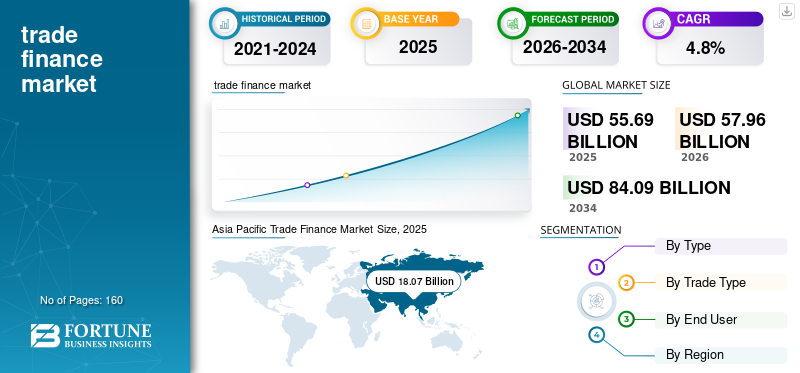
The global trade finance market size was valued at USD 55.69 billion in 2025 and is projected to grow from USD 57.96 billion in 2026 to USD 84.09 billion by 2034, exhibiting a CAGR of 4.8% during the forecast period. Asia Pacific dominated the trade finance market with a market share of 32.45% in 2025.
Trade finance includes the total revenue generated by banks, insurers, export credit agencies, and financial institutions through financing, guaranteeing, insuring, and discounting across borders. Growing import-export activity, the expansion of small and medium-sized enterprises, and diversification of the supply chain are bolstering the growth of the market. The shift toward the digitalization of trade documents and the growing need for supply chain financing are further accelerating market growth. Companies are increasingly concentrating on green finance, ESG-linked, and sustainability-linked trade finance.
- For instance, in February 2025, Finastra launched Assist.AI, an AI-powered assistant for its Trade Innovation solution, using Microsoft Azure OpenAI Service.
Key players such as HSBC Holdings plc, Citigroup Inc., BNP Paribas S.A., Standard Chartered plc, and Deutsche Bank AG are among the key players in the market. These companies are focused on launching new supply chain finance solutions in collaboration with other players to strengthen their market position and increase their market share.
Download Free sample to learn more about this report.
Trade Finance Market Key Takeaways
 Global Market Size & Forecast
- 2025 Market Size: USD 55.69 billion
- 2026 Market Size: USD 57.96 billion
- 2034 Forecast Market Size: USD 84.09 billion
- CAGR: 4.8% from 2026-2034
 Market Share
- Asia Pacific dominated the trade finance market with a 32.45% share in 2025.
- The digital trade platforms & services segment is expected to grow at the highest CAGR of 7.7% during the forecast period.
- The SMEs segment is projected to register the highest CAGR of 5.7% during the forecast period.
 Key Regional Highlights
North America
North America is driven by strong cross-border trade activity and mature banking infrastructure supporting market growth.
Asia Pacific
Asia Pacific leads the market due to its large manufacturing base, export-oriented economies, expanding intra-Asia trade, and strong SME participation in global supply chains.
Europe
Europe is supported by its strong export-oriented industrial base, intra-European trade, and extensive banking support for cross-border commercial activities.
U.S.
The market holds a leading position in North America due to its large import-export base and strong trade ecosystem.
Japan
Increasing international trade activities and advanced financial infrastructure are supporting market expansion.
Read More

TRADE FINANCE MARKET TRENDS
Rising Global Trade Activity and Institutional Funding to Gain Market Momentum
Growing global trade volumes and increasing working capital are supporting the trade finance market growth. Several traditional players, such as banks and NBFCs, are increasing their partnerships with institutional investors to fund trade-related assets. Trade finance assets offer short-term growth that is attractive to institutional investors. Large corporates are looking to improve cash flow and strengthen supplier relationships, while suppliers need faster access to payments. Institutional capital can help expand the funding capacity of these programs, especially when banks seek to manage balance sheet pressure, regulatory capital requirements, or concentration risk.
- For example, in September 2025, Barclays partnered with CGI to integrate CGI Trade360 with Komgo’s Konsole multi-bank trade finance platform. The integration aims to reduce manual data entry, speed up transaction processing, and provide multinational corporate clients with greater transparency across trade finance workflows.
MARKET DYNAMICS
MARKET DRIVERS
Download Free sample to learn more about this report.
Rising Global Import and Export Activity to Support Industry Expansion
The expansion of global import and export activity is a major driver for the market, as businesses increasingly depend on international suppliers, distributors, and customers to support production, procurement, and sales. As cross-border trade volumes grow, companies require secure financing mechanisms such as letters of credit, documentary collections, bank guarantees, trade loans, export credit, and receivables finance to manage payment risks and maintain liquidity throughout the trade cycle. As companies expand into new markets, they increasingly rely on banks, export credit agencies, insurers, and fintech platforms to reduce buyer default risk, improve transaction transparency, and ensure smoother payment settlement. Rising geopolitical tensions, tariff changes, sanctions, and supply chain disruptions are reshaping trade routes and increasing transaction uncertainty, thereby strengthening the need for trade finance solutions.
- For instance, in May 2026, FIS announced that Glencore selected its Supply Chain Finance Platform to support a USD 2.55 billion oil and gas trade receivables securitization program.
MARKET RESTRAINTS
High Cost of Financing and Bank Balance Sheet Constraints to Limit Market Growth
The high cost of financing and bank balance sheet constraints act as a major restraint on the Market, especially for SMEs, emerging-market exporters, and companies operating in high-risk trade corridors. Trade finance depends heavily on banks’ ability and willingness to provide short-term credit, guarantees, letters of credit, receivables finance, and supply chain finance. However, when interest rates remain elevated, borrowing costs for importers and exporters increase, making trade finance less affordable for businesses with limited margins.
MARKET OPPORTUNITIES
Untapped SMEs and MSMEs Trade Finance Demand to Bring Market Opportunities
The untapped SME and MSME trade finance demand represents one of the most significant opportunities in the market, as smaller businesses increasingly participate in import and export activities but continue to face limited access to formal financing. SMEs often require trade finance support for raw material procurement, inventory purchases, export shipments, invoice discounting, receivables financing, and purchase order financing. However, compared to large corporations, they usually have weaker credit histories, limited collateral, lower bargaining power with banks, and insufficient financial documentation.
Digital trade finance platforms can improve access by using alternative data, transaction history, e-invoices, logistics data, buyer payment records, and platform-based risk scoring instead of relying only on collateral-heavy credit assessment.
MARKET CHALLENGES
Limited Interoperability Between Digital Trade Platforms to Hinder Market Development
Limited interoperability between digital trade platforms is a major challenge in the market, as trade finance involves multiple participants, including banks, exporters, importers, insurers, shipping companies, customs authorities, ports, fintech platforms, and logistics providers. Each of these stakeholders often uses different digital systems, documentation formats, compliance processes, and data standards, making it difficult to create a seamless end-to-end digital trade finance workflow.
Segmentation Analysis
By Type
Letters of Credit Segment Dominated the Market Owing to Their Ability to Reduce Payment Risk
Based on type, the market is divided into letters of credit, supply chain finance, receivables finance, guarantees & standby LCs, trade loans, trade credit insurance, and digital trade platforms & services.
Letters of credit dominated the global market in 2025. Letters of credit remain among the most trusted instruments for securing cross-border transactions between buyers and sellers. Their strong adoption is driven by their ability to reduce payment risk, ensure contractual compliance, and provide assurance to both exporters and importers. In international trade, where counterparties may not have long-standing relationships, letters of credit help build confidence by involving banks as payment intermediaries. Large corporates and exporters continue to prefer this instrument for high-value shipments, commodity trade, machinery exports, and transactions involving emerging markets.
The digital trade platforms & services segment is expected to witness the highest growth rate of about 7.7% during the forecast period, owing to a rising shift toward banks, fintech companies, and corporates. These platforms support faster processing of trade documents, digital letters of credit, electronic bills of lading, automated compliance checks, and real-time transaction tracking. Their growth is strongly supported by the need to reduce paperwork, minimize documentation errors, and improve transparency across trade finance operations.
- For instance, in May 2026, Drip Capital partnered with YES BANK at GTR India 2026 to improve trade finance access for Indian MSMEs.
To know how our report can help streamline your business, Speak to Analyst
By End User
Large Corporates Segment Lead the Market Owing to their High-Volume Transactions Trade Activities and Complex Supplier Networks
Based on end user, the market is segmented into large corporates, mid-market companies, SMEs, and financial institutions.
Large corporates dominate the market due to their high-volume international trade activities, complex supplier networks, and strong requirement for structured working capital solutions. These companies frequently use letters of credit, guarantees, receivables finance, supply chain finance, and trade loans to support large-scale procurement, production, and export operations. Their strong credit profiles and long-standing banking relationships allow them to access customized and cost-effective trade finance solutions from global banks.
The SMEs segment is expected to witness the highest growth rate of about 5.7% during the forecast period, as smaller businesses increasingly participate in import-export activities and global supply chains. Many SMEs require financing for raw material procurement, inventory purchase, shipment execution, invoice discounting, and receivables management.
By Trade Type
International Segment Dominated the Market due to Higher Risks in Cross-Border Transactions
Based on trade type, the market is segmented into international and domestic.
The international segment accounted for highest trade finance market share in 2025. The segment dominates the market as cross-border transactions carry higher payment, currency, documentation, and counterparty risks compared to domestic trade. Exporters and importers rely heavily on trade finance instruments such as letters of credit, guarantees, documentary collections, trade loans, and export credit insurance to secure transactions across different countries. International trade often involves longer shipment timelines, customs clearance, foreign exchange exposure, and unfamiliar counterparties, making financing and risk mitigation essential.
The domestic segment is expected to witness the highest growth rate of about 5.1% during the forecast period, as businesses increasingly adopt structured financing solutions for local supply chains, distributor networks, and B2B transactions. Although domestic trade involves lower cross-border risk, companies still face working capital challenges due to delayed payments, inventory financing needs, and extended credit terms.
Trade Finance Market Regional Outlook
By geography, the market is categorized into Europe, North America, Asia Pacific, South America, and the Middle East & Africa.
North America
Asia Pacific Trade Finance Market Size, 2025 (USD Billion)
To get more information on the regional analysis of this market, Download Free sample
The North American market is driven by strong cross-border trade activity, mature banking infrastructure, and the high adoption of supply chain finance among large corporates. The region benefits from deep trade flows across the U.S., Canada, and Mexico, where automotive, energy, agriculture, electronics, machinery, and consumer goods sectors require structured financing for imports and exports. Growing supply chain diversification and nearshoring are also increasing demand for receivables finance, payables finance, guarantees, and trade loans. The region also witnesses strong demand from corporates managing tariff exposure, supplier liquidity, and cross-border payment risks. Overall, North America’s market is supported by resilient trade flows, sophisticated financial institutions, and the rising need for supply chain resilience.
U.S. Trade Finance Market
The U.S. market holds a leading position within North America due to the country’s large import-export base, strong corporate banking ecosystem, and extensive participation of multinational companies in global trade. U.S.-based corporates actively use letters of credit, supply chain finance, receivables finance, trade credit insurance, and guarantees to manage complex global procurement and sales networks.
Europe
The European market is driven by its strong export-oriented industrial base, intra-European trade, and extensive banking support for cross-border commercial activity. Major economies such as Germany, France, the Netherlands, Italy, Spain, and the U.K. rely heavily on trade finance for machinery, automotive, chemicals, pharmaceuticals, energy equipment, food products, and high-value manufactured goods. European companies increasingly require trade finance solutions to manage supplier risk, delayed payments, documentation complexity, and currency exposure across both EU and non-EU trade corridors. Overall, Europe’s market growth is supported by export strength, digitalization, sustainable finance, and the need to manage increasingly complex cross-border trade relationships.
U.K. Trade Finance Market
The U.K.’s market will reach a value of USD 2.16 billion in 2026, representing roughly 3.7% of global revenues.
Germany Trade Finance Market
Germany’s market will reach USD 2.73 billion in 2026, equivalent to around 4.7% of the global sales.
Asia Pacific
Asia Pacific leads the market, driven by its large manufacturing base, export-oriented economies, expanding intra-Asia trade, and strong SME participation in global supply chains. Countries such as China, India, Japan, South Korea, Singapore, Vietnam, Indonesia, Malaysia, and Thailand are major contributors to regional demand across electronics, textiles, automotive, machinery, chemicals, consumer goods, and commodities sectors. Governments and financial institutions are promoting digital trade documentation, e-invoicing, and supply chain finance to improve access and reduce transaction friction. Overall, the Asia Pacific market is driven by manufacturing scale, export intensity, SME financing demand, digital adoption, and regional supply chain restructuring.
India Trade Finance Market
The Indian market will be valued at USD 2.86 billion in 2026, accounting for roughly 4.9% of the global market. Supportive government-led startup initiatives and an increasing digital consumer base are expected to propel market growth in India.
China Trade Finance Market
China’s market is projected to remain dominant in the Asia Pacific region in 2026, with revenues reaching USD 6.75 billion, representing roughly 11.7% of global sales.
ASEAN Trade Finance Market
The ASEAN market in 2026 will reach a value of USD 3.74 billion, accounting for roughly 6.5% of revenues.
South America
Countries such as Brazil, Argentina, Chile, Colombia, and Peru rely heavily on trade finance to support exports of soybeans, coffee, meat, copper, lithium, iron ore, oil, and other commodities. Supply chain finance is also gaining importance as large buyers seek to improve supplier liquidity and stabilize procurement across agriculture, mining, retail, and industrial sectors. Development finance institutions and banks play a key role in supporting trade finance access, particularly for SMEs and mid-sized exporters that face collateral and credit-history constraints.
Brazil Trade Finance Market
The Brazilian market will reach USD 1.63 billion in 2026, representing roughly 2.8% of the global sales.
Middle East and Africa
Trade finance plays a critical role in the Middle East and African regions as businesses often face higher counterparty risk, limited credit access, foreign exchange volatility, and longer settlement cycles. Digital trade platforms and development finance institutions are expected to play a growing role in improving access for SMEs and underserved exporters. Overall, the market is supported by commodity flows, infrastructure-led trade, import financing needs, and the push to strengthen regional supply chains.
GCC Trade Finance Market
The GCC market will reach USD 2.64 billion in 2026, representing roughly 4.5% of the global sales.
COMPETITIVE LANDSCAPE
Key Industry Players
Industry Participants Are Investing in Digital Trade Platforms to Limit Paper Dependency
Key players in the market are adopting strategies focused on digital transformation, supply chain finance expansion, automation, partnerships, and broader access to financing. Several banks and other financial institutions are heavily investing in digital trade platforms to limit paper dependency and improve transaction speed. Players are adopting AI-enabled document verification, automated compliance screening, and fintech partnerships to reduce operational complexity and improve risk assessment. Many institutions are also expanding SME-focused trade finance, sustainable trade finance, and supply chain finance offerings to capture underserved demand and support evolving global trade flows.
- For instance, in July 2025, Bank of America advanced its Digital Trade Network to modernize trade and supply chain finance for corporate clients. The initiative includes Open Account Automation and aims to reduce paper-based workflows, improve data access, and support better credit and financing decisions through AI, APIs, and cloud infrastructure.
LIST OF KEY TRADE FINANCE MARKET COMPANIES PROFILED
- HSBC Holdings plc (U.K.)
- Citigroup Inc. (U.S.)
- JPMorgan Chase & Co. (U.S.)
- BNP Paribas S.A. (France)
- Standard Chartered plc (U.K.)
- Deutsche Bank AG (Germany)
- Santander Group (Spain)
- Digital Check Corp. (U.S.)
- ING Group (Netherlands)
- MUFG Bank, Ltd. (Japan)
KEY INDUSTRY DEVELOPMENTS
- April 2026: Standard Chartered and IFC announced a risk-sharing facility to expand supply chain finance across eight African markets.
- September 2025: Deutsche Bank closed a USD 184 million ECA-backed export credit facility for Thaicom’s subsidiary Space Tech Innovation, alongside Standard Chartered.
- September 2025: HSBC Asset Management launched a Trade and Working Capital Solutions strategy in partnership with HSBC’s Global Trade Solutions business. The strategy gives institutional investors access to trade loans, receivables, and payables finance across regions, reflecting rising private-credit demand for trade finance assets.
- June 2025: BNP Paribas signed an MoU with XTransfer to simplify cross-border trade payments for SMEs, particularly between China and the Eurozone. The collaboration aims to reduce transaction costs, processing time, and foreign-exchange complexity for European SMEs and Chinese exporters.
- January 2025: Citi partnered with CredAble to digitize trade finance controls and strengthen post-disbursement invoice validation. The white-labelled solution is designed to validate invoices against government-backed digital public infrastructure, helping detect inconsistencies in invoice numbers, values, dates, and transport data.
REPORT COVERAGE
The global trade finance market analysis includes a comprehensive study of the market size & forecast by all the market segments included in the report. It includes details on the market dynamics and market trends expected to drive the market over the forecast period. It provides information on key aspects, including an overview of technological advancements, the regulatory environment, and product launches. Additionally, it details partnerships, mergers & acquisitions, as well as key industry developments. The global market research report also provides a detailed competitive landscape with information on the market share and profiles of key operating players.
Request for Customization to gain extensive market insights.
Report Scope & Segmentation
| ATTRIBUTE | DETAILS |
| Study Period | 2021-2034 |
| Base Year | 2025 |
| Estimated Year | 2026 |
| Forecast Period | 2026-2034 |
| Historical Period | 2021-2024 |
| Growth Rate | CAGR of 4.8% from 2026 to 2034 |
| Unit | Value (USD Billion) |
| Segmentation | By Type, Trade Type, End User, and Region |
| By Type |
|
| By Trade Type |
|
| By End User |
|
| By Region |
|
Frequently Asked Questions
According to Fortune Business Insights, the global market value stood at USD 55.69 billion in 2025 and is projected to reach USD 84.09 billion by 2034.
In 2025, the market value stood at USD 18.07 billion.
The market is expected to exhibit a CAGR of 4.8% during the forecast period.
By type, the letters of credit segment dominated the market.
Rising global import and export activity is the key factor driving the market.
HSBC Holdings plc, Citigroup Inc., JPMorgan Chase & Co., BNP Paribas S.A., and Standard Chartered plc are the major players in the global market.
Asia Pacific dominates the market.



- 2021-2034
- 2025
- 2021-2024
- 160
Get 30-60 hrs Free Customization
Expand Regional and Country Coverage, Segments Analysis, Company Profiles, Competitive Benchmarking, and End-user Insights.












Related Reports
-
US +1 833 909 2966 ( Toll Free )
-
Get In Touch With Us