Textile Market Size, Share & Industry Analysis, By Product Type (Technical Textile, Home Textile, Apparel Textiles, and Industrial Textiles), By Textile Form (Synthetic Fibers and Natural Fibers), By Fabric Type (Woven and Non-woven), By End-user (Residential, Commercial (Hospitality, Healthcare, Corporate Offices, and Others)), By Distribution Channel (Specialty Stores, Supermarkets & Hypermarkets, Online Stores, and Others), and Regional Forecast, 2026-2034
 Download Free Sample
(Offer valid till 30th Sep 2026)

KEY MARKET INSIGHTS
 Listen to Audio Version
The global textile market size was valued at USD 1,007.9 billion in 2025 and is projected to grow from USD 1,065.45 billion in 2026 to USD 1,955.50 billion by 2034, exhibiting a CAGR of 7.11% during the forecast period. Asia Pacific dominated the adventure tourism market with a market share of 44.17% in 2025.
Textile products mainly include flexible materials made from natural and synthetic fibers, yarns, and fabrics. The materials can be woven or knitted into different forms and are widely used in clothing, home furnishings, medical use, and other sectors. The increasing consumer shift from traditional synthetic fabric materials toward organic cotton, recycled polyester, and biodegradable fabrics is further driving the global textiles market.
Key companies such as Hengli Textile, Shenzhou International Group Holdings Ltd, Toray Industries, Inc., and Chargeurs SA are focusing on the development of wearable textiles and antibacterial fabrics, which are contributing to the growth of the global textile market. Furthermore, innovations in smart textiles, 3D printing, and automation technologies are further promoting the expansion of the textile industry.
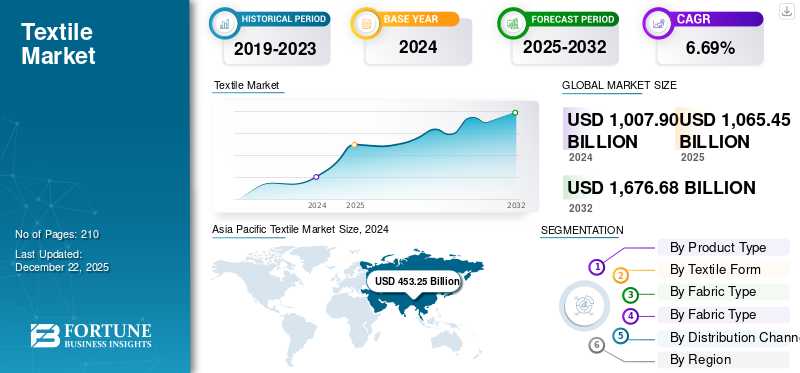
Download Free sample to learn more about this report.
Textile Market Key Takeaways
 Global Market Size & Forecast
- 2025 Market Size: USD 1,007.9 billion
- 2026 Market Size: USD 1,065.45 billion
- 2034 Forecast Market Size: USD 1,955.50 billion
- CAGR: 7.11% from 2026–2034
 Market Share
- Asia Pacific dominated the textile market with a 44.17% share in 2025.
- Synthetic fibers led the textile form segment with a 68.05% share in 2026.
- Residential applications led the end-user segment with a 64.03% share in 2026.
 Key Regional Highlights
Asia Pacific
Asia Pacific led with USD 470.61 billion in 2025 and is projected to reach USD 489.63 billion in 2026.
North America
North America reached USD 274.78 billion in 2025, representing 25.79% of global revenue.
Europe
Europe accounted for 21.12% of the global market in 2025, valued at USD 225.02 billion.
U.S.
The U.S. textile market is projected to reach USD 246.75 billion by 2026.
Japan
Japan’s textile market is valued at USD 40.64 billion by 2026.
Read More

Market Dynamics
Market Drivers
Growing Demand for Technical Textiles from Different Sectors to Foster Market Growth
The expansion of technical textiles is driven by their enhanced functional properties and wide-ranging applications across different industries, such as automotive, agriculture, healthcare, and others. Furthermore, technological advancements in the production of fabric products, including smart, multi-functional, and sustainable fiber products, are expected to drive the textile market growth in the long run. For instance, according to the India Brand Equity Foundation data, published in July 2023, the import value of technical textiles in India reached USD 2.46 billion in FY 2021-2022.
Market Restraints
Fluctuation in the Prices of Cotton to Limit Market Growth
The price instability of cotton acts as a restraining factor for the overall textile market. Cotton is one of the most essential raw materials that is used to produce different types of fabric products. Therefore, when cotton prices rise, fabric manufacturers face increasing production costs, often leading to higher prices of the final products. This situation reduces profit margins, particularly for smaller firms, thus restricting market growth.
Market Opportunities
Rapid Establishment of Online Sales Channels by Textile Manufacturers to Augment Growth
Recently, fabric brands have been leveraging online sales platforms to reach global buyers and distributors, tapping into new markets beyond their traditional reach and overcoming geographical barriers. Digital transformation also enables small manufacturers to diversify their sales channels and attract both buyers and suppliers. For instance, in September 2023, Mango, a European fashion brand, expanded its online sales by launching in twenty-two new markets, particularly across Africa and several emerging regions.
Textile Market Trends
Inclination of Consumers toward Sustainable and Organic Fabrics to Support Market Development
In recent times, consumers have increasingly favored fabrics that reduce environmental impact, such as organic cotton, biodegradable fibers, and recycled materials that help minimize waste. Fabric manufacturers and brands are investing in research and development to innovate new bio-fabricated and circular economy-driven fabrics. This sustainability trend is opening new growth opportunities across markets such as fashion apparel, home textiles, sportswear, and others. For instance, in April 2023, Zara, a global fashion retail company, launched a ‘first of its kind’ women's capsule collection made with recycled polycotton blended textiles, in partnership with Circ, a fashion technology company specializing in recycling polycotton waste.
Download Free sample to learn more about this report.
Segmentation Analysis
By Product Type
Extensive Retail Ecosystem Boosted Apparel Textiles Segment Growth
Based on product type, the market is divided into technical textiles, home textiles, apparel textiles, and industrial textiles.
The apparel textiles segment is expected to dominate the market, capturing a share of 30.30% in 2026. Apparel encompasses a broad range of products and styles for men, women, and kids, supported by advanced manufacturing capabilities and extensive retail ecosystems globally. Continuous innovation in smart clothing products with advanced features is further boosting segment growth.
For instance, according to the India Brand Equity Foundation, in FY 2022, Indian fabrics and apparel exports increased by 41%, reaching a value of USD 44.40 billion in 2022.
The technical textiles segment is expected to grow at the fastest CAGR during the forecast period.
To know how our report can help streamline your business, Speak to Analyst
By Textile Form
Increased Demand for Durable Fibers to Boost the Growth of the Synthetic Segment
Based on textile form, the market is divided into synthetic fibers and natural fibers.
The synthetic fibers segment is expected to hold the majority share of the market, accounting for 68.05% in 2026. Synthetic fibers such as polyester, nylon, and acrylic are more cost-effective to produce compared to natural fibers. Furthermore, these fibers offer superior strength, durability, and elasticity, making them highly suitable for various industrial applications, thus supporting the growth of the segment.
The natural fibers segment is expected to grow at the fastest CAGR of 8.65% during the forecast period.
By Fabric Type
Growing Application of Woven Fabrics Boosts the Growth of the Segment
Based on fabric type, the market is divided into woven and non-woven.
The woven segment is expected to lead the market, accounting for an estimated 66.53% share in 2026. The interlacing of yarns in woven fabrics provides high performance and resistance to wear, making them suitable for apparel and technical textile applications, such as airbags, seat belts, and medical products, boosting the segment growth.
For instance, according to the National Cotton Council of America, textile mills in the U.S. typically manufacture approximately 8 billion square yards of woven cotton goods and 3 billion square yards of knitted cotton goods annually.
The non-woven is estimated to be the fastest-growing segment with a CAGR of 8.43% during the forecast period.
By End-user
Rising Prevalence of Home Décor and Renovations to Boost the Fabric Demand within the Residential Sector
Based on end-user, the market is divided into residential and commercial. The commercial segment is further divided into hospitality, healthcare, corporate offices, and others.
The residential segment is expected to lead the market, accounting for 64.03% in 2026. The increasing consumer spending on home décor and renovations makes textiles a suitable option to upgrade living spaces. Moreover, higher urban populations and increasing disposable income allow consumers to invest in quality and stylish products, further driving growth in the residential sector.
For instance, according to a report published by the Government of India in August 2024, by 2030, it is projected that over 40 percent of India’s population will reside in urban areas.
The commercial segment is expected to grow at the fastest CAGR of 7.98% during the forecast period.
By Distribution Channel
Easy Accessibility Boosts the Growth of Supermarkets/Hypermarkets Segment
Based on distribution channel, the market is divided into specialty stores, supermarkets & hypermarkets, online stores, and others.
The supermarkets/hypermarkets segment led the global market with a share of 37.57% in 2024. Supermarkets/hypermarkets are widely accessible and attract regular foot traffic, making it easier for shoppers to purchase apparel, home textiles, and other fabrics in one place. Additionally, their large-scale buying power allows supermarkets to offer textiles at lower prices, attracting price-sensitive consumers and fueling segment growth.
The online stores segment is expected to grow at the fastest CAGR of 9.79% during the forecast period.
Textile Market Regional Outlook
By region, the global textile market analysis is segmented into North America, Europe, Asia Pacific, South America, and the Middle East & Africa.
Asia Pacific Textile Market Size, 2025 (USD Billion) To get more information on the regional analysis of this market, Download Free sample
Asia Pacific
Asia Pacific dominated the market with a valuation of USD 470.61 billion in 2025 and is projected to reach USD 489.63 billion in 2026. Countries such as China, India, and Bangladesh hold a strong position due to their vast production infrastructure, skilled labor, and abundant raw material supply for textile manufacturing. Supportive trade agreements, foreign direct investments, and low labor costs further enhance the region’s competitiveness. Within the region, Japan is valued at USD 40.64 billion by 2026, while China is expected to reach USD 167.91 billion by 2026.
North America
The North America market was valued at USD 274.78 billion in 2025, capturing 25.79% of global revenue, and is estimated to reach USD 298.61 billion in 2026. Growth is driven by a strong focus on innovation, sustainability, and high-performance textiles. Increasing demand for eco-friendly and smart textiles, supported by environmental regulations and evolving consumer preferences, is boosting the market. The U.S. market is projected to reach USD 246.75 billion by 2026.
Europe
In 2025, Europe held 21.12% of the global market, reaching a valuation of USD 225.02 billion, and is projected to grow to USD 242.05 billion in 2026. Growth is supported by increasing adoption of sustainable and advanced textile solutions. Countries such as the UK and Germany are key contributors, with market values of USD 39.26 billion and USD 46.18 billion respectively by 2026.
South America
South America recorded a market size of USD 65.31 billion in 2025, capturing 6.13% of the global market share, and is projected to reach USD 67.29 billion in 2026. Market growth is driven by expanding populations, increasing urbanization, and the development of local textile production capabilities. Rising investments in the textile sector are further supporting regional expansion.
Middle East & Africa
In 2025, the Middle East & Africa market stood at USD 29.73 billion, representing 2.79% of global demand, and is projected to grow to USD 31.38 billion in 2026. Growth in the region is fueled by rapid urbanization, population growth, and increasing investments in textile manufacturing. The development of local industries and improving production capabilities are contributing to market growth.
Competitive Landscape
Key Market Players
Industry Participants Focus on Product Innovation to Minimize Environmental Impact
Companies in the market are constantly focusing on product innovations, including bio-based, recycled, and biodegradable fabrics to reduce environmental impact. This strategic shift is largely driven by the rising consumer demand for green products, opening new markets, and attracting eco-conscious consumers. Furthermore, rising innovations in recycling and circular production models reduce industry waste and resource use, positioning brands competitively within the market. For instance, in December 2024, Supreme Nonwoven, an Indian company specializing in non-woven solutions, launched the Circuline Innovation Lab, a pioneering initiative aimed at advancing sustainable material design and production in the nonwoven fabric industry.
List of Key Textile Companies Profiled in the Report
- Hengli Textile (China)
- Shenzhou International Group Holdings Ltd (Hong Kong)
- Toray Industries, Inc. (Japan)
- Chargeurs SA (France)
- Far Eastern New Century Corp (Taiwan)
- Albany International Corp (U.S.)
- Coats Group plc (U.K.)
- Zhe Jiang Taihua New Material Co., Ltd (China)
- Alok Industries Ltd (India)
- The Japan Wool Textile Co., Ltd (Japan)
Key Industry Developments
- August 2025 – The Kerala Industries Department of India launched a new online platform to market products from state-run textile public sector undertakings (PSUs), with the aim of modernizing sustainable production, expanding market reach, and boosting profitability for these enterprises.
- June 2025 – Sanathan Textiles Limited, an Indian fabric manufacturing company, marked World Environment Day 2025 with its ‘Plastic-to-Plant’ Exchange Drive, an initiative designed to foster circularity and community-driven climate action.
- May 2025 – TechnoSport, an Indian activewear company, launched its revolutionary Cotflex collection, a sustainable and high-performance activewear line designed for men, women, and children.
- March 2024 – Kyocera, a Japanese ceramics and electronics manufacturer, launched the 'TRUE BLUE TEXTILE' project to promote its ‘Wear to Save Water’ fashion concept, aiming to spotlight the environmental impact of textile production and champion water conservation in the industry.
- March 2024 – Hologenix, a materials science company, expanded its partnership with Decathlon for a second product launch, introducing a new activewear set that integrates Hologenix’s ‘CELLIANT’ infrared technology with ‘REPREVE’ recycled polyester fibers.
REPORT COVERAGE
The market research report provides a comprehensive analysis, focusing on key elements such as major companies, regional and market segmentation, regional analysis, supply chain analysis, competitive dynamics, product types, textile form, fabric type, end-user, and distribution channels. Additionally, it offers insights into market trends and highlights significant developments within the industry. Beyond these aspects, it also examines various factors that have contributed to market growth in recent years.
Request for Customization to gain extensive market insights.
Report Scope & Segmentation
|
ATTRIBUTE |
DETAILS |
|
Study Period |
2021-2034 |
|
Base Year |
2025 |
|
Estimated Year |
2026 |
|
Forecast Period |
2026-2034 |
|
Historical Period |
2021-2024 |
|
Growth Rate |
CAGR of 7.11% from 2026 to 2034 |
|
Unit |
Value (USD Billion) |
|
Segmentation |
By Product Type
By Textile Form
By Fabric Type
By End-user
o Hospitality o Healthcare o Corporate Offices o Others By Distribution Channel
|
|
By Region North America (By Product Type, Textile Form, Fabric Type, End-user, Distribution Channel, and Country) · U.S. · Canada · Mexico Europe (By Product Type, Textile Form, Fabric Type, End-user, Distribution Channel, and Country) · Germany · U.K. · France · Italy · Spain · Rest of Europe Asia Pacific (By Product Type, Textile Form, Fabric Type, End-user, Distribution Channel, and Country) · China · India · Japan · Australia · Rest of Asia Pacific South America (By Product Type, Textile Form, Fabric Type, End-user, Distribution Channel, and Country) · Brazil · Argentina · Rest of South America Middle East & Africa (By Product Type, Textile Form, Fabric Type, End-user, Distribution Channel, and Country) · South Africa · UAE · Rest of Middle East & Africa |
Frequently Asked Questions
Fortune Business Insights says that the global market size stood at USD 1,065.45 billion in 2025 and is anticipated to record a valuation of USD 1,955.50 billion by 2034.
Fortune Business Insights says that the global market value stood at USD 1,007.90 billion in 2025.
The global market will exhibit a CAGR of 7.11% during the forecast period (2026-2034).
By product type, the apparel textiles segment dominates the market.
The growing demand for technical textiles from different sectors is a key factor driving the global market.
Hengli Textile, Shenzhou International Group Holdings Ltd, Toray Industries, Inc., and Chargeurs SA are some of the leading players globally.
Asia Pacific dominated the global market in 2025.



- 2021-2034
- 2025
- 2021-2024
- 210
-
(Offer valid till 30th Sep 2026)
Get 30-60 hrs Free Customization
Expand Regional and Country Coverage, Segments Analysis, Company Profiles, Competitive Benchmarking, and End-user Insights.


















Related Reports
-
US +1 833 909 2966 ( Toll Free )
-
Get In Touch With Us