Asset Management Market Size, Share & Industry Analysis, By Asset Type (Alternative Asset and Traditional Asset), By Client Type (Retail and Institutional), By Strategy (Active and Passive), By Vertical (Energy, Manufacturing, BFSI, Retail, Government, and Others), and Regional Forecast, 2026-2034
 Download Free Sample
Asset Management Market Future Outlook
 Listen to Audio Version
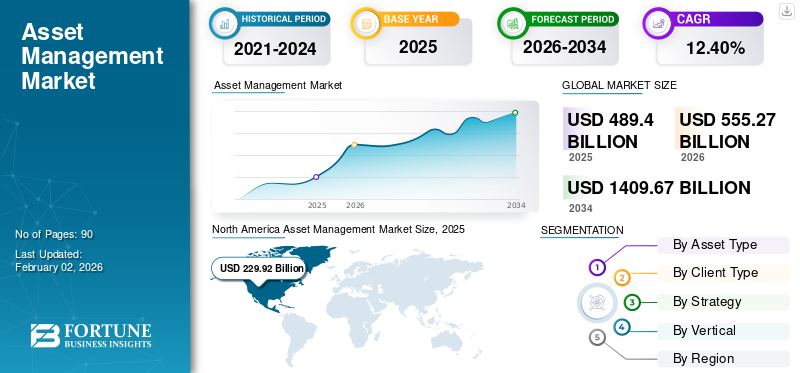
The global asset management market size was valued at USD 432.77 billion in 2025 and is projected to grow from USD 489.40 billion in 2026 to USD 1,122.04 billion by 2034, exhibiting a CAGR of 12.6% during the forecast period. North America dominated the market with a market share 47.00% in 2025. Industry growth is driven by institutional capital expansion, retirement savings accumulation, alternative investment adoption, digital wealth platforms, regulatory transparency, and evolving portfolio diversification strategies.
The market refers to the industry involved in managing investments on behalf of clients, including institutions, individuals, and corporations. Asset management companies are responsible for managing various types of assets, such as bonds, equities, real estate, and alternative investments, with the goal of exploiting returns for their clients based on their investment goals and risk preferences. Key growth factors in the market include increasing global wealth, which drives demand for diverse investment solutions, advancements in technology enabling more efficient and personalized investment strategies, and the growing popularity of passive investment vehicles such as ETFs and index funds.
Key companies in asset management, such as BlackRock, Inc., Fidelity Investments, and J.P. Morgan Asset Management, are adopting growth strategies. These companies manage huge amounts of assets throughout multiple geographies and investment strategies, determining the overall landscape of the global market.
The global asset management market represents a foundational pillar of modern financial systems, facilitating capital allocation between investors seeking returns and enterprises requiring long-term funding. Asset management involves the professional management of financial investments—including equities, bonds, real estate, and alternative assets—on behalf of institutional and retail investors.
Institutional investors dominate the asset management industry in terms of assets under management (AUM). Pension funds, sovereign wealth funds, insurance companies, and endowments allocate significant capital through professional asset managers to achieve diversified portfolio exposure. Retail investors also represent a rapidly expanding segment, particularly as digital investment platforms improve accessibility to global financial markets.
The asset management market size continues to expand alongside global wealth accumulation and retirement savings growth. Long-term demographic changes, including aging populations in developed economies, increase the importance of professionally managed investment portfolios. Retirement funds require structured investment strategies that balance income generation with long-term capital preservation.
Market dynamics are also shaped by macroeconomic variables. Interest rate cycles, inflation expectations, and capital market volatility influence portfolio allocation strategies. Asset managers must continuously adjust investment approaches in response to evolving economic conditions. Institutional buyers evaluate asset managers based on several factors, including historical performance, risk management frameworks, operational transparency, and fee structures. Portfolio diversification, asset allocation expertise, and investment research capabilities remain central competitive differentiators.
Download Free sample to learn more about this report.
Asset Management Market Key Takeaways
 Market Size & Forecast
- 2025 Market Size: USD 432.77 Billion
- 2026 Market Size: USD 489.40 Billion
- 2034 Forecast Market Size: USD 1,122.04 Billion
- CAGR: 12.6% from 2026–2034
 Market Share
- North America dominated the asset management market with a 47.00% share, generating USD 229.92 billion in 2025.
- Traditional assets are projected to account for 67.78% of the market share in 2026.
- The retail segment is expected to hold a 71.57% market share in 2026.
 Key Regional Highlights
North America
North America generated USD 229.92 billion in 2025 and is projected to reach USD 262.11 billion in 2026.
Europe
Europe accounted for USD 116.34 billion in 2025 and is projected to reach USD 131.18 billion in 2026.
Asia Pacific
Asia Pacific generated USD 118.91 billion in 2025 and is expected to reach USD 135.38 billion in 2026.
U.S.
The asset management market was valued at USD 184.89 billion in 2025 and is projected to reach USD 211.48 billion in 2026.
Japan
The asset management market is projected to reach USD 43.84 billion in 2026.
Read More

IMPACT OF GENERATIVE-AI
Rising AI-Driven Data Analysis and Enhancements in Investment Strategies to Boost Market Growth
Generative AI is considerably changing the market through better investment strategies, data analysis, and portfolio optimization. It aids firms in processing substantial volumes of unstructured data, such as social media sentiment, news stories, and market papers. It is useful since it offers more informed decision-making along with predictive perceptions.
AI-driven systems generate investment strategies tailored for clients, and client feedback improves when systems adjust to individual preferences and risk profiles. Furthermore, generative AI helps automate routine tasks such as compliance checks and reporting, with risk management as it grows operational efficiency. As a result, asset managers can offer more data-driven as well as tailored solutions while they perform better and reduce costs in an increasingly competitive market.
Asset Management Market Trends
Rising Collaboration with Fintech Startups is Considered to be a Significant Trend
The companies in the market are gradually partnering with fintech startups to enhance digital capabilities, increase innovation, and offer more tailored and efficient investment solutions. These partnerships help traditional firms to incorporate advanced technologies such as robo-advisory platforms, AI-driven analytics, and automated compliance tools without extensive in-house development. For instance
- State Street is leveraging fintech blockchain startups to streamline and tokenize fund settlements, decreasing operational costs and transaction times. This integration also boosts security and transparency for retail and institutional investors.
By leveraging fintech expertise, asset managers can simplify operations, deliver seamless digital experiences, and reduce costs. Thus, companies take the lead in technology to meet these expectations by providing instant and demand policies.
The asset management market is experiencing a structural transformation as global financial markets evolve and investor expectations become more sophisticated. One prominent asset management market trend involves the increasing adoption of passive investment strategies, particularly through exchange-traded funds (ETFs) and index-tracking funds. Institutional investors often incorporate passive strategies to reduce management costs while maintaining diversified exposure to major market indices.
Another notable trend is the rapid expansion of alternative assets within institutional portfolios. Private equity, infrastructure investments, hedge funds, and real estate assets now represent a growing portion of global asset allocations. Institutional investors increasingly pursue alternative assets to enhance portfolio diversification and mitigate volatility associated with traditional equity markets.
Digital transformation is also reshaping the asset management industry. Advanced data analytics, algorithmic portfolio construction, and automated investment platforms allow asset managers to process large datasets and evaluate investment opportunities more efficiently. Technology-driven portfolio management systems enhance transparency and improve risk monitoring capabilities.
Investor behavior is also shifting toward outcome-based investment frameworks. Clients increasingly expect asset managers to align portfolios with specific financial objectives such as retirement income generation, capital preservation, or long-term growth. These trends reflect broader structural shifts within global financial markets, reinforcing the strategic importance of diversified investment management solutions.
Key Market Dynamics
Market Drivers
Increased Focus on ESG and Sustainable Investment Strategies to Drive Expansion of the Market
The increasing awareness of environmental, social, and governance (ESG) is considerably prompting investment decisions and creating new driving factors for the asset management market growth. Investors are progressively prioritizing sustainable and responsible investing to align their portfolios with long-term environmental and social objectives while sustaining competitive financial returns. For instance,
- By 2025, asset managers such as Vanguard and BlackRock are planning to expand ESG-focused offerings, including climate-conscious funds, green bonds, and socially responsible investment portfolios. This expansion will help to meet increasing client demand.
Institutional investors, including sovereign wealth funds and pension funds, are assigning larger shares of their portfolios to ESG-compliant assets that are driving the development of advisory services and specialized funds. This shift is pushing multiple companies to integrate sustainability reporting, ESG analytics, and impact measurement tools into their investment processes.
Several macroeconomic and structural factors contribute to the continued expansion of the asset management market. Global wealth accumulation represents one of the most significant drivers. As household wealth increases across developed and emerging economies, individuals and institutions increasingly seek professional investment management services.
Retirement savings growth also supports asset management market growth. Many countries have shifted from employer-sponsored pension guarantees toward defined contribution retirement plans. This transition requires individuals to allocate savings through professionally managed investment portfolios.
Institutional investors remain a dominant source of capital inflows. Pension funds, insurance companies, and sovereign wealth funds collectively manage trillions of dollars in investable assets. These organizations rely heavily on external asset managers to construct diversified portfolios and manage complex investment strategies.
Technology also contributes to industry expansion. Digital investment platforms enable asset managers to reach a broader client base, including retail investors previously underserved by traditional wealth management models. Emerging markets represent another growth catalyst. As financial systems mature and capital markets deepen, institutional investors in these regions increasingly allocate funds through professional asset managers.
Market Restraints
Cybersecurity and Data Privacy Concerns Can Restrict Market Growth
As the industry progressively depends on digital platforms and cloud computing, it becomes more vulnerable to data breaches, cyberattacks, and unapproved access to sensitive client information. These risks can lead to regulatory penalties, financial losses, and reputational damage, resulting in investors being more careful about investing in funds through asset management firms.
In particular, Smaller and mid-sized enterprises are struggling to invest in advanced cybersecurity infrastructure, which in turn is restricting their capability to compete effectively. Thus, concerns around cybersecurity and data privacy act as a major restraint, potentially reducing market adoption and overall market growth.
Despite favorable structural drivers, the asset management market faces several constraints that influence profitability and competitive dynamics. Fee compression represents one of the most significant challenges affecting the industry. The rapid expansion of passive investment products has intensified competition, leading many institutional clients to demand lower management fees.
Market volatility also influences asset management industry performance. Economic downturns, interest rate changes, and geopolitical uncertainty can reduce investment returns and influence investor confidence. Lower asset values directly affect management revenue since fees are typically based on assets under management.
Regulatory compliance requirements introduce additional operational complexity. Financial regulators impose strict transparency, reporting, and investor protection standards on asset managers. While these regulations enhance market stability, they also increase compliance costs and administrative burdens. Investor expectations also continue evolving. Institutional clients demand higher transparency, customized portfolio strategies, and consistent performance relative to benchmarks.
Market Opportunities
Growing Technological Advancement to Create Major Market Opportunity in the Coming Years
Adoption of machine learning, AI, blockchain and big data analytics is transforming risk assessment, portfolio management, and customer experience, permitting asset managers to offer efficient, and personalized investment solutions. For instance,
- In 2025, BlackRock plans to develop the use of its Aladdin platform, an AI-driven portfolio management and risk analytics tool. This will help to boost real-time investment decisions for retail and institutional clients.
- J.P. Morgan Asset Management is utilizing AI-powered algorithms to automate predictive analytics and portfolio optimization, allowing faster and more exact investment references.
Thus, the incorporation of advanced technologies is expected to create major market opportunities, increase the adoption of digital platforms, attract new investors, and allow asset managers to remain competitive in the financial landscape.
The asset management market presents numerous opportunities as global financial markets continue expanding and investment strategies become more sophisticated. One of the most promising opportunities involves the growing demand for alternative investment strategies. Institutional investors increasingly allocate capital toward private equity, infrastructure, and hedge fund strategies to diversify portfolios and enhance long-term returns.
Sustainable investing also represents a major growth opportunity. Environmental, social, and governance (ESG) investment frameworks are gaining traction among both institutional and retail investors. Asset managers that integrate ESG metrics into portfolio construction may attract capital from investors seeking responsible investment strategies.
Digital wealth platforms also create significant opportunities for industry expansion. Technology-driven investment services enable asset managers to provide automated portfolio management solutions at lower cost. These platforms extend investment access to broader retail investor populations. Another opportunity involves customized investment solutions for institutional clients. Pension funds and sovereign wealth funds often require tailored asset allocation strategies designed to meet long-term financial obligations.
SEGMENTATION ANALYSIS
By Asset Type
Well-Established Investment Instruments by Traditional Asset Accelerated Market Growth
Based on asset type, the market is divided into traditional assets and alternative assets.
Traditional Asset
Traditional assets are projected to account for 67.78% of the total market share in 2026, as they represent well-established investment instruments such as bonds, equities, and cash equivalents. These assets are mainly used by retail and institutional investors owing to their predictable returns, relative stability, and high liquidity. Additionally, these assets work under regulatory frameworks that decrease investor risk and compliance complexity, making a safe and trusted choice.
Traditional assets remain the largest segment within the asset management market, representing the core of most investment portfolios. These assets include publicly traded equities, fixed income securities, money market instruments, and diversified mutual funds.
Equity investments play a critical role in generating long-term capital appreciation. Institutional investors allocate substantial capital toward domestic and international equity markets to capture economic growth across sectors and geographic regions. Equity portfolios often form the primary growth component of diversified investment strategies.
Fixed income securities, including government bonds and corporate debt instruments, provide income stability and risk diversification. Institutional investors often increase fixed income allocations during periods of economic uncertainty to preserve capital and maintain portfolio stability. The growth of passive investment vehicles has reinforced the importance of traditional assets. Index funds and exchange-traded funds tracking major equity and bond benchmarks allow investors to obtain diversified exposure at relatively low cost.
Alternative Asset
The alternative asset is anticipated to grow at the highest CAGR of 15.8% during the forecast period, owing to rising investor demand for portfolio diversification and higher returns. Assets such as hedge funds, private equity, commodities, real estate, and infrastructure offer potential for superior yields, especially in low-interest-rate environments.
Alternative assets represent one of the fastest-growing segments of the asset management market. This category includes investment vehicles that fall outside traditional publicly traded securities, such as private equity, hedge funds, infrastructure investments, venture capital, private credit, and real estate funds. Institutional investors increasingly incorporate these assets to diversify portfolios and enhance long-term returns.
Alternative investments have gained prominence due to structural changes in global financial markets. Low-interest-rate environments during much of the past decade encouraged institutional investors to pursue higher-yielding opportunities beyond traditional fixed-income assets. Infrastructure funds, renewable energy projects, and private capital investments have therefore attracted significant institutional capital.
Institutional investors such as sovereign wealth funds and pension funds frequently allocate substantial portions of their portfolios to alternatives because they can tolerate longer investment horizons and reduced liquidity. These investors often pursue direct investment structures or specialized funds managed by experienced asset managers.
By Client Type
Increasing Retail Clients that Accessed Investment Platforms Accelerated Market Growth
Based on client type, the market is divided into retail and institutional.
Retail
The retail segment is expected to represent 71.57% of the market share in 2026 and is projected to grow at the highest CAGR during the forecast period due to rising smartphone penetration, financial literacy, and digital access to investment platforms. Retail investors are increasingly adopting ETFs, mutual funds, and robo-advisory services to create expanded portfolios, driven by long-term financial planning and the desire for wealth creation.
For instance,
- In 2025, platforms including Vanguard’s digital investment tools in the U.S. and Zerodha in India are intensifying their offerings, making investment products more affordable and accessible for individual investors.
Retail investors represent individuals allocating personal savings through professionally managed investment products. Historically, retail participation in the asset management industry was limited to high-net-worth individuals receiving personalized wealth management services. However, digital investment platforms have significantly expanded retail access to global capital markets.
Retail investors typically invest through mutual funds, exchange-traded funds, retirement accounts, and digital brokerage platforms. These vehicles provide diversified exposure to equities, bonds, and multi-asset portfolios without requiring extensive financial expertise.
Robo-advisory platforms represent a particularly important innovation. These systems use algorithm-driven portfolio allocation models to construct diversified investment portfolios aligned with individual risk tolerance and financial goals. Retail investors typically prioritize cost efficiency, ease of access, and long-term wealth accumulation. As a result, passive investment products and diversified mutual funds dominate retail investment allocations.
Additionally, AI-driven recommendations, personalized digital advisory services, and low-fee structures are encouraging more retail participation and helping to further boost the segment’s growth.
Institutional
Institutional investors dominate the asset management market share in terms of assets under management. These investors include pension funds, insurance companies, sovereign wealth funds, university endowments, charitable foundations, and corporate treasury investment programs.
Institutional portfolios often involve sophisticated investment strategies designed to meet long-term financial obligations. Pension funds, for example, allocate capital across diversified asset classes to generate stable returns capable of supporting future retirement payments. Institutional investment mandates frequently involve large capital allocations and complex portfolio structures. Asset managers must demonstrate expertise in multiple asset classes, including equities, fixed income, private equity, infrastructure investments, and alternative strategies.
Due to the scale of institutional investments, this segment significantly influences asset management market growth and competitive dynamics. Asset managers capable of securing institutional mandates often establish long-term revenue streams and strategic market positioning.
By Strategy
Increasing Focus on Managing Investments by an Active Strategy to Boost Market Growth
Based on strategy, the market is divided into active and passive.
Active Strategy
Active strategies are anticipated to hold a 59.41% market share in 2026 as they focus on managing investments actively through research-based stock choices, timing of the market, and tactical asset allocation to outperform benchmarks. Both big investment firms and individual investors often choose active management as it can lead to major returns, especially in uncertain or less efficient markets.
Companies such as J.P. Morgan Asset Management are highlighting their actively managed mutual funds and ETFs, using their own research groups and AI tools to improve their portfolios. The ability to react quickly to market shifts and offer customized investment plans helps keep this strategy in a strong position in the market.
Active investment management represents a traditional pillar of the asset management industry. Portfolio managers using active strategies aim to outperform benchmark indices through security selection, sector allocation adjustments, and tactical portfolio positioning.
Active management relies heavily on fundamental research and macroeconomic analysis. Portfolio managers evaluate corporate earnings potential, industry trends, and economic indicators to identify undervalued investment opportunities. Active strategies remain particularly relevant in market segments where pricing inefficiencies exist. Examples include emerging markets, small-cap equities, private credit, and sector-specific investment strategies. Skilled portfolio managers may generate alpha by identifying opportunities not reflected in benchmark indices.
Despite these capabilities, active management faces increasing pressure from cost-sensitive investors. Many institutional clients compare active manager performance directly against passive benchmark funds. Asset managers must therefore demonstrate consistent performance and strong analytical capabilities to justify higher management fees.
Passive Strategy
Passive strategy is anticipated to grow at the highest CAGR of 14.4% during the forecast period due to lower fees, transparency, and simplicity in comparison to active management. Passive investment strategies have transformed the competitive structure of the asset management market. Passive funds track benchmark indices rather than attempting to outperform them through active security selection. Index-tracking funds replicate the composition of market benchmarks such as equity indices or bond market aggregates. Portfolio managers adjust holdings periodically to maintain alignment with index weightings.
Exchange-traded funds (ETFs) have been particularly influential in expanding passive investment adoption. ETFs combine diversified portfolio exposure with real-time trading capabilities, allowing investors to adjust positions efficiently.
Institutional investors increasingly implement a “core-satellite” investment framework. Passive funds provide broad market exposure as core holdings, while active managers pursue specialized investment opportunities around this foundation. Although passive strategies continue gaining market share, many investors maintain a balanced combination of active and passive allocations to achieve optimal diversification and performance.
By Vertical
To know how our report can help streamline your business, Speak to Analyst
Increasing Adoption of Asset Tracking to Manage Physical and Digital Assets in Manufacturing to Propel Market
Based on vertical, the market is analyzed into energy, manufacturing, BFSI, retail, government, and others.
Energy
Energy investments represent an important vertical within institutional asset allocation strategies. Asset managers often allocate capital toward renewable energy projects, power generation infrastructure, and energy distribution networks. These investments typically provide long-term income streams aligned with institutional investment horizons.
Manufacturing
Manufacturing captured the largest market share in 2024. Manufacturing companies are using asset tracking tools to manage both physical and digital assets in their production processes. To run smoothly and improve efficiency, manufacturers are spending heavily on automation, predictive maintenance, and using systems that help to track asset performance. This is especially important in areas including heavy machinery and industrial equipment, where keeping assets in good shape and running efficiently is key to cost reduction and operational success.
Manufacturing sector investments focus on industrial companies and infrastructure supporting global production networks. Asset managers analyze economic expansion trends, supply chain developments, and technological modernization initiatives when allocating capital to manufacturing portfolios.
BFSI
The BFSI sector is forecast to account for 27.06% of the total market share in 2026. The shift toward digital banking, automated financial processes, and wealth management, with the growing importance of cybersecurity in protecting financial assets, is expected to fuel the growth in the BFSI sector.
The banking, financial services, and insurance (BFSI) sector represents a major component of diversified equity and fixed income portfolios. Financial institutions often exhibit strong capital flows and market influence, making them significant investment targets for institutional asset managers.
Retail
Retail sector investments typically involve publicly traded consumer companies, commercial real estate assets, and e-commerce infrastructure. Asset managers evaluate demographic trends, consumer spending patterns, and urbanization dynamics when constructing retail sector portfolios.
Government
Government-related investment opportunities include sovereign bonds, infrastructure financing programs, and public-private partnership projects. These investments often provide stable income streams supported by regulatory frameworks and government backing.
ASSET MANAGEMENT MARKET REGIONAL OUTLOOK
By geography, the market is categorized into Europe, North America, Asia Pacific, South America, and the Middle East & Africa.
North America Asset Management Market Analysis
North America Asset Management Market Size, 2025 (USD Billion)
To get more information on the regional analysis of this market, Download Free sample
North America held the dominant asset management market share in 2023, valued at USD 178.01 billion, and also took the leading share in 2024, with USD 202.22 billion. The region is at the forefront of innovation with products including ETFs, digital advisory platforms, and ESG-focused funds. The ongoing shift toward passive strategies and the adoption of AI-driven portfolio management are transforming the North America market dynamics. The U.S. market is projected to reach USD 211.48 billion by 2026. The North America market was valued at USD 229.92 billion in 2025, capturing 47.00% of global revenue, and is estimated to reach USD 262.11 billion in 2026.
North America represents the largest share of the global asset management market, supported by mature financial markets and a strong institutional investor base. Pension funds, insurance companies, and sovereign funds allocate substantial capital through professional asset managers. Regulatory transparency and developed capital markets strengthen industry stability. Rising adoption of digital wealth platforms and alternative investment strategies continues to support asset management market growth across the region.
United States Asset Management Market
The United States dominates the asset management industry due to its extensive capital markets and concentration of global asset managers. Institutional investors such as pension funds and endowments drive significant assets under management. The U.S. asset management market benefits from strong equity markets, diversified investment products, and advanced financial technology infrastructure. Growth is further supported by retirement savings programs and expanding exchange-traded fund adoption.
In 2025, the U.S. market is estimated to reach USD 184.89 billion. This is owing to the presence of leading firms such as Vanguard, BlackRock, and Fidelity. These companies are adopting multiple strategies to increase their revenue. For instance,
- In November 2024, Schwab, the asset management arm of The Charles Schwab Corporation, launched the Schwab Mortgage-Backed Securities ETF. The ETF will offer simple access to investment-grade mortgage-backed securities issued by U.S. government agencies.
Download Free sample to learn more about this report.
Europe Asset Management Market Analysis
During the forecast period, the European region is projected to record a considerable growth rate of 13.9%, which is the second highest among all the regions, and reach the valuation of USD 116.34 billion in 2025. The European market is experiencing rapid growth, fueled by rising household wealth, favorable regulatory initiatives, and improved financial literacy. The region combines mature markets such as the U.K. with high-growth opportunities in digital advisory and wealth-tech solutions. Backed by these factors, countries including the U.K. are expected to record the valuation of USD 39.20 billion, Germany to record USD 21.57 billion, and France to record USD 19.30 billion in 2025. In 2025, Europe held 23.70% of the global market, reaching a valuation of USD 116.34 billion, and is projected to grow to USD 131.18 billion in 2026.
Europe represents a major asset management market characterized by strong regulatory frameworks and institutional investor participation. Pension funds, insurance institutions, and sovereign investors allocate capital across diversified portfolios managed by global and regional asset managers. Regulatory structures emphasizing transparency and investor protection support industry credibility. Sustainable investment strategies and environmental, social, and governance integration increasingly shape asset management market trends across European markets.
Germany Asset Management Market
The German market is projected to reach USD 25.53 billion by 2026. Germany holds a significant position within the European asset management market, supported by its large institutional investor base and strong banking infrastructure. Pension schemes, insurance companies, and corporate investment funds allocate capital through professional asset managers. Demand for diversified investment portfolios continues to expand as retirement savings accumulate. Regulatory oversight and stable financial institutions contribute to sustained development within the German asset management industry.
United Kingdom Asset Management Market
The UK market is projected to reach USD 43.69 billion by 2026. The United Kingdom remains a major financial hub within the global asset management industry. London hosts numerous global asset management firms managing capital for institutional and international investors. Strong capital market infrastructure, regulatory oversight, and access to global financial markets strengthen the United Kingdom’s position. The growing adoption of sustainable investment strategies and alternative assets continues shaping asset management market trends across the region.
Asia-Pacific Asset Management Market Analysis
The market in the Asia Pacific is estimated to reach USD 118.91 billion in 2025 and secure the position of the third-largest region in the market. In the region, India and China are both estimated to reach USD 48.59 billion each in 2025. The Asia Pacific market is shaped by growing household wealth, rising pension assets, and evolving investment culture. At the same time, capital market development and regulatory reforms initiatives across key economies such as China, India, and Australia are attracting both regional investors. The Indian market is projected to reach USD 22.81 billion by 2026. The market in Asia Pacific reached USD 118.91 billion in 2025, representing 24.30% of total market revenue, and is projected to reach USD 135.38 billion in 2026.
Asia-Pacific represents one of the fastest-growing regions within the asset management market. Expanding wealth levels, pension system development, and financial market modernization support regional industry growth. Institutional investors increasingly allocate capital across diversified investment vehicles. Governments across the Asia-Pacific continue strengthening financial regulations and investment frameworks. These developments contribute to increasing participation in global capital markets and rising demand for professional asset management services.
Japan Asset Management Market
The Japanese market is projected to reach USD 43.84 billion by 2026. Japan holds the largest share of the Asia Pacific market owing to the widespread adoption of e-commerce and fintech services. Alipay and WeChat Pay have integrated asset management products such as travel, health, and product warranties directly into their platforms, offering consumers seamless purchasing options. Additionally, China’s regulatory framework is evolving to support the digital transformation of the insurance sector, encouraging insurers to adopt innovative solutions.
Japan represents a mature yet evolving asset management market characterized by large pension funds and institutional investors. Government pension programs allocate significant capital across diversified global investment portfolios. Asset managers increasingly focus on alternative investments and international diversification strategies. Regulatory reforms supporting financial market transparency and investment modernization continue encouraging asset management market growth within Japan’s institutional investment landscape.
China Asset Management Market
The Chinese market is projected to reach USD 33.83 billion by 2026. China’s asset management market has expanded significantly as financial sector reforms encourage broader capital market participation. Institutional investors, insurance companies, and wealth management platforms allocate capital through diversified investment products. Rapid economic development and rising household wealth support industry expansion. Regulatory reforms aimed at improving financial transparency and risk management continue to strengthen the Chinese asset management industry.
Latin America Asset Management Market Analysis
Latin America’s asset management market continues to develop as financial markets mature and institutional investment expands. Pension funds represent a key driver of capital allocation across regional markets. Economic diversification and regulatory improvements support industry growth. Asset managers increasingly focus on infrastructure and private equity investments within the region. These developments gradually strengthen Latin America’s participation in the global asset management industry.
Over the forecast period, South America would witness a moderate growth in this market. The South America market in 2025 is set to record USD 12.60 billion as its valuation. The market in South America is driven by expanding pension funds and a young and growing investor base.
Middle East & Africa Asset Management Market Analysis
In the Middle East & Africa, GCC is set to attain the value of USD 5.65 billion in 2025. Recent regulatory liberalization in Saudi Arabia and the UAE is opening capital markets to foreign investors, while digital wealth platforms in markets including the UAE and South Africa are gradually increasing retail participation. In 2025, the Middle East & Africa market stood at USD 11.62 billion, representing 2.40% of global demand, and is projected to grow to USD 12.87 billion in 2026.
The Middle East and Africa asset management market is driven primarily by sovereign wealth funds and institutional investors managing large capital reserves. Energy revenues support significant investment portfolios across global markets. Financial market modernization and regulatory improvements encourage industry development. Asset managers increasingly focus on infrastructure investments and diversified international portfolios, supporting regional asset management market expansion.
South America
South America recorded a market size of USD 12.6 billion in 2025, capturing 2.60% of the global market share, and is projected to reach USD 13.73 billion in 2026.
Competitive Landscape
Key Industry Players
Broader Service Portfolio & Product Expansion among Key Players to Propel Market Growth
Key players in the asset management market are focusing on partnerships, strategic acquisitions, and the development of innovative digital investment platforms to boost their competitive edge and expand their market presence. These strategies are helping companies to meet the rising demand for customized investment solutions across various asset classes.
The global asset management market is highly competitive and concentrated among several large multinational investment firms managing diversified portfolios across asset classes and geographic markets. Competitive positioning within the asset management industry is influenced by assets under management, investment performance, research capabilities, and the ability to deliver diversified investment strategies tailored to institutional and retail investors.
Large global asset managers dominate the market through broad product portfolios, global investment research networks, and strong institutional relationships. These firms manage diversified investment vehicles across equities, fixed income, multi-asset portfolios, private markets, and alternative investments. Scale advantages allow leading firms to reduce operational costs, expand passive investment products, and develop advanced data-driven investment analytics.
These organizations compete primarily on investment performance, fee structures, and product innovation. Passive investment vehicles, particularly exchange-traded funds (ETFs), have become a key competitive battleground due to their rapid growth and cost advantages. In addition to large global firms, numerous niche asset managers specialize in specific investment strategies or asset classes. These firms often focus on private equity, hedge funds, venture capital, infrastructure investments, or sector-focused portfolios. Specialized expertise allows these managers to compete effectively in segments where deep market knowledge is essential.
Strategic partnerships and acquisitions remain common across the asset management industry. Large asset managers frequently acquire boutique investment firms to expand capabilities in alternative assets or emerging market strategies. Similarly, partnerships with financial technology providers help asset managers enhance portfolio analytics, risk management systems, and digital wealth platforms.
Furthermore, companies are denoting key challenges such as risk management, regulatory compliance, and portfolio optimization by utilizing advanced analytics, blockchain technology, and artificial intelligence to develop efficiency and scalability.
Long List of Asset Management Companies Studied
- BlackRock, Inc. (U.S.)
- The Vanguard Group, Inc. (U.S.)
- Fidelity Investments (U.S.)
- J.P. Morgan Asset Management (U.S.)
- BNY Mellon Investments Management (U.S.)
- Amundi (France)
- Allianz Global Investors (Germany)
- Capital Group (U.S.)
- Northern Trust Asset Management (U.S.)
- Vanguard Group (U.S.)
- Goldman Sachs Asset Management (U.S.)
- Invesco Ltd (U.S.)
- State Street Global Advisors (U.S.)
- Berkshire Hathaway (U.S.)
- T. Rowe Price (U.S.)
- Schroders (U.K.)
- Franklin Templeton (U.S.)
- Invesco (U.S.)
- UBS Asset Management (Switzerland)
- And Others.
Recent Asset Management Industry Key Developments
- January 2025: BlackRock expanded its private markets investment platform through the integration of new infrastructure investment funds designed to increase exposure to renewable energy assets and global transportation infrastructure projects.
- October 2024: Vanguard Group launched a new series of low-cost global index exchange-traded funds aimed at expanding passive investment access for institutional and retail investors across international equity and fixed income markets.
- August 2024: Fidelity Investments introduced an advanced digital portfolio analytics platform utilizing artificial intelligence and predictive analytics to enhance portfolio risk monitoring and institutional client reporting capabilities.
- Amundi formed a strategic partnership with a European financial technology provider to develop data-driven portfolio management tools supporting environmental, social, and governance investment strategies across institutional portfolios.
- March 2024: Goldman Sachs Asset Management expanded its private credit investment platform through the launch of new global direct lending funds targeting middle-market corporate borrowers and infrastructure financing opportunities.
REPORT COVERAGE
The report provides a detailed analysis of the market and focuses on key aspects such as leading companies, product/service types, and leading applications of the product. Besides, the report offers insights into the market trends and highlights key industry developments. In addition to the factors above, the report encompasses several factors that contributed to the growth of the market in recent years.
Request for Customization to gain extensive market insights.
REPORT SCOPE & SEGMENTATION
|
ATTRIBUTE |
DETAILS |
|
Study Period |
2021–2034 |
|
Base Year |
2025 |
|
Estimated Year |
2026 |
|
Forecast Period |
2026-2034 |
|
Historical Period |
2021–2024 |
|
Growth Rate |
CAGR of 12.40% from 2026-2034
|
|
Unit |
Value (USD Billion) |
|
Segmentation |
By Asset Type
By Client Type
By Strategy
By Vertical
By Region
|
|
Companies Profiled in the Report |
|
Frequently Asked Questions
The market is projected to reach USD 1,122.04 billion by 2034.
In 2025, the market was valued at USD 432.77 billion.
The market is projected to grow at a CAGR of 12.6% during the forecast period.
By Vertical, Manufacturing is leading the market.
Increased Focus on ESG and Sustainable Investment Strategies to Drive the Expansion of the Market
BlackRock, Inc., Fidelity Investments, J.P Morgan Asset Management are the top players in the market.
Asia Pacific is expected to hold the highest market share.



- 2021-2034
- 2025
- 2021-2024
- 90
Get 30-60 hrs Free Customization
Expand Regional and Country Coverage, Segments Analysis, Company Profiles, Competitive Benchmarking, and End-user Insights.













Related Reports
-
US +1 833 909 2966 ( Toll Free )
-
Get In Touch With Us