Asset Performance Management Market Size, Share & Industry Analysis, By Deployment (Cloud and On-premises), By Enterprise Type (Large Enterprises and Small & Medium Enterprises), By Type (Asset Integrity Management, Predictive Asset Management, Asset Strategy Optimization, Asset Reliability, and Others), By Industry (Manufacturing, Government, Chemical, Oil & Gas, Energy & Utility, Healthcare, and Others), and Regional Forecast, 2026-2034
 Download Free Sample
ASSET PERFORMANCE MANAGEMENT MARKET SIZE AND FUTURE OUTLOOK
 Listen to Audio Version
The global asset performance management market size was valued at USD 3.90 billion in 2025. The market is projected to grow from USD 5.00 billion in 2026 to USD 12.44 billion by 2034, exhibiting a CAGR of 13.8% during the forecast period North America dominated the asset performance management market with a market share of 48.71% in 2025.
Asset performance management platforms are advanced digital infrastructures designed to monitor, analyze, and optimize the performance of industrial and critical assets across manufacturing, energy, utilities, oil and gas, and transportation sectors. These platforms support mission-critical functions, including predictive and prescriptive maintenance, asset integrity management, reliability optimization, and lifecycle management across single-site and multi-site operations. Built to meet stringent operational, safety, and regulatory requirements, APM solutions enable real-time data collection, advanced analytics, and decision support, helping organizations reduce downtime, extend asset life, and maximize return on capital investments.
The increasing focus on digital transformation, Industrial IoT adoption, and sustainability initiatives is driving demand for scalable, AI-enabled APM solutions. Organizations are leveraging these platforms to integrate data from sensors, connected devices, and operational systems, improving predictive maintenance, energy efficiency, and overall asset performance. Cloud and hybrid deployment models further enhance accessibility, operational flexibility, and multi-site monitoring capabilities, allowing organizations to implement data-driven decision-making across complex industrial environments.
Key players such as General Electric, Oracle, IBM, AVEVA, and ABB are strengthening their market positions through technological innovation, AI and machine learning integration, strategic partnerships, and investments in cloud-based and edge-enabled APM solutions. These efforts aim to deliver industry-specific platforms that support real-time analytics, autonomous asset management, and predictive operational strategies while ensuring reliability, regulatory compliance, and optimized performance across critical assets.
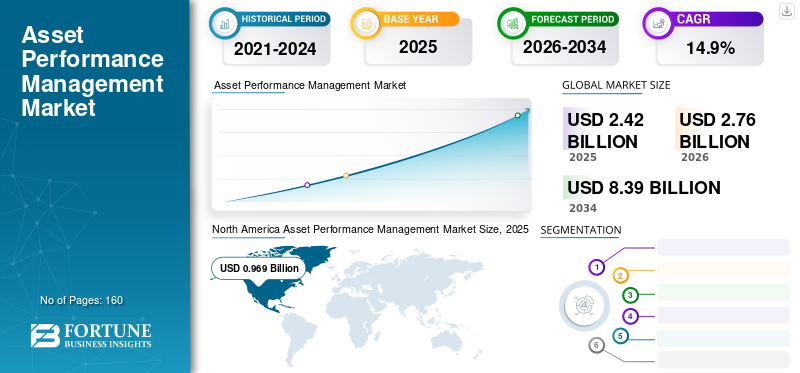
Download Free sample to learn more about this report.
Asset Performance Management Market Key Takeaways
 Global Market Size & Forecast
- 2025 Market Size: USD 3.90 billion
- 2026 Market Size: USD 5.00 billion
- 2034 Forecast Market Size: USD 12.44 billion
- CAGR: 13.8% from 2026–2034
 Market Share
- North America dominated the market with a 48.71% share in 2025.
- On-premise deployment led the market with a 53.3% share in 2025.
- Large enterprises dominated the market with a 64.8% share in 2025.
 Key Regional Highlights
North America
North America reached USD 1.90 billion in 2025, accounting for 48.71% of the global market.
Europe
Was valued at USD 0.87 billion in 2025, driven by sustainability and infrastructure modernization.
Asia Pacific
Reached USD 0.58 billion in 2025 and is expected to record the highest CAGR during the forecast period.
U.S
The market reached USD 1.35 billion in 2025.
Japan
The market reached USD 0.14 billion in 2025.
Read More

IMPACT OF GENERATIVE AI
Role of Generative AI in Enabling Real-Time Predictive and Autonomous Capabilities in Asset Performance Management
Generative AI is emerging as a transformative force in the asset performance management market growth, enabling organizations to move beyond traditional predictive maintenance toward fully prescriptive, scenario-driven decision-making. By analyzing historical and real-time data from sensors and connected devices, generative AI can simulate multiple operational scenarios, identify potential failures, and generate optimized maintenance strategies that minimize downtime and extend asset life.
- In January 2025, Yokogawa Electric and UptimeAI partnered to integrate UptimeAI’s AI-powered platform into Yokogawa’s OpreX Asset Health Insights service. The combined solution leverages AI agents, predictive analytics, and self-learning workflows to help industrial plants across sectors such as oil and gas, chemicals, and renewable energy optimize operations, reduce maintenance costs, and improve reliability.
Additionally, generative AI can automate reporting and produce actionable insights in human-readable form, accelerating decision-making and reducing reliance on manual data analysis.
ASSET PERFORMANCE MANAGEMENT MARKET TRENDS
Focus on Sustainability and Energy Efficiency Driving Asset Performance Management Adoption
There is an increasing emphasis on sustainability, energy efficiency, and regulatory compliance across industrial sectors, which is emerging as a significant trend in the market.
Organizations are under growing pressure from governments, investors, and customers to reduce carbon emissions, optimize energy consumption, and operate more responsibly. APM platforms are being leveraged as strategic tools to support these objectives by continuously monitoring energy usage, tracking operational inefficiencies, and identifying opportunities to minimize waste across critical assets.
- In November 2024, IBM launched IBM Maximo Renewables, a new solution to help companies manage and optimize renewable energy assets. The platform offers monitoring, predictive maintenance, root-cause analysis, and automated recommendations to improve efficiency, extend asset lifespans, and reduce downtime and costs.
By analyzing real-time and historical performance data, these systems can identify high-energy-consuming equipment, recommend process optimizations, and prioritize maintenance interventions to reduce environmental impact.
Market Dynamics
Market Drivers
Download Free sample to learn more about this report.
Increasing Focus on Operational Efficiency and Cost Reduction Drives Market Growth
The increasing focus on operational efficiency and cost reduction is one of the strongest drivers of the market growth. Organizations across asset-intensive industries, including manufacturing, energy, transportation, and utilities, face significant financial and operational consequences when equipment experiences unplanned downtime. For instance,
- According to an industry report, Organizations implementing robust asset performance management systems can increase equipment longevity by up to 40%, reduce maintenance costs by 25%, and lower unplanned downtime by nearly a third, unlocking maximum operational efficiency.
Every hour of unexpected disruption can result in production losses, missed deliveries, regulatory penalties, or even safety incidents, directly affecting both revenue and profitability. In response, companies are adopting APM solutions that enable predictive and condition-based maintenance strategies. These platforms collect real-time and historical asset data to detect early warning signs of equipment failure, optimize maintenance schedules, and reduce unnecessary servicing.
Market Restraints
Cybersecurity Concerns Restraint the Market Growth
Cybersecurity concerns represent a significant restraint on the market, as these platforms fundamentally alter the security architecture of industrial environments. APM solutions integrate operational technology, such as control systems and field sensors, with enterprise IT networks and, increasingly, with cloud-based analytics platforms.
This convergence removes the historical isolation of operational systems and exposes assets that were previously separated from external networks to broader connectivity risks. In sectors such as energy, utilities, oil and gas, and manufacturing, where uptime is directly tied to revenue and public safety, even a brief cyber incident can halt production lines, disrupt power distribution, or suspend extraction activities, leading to significant financial losses and regulatory consequences.
Consequently, organizations often postpone or scale back APM implementation until detailed risk assessments, secure network architectures, and regulatory compliance checks are fully addressed, thereby slowing overall market adoption despite clear performance advantages.
Market Opportunities
Adoption of IoT and Connected Devices to Boost the Market Growth
The increasing adoption of Industrial IoT technologies presents a significant growth opportunity for the market. Industrial environments are progressively deploying smart sensors, connected devices, and embedded monitoring systems across critical equipment and infrastructure. These devices continuously capture real-time operational parameters, including temperature, vibration, pressure, energy consumption, and load conditions.
The declining cost of sensor hardware and improvements in network connectivity have made large-scale data acquisition economically feasible, even for complex multi-site operations. This continuous and granular data flow enhances the analytical capabilities of APM platforms by enabling accurate condition monitoring, failure prediction, and performance benchmarking.
Segmentation Analysis
By Deployment
On-Premises Deployment Dominates Due to Security and Control Priorities
Based on the deployment, the market is divided into cloud and on-premise.
On-premise segment held the majority share of deployments in 2024. In 2025, the segment dominated with a 53.3% share, as many organizations, particularly in oil and gas, energy, and heavy manufacturing, prefer to maintain direct control over sensitive operational and asset data. These industries often operate critical infrastructure where downtime or security breaches can have severe financial and safety consequences, making them cautious about cloud-based solutions. Additionally, legacy systems and existing IT/OT integrations are easier to manage and customize in on-premises environments.
Cloud segment is expected to witness the highest CAGR of 16.1% during the forecast period.
By Enterprise Type
Large Enterprises Leads the Market Through High-Value Asset Management
Based on enterprise type, the market is categorized into large enterprises and Small & Medium Enterprises (SMEs).
Large enterprises segment held the largest asset performance management market share in 2024. In 2025, the segment dominated with a 64.8% share, as they operate high-value, complex, and asset-intensive operations that demand sophisticated monitoring and maintenance solutions. These organizations have the financial capacity to invest in advanced APM platforms, integrate them across multiple sites, and leverage analytics for predictive and prescriptive maintenance. Additionally, large enterprises face higher operational, safety, and regulatory risks, making asset reliability and performance optimization a strategic priority.
Small & medium enterprises segment is expected to witness the highest CAGR of 17.1% during the forecast period.
By Type
Asset Integrity Management Leads Market with Risk Mitigation and Compliance Focus
Based on the type, the market is classified into asset integrity management, predictive asset management, asset strategy optimization, asset reliability, and others.
Asset integrity management segment held the majority share in 2024. In 2025, the segment dominated with a 32.3% share, as it focuses on ensuring the safety, reliability, and regulatory compliance of critical industrial assets, a top priority for industries such as oil and gas, energy, and chemicals. Companies face significant financial and safety risks if key assets fail, making continuous monitoring, inspection, and maintenance essential. Asset integrity management solutions provide real-time visibility into asset conditions, detect corrosion, wear, or structural weaknesses, and help prevent catastrophic failures. Additionally, stringent environmental and safety regulations require companies to maintain documented integrity programs, further driving adoption.
Asset reliability segment is expected to witness the highest CAGR of 18.3% during the forecast period.
To know how our report can help streamline your business, Speak to Analyst
By Industry
Non-Discrete Industries Lead and Expand Rapidly Due to Digital Optimization Initiatives
Based on the industry, the market is segmented into discrete industries and non-discrete industries.
Non-discrete Industries segment held the majority share in 2024. In 2025, the segment dominated with a 63.2% share, as they rely on large, high-value, and continuously operating assets. Equipment failures in these sectors can lead to substantial financial losses, safety hazards, and regulatory penalties. APM solutions provide real-time monitoring, predictive maintenance, and compliance tracking, which are critical for managing the complexity and risk of these continuous-process operations. The high cost of downtime and the need for asset integrity make non-discrete industries the largest adopters of APM solutions.
Non-discrete industries segment is expected to witness the highest CAGR of 14.8% during the forecast period, as it increasingly adopts digital transformation and predictive maintenance technologies to optimize operational efficiency. The growing focus on sustainability, energy efficiency, and regulatory compliance is accelerating APM adoption across sectors such as oil and gas, power generation, and chemicals.
Asset Performance Management Market Regional Outlook
By geography, the market is categorized into North America, South America, Europe, the Middle East & Africa, and Asia Pacific.
North America
North America Asset Performance Management Market Size, 2025 (USD Billion)
To get more information on the regional analysis of this market, Download Free sample
North America holds the largest market share due to its advanced industrial infrastructure and high adoption of digital technologies. Industries such as oil and gas, power generation, and manufacturing have a high concentration of aging yet critical assets that require sophisticated monitoring to maximize uptime and ROI. The region also benefits from strong IT-OT integration, widespread deployment of IoT and sensor networks, and mature cloud and analytics ecosystems, which accelerate and improve the effectiveness of APM implementation.
The North American market held the largest share valued at USD 1.90 billion in 2025.
U.S. Asset Performance Management Market
Given North America’s strong contribution and the U.S. dominance in the region, the U.S. market was valued at around USD 1.35 billion in 2025, accounting for roughly 34.6% of global sales.
Europe
Europe is projected to grow at 12.6% over the coming years. The region reached a valuation of USD 0.87 billion in 2025, driven by its strong focus on sustainability, energy transition, and regulatory compliance. Industries across the region are under pressure to reduce carbon emissions, improve energy efficiency, and adopt greener practices, which increases demand for APM systems that optimize asset performance while supporting environmental targets. Additionally, Europe is investing heavily in modernizing aging industrial and utility infrastructure, creating opportunities for predictive and condition-based maintenance solutions.
U.K. Asset Performance Management Market
The U.K. market in 2025 was valued at USD 0.20 billion, representing roughly 5.1% of global revenues.
Germany Asset Performance Management Market
Germany’s market reached approximately USD 0.17 billion in 2025, equivalent to around 4.4% of global sales.
Asia Pacific
Asia Pacific is expected to grow at the highest CAGR during the forecast period. The region reached a valuation of USD 0.58 billion in 2025, driven by rapid industrialization, large-scale infrastructure development, and the modernization of aging assets. Countries such as China, India, and Southeast Asian nations are investing heavily in power generation, manufacturing, transportation, and utilities, creating a substantial base of critical assets that require efficient monitoring and maintenance. The region is also increasingly adopting Industrial IoT, smart factory technologies, and cloud-based solutions to improve operational efficiency, reduce downtime, and optimize asset life.
Japan Asset Performance Management Market
The Japanese market in 2025 was valued at USD 0.14 billion, accounting for roughly 3.6% of global revenues.
China Asset Performance Management Market
China’s market is projected to be one of the largest worldwide, with 2025 revenues valued at around USD 4.9 billion, representing roughly 8.4% of global sales.
India Asset Performance Management Market
The Indian market in 2025 was valued at around USD 0.10 billion, accounting for roughly 2.6% of global market share.
South America and Middle East & Africa
The Middle East & Africa region is expected to grow at the second-highest CAGR over the forecast period. It is due to the rapid development of energy, oil and gas, and utility infrastructure, combined with increasing digitalization initiatives. The region is witnessing significant investments in large-scale industrial and energy projects, including refineries, power plants, and renewable energy facilities, which require reliable asset monitoring and predictive maintenance.
South America is expected to grow at a stable CAGR during the forecast period, driven by gradual industrial modernization and increasing investments in energy, mining, and manufacturing sectors. Companies are adopting APM solutions to improve operational efficiency and reduce downtime in existing assets. However, slower digital adoption and limited infrastructure compared to other regions moderate growth.
GCC Asset Performance Management Market
The GCC market is reached approximately USD 0.14 billion in 2025, accounting for roughly 3.6% of global revenues.
Competitive Landscape
Key Industry Players
Key Market Players Implement Strategic Initiatives to Strengthen Digital Asset Intelligence Capabilities
Market participants are expanding their portfolios to address the growing demand for predictive analytics, real-time monitoring, and AI-driven maintenance solutions across asset-intensive industries. Companies are investing in advanced analytics, Industrial IoT integration, cloud-based platforms, and edge computing capabilities to enhance asset visibility and operational efficiency.
LIST OF KEY ASSET PERFORMANCE MANAGEMENT COMPANIES PROFILED
- General Electric Company (U.S.)
- Oracle Corporation (U.S.)
- IBM Corporation (U.S.)
- Infor, Inc. (U.S.)
- AVEVA Group Limited (U.K)
- Aspen Technology Inc. (U.S.)
- ABB (Switzerland)
- SAP SE (Germany)
- Rockwell Automation (U.S.)
- Hexagon AB (Sweden)
- ai (U.S.)
- Siemens AG (Germany)
- Bentley Systems (U.S.)
Key Industry Developments
- January 2026: Emerson announced the latest evolution of its AspenTech Asset Performance Management portfolio, introducing new enhancements to Aspen Mtell. The release enables faster deployment of AI-driven asset health monitoring, improved alert prioritization, and deeper integration with enterprise systems, accelerating ROI and continuous reliability improvements.
- November 2025: Baker Hughes secured a multi-year contract with China Petroleum Engineering & Construction Corporation on behalf of Aramco to deploy its Cordant Asset Performance Management suite across four gas compression stations in Saudi Arabia. The project supports the expansion of the Kingdom’s Master Gas System, aiming to improve asset reliability, reduce downtime, and enhance operational efficiency through AI-driven digital solutions.
- November 2025: Schneider Electric launched a unified asset performance management service model in the U.S., designed to simplify and strengthen critical infrastructure management. The new approach consolidates its broad technology portfolio into a single point of contact and a single expert team, reducing reliance on multiple vendors.
- July 2025: Aker BP has implemented SAP Asset Performance Management, integrated with SAP S/4HANA and SAP Business Technology Platform, to enable predictive and condition-based maintenance across its offshore operations. The solution centralizes real-time and third-party data, helping reduce unplanned downtime, lower maintenance costs, and improve safety in harsh, unmanned environments.
- July 2024: Equinor announced that it is advancing its asset management strategy by implementing condition-based maintenance through SAP Asset Performance Management. The integrated solution enables real-time monitoring, automated alerts, and seamless data exchange within its SAP ecosystem, reducing manual processes and improving efficiency.
Report Coverage
The report provides a detailed analysis of the market and focuses on key aspects, including leading companies, product types, and the leading applications of the product. Besides, it offers insights into the market trends and highlights key industry developments. In addition to the factors above, the market's growth in recent years was driven by several other factors.
Request for Customization to gain extensive market insights.
Report Scope & Segmentation
| ATTRIBUTE | DETAILS |
| Study Period | 2021-2034 |
| Base Year | 2025 |
| Estimated Year | 2026 |
| Forecast Period | 2026-2034 |
| Historical Period | 2021-2024 |
| Growth Rate | CAGR of 13.8% from 2026-2034 |
| Unit | Value (USD Billion) |
| Segmentation | By Deployment, Enterprise Type, Type, Industry, and Region |
| By Deployment |
|
| By Enterprise Type |
|
| By Type |
|
| By Industry |
|
| By Region |
|
Frequently Asked Questions
According to Fortune Business Insights, the global market value stood at USD 3.90 billion in 2025 and is projected to reach USD 12.44 billion by 2034.
In 2025, the North America's market value stood at USD 1.90 billion.
The market is expected to grow at a CAGR of 13.8% over the forecast period.
By type, asset integrity management segment led the market in 2025.
Increasing focus on operational efficiency and cost reduction are the key factors driving the market.
General Electric, Oracle, IBM, AVEVA, and ABB are the major players in the global market.
North America dominated the market in 2025 with the largest share.



- 2021-2034
- 2025
- 2021-2024
- 110
Get 30-60 hrs Free Customization
Expand Regional and Country Coverage, Segments Analysis, Company Profiles, Competitive Benchmarking, and End-user Insights.




















Related Reports
-
US +1 833 909 2966 ( Toll Free )
-
Get In Touch With Us