Amino Acids Market Size, Share & Industry Analysis, By Product Type (Essential Amino Acids [Lysine, Methionine, Threonine, Leucine, Isoleucine, Tryptophan], Non-Essential Amino Acids [Alanine, Aspartic Acid, Asparagine, Cysteine, Glutamic Acid, Others]), By Source (Plant-based, Animal-based, & Fermentation-Based), By Grade (Food, Pharma, & Industrial), By End-Use (Food & Beverages [Bakery & Confectionery, Dairy, Processed Foods, Meat Products, Functional Beverages], Dietary Supplements, Animal Feed, Pharmaceuticals, Cosmetics & Personal Care, Agriculture) & Regional Forecast, 2026-2034
 Download Free Sample
(Offer valid till 30th Sep 2026)

Amino Acids Market Size and Future Outlook
 Listen to Audio Version
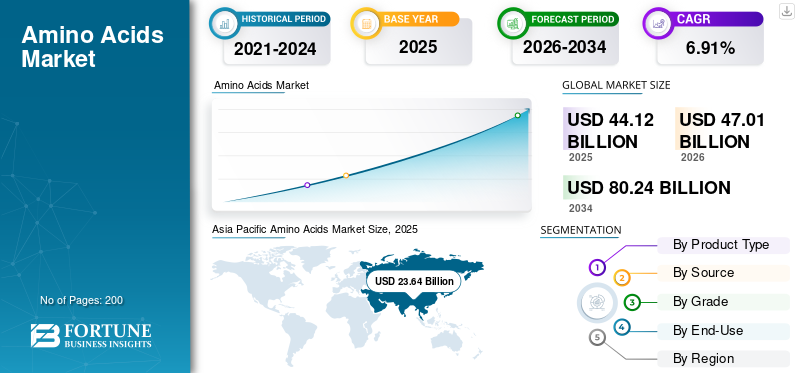
The global amino acids market size was valued at USD 44.12 billion in 2025. The market is projected to grow from USD 47.01 billion in 2026 to USD 80.24 billion by 2034, exhibiting a CAGR of 6.91% during the forecast period. Asia Pacific dominated the amino acids market with a market share of 53.58% in 2025.
Amino acids are organic compounds that serve as fundamental building blocks of proteins and play a crucial role in biological metabolism, nutrition, and industrial biotechnology. They are widely used across food, pharmaceuticals, and animal feed, where they function as nutritional supplements, flavor enhancers, feed additives, and functional ingredients. Industrial amino acid production typically involves microbial fermentation processes using agricultural raw materials such as corn, sugarcane, and molasses, enabling large-scale bio-based manufacturing.
Furthermore, expanding applications in personal care, pharmaceuticals, and functional nutrition are supporting market expansion. The increasing use of amino acids in feed additives, sports nutrition, and clinical nutrition products is driving demand across multiple industries. Major companies operating in the market include Ajinomoto Co., Inc., Evonik Industries AG, Archer Daniels Midland Company, CJ CheilJedang Corporation, and Kyowa Hakko Bio Co., Ltd., which play a key role in global amino acids production and supply. These companies continue to expand fermentation capacity and invest in biotechnology innovation to meet the growing demand for amino acids in food, pharmaceutical, and animal feed applications worldwide.
Download Free sample to learn more about this report.
Amino Acids Market Trends
Expansion of Bio-Based Fermentation Technologies to Influence Industry Trends
The global amino acids industry is witnessing significant technological advancement as manufacturers increasingly adopt fermentation-based, bio-based production methods. Microbial fermentation processes enable the efficient conversion of agricultural raw materials, such as corn, glucose, and other sugar substrates, into essential amino acids with high yields and a lower environmental impact. Biotechnology innovations are enabling improved production efficiency, cost optimization, and sustainable amino acids production across major markets. These developments are particularly important as the worldwide demand for animal nutrition, pharmaceutical ingredients, dietary supplements, and functional foods continues to grow.
- According to the Food and Agriculture Organization (FAO), global meat production exceeded 360 million metric tons in 2023, reflecting the strong expansion of the livestock sector and rising protein consumption worldwide. Rising livestock production significantly increases the demand for amino acids used as feed additives to improve feed utilization efficiency.
MARKET DYNAMICS
Market Drivers
Download Free sample to learn more about this report.
Expanding Animal Feed Industry and Livestock Production to Support Market Growth
The rapid expansion of the animal feed industry is one of the most significant factors supporting global amino acids market growth. Amino acids such as lysine, methionine, and threonine are widely used as feed additives in poultry, swine, and aquaculture diets to optimize nutrient utilization and improve feed conversion efficiency.
Modern livestock farming increasingly relies on balanced amino acid nutrition to reduce feed costs, enhance growth performance, and support sustainable meat production. Amino acids also help reduce nitrogen excretion in livestock farming, which improves environmental sustainability and feed efficiency.
- According to Alltech, one of the global leaders in animal nutrition and biotechnology, global feed production rebounded in 2024 after a stagnant 2023, increasing from 1.380 billion metric tons (mt) (+1.2%) to 1.396 billion mt.
Market Restraints
Volatility in Agricultural Raw Materials and Production Costs to Restrict Market Expansion
The global amino acids industry relies heavily on agricultural raw materials, such as corn, sugar, and molasses, which serve as key feedstocks for microbial fermentation processes to produce amino acids such as lysine, glutamic acid, and threonine. Price fluctuations in these agricultural commodities directly influence manufacturing costs and industry profitability.
Rising energy prices and logistics challenges may increase manufacturing expenses for fermentation-derived amino acids. Additionally, environmental regulations and sustainability requirements may influence production economics and market competitiveness.
- For instance, the Food and Agriculture Organization (FAO) Sugar Price Index rose 26.7% in 2023 due to weather disruptions and export restrictions, underscoring the volatility of key fermentation inputs used in amino acid production.
Market Opportunities
Rising Demand for Dietary Supplements and Functional Foods to Create Market Opportunities
The rapid expansion of the global nutraceutical industry is creating major opportunities for amino acid manufacturers. Amino acids are increasingly incorporated into dietary supplements and functional foods, including sports nutrition products, protein beverages, nutritional powders, and health supplements. Health-conscious consumers are seeking protein-rich diets and metabolic-support supplements, driving growing demand for amino acids such as leucine, glutamine, and tryptophan in sports nutrition and wellness products. In addition, amino acids are increasingly used in personal care formulations for skin conditioning, anti-aging, and hair care applications.
- According to the National Institutes of Health (NIH), the global dietary supplement market continues to expand rapidly, with over 50% of U.S. adults regularly consuming dietary supplements, many of which contain amino acids and protein ingredients.
SEGMENTATION ANALYSIS
By Product Type
Essential Amino Acids Segment Dominated Due to High Demand in Feed and Nutrition Applications
Based on product type, the market is segmented into essential amino acids and non-essential amino acids. The essential amino acids is segmented further into lysine, methionine, threonine, leucine, isoleucine, tryptophan, and others. The non-essential amino acids is further divided alanine, aspartic acid, asparagine, cysteine, glutamic acid, glycine, glutamine, serine, tyrosine, proline, others.
The essential amino acids segment dominated the global amino acids market share, valued at approximately USD 24.25 billion in 2025, accounting for the largest share due to extensive demand in the animal feed industry, nutrition supplements, and pharmaceutical formulations. Essential amino acids such as lysine, methionine, and threonine are widely used as feed additives to improve livestock growth performance and feed efficiency. These amino acids are critical components in modern feed formulations used in poultry, swine, and aquaculture production systems.
The non-essential amino acids segment is projected to grow at the fastest CAGR of 7.60% during the forecast period, driven by increasing applications in dietary supplements and functional foods, pharmaceuticals, and personal care products.
By Source
Synthetic & Fermentation-Based Segment Dominated Due to Large-Scale Bio-Based Production
Based on the source, the market is segmented into plant-based, animal-based, and synthetic & fermentation-based amino acids.
The synthetic & fermentation-based segment dominated the global market, valued at USD 33.09 billion in 2025, as microbial fermentation technologies enable cost-efficient bio-based amino acids production using agricultural raw materials such as corn and molasses. Major manufacturers widely adopt fermentation-based production systems due to scalability, sustainability, and consistent product quality.
Meanwhile, the plant-based segment is projected to grow at the fastest CAGR of 8.00% during the forecast period, owing to rising consumer interest in plant-based amino acids used in vegan dietary supplements, sports nutrition products, and functional foods.
To know how our report can help streamline your business, Speak to Analyst
By Grade
Feed Grade Segment Dominated Due to Extensive Use in the Animal Feed Industry
Based on grade, the market is segmented into food grade, pharma grade, feed grade, and cosmetic/industrial grade amino acids.
The feed grade segment dominated the global market, valued at USD 24.91 billion in 2025, driven by extensive use in the animal feed industry. Feed-grade amino acids are widely used as nutritional supplements in poultry, swine, and aquaculture diets to improve feed utilization efficiency and support livestock productivity.
The pharma grade segment is projected to grow at the fastest CAGR of 7.78% during the forecast period, driven by increasing pharmaceutical applications and the growing use of amino acids in clinical nutrition and drug formulations.
By End-Use
Food & Beverages Segment Dominated Due to the Expanding Functional Food and Nutrition Industry
Based on the end-use, the market is segmented into food & beverages (bakery & confectionery, dairy, processed foods, meat products, functional beverages, and others), dietary supplements, animal feed & pet food, pharmaceuticals, cosmetics & personal care, agriculture, and others.
The food & beverages segment dominated the global market, valued at approximately USD 21.78 billion in 2025, driven by the increasing incorporation of amino acids in dietary supplements and functional foods, fortified beverages, protein-enriched products, and processed food formulations. Amino acids such as glutamic acid, leucine, and glycine are widely used as flavor enhancers, nutritional fortifiers, and functional ingredients in food systems.
Meanwhile, the dietary supplements segment is projected to grow at the fastest CAGR of 9.05% over the forecast period, driven by rising demand for protein supplements, sports nutrition products, and functional foods.
Amino Acids Market Regional Outlook
Regionally, the report covers the global market analysis across North America, Europe, Asia Pacific, South America, and the Middle East & Africa.
North America
Asia Pacific Amino Acids Market Size, 2025 (USD Billion)
To get more information on the regional analysis of this market, Download Free sample
The North America market accounted for USD 7.44 billion in 2025 and is projected to reach USD 12.85 billion by 2034, growing at a CAGR of 6.30% during the forecast period. Growth in the region is supported by strong demand for dietary supplements and functional foods, expanding livestock production, and growing use of amino acids in pharmaceutical and nutrition products.
U.S. Amino Acids Market
The U.S. dominates the regional market, valued at approximately USD 5.06 billion in 2025, supported by a large nutraceutical industry and increasing demand for amino acids in sports nutrition, pharmaceuticals, and animal feed applications.
Europe
Europe accounted for USD 8.95 billion in 2025 and is projected to reach USD 14.68 billion by 2034, registering a CAGR of 5.69% during the forecast period. Growth is supported by increasing demand for sustainable, bio-based ingredients and the expansion of functional food and pharmaceutical industries.
Germany Amino Acids Market
Germany leads the European market with a value of approximately USD 2.03 billion in 2025, supported by its strong pharmaceutical manufacturing base and advanced biotechnology sector.
U.K. Amino Acids Market
The U.K. market was valued at approximately USD 0.92 billion in 2025, driven by rising demand for dietary supplements and functional foods, as well as the increasing adoption of amino acids in sports nutrition products.
Asia Pacific
The Asia Pacific market represented the largest regional market, valued at USD 23.64 billion in 2025, and is projected to reach USD 45.67 billion by 2034, growing at a CAGR of 7.63% during the forecast period. Rapid expansion of the livestock sector, rising demand for protein-rich diets, and increasing amino acids production capacities are major drivers in the region.
China Amino Acids Market
China represents the largest market in the region, valued at approximately USD 14.83 billion in 2025, supported by large-scale fermentation-based amino acids production and strong demand from the animal feed industry.
South America, and the Middle East & Africa
The South American market reached USD 3.07 billion in 2025 and is projected to grow at a CAGR of 6.64% during the forecast period, supported by expanding livestock production and increasing demand for feed additives in Brazil and Argentina.
The Middle East & Africa market was valued at USD 1.03 billion in 2025 and is expected to expand at a CAGR of 4.91% during the forecast period, driven by rising demand for nutritional supplements and expanding poultry and livestock production.
Brazil Amino Acids Market
Brazil represents the largest market in South America, valued at approximately USD 1.92 billion in 2025, driven by its large livestock industry and increasing use of amino acids to improve feed efficiency in animal nutrition.
COMPETITIVE LANDSCAPE
Key Industry Players
Key Players Focus on Fermentation Technology and Bio-Based Amino Acids Production
The global market is moderately consolidated, with leading biotechnology and food ingredient manufacturers focusing on advanced fermentation technologies and bio-based amino acids production. Companies are expanding production capacity, improving microbial strains, and investing in sustainable fermentation processes to meet the growing demand for amino acids across food, pharmaceutical, and feed industries.
The rising use of plant-based amino acids, increasing demand for dietary supplements and functional foods, and expanding animal feed industry are encouraging companies to strengthen their global supply networks and invest in biotechnology innovation.
Key Players in the Amino Acids Market
|
Rank |
Company Name |
|
1 |
Ajinomoto Co., Inc. |
|
2 |
Evonik Industries AG |
|
3 |
ADM (Archer Daniels Midland Company) |
|
4 |
CJ CheilJedang Corporation |
|
5 |
Kyowa Hakko Bio Co., Ltd. |
List of Key Amino Acids Companies Profiled
- Ajinomoto Co., Inc. (Japan)
- Evonik Industries AG (Germany)
- Archer Daniels Midland Company (U.S.)
- CJ CheilJedang Corporation (South Korea)
- Kyowa Hakko Bio Co., Ltd. (Japan)
- Meihua Holdings Group Co., Ltd. (China)
- Fufeng Group Company Limited (China)
- Global Bio-Chem Technology Group Company Limited (China)
- Sumitomo Chemical Co., Ltd. (Japan)
- Daesang Corporation (South Korea)
KEY INDUSTRY DEVELOPMENTS
- March 2026: Croda International Plc announced a strategic supply partnership with Amino GmbH to bolster its biopharma offerings. This collaboration enhances global access to high-purity amino acids for pharmaceutical formulation and biomanufacturing. The deal combines Croda's expertise in smart science and global reach with Amino's precision manufacturing of amino acids, including histidine and arginine.
- February 2026: GNC launched a reformulated GNC AMP Wheybolic protein powder, emphasizing its leucine-rich profile for enhanced muscle performance. This upgrade delivers 50g of whey protein and 6.2g of leucine per serving to optimize strength gains and recovery for athletes.
- October 2025: Leucine Rich Bio, a Bengaluru-based microbiome company, unveiled BugSpeaks as India's first facial skin microbiome test. This at-home test analyzes the microbial composition of facial skin using next-generation sequencing to provide personalized skincare insights and recommendations.
- June 2023: Evonik launched an updated version of its Biolys product, a lysine source for animal feeds. The upgrade increased L-lysine content to 62.4% from 60%, improving efficiency in livestock such as swine and poultry while retaining fermentation-derived nutrients.
- August 2020: ADM Animal Nutrition launched NutriPass L, an encapsulated lysine supplement, to provide rumen-stable, intestinally available lysine for ruminants such as dairy cows and growing cattle. NutriPass L uses a patent-pending encapsulation technique to deliver lysine consistently, supporting milk production, lean tissue gain, and milk components.
REPORT COVERAGE
The global amino acids market report analyzes the market in depth and highlights key aspects, including market trends, market dynamics, prominent companies, investment in research and development, and end-use. In addition, the report provides insights into the market and highlights significant industry developments.
Request for Customization to gain extensive market insights.
Report Scope & Segmentation
| ATTRIBUTE | DETAILS |
| Study Period | 2021-2034 |
| Base Year | 2025 |
| Estimated Year | 2026 |
| Forecast Period | 2026-2034 |
| Historical Period | 2021-2024 |
| Growth Rate | CAGR of 6.91% from 2026 to 2034 |
| Unit | Value (USD Billion) |
|
Segmentation |
By Product Type
|
|
By Source
|
|
|
By Grade
|
|
|
By End-Use
|
|
|
By Region
|
Frequently Asked Questions
Fortune Business Insights says that the global market was USD 44.12 billion in 2025 and is anticipated to reach USD 80.24 billion by 2034.
At a CAGR of 6.91%, the global market will grow steadily over the forecast period.
By grade, the feed grade segment leads the market.
Asia Pacific held the largest market share in 2025.
Expanding animal feed industry and livestock production to support market growth.
Ajinomoto Co., Inc., Evonik Industries AG, Archer Daniels Midland Company, CJ CheilJedang Corporation, and Kyowa Hakko Bio Co., Ltd. are the leading companies in the market.
Expansion of bio-based fermentation technologies to influence industry trends.



- 2021-2034
- 2025
- 2021-2024
- 200
-
(Offer valid till 30th Sep 2026)
Get 30-60 hrs Free Customization
Expand Regional and Country Coverage, Segments Analysis, Company Profiles, Competitive Benchmarking, and End-user Insights.




















Related Reports
-
US +1 833 909 2966 ( Toll Free )
-
Get In Touch With Us