Solar Tracker Market Size, Share & Industry Analysis, By Movement (Single-axis and Dual-axis), By Control Method (Manual Tracking Systems, Passive Tracking Systems, and Active Tracking Systems), By Type (Photovoltaic (PV) and Concentrated Solar Power (CSP)), By Application (Utility and Non-Utility), Regional Forecast, 2026-2034
 Download Free Sample
 Solar Tracker Market Size and Future Outlook
 Listen to Audio Version
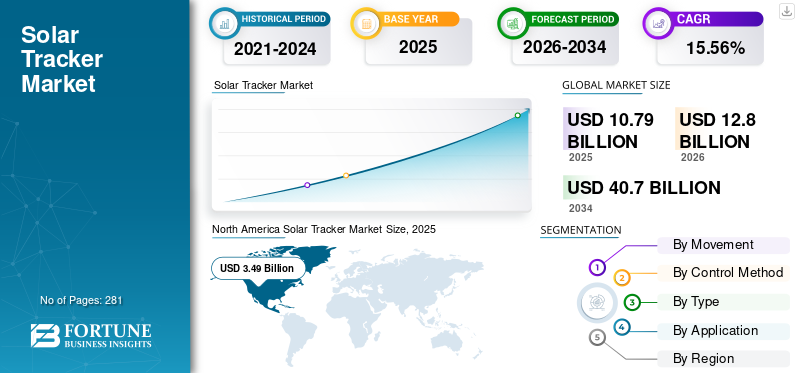
The global solar tracker market size was valued at USD 10.79 billion in 2025 and is projected to grow from USD 12.80 billion in 2026 to USD 40.70 billion by 2034, exhibiting a CAGR of 15.56% during the forecast period. North America dominated the global solar tracker market with a market share of 32.34% in 2025.
The popularity of the solar tracker market is increasing rapidly as utility-scale solar projects prioritize higher energy yields and lower electricity costs. Trackers enable photovoltaic panels to follow the sun throughout the day, increasing power generation by 15–30% compared with fixed-tilt systems. As countries accelerate the shift toward clean energy, developers are under pressure to maximize output from each megawatt installed, making trackers an attractive choice for boosting efficiency without significantly expanding land use. The growing adoption of bifacial solar modules further strengthens this trend, since trackers enhance the energy gain from both sides of the panels.
For instance, NEXTracker, a global leader in single axis solar trackers that designs and manufactures advanced solar trackers that enable photovoltaic panels to follow the sun’s movement, increasing energy production for utility-scale solar plants. NEXTracker is recognized for its intelligent, modular, and self-powered tracker systems, including the NX Horizon platform, which employs an independent row architecture to enhance resilience and minimize maintenance requirements.
Download Free sample to learn more about this report.
MARKET DYNAMICS
MARKET DRIVERS
Higher Energy Yield Facilitated by Solar Trackers to Propel the Market Growth
Solar trackers deliver higher energy yield primarily because they optimize the angle of incidence between sunlight and the solar panels throughout the day. By continuously adjusting panel orientation to follow the sun’s movement from east to west, trackers maintain a more perpendicular alignment with incoming radiation, which substantially increases energy capture. This dynamic positioning is especially beneficial during early morning and late afternoon hours, when fixed-tilt systems receive sunlight at suboptimal angles and produce significantly less power, thus leading to solar tracker market growth.
For instance, in regions with high direct normal irradiance, such as southern Europe, the Middle East, Australia, and parts of the United States, the performance gap between trackers and fixed systems becomes even more pronounced. These areas experience strong, consistent sunlight that trackers can exploit to maximize daily output, improving both energy yield and system reliability.
MARKET RESTRAINTS
High Initial Cost and Complex Installation & Maintenance to Restrict Market Expansion
One of the primary restraints for solar trackers is their higher upfront cost compared with fixed-tilt systems. Trackers require additional structural components, motors, actuators, and control systems, which increase capital expenditure.
Solar trackers are mechanically more complex and require specialized installation expertise. They involve moving parts that must operate smoothly and withstand environmental stress. This increases installation time and maintenance requirements. In remote areas or regions lacking skilled labor and reliable servicing infrastructure, maintaining tracker systems can be challenging and costly.
MARKET OPPORTUNITIES
Rising Deployment of Utility-Scale Solar Projects is Anticipated to Create Growth Opportunities
One of the biggest opportunities for solar trackers lies in the global surge of utility-scale solar projects. As governments and private developers aim to expand renewable energy capacity, large solar farms are increasingly preferred due to their cost efficiency and ability to integrate with energy storage systems.
Trackers offer a compelling value proposition by significantly boosting energy output, making them a natural fit for utility-scale installations. The expansion of solar parks across regions with abundant land, such as the Middle East, Africa, Latin America, and parts of Asia, creates strong growth potential for advanced tracking solutions.
SOLAR TRACKER MARKET TRENDS
Growing Adoption of Bifacial Photovoltaic Modules Leads to Demand for Solar Trackers
The growing adoption of bifacial photovoltaic modules is significantly driving the demand for solar trackers, creating one of the strongest current drivers in utility-scale solar development. Bifacial panels produce electricity from both their front and rear surfaces, capturing reflected sunlight from the ground in addition to direct irradiance.
When combined with single-axis trackers, these panels achieve optimal orientation throughout the day, maximizing both direct and backside energy gains. This synergy can increase overall power generation by 20–35% compared with traditional monofacial fixed-tilt systems, making the combination especially valuable in regions with high solar irradiance and reflective ground conditions.
Download Free sample to learn more about this report.
MARKET CHALLENGES
Vulnerability to Environmental Stress Presents Significant Challenges for Market Growth
Solar trackers face significant challenges in regions exposed to extreme weather conditions, as their moving structures must operate reliably under a wide range of environmental stresses. High wind speeds can be particularly problematic, since tracker rows are more susceptible to torsional forces compared with fixed-tilt systems.
Sudden gusts or storms can lead to structural deformation or misalignment if trackers are not equipped with fast and reliable stow mechanisms that reposition panels into a safe angle. Heavy snowfall adds another layer of complexity, increasing the weight load on tracker components and potentially hindering movement if snow accumulates unevenly across modules.
Segmentation Analysis
By Movement
High Performance, Reliability, and Cost-Effectiveness Fuels the Demand for Single Axis Segment
Based on movement, the market is divided into single-axis and dual-axis.
The single-axis segment is projected to dominate the market with a share of 86.81% in 2026. The single-axis solar trackers offer a significant energy gain, typically 15–25% over fixed-tilt systems, yet they remain far less complex and expensive than dual-axis designs. They track the sun’s movement along one horizontal axis (east to west), which captures most of the daily irradiance improvement without requiring the additional motors or mechanisms needed for vertical adjustment.
The dual-axis segment is experiencing the fastest growth and is expected to grow at a CAGR of 17.32%. Dual-axis solar trackers are gaining attention in specific applications due to their ability to maximize energy capture by following the sun’s movement both horizontally and vertically. This capability enables panels to maintain an optimal angle throughout the day and across seasons, resulting in significantly higher energy yields.
To know how our report can help streamline your business, Speak to Analyst
By Control Method
Superior Balance of Performance, Flexibility, and Energy Optimization Leads to Active Tracking Systems Domination
On the basis of the control method, the market is classified into manual tracking systems, passive tracking systems, and active tracking systems.
The active tracking systems segment is projected to dominate the market with a share of 79.27% in 2026. Active tracking systems dominate the solar tracker market share because they offer a superior balance of performance, flexibility, and energy optimization compared to passive systems.
The manual tracking systems segment is experiencing significant growth and is expected to grow at a CAGR of 10.41%. Manual tracking systems offer simplicity, low cost, and ease of operation are more important than maximizing energy yield. Unlike active systems that require motors, sensors, and automated controls, manual trackers rely on human adjustment to reposition panels a few times a day or seasonally. This drastically reduces upfront costs, making manual systems highly attractive for farmers, remote communities, and off-grid users with limited budgets.
By Type
Photovoltaic (PV) is a Leading Segment as it Supports Utility-Scale PV Installation
On the basis of type, the market is bifurcated into photovoltaic and concentrated solar power (CSP).
The photovoltaic (PV) segment is projected to dominate the market with a share of 85.40% in 2026. Photovoltaic (PV) solar trackers are dominant because they directly support the world’s fastest-growing segment of solar power generation, utility-scale PV installations. PV trackers continuously adjust the orientation of solar panels to follow the sun’s movement, allowing panels to remain optimally aligned with incoming sunlight throughout the day.
The concentrated solar power (CSP) segment is experiencing significant growth and is expected to grow at a CAGR of 13.46%. Manual tracking systems offer simplicity, low cost, and ease of operation are more important than maximizing energy yield. Unlike active systems that require motors, sensors, and automated controls, manual trackers rely on human adjustment to reposition panels a few times a day or seasonally.
By Application
Utility Sector Widely Uses Solar Tracker for Large, Grid-Connected Solar Farms Leading to Segmental Dominance
Based on the application, the market is classified into utility and non-utility segments.
In 2025, the utility segment is anticipated to dominate with an 85.64% share. Utility developers deploy single-axis or dual-axis trackers to enhance electricity output throughout the day, enabling higher capacity factors and lower leveled cost of electricity. Trackers help utility-scale plants produce more energy from the same land area, support better integration with the grid by smoothing output curves, and enhance the performance of bifacial modules, which are widely used in modern solar parks.
The non-utility segment is experiencing significant growth and is expected to grow at a CAGR of 18.03%. In the non-utility sector, solar trackers are used in commercial, industrial, agricultural, and off-grid applications where energy optimization is valuable, but system sizes are smaller. Commercial and industrial facilities can utilize trackers to enhance on-site energy generation for self-consumption, thereby reducing their reliance on grid electricity.
Solar Tracker Market Regional Outlook
By region, the market is categorized into Europe, North America, Asia Pacific, Latin America, and the Middle East & Africa.
North America
The North America market generated USD 3.49 billion in 2025, representing 32.39% of the global market landscape, and is expected to reach USD 4.13 billion in 2026.
North America Solar Tracker Market Size, 2025 (USD Billion)
To get more information on the regional analysis of this market, Download Free sample
North America is a major user of solar trackers due to a combination of favorable geography, strong solar policies, and large-scale project development that aligns perfectly with the benefits trackers provide. North America is also home to some of the world’s leading tracker manufacturers and EPC companies, which have strengthened supply chains and increased the availability of technologically advanced tracking systems. The U.S. market is projected to reach USD 3.62 billion by 2026.
Europe
Europe contributed 19.07% to the global market in 2025, with a valuation of USD 2.06 billion, and is projected to reach USD 2.45 billion in 2026. Europe is a major user of solar trackers due to its strong commitment to renewable energy expansion and the push to maximize efficiency in increasingly land-constrained regions. Southern European countries, such as Spain, Italy, Portugal, and Greece, benefit from high solar irradiation, enabling trackers to increase both daily and annual energy output significantly.
In 2025, the Spain market is estimated to reach USD 0.72 billion. Spain’s strong governmental support for renewable energy through auction programs, grid-access reforms, and ambitious targets under the Europe climate framework has further encouraged the adoption of high-performance solar technologies. Many of Spain’s modern solar projects utilize bifacial modules, and trackers are crucial in unlocking their full energy potential. The UK market is projected to reach USD 0.29 billion by 2026, while the Germany market is projected to reach USD 0.49 billion by 2026.
Asia Pacific
Other regions, such as the Asia Pacific, are anticipated to show the fastest growth in the coming years. During the forecast period, the Asia Pacific is projected to record a growth rate of 17.21% and reach a valuation of USD 3.32 billion in 2025. Asia Pacific uses solar trackers extensively due to its rapid expansion of utility-scale solar projects, diverse climatic advantages, and increasing focus on boosting renewable energy efficiency. The region hosts some of the world’s fastest-growing solar markets, including China, India, Australia, and several Southeast Asian countries, where large tracts of land and strong sunlight conditions make trackers an appealing option. Backed by these factors, countries such as China are expected to reach a valuation of USD 1.42 billion by 2026. The Japan market is projected to reach USD 0.17 billion by 2026 and the India market is projected to reach USD 1.18 billion by 2026.
Middle East & Africa
In 2025, Middle East & Africa held 6.42% of the global market, reaching a valuation of USD 0.69 billion, and is projected to grow to USD 0.81 billion in 2026. In the region, the GCC is estimated to reach USD 0.45 billion in 2025. This growth is majorly owing to rising investments in the circular economy and green waste technologies.
Latin America
Latin America contributed approximately USD 1.22 billion to the global market in 2025, accounting for 11.32% share, and is expected to reach USD 1.41 billion in 2026. Over the forecast period, the Latin America region is expected to witness tremendous opportunities for solar trackers. Countries such as Chile, Brazil, and Mexico experience some of the highest solar irradiation levels in the world, enabling trackers to increase their daily energy output significantly. The Latin American market is expected to reach a valuation of USD 1.22 billion in 2025. In Latin America, Brazil is set to attain the value of USD USD 0.67 billion in 2025.
COMPETITIVE LANDSCAPE
Key Industry Players:
Predictive Controls, Weather Forecasting, and Machine-Learning Algorithms By Key Industry Players To Expand Market
The demand for solar trackers among key companies, such as NEXTracker, Array Technologies, Trina Solar, and SunPower Corporation, now combines solar trackers with predictive controls, weather forecasting, and machine-learning algorithms to maximize plant output. For example, one company’s suite utilizes advanced sensors and weather data to adjust tracker tilt dynamically, thereby improving yield, particularly for bifacial modules.
For instance, in February 2023, Nextracker announced the completion of its solar tracker supply for the Sizergh Solar Farm in the United Kingdom, a project developed by NextEnergy Capital. For this installation, Nextracker provided its NX Horizon single-axis trackers, which were chosen to improve energy yield across the site’s variable terrain.
LIST OF KEY SOLAR TRACKER COMPANIES PROFILED
- NEXTracker (U.S.)
- Array Technologies (U.S.)
- Trina Solar (China)
- SunPower Corporation (U.S.)
- ArcelorMittal Projects (Luxembourg)
- Soltec (Spain)
- Convert Italia (Italy)
- PV Hardware (Spain)
- Arctech Solar (U.S.)
- Solar Steel (Spain)
- Ideematec (Germany)
- SunPower (U.S.)
- Scorpius Trackers (India)
- Sun Action Trackers (U.S.)
KEY INDUSTRY DEVELOPMENTS
- In August 2025, ARRAY acquired APA Solar, a provider of solar racking and foundation solutions, strengthening its position as a fully integrated solar infrastructure supplier. The acquisition expands ARRAY’s portfolio beyond trackers to include foundations and racking, enabling end-to-end structural solutions, improved project delivery, and greater value for utility-scale solar developers.
- In July 2025, Nextracker launched a dedicated robotics and AI division following its acquisition of OnSight Technology, a company specializing in autonomous inspection and fire-detection systems for solar plants. This move positions Nextracker to enhance solar operations and maintenance through advanced automation, real-time monitoring, and AI-driven safety capabilities.
- In February 2025, Soltec (Spain) announced that it will refocus its business strategy exclusively on solar tracker supply, following its milestone of delivering 18.7 GW of trackers globally as of mid-2024. With the majority of its revenue already derived from tracker solutions, the company plans to streamline operations, concentrate resources on core manufacturing, and strengthen its competitive position in the global utility-scale solar market.
- In December 2024, ARRAY Technologies, together with partner RP Construction Services (RP), announced surpassing 6 GW of deployed solar capacity in North America. The milestone highlights strong market presence and consistent large-scale adoption of ARRAY’s tracker technology across utility solar projects.
- In 2022, worldwide solar tracker installations jumped sharply, with global shipments reaching 92 GW DC, up ~28% from 2022. This reflects a strong uptick in utility-scale solar projects globally.
REPORT COVERAGE
The global solar tracker market analysis provides an in-depth study of the market size & forecast by all the market segments included in the report. It includes details on the market dynamics and Solar Tracker market trends expected to drive the market in the forecast period. It offers information on the technological advancements, new product launches, key industry developments, and details on partnerships, mergers & acquisitions. The solar tracker market research report also encompasses a detailed competitive landscape with information on the market share and profiles of key operating players.
Request for Customization to gain extensive market insights.
Report Scope & Segmentation
| ATTRIBUTE | DETAILS |
| Study Period | 2021-2034 |
| Base Year | 2025 |
| Forecast Period | 2026-2034 |
| Historical Period | 2021-2024 |
| Growth Rate | CAGR of 15.56% from 2026-2034 |
| Unit | Revenue (USD Billion), Volume (GW) |
| Segmentation | By Movement, Control Method, Type, Application, and Region |
| By Movement |
|
| By Control Method |
|
| By Type |
|
| By Application |
|
| By Region |
|
Frequently Asked Questions
Fortune Business Insights says that the global market value stood at USD 10.79 billion in 2025 and is projected to reach USD 40.70 billion by 2034.
In 2025, the market value stood at USD 3.32 billion.
The market is expected to exhibit a CAGR of 15.56% during the forecast period of 2026-2034.
The utility segment led the market by application.
The solar tracker market is driven by higher energy yield, rising utility-scale solar projects, bifacial module adoption, declining tracker costs, and improved efficiency through smart, weather-adaptive technologies.
NEXTracker, Array Technologies, Trina Solar, and others are some of the prominent players in the market.
North America dominated the market in 2025.
Major factors expected to favor solar tracker adoption include high solar irradiation, rising utility-scale projects, bifacial module growth, improved tracker durability, and lower LCOE are key factors favoring adoption.



- 2021-2034
- 2025
- 2021-2024
- 281
Get 20% Free Customization
Expand Regional and Country Coverage, Segments Analysis, Company Profiles, Competitive Benchmarking, and End-user Insights.


















Related Reports
-
US +1 833 909 2966 ( Toll Free )
-
Get In Touch With Us