Bamboos Market Size, Share & Industry Analysis, By Application (Construction & Building Materials, Furniture & Flooring, Houseware & Consumer Goods, Bamboo Shoots, Industrial & Energy Uses, and Others), and Regional Forecast, 2026-2034
 Download Free Sample
Bamboos Market Overview
 Listen to Audio Version
The global bamboos market size was valued at USD 73.31 billion in 2025. The market is projected to grow from USD 77.23 billion in 2026 to USD 117.89 billion by 2034, exhibiting a CAGR of 5.4% during the forecast period. Asia Pacific dominated the bamboos market with a market share of 72.5% in 2025.
Bamboos are fast-growing, natural plants with strong, hollow stems that are used as a renewable raw material across many everyday products. They are valued for their rapid growth, repeated harvestability, and provide a sturdy material that is easy to work with. Bamboo is widely used in construction and housing materials, furniture and home décor, flooring, paper and packaging, handicrafts, and a range of consumer goods where durability and a natural look are important. In addition, increasing construction activity, wider use of eco-friendly packaging, and growing interest in natural lifestyle products are driving the market growth.
The market is dominated by a limited number of established companies that benefit from large-scale manufacturing capabilities and long operating histories. Leading players such as Moso-bamboo, Bamboo Australia, Shanghai Tenbro Bamboo Textile Co., Ltd., Vietnam Bamboo Corporation, and Bamboostan compete based on production capacity, operational efficiency, and dependable supply networks.
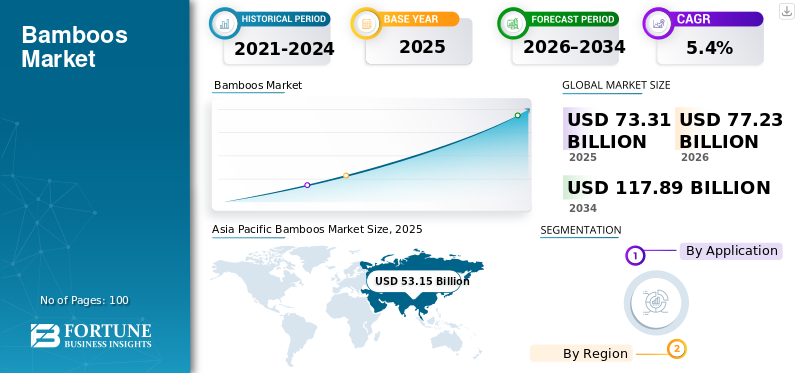
Download Free sample to learn more about this report.
Bamboos Market Key Takeaways
 Global Market Size & Forecast
- 2025 Market Size: USD 73.31 billion
- 2026 Market Size: USD 77.23 billion
- 2034 Forecast Market Size: USD 117.89 billion
- CAGR: 5.4% from 2026-2034
 Market Share
- Asia Pacific dominated the bamboos market with a 72.5% share in 2025.
- The construction & building materials segment held the largest market share.
- The furniture & flooring segment is projected to grow at a CAGR of 6.1% during the forecast period.
 Key Regional Highlights
North America
North America was valued at USD 6.60 billion in 2025.
Asia Pacific
Asia Pacific accounted for USD 53.15 billion in 2025 and is projected to reach USD 56.18 billion in 2026.
Europe
Europe was valued at USD 5.86 billion in 2025.
U.S.
The market was valued at USD 5.41 billion in 2025.
Japan
The market is expected to witness steady growth during the forecast period.
Read More

BAMBOOS MARKET TRENDS
Rising Adoption of Bamboo in Sustainable Design and Eco-Conscious Consumption is a Key Market Trend
A key trend in the market is the growing preference for bamboo-based materials in sustainable construction, interior design, and everyday consumer products. Builders, designers, and brands are increasingly prioritizing natural materials that combine durability with a low environmental impact throughout their life cycles. This trend supports higher use of bamboo in flooring, furniture, wall panels, home décor, and lifestyle goods, where both performance and sustainability matter. As sustainability becomes a core purchasing criterion, bamboo is gaining traction as a mainstream material rather than a niche alternative.
- According to Science Direct, bamboo is gaining wider adoption in construction materials, interior products, and consumer goods due to its renewability, strength, and suitability as a sustainable alternative to traditional materials, reinforcing its growing role in sustainable design trends.
MARKET DYNAMICS
MARKET DRIVERS
Rising Demand for Sustainable Materials Drives Market Growth
Bamboos market growth is strongly driven by rising demand for sustainable, renewable materials across construction, consumer goods, and packaging applications. Bamboo is increasingly preferred as it grows rapidly, is renewable, and offers good strength and durability compared to traditional materials. As governments and businesses promote eco-friendly alternatives to wood, plastics, and metals, the use of bamboo is expanding in housing, furniture, flooring, and everyday products. In addition, rising awareness around carbon reduction and responsible resource use continues to encourage wider use of bamboo products across multiple end-use sectors.
- The International Bamboo and Rattan Organization (INBAR) states that bamboo is a fast-growing, renewable material widely promoted as a sustainable alternative to conventional resources in construction, consumer products, and green development due to its strength, rapid renewability, and environmental benefits.
MARKET RESTRAINTS
Dependence on Construction Spending and Project Delays Restricts the Market Growth
The market faces restraint due to its strong reliance on construction activity and the pace of infrastructure and real estate projects. Demand for bamboo-based materials is closely tied to public spending, housing development, and commercial construction, making it sensitive to budget constraints and shifts in investment priorities. Delays in project approvals, funding allocation, or execution can temporarily reduce material demand and slow procurement cycles. In many regions, construction projects are affected by regulatory approvals, land availability, and coordination challenges, which can extend timelines and defer material usage.
- According to the World Bank, delays in infrastructure and construction projects are common due to procurement, financing, and regulatory approval challenges, which often shift project timelines and postpone material demand in construction-linked markets.
MARKET OPPORTUNITIES
Expanding Use of Bamboo in Green Construction and Sustainable Products Creates New Opportunities
The market presents strong growth opportunities as governments and private developers increase focus on green construction and environmentally responsible materials. Bamboo is increasingly adopted in building components, interior finishes, furniture, and structural applications due to its renewable nature, strength, and low environmental impact. As green building standards and sustainability certifications gain wider acceptance, demand for natural materials that help reduce carbon footprints is rising.
- According to the International Bamboo and Rattan Organization (INBAR), bamboo is increasingly promoted for green building and sustainable product applications due to its rapid renewability, strength, and support for low-carbon construction and environmentally responsible manufacturing.
MARKET CHALLENGES
Supply Chain Constraints and Quality Standardization Create Challenges for the Market
The market faces challenges related to inconsistent raw material supply and variations in product quality across regions. Bamboo availability is influenced by harvesting cycles, climate conditions, and land-use practices, which can affect supply stability and pricing. At the same time, differences in processing methods and limited standardization make it difficult to maintain uniform quality for large-scale construction and commercial applications. These factors can create uncertainty in supply planning and slow broader adoption in high-volume end-use segments.
- According to Science Direct, bamboo is produced in varying shapes, sizes, and mechanical characteristics, creating challenges for standardization and manufacturing consistency, and limiting its use in high-quality, large-scale industrial and construction applications without additional treatment and processing controls.
Download Free sample to learn more about this report.
Segmentation Analysis
By Application
To know how our report can help streamline your business, Speak to Analyst
Widespread Use in Structural and Interior Applications Supports the Dominance of Construction & Building Materials
Based on application, the market is segmented into construction & building materials, furniture & flooring, houseware & consumer goods, bamboo shoots, industrial & energy uses, and others.
Construction & building materials hold the largest bamboos market share due to the material’s broad use across structural, architectural, and interior applications. Bamboo is widely used in housing components, flooring, wall panels, roofing elements, scaffolding, and furniture, as it offers good strength, flexibility, and durability while being renewable. Compared with many conventional materials, bamboo is lightweight and easier to handle, which supports its adoption in both traditional and modern construction practices.
- According to the International Bamboo and Rattan Organization (INBAR), the construction sector is the largest user of bamboo globally, with it widely used in housing, structural components, flooring, panels, and scaffolding due to its strength, renewability, and suitability for low-carbon building solutions.
The furniture & flooring segment is expected to grow at a CAGR of 6.1% over the forecast period.
Bamboos Market Regional Outlook
By geography, the market is categorized into North America, Europe, Asia Pacific, Latin America, and the Middle East & Africa.
Asia Pacific
Asia Pacific Bamboos Market Size, 2025 (USD Billion)
To get more information on the regional analysis of this market, Download Free sample
Asia Pacific dominates the global market in 2025, valued at approximately USD 53.15 billion, and is expected to maintain its leading role in 2026, reaching around USD 56.18 billion. The region’s leadership is supported by abundant bamboo resources, long-standing use of bamboo in construction and daily applications, and strong processing and manufacturing capabilities. Rapid urbanization, sustained construction activity, and increasing adoption of sustainable and renewable materials continue to drive demand across the region.
China Bamboos Market
Based on Asia Pacific’s strong contribution and China’s extensive bamboo cultivation and processing base, the China market was valued at USD 27.64 billion in 2025, accounting for approximately 52.0% of regional demand. Market expansion is supported by widespread use of bamboo in construction materials, flooring, furniture, panels, and textiles, along with rising preference for sustainable alternatives in interior and consumer applications.
To know how our report can help streamline your business, Speak to Analyst
India Bamboos Market
The India market was valued at USD 11.69 billion in 2025. Demand is driven by the expanding use of bamboo in housing, furniture, handicrafts, and eco-friendly consumer products, supported by government initiatives to boost bamboo cultivation and rural employment. Growing construction activity, increased focus on sustainable materials, and rising domestic processing capacity support steady consumption across urban and semi-urban areas.
North America
North America remains an important regional market for bamboo, valued at USD 6.60 billion in 2025. Demand is supported by growing interest in sustainable and renewable materials across construction, furniture, packaging, and consumer product applications. The region benefits from increasing adoption of green building practices, rising preference for eco-friendly interior materials, and expanding use of bamboo-based lifestyle products.
U.S. Bamboos Market
The U.S. market in 2025 was valued at USD 5.41 billion, accounting for approximately 82.0% of regional demand. Growth is driven by increasing use of bamboo in residential construction, interior décor, furniture, flooring, and eco-conscious consumer goods. Rising awareness of sustainability, demand for natural materials, and adoption of green building standards continue to support bamboo consumption across residential and commercial applications.
Europe
Europe is expected to record steady growth in the bamboo market. It was valued at USD 5.86 billion in 2025. The region is shaped by strict environmental regulations, strong sustainability targets, and a growing preference for renewable and low-carbon materials in construction and consumer products. Demand is supported by the use of bamboo in green buildings, interior applications, furniture, and packaging, along with the rising adoption of natural materials in lifestyle and design-oriented markets.
Germany Bamboos Market
Germany’s market recorded a valuation of USD 1.41 billion in 2025, accounting for approximately 24.0% of regional demand. Consumption is supported by high awareness of sustainability, strong adoption of eco-friendly building materials, and steady demand for bamboo-based flooring, panels, furniture, and interior products.
Italy Bamboos Market
The Italy market in 2025 was valued at USD 0.76 billion, representing roughly 13.0% of regional revenues. Demand is driven by the use of bamboo in interior design, furniture, flooring, and decorative applications, particularly in residential renovation and hospitality projects.
Latin America and Middle East, and Africa
Latin America and the Middle East & Africa are expected to witness moderate growth in the market during the forecast period. The Latin America market reached a valuation of USD 4.40 billion in 2025, supported by the rising use of bamboo in construction, furniture, handicrafts, and eco-friendly consumer products. Growth is linked to expanding housing activity, increasing interest in sustainable building materials, and wider use of bamboo-based products in interior and lifestyle applications. The Middle East & Africa market was valued at USD 3.30 billion in 2025, supported by growing demand for natural materials in construction, hospitality interiors, and decorative applications, as well as increasing awareness of sustainable alternatives.
Brazil Bamboos Market
The Brazilian industry in 2025 was valued at USD 2.02 billion, accounting for approximately 46.0% of Latin America revenues. Demand is driven by the use of bamboo in furniture, interior décor, handicrafts, and selected construction applications. Growing focus on sustainable design, the expansion of residential projects, and the rising adoption of natural materials in home and commercial spaces support steady consumption across the country.
COMPETITIVE LANDSCAPE
Key Industry Players
High Capital Intensity and Strategic Asset Management Shape Competition in the Market
The market is relatively consolidated and capital-intensive, as large-scale operations require investment in research and development, treatment technologies, and consistent quality control to meet construction and commercial standards. The need for reliable raw material sourcing, standardized production, and compliance with sustainability and performance requirements creates high entry barriers for new players.
Leading companies in the market are Moso-bamboo, Bamboo Australia, Shanghai Tenbro Bamboo Textile Co., Ltd., Vietnam Bamboo Corporation, and Bamboostan, which primarily focus on improving operational efficiency, enhancing product quality, and strengthening upstream sourcing and processing integration rather than pursuing aggressive capacity expansion.
LIST OF KEY BAMBOOS COMPANIES PROFILED
- Moso-bamboo (Netherlands)
- Bamboo Australia (Australia)
- BAMBOO VILLAGE COMPANY LIMITED (Vietnam)
- Shanghai Tenbro Bamboo Textile Co., Ltd. (China)
- Oceans Republic Company Limited. (Vietnam)
- YI BAMBOO LIMITED (China)
- Vietnam Bamboo Corporation (Vietnam)
- Bamboostan (India)
- Wood Pickers India. (India)
- Yamagishi Bamboo Store Co., Ltd. (Japan)
KEY INDUSTRY DEVELOPMENTS
- June 2023: MOSO Bamboo inaugurated its new international headquarters and experience center in Zwaag, the Netherlands, strengthening its operational presence and showcasing engineered bamboo products for construction and architectural applications.
REPORT COVERAGE
The global market analysis provides an in-depth study of the market size and forecast for all the market segments included in the report. It includes details on the market dynamics and trends expected to drive the market over the forecast period. It offers information on the technological advancements, new product launches, key industry developments, and details on partnerships, mergers, and acquisitions. The market research report also encompasses detailed competitive landscape with information on the market share and profiles of key operating players.
Request for Customization to gain extensive market insights.
Report Scope & Segmentation
|
ATTRIBUTE |
DETAILS |
|
Study Period |
2021-2034 |
|
Base Year |
2025 |
|
Estimated Year |
2026 |
|
Forecast Period |
2026-2034 |
|
Historical Period |
2021-2024 |
|
Growth Rate |
CAGR of 5.4% from 2026-2034 |
|
Unit |
Value (USD Billion) |
|
Segmentation |
By Application, and Region |
|
By Application |
· Construction & Building Materials · Furniture & Flooring · Houseware & Consumer Goods · Bamboo Shoots (Food) · Industrial & Energy Uses · Others |
|
By Geography |
· North America (By Application, and Country) o U.S. (By Application) o Canada (By Application) · Europe (By Application, and Country/Sub-region) o Germany (By Application) o France (By Application) o U.K. (By Application) o Italy (By Application) o Spain (By Application) o Rest of Europe (By Application) · Asia Pacific (By Application, and Country/Sub-region) o China (By Application) o India (By Application) o Japan (By Application) o South Korea (By Application) o Rest of Asia Pacific (By Application) · Latin America (By Application, and Country/Sub-region) o Brazil (By Application) o Mexico (By Application) o Rest of Latin America (By Application) · Middle East & Africa (By Application, and Country/Sub-region) o GCC (By Application) o South Africa (By Application) o Rest of the Middle East & Africa (By Application) |
Frequently Asked Questions
Fortune Business Insights says that the global market size was valued at USD 73.31 billion in 2025 and is projected to reach USD 117.89 billion by 2034.
Recording a CAGR of 5.4%, the market is slated to exhibit steady growth during the forecast period of 2026-2034.
The construction & building materials application segment is leading the market.
Asia Pacific held the highest market share in 2025.
Rising demand for sustainable materials is the key factor driving the market growth.



- 2021-2034
- 2025
- 2021-2024
- 100
Get 30-60 hrs Free Customization
Expand Regional and Country Coverage, Segments Analysis, Company Profiles, Competitive Benchmarking, and End-user Insights.


















-
US +1 833 909 2966 ( Toll Free )
-
Get In Touch With Us