Winter Sports Equipment Market Size, Share & Industry Analysis, By Product (Ski Equipment, Poles, Snowboards, Bindings, Hockey Sticks, Footwear, Protective Gear, and Others), By Application (Outdoor and Indoor), By End-User (Women, Men, and Kids), By Distribution Channel (Specialty Sports Retail Stores, Online Retail, Hypermarkets & Supermarkets, Department Stores, Institutional/Direct Sales (B2B), and Others), By Target Audience (Recreational Users, Professional Users, Children, Seniors, and Disabled Individuals), and Regional Forecast, 2026-2034
 Download Free Sample
(Offer valid till 31st Oct 2026)

Winter Sports Equipment Market Size and Future Outlook
 Listen to Audio Version
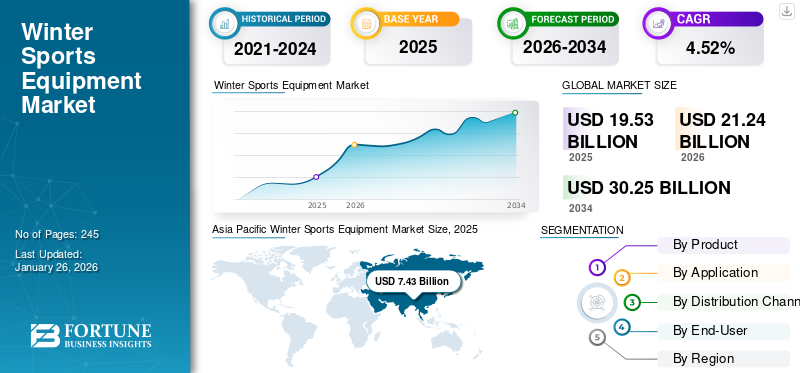
The global winter sports equipment market size was valued at USD 19.53 billion in 2025. The market is projected to grow from USD 21.24 billion in 2026 to USD 35.59 billion by 2034, exhibiting a CAGR of 6.66% during the forecast period. Asia Pacific dominated the winter sports equipment market with a market share of 38.04% in 2025.
Advanced, feature-rich equipment and gear significantly enhance individual performance in winter sports. Rising winter sports participation rate and increasing consumer preference for durable and innovative winter footwear, skis, bindings, and snowboards accelerate the global market growth. Consumers prefer ski equipment with strong edge grip, higher durability, and gear that supports instant turn initiations, ensuring an adventurous cross country skiing experience. According to Snowsports Industries America (SIA), a U.S. national trade association, snow sports participants in the U.S. increased from 29.9 million in the 2022-2023 financial year to more than 30 million in 2023-24.
Leading players in the market include Amer Sports Corporation, K2 Snow, Rossignol Group, and Tecnica Group. They focus on integrating cutting-edge technology, eco-friendly materials, and durable designs based snow gaming products to enhance the experience of athletes and enthusiasts. For instance, K2 Sports offers Carbon Darkweb technology-based snowboards that allow users to make instant movements on hard or soft snow surfaces.
Download Free sample to learn more about this report.
Winter Sports Equipment Market Key Takeaways
 Global Market Size & Forecast
- 2025 Market Size: USD 19.53 billion
- 2026 Market Size: USD 21.24 billion
- 2034 Forecast Market Size: USD 35.59 billion
- CAGR: 6.66% from 2026-2034
 Market Share
- Asia Pacific dominated the winter sports equipment market with a 38.04% share in 2025.
- The footwear segment accounted for the largest market share of 32.05% in 2025.
- The indoor segment is projected to grow at the fastest CAGR of 7.58% during 2026–2034.
 Key Regional Highlights
North America
North America is estimated to reach USD 5.56 billion in 2026, maintaining its position as the third-largest regional market.
Asia Pacific
Asia Pacific accounted for USD 7.43 billion in 2025, representing 38.07% of the global market.
Europe
Europe reached USD 5.85 billion in 2025 and is expected to hold a 29.97% market share in 2026.
U.S.
The market reached USD 4.67 billion in 2025, accounting for 23.91% of global sales.
Japan
The market was valued at USD 0.87 billion in 2025, representing 4.47% of global revenues.
Read More

WINTER SPORTS EQUIPMENT MARKET TRENDS
Rising Demand for Personalized and Custom-fit Winter Sports Gear to be a New Market Trend
Rising consumer demand for personalized, custom-fit winter sports gear that better aligns with body type, skill level, and performance preferences is favoring global market growth. In addition, advancements in the development of heat-moldable liners, 3D foot scanning, and adjustable fitting systems, and precision-tuned setups that improve users’ control and responsiveness are positively contributing to the global market expansion. Manufacturers use digital tools to produce modular components and offer in-store customization services for tailored configurations. Rising consumer demand for high performance gear equipped with such personalized designs is augmenting the market growth.
MARKET DYNAMICS
MARKET DRIVERS
Download Free sample to learn more about this report.
Expanding Snow Sports Infrastructural Facilities to Drive Product Demand
The expanding snow sports infrastructure, including ice rinks, artificial ice chutes, snow-covered slopes, and others, is driving product demand in these settings globally. In addition, governmental assistance in building ice sports infrastructure and the growing popularity of winter sports leagues, including the Winter Olympics, FIS World Cup Tour, X Games, and others, are encouraging enthusiasts to buy new products, driving the global winter sports equipment market growth. According to the Government of China, the number of winter sports venues in China reached 2,847 by the end of 2023, up 16.1% from the previous year.
MARKET RESTRAINTS
Health Injury Risks Due to Unsupervised Winter Sports Activities to Limit Market Growth
Uncertain health risks, including strains, fractures, and knee dislocations, due to unsupervised winter sports activities are discouraging consumers from participating in snowboarding, hampering demand for such sports gear. In addition, the growing social media influence of snow sports-related health injuries among participants is hampering participation among beginners, restraining global market growth.
MARKET OPPORTUNITIES
Increasing Popularity of Winter Tourism to Create Market Opportunities
The increasing popularity of winter tourism and growing consumer spending on snow tourism services, including ski lessons & coaching, ski tuning & waxing services, snowboard & ski gear subscription services, and others, is driving strong product demand across many countries. According to the Government of China, during the winter season of 2024, China recorded more than 385.0 million winter leisure visits, a 38% increase over the previous year, with related sports facility revenue increasing by 50%. In addition, rising participation in casual tourism activities, including skiing, snowboarding, winter trekking, and snowshoeing, favors global market expansion.
MARKET CHALLENGES
Increasing Trend of Buying Rented Gear to Challenge Industry Growth
The increasing number of ski resorts offering equipment for rent is expected to limit demand among casual winter sports participants. In addition, an increasing consumer preference for second-hand/rented winter equipment is negatively impacting global retail sales of such products. Additionally, significant competition among numerous industry players poses a challenge for key brands in building a strong market position in the global market.
Segmentation Analysis
By Product
Snow Facilities Mandating Usage of Boots for Snow Sports Led to Dominance of Footwear Segment
By product, the market is segmented into ski equipment, poles, snowboards, bindings, hockey sticks, footwear, protective gear, and others.
The footwear segment accounted for the leading global winter sports equipment market share of 32.05% in 2025. The segment is projected to grow at the rate of 7.06% during 2026-2034. Snow facilities mandate the use of snowboard and ski boots to ensure user safety while playing. Significant consumer demand for snow sports footwear to play various sports, including skiing, snowboarding, ice hockey, and others, is generating considerable footwear segmental revenues. In addition, advancements in BOA lacing systems, adjustable flex designs, and enhanced insulation technologies for improved footwear performance during winter sports activities are favoring the segment’s growth.
To know how our report can help streamline your business, Speak to Analyst
The ski equipment segment is projected to grow at the fastest rate of 7.31% from 2026 to 2034. Advancements in the development of all-mountain skis with lightweight materials and improved edge-control technologies are positively contributing to the segment’s growth.
By Application
Inherent Nature of Winter Sports Conducting in Outdoor Facilities Led to Dominance of Outdoor Segment
Based on the application, the market is bifurcated into indoor and outdoor.
The outdoor segment accounted for the leading global market share in 2025. The segment is projected to grow at the rate of 6.48% during 2026-2034. The inherent nature of winter sports, conducted in outdoor facilities such as mountains, ski resorts, and open terrain, is generating considerable revenue from the outdoor segment. Governmental assistance is building ski resort facilities, and the rising number of international arrivals participating in snow sports is favoring the segment’s growth.
The indoor segment is projected to grow at the fastest rate of 7.58% during 2026-2034. The expansion of artificial ski facilities and indoor snow parks, which enable beginners, children, and casual players to play sports in controlled conditions, is driving the indoor segment’s growth.
By End-User
High Men's Participation in Winter Sports Over its Counterparts Led to Dominance of Men's Segment
Based on end-user, the market is segmented into women, men, and kids.
The men's segment accounted for the leading global market share of 53.98% in 2025. The segment is projected to grow at the rate of 6.26% during 2026-2034. Greater men’s participation in snow sports, robust participation in high-intensity activities, and a preference for performance-oriented equipment are generating considerable revenue from the men’s segment. In addition, the growing number of men participating in multi-sport snow activities is driving the segment’s growth.
The women segment is projected to grow at the fastest rate of 7.24% during 2026-2034. Increasing women's participation in skiing & snowboarding facilities and the expanding number of training centers offering beginner-friendly snow sports training for women are driving the women's segment’s growth.
By Target Audience
Robust Base of Recreational and Casual Participants Led to Dominance of Recreational Users Segment
Based on target audience, the market is segmented into recreational users, professional users, children, seniors, and disabled individuals.
The recreational users segment accounted for the leading global market share of 69.08% in 2025. The segment is projected to grow at a 6.41% rate during 2026-2034. A large base of recreational & casual participants, tourists, and seasonal users in winter sports is generating considerable product revenue from the recreational users segment. In addition, the expansion of ski resort infrastructure, training schools, and beginner-friendly programs supporting the growth of beginner participants is positively contributing to the segment’s growth.
The disabled individuals segment is projected to grow at the fastest CAGR of 8.59% during 2026-2034. The expanding number of adaptive winter sports programs, Paralympic initiatives, and specialized training programs emphasizing inclusivity and accessibility of sports equipment for disabled individuals is driving the segment’s growth.
By Distribution Channel
Provision of Expert Guidance and Professional Assistance Led to Dominance of Specialty Sports Retail Stores Segment
Based on distribution channel, the market is segmented into specialty sports retail stores, online retail, hypermarkets & supermarkets, department stores, institutional/direct sales (B2B), and others.
The specialty sports retail stores segment exhibited a leading global market share of 37.59% in 2025. Specialty stores provide consumers with expert guidance on winter sports equipment, protective gear, and footwear, which is driving product sales at these stores. Furthermore, consistent manufacturers’ efforts to open new specialty brand stores across international markets are driving the segment’s revenue growth.
The online retail segment is growing at the fastest CAGR of 7.65% from 2026 to 2034. The increasing adoption of online shopping for winter sports goods and the consistent discounting by Direct-to-Consumer (DTC) brands are driving the online product sales and the segment’s growth.
Winter Sports Equipment Market Regional Outlook
By region, the market is categorized into North America, Europe, Asia Pacific, South America, and the Middle East & Africa.
Asia Pacific
Asia Pacific Winter Sports Equipment Market Size, 2025 (USD Billion)
To get more information on the regional analysis of this market, Download Free sample
The Asia Pacific region held the largest global market share of 38.07% and a market size of USD 7.43 billion in 2025. The region’s market is growing at the fastest rate of 7.40% during 2026-2034. The region dominated the market, owing to higher spending on performance equipment by Chinese and Japanese snow sportsmen. In addition, the increasing number of snow sports resorts, skiing facilities, and indoor snow facilities in India, China, and Southeast Asia is driving market growth in these regions. Furthermore, frequent snow sports events promoting luxury-branded snow gaming products are accelerating product revenues across China, Japan, and Southeast Asia. The Economic Department of the State General Administration of Sport (SGAS) reported 313 million sports enthusiasts engaged in snow & ice sports or related leisure activities since the beginning of the 2022 Beijing Winter Olympics.
Japan Winter Sports Equipment Market
The Japanese market was valued at around USD 0.87 billion in 2025, accounting for roughly 4.47% of global product revenues.
China Winter Sports Equipment Market
China’s market is projected to be one of the largest in the Asia Pacific, with revenues valued at around USD 3.81 billion in 2025, representing roughly 19.49% of global product sales. The growing popularity of the Beijing Winter Olympics and the rising number of beginner participants seeking snow sports training equipment are driving growth in the Chinese market.
India Winter Sports Equipment Market
The Indian market was valued at around USD 0.47 billion in 2025, accounting for roughly 2.40% of global market revenues.
Europe
The European region to hold a second-leading global market share of 29.97% in 2026. The region’s market size reached USD 5.85 billion in 2025. The region is expected to maintain its international market position during the forecast period (2026-2034). The rising adoption of online shopping for sports goods and consumers' easier access to branded products at specialty sports stores are accelerating product sales in Europe. The greater number of alpine skiers and their preference for high-quality skiing equipment and footwear further drive product demand in the region.
U.K. Winter Sports Equipment Market
The U.K. market was valued to be around USD 1.26 billion in 2025, representing approximately 6.46% of global product revenues.
Germany Winter Sports Equipment Market
Germany’s market reached approximately USD 0.96 billion in 2025, equivalent to around 4.90% of global product sales.
North America
The North America region held the third-largest global market share at 26.53% in 2025. The North American market size is estimated to reach USD 5.56 billion by 2026. The growing trend of outdoor recreation and the increasing popularity of minimalistic, feature-driven snow sports equipment are accelerating product sales in the U.S. and Mexico. The growing number of snow sports courts in Northern Canada is driving demand for products in the region.
U.S. Winter Sports Equipment Market
The U.S. market size reached USD 4.67 billion in 2025. The U.S. market accounted for around 23.91% of the global market sales in 2025. A strong culture of recreational skiing, snowboarding, and ice hockey, along with an extensive network of ski resorts and winter sports infrastructure, is generating considerable product revenues across the U.S.
South America and Middle East & Africa
Over the forecast period, the markets for the South American and Middle East & African regions are expected to grow at a moderate rate from 2026 to 2034. The South America market in 2025 is reached a valuation of USD 0.68 billion. The growing number of international travelers spending on new purchases or rental winter sports products, and the increasing interest in winter sports among local populations, are driving product revenue growth across the South America and Middle East & Africa regions.
South Africa Winter Sports Equipment Market
The South African market is projected to reach approximately USD 0.075 billion by 2025, accounting for roughly 0.39% of the global market revenues.
Saudi Arabia Winter Sports Equipment Market
Saudi Arabia reached a market value of USD 0.052 billion by 2025.
COMPETITIVE LANDSCAPE
Key Industry Players
Key Players Focus on Expanding their Production Capacity to Strengthen their Business Presence
Amer Sports Corporation, K2 Snow, Rossignol Group, Tecnica Group, and BAUER HOCKEY, LLC are among the leading players in the market. Key players are expanding their production capacity for snow sports equipment to strengthen their business presence in emerging markets, including Asia, the Middle East & Africa, Russia, and Eastern Europe. For instance, in March 2024, Amer Sports Corporation opened a new Nordic ski factory in Bulgaria and started construction of an Alpine binding factory in Romania.
LIST OF KEY WINTER SPORTS EQUIPMENT COMPANIES PROFILED IN REPORT
- Amer Sports Corporation (Finland)
- K2 Snow (U.S.)
- Rossignol Group (France)
- Tecnica Group (Italy)
- BAUER HOCKEY, LLC. (U.S.)
- Fischer Sports GmbH (Austria)
- Icelantic Skis (U.S.)
- Alpina Sports (Slovenia)
- Black Crows (France)
- SCOTT Sports SA (Switzerland)
KEY INDUSTRY DEVELOPMENTS
- September 2025: Winter Sports Retailers (WSR), Inc. announced a merger agreement between Snowsports Merchandising Corporation (SMC) and Sports Specialists Ltd., (SSL). This collaboration is expected to open new avenues for the shared resources and collaboration among brands and retailers.
- January 2025: Salomon, a premium ice sports brand, launched its 2025/26 S/PRO SUPRA DUAL BOA Ski Boots, featuring an advanced controlled design and cutting-edge skier-focused technologies.
- December 2024: Mountain Trade Network (MTN) acquired London Snow Show brand which was previously owned by Raccoon Media Group to expand MTN’s presence in the U.K. snow sports industry.
- November 2024: Boss, a German luxury brand, unveiled a capsule collection of snow gaming products, including technical outerwear and après-ski pieces. Through this product portfolio expansion, the brand aimed to strengthen its market position across Europe.
- February 2024: Sports Specialists Ltd. (SSL) and Snowsports Merchandising Corporation (SMC) announced a merger, creating new opportunities for business collaborations, resource management, and expanded brand and retailer networks.
- June 2023: Transformation Capital, a Netherlands-based equity firm, became a shareholder in Kubus Sports, a premium sports goods brand. This partnership enables Kubus Sports to strengthen its position in niche sports equipment markets, including winter sports, field hockey, padel, wakeboarding, sailing, and foiling.
REPORT COVERAGE
The global winter sports equipment market analysis provides an in-depth study of market insights, market size, and forecast by distribution channel, age groups, and other market segments included in the report. In addition, the report outlooks market dynamics, consumer preferences for products, and market trends expected to drive the market during the forecast period. The report on the global market includes information on technological advancements, new product launches, supply chain analysis, key developments in the industry, and details on partnerships, mergers & acquisitions. The market research report also encompasses a detailed competitive landscape with information on the market share and profiles of key operating players.
Request for Customization to gain extensive market insights.
Report Scope & Segmentation
| ATTRIBUTE | DETAILS |
| Study Period | 2021-2034 |
| Base Year | 2025 |
| Estimated Year | 2026 |
| Forecast Period | 2026-2034 |
| Historical Period | 2021-2024 |
| Growth Rate | CAGR of 6.66% from 2026 to 2034 |
| Unit | Value (USD Billion) |
| Segmentation | By Product, Application, End-User, Distribution Channel, Target Audience, and Region |
| By Product |
|
| By Application |
|
| By End-User |
|
| By Distribution Channel |
|
| By Target Audience |
|
| By Region |
|
Frequently Asked Questions
Fortune Business Insights says that the worldwide market size was valued at USD 19.53 billion in 2025 and is projected to grow from USD 21.24 billion in 2026 to USD 30.25 billion by 2034.
In 2025, the market value stood at USD 19.53 billion.
The global market forecasted to grow at a CAGR of 4.52% during 2026-2034.
By product, the footwear segment dominated the market.
Growing construction of snow sports resorts is a key driving market growth.
Amer Sports Corporation, K2 Snow, Rossignol Group, Tecnica Group, and BAUER HOCKEY, LLC. are the leading companies operating in the global market.
Asia Pacific dominated the market in 2024.
Increasing spending on winter tourism is set to create newer market growth opportunities.



- 2021-2034
- 2025
- 2021-2024
- 236
-
(Offer valid till 31st Oct 2026)
Get 30-60 hrs Free Customization
Expand Regional and Country Coverage, Segments Analysis, Company Profiles, Competitive Benchmarking, and End-user Insights.



















-
US +1 833 909 2966 ( Toll Free )
-
Get In Touch With Us