Dermatology Laser Market Size, Share & Industry Analysis, By Product Type (Single-wavelength Laser Systems, Dual-wavelength Laser Systems, Modular Multi-wavelength Laser Platforms, and Hybrid Laser-based Platforms), By Application (Hair Removal, Skin Resurfacing & Scar Treatment, Pigmentation & Tattoo Removal, and Vascular Lesion Treatment), By Technology (Diode Lasers, Nd:YAG Lasers, CO2 Lasers, Alexandrite Lasers, and Others), By End User (Dermatology Clinics, Medical Aesthetic Clinics & Medical Spas, Hospitals, Plastic Surgery Clinics, and Others), and Regional Forecast, 2026-2034
 Download Free Sample
Dermatology Laser Market Size and Future Outlook
 Listen to Audio Version
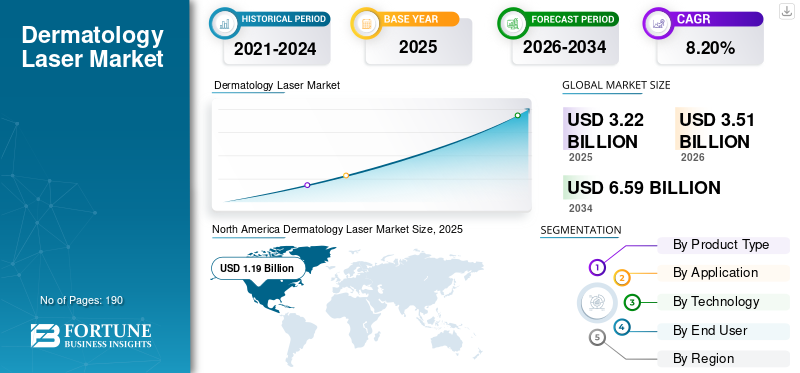
The global dermatology laser market size was valued at USD 3.22 billion in 2025. The market is projected to grow from USD 3.51 billion in 2026 to USD 6.59 billion by 2034, exhibiting a CAGR of 8.20% during the forecast period. North America dominated the dermatology laser market with a market share of 36.95% in 2025.
Dermatology laser systems are widely used for hair removal, skin resurfacing, scar treatment, pigmentation treatment lasers, tattoo removal, and vascular laser therapy. The global market is growing due to the increasing demand for minimally invasive and non-surgical procedures for improving skin appearance and treating dermatological conditions. Developments in fractional energy delivery, cooling technologies, adjustable treatment parameters, and customized treatment modes are improving treatment precision, patient comfort, and recovery time. These improvements are encouraging healthcare providers to upgrade their existing devices and expand their range of laser-based treatment services, thereby supporting market growth.
- For instance, in October 2025, Cynosure Lutronic launched the eCO2 3D fractional CO₂ laser for advanced skin-resurfacing procedures. The system combines power, precision, and adjustable treatment controls to treat different resurfacing requirements, demonstrating the growing focus of manufacturers on developing versatile and technologically advanced dermatology laser platforms.
Key players, such as Cynosure Lutronic, Inc., Candela Corporation, El.En. S.p.A., and Fotona d.o.o. are actively participating in new technology launches, strategic collaborations, and acquisitions, as well as investment initiatives to expand market presence.
Download Free sample to learn more about this report.
DERMATOLOGY LASER MARKET KEY TAKEAWAYS
 Global Market Size & Forecast
- 2025 Market Size: USD 3.22 billion
- 2026 Market Size: USD 3.51 billion
- 2034 Forecast Market Size: USD 6.59 billion
- CAGR: 8.20% from 2026–2034
 Market Share
- North America dominated the market with a 36.95% share in 2025.
- The Single-wavelength Laser Systems segment held the largest market share in 2025.
- The Hair Removal segment held the largest market share in 2025.
 Key Regional Highlights
North America
North America reached USD 1.19 billion in 2025, driven by high aesthetic procedure spending, advanced laser adoption, and a large network of dermatology and medical-aesthetic clinics.
Asia Pacific
Asia Pacific held the second-largest market share in 2025 and is projected to reach USD 1.00 billion by 2026, supported by expanding aesthetic clinics, rising disposable incomes, and growing beauty awareness.
Europe
Europe projected to reach USD 0.87 billion by 2026, growing at a 6.88% CAGR, driven by demand for non-invasive skin rejuvenation, hair removal, and pigmentation treatments.
U.S.
The market is estimated to reach USD 1.13 billion by 2026, accounting for approximately 32.11% of global revenues.
Japan
The market is estimated to reach USD 0.21 billion by 2026, accounting for approximately 6.10% of global revenues.
Read More

DERMATOLOGY LASER MARKET TRENDS
Growing Adoption of Multi-wavelength Laser Platforms is a Prominent Market Trend
The market is witnessing increasing adoption of multi-wavelength platforms that combine different laser technologies within a single system. Each wavelength targets specific skin structures and laser skin treatment depths, enabling physicians to address pigmentation, vascular lesions, scars, wrinkles, and skin resurfacing using one platform. These systems allow clinics to customize treatment parameters according to the patient’s skin condition, skin type, and desired clinical outcome. Consequently, manufacturers are increasingly developing multi-wavelength systems with integrated handpieces and flexible treatment modes, making this an important trend in the market.
- For instance, in September 2025, Sciton launched HALO TRIBRID, a triple-wavelength skin-resurfacing laser integrating 2,940 nm, 1,927 nm, and 1,470 nm wavelengths into a single handpiece. The platform combined superficial ablation, pigmentation treatment, and deeper dermal remodeling capabilities, demonstrating the growing industry focus on versatile systems that can treat multiple skin layers during a customized treatment session.
MARKET DYNAMICS
MARKET DRIVERS
Download Free sample to learn more about this report.
Expansion of Minimally Invasive and Non-invasive Aesthetic Procedures Fosters Market Growth
The increasing preference for minimally invasive and non-invasive aesthetic procedures is supporting the dermatology laser market growth. Patients are increasingly choosing laser-based hair removal, skin resurfacing, pigmentation correction, scar reduction, and skin-tightening treatments due to shorter recovery periods, limited procedural discomfort, and lower complication risks compared with surgical procedures. The availability of customizable treatment settings and improved cooling technologies is further expanding the suitability of these procedures across different age groups and skin types. This growing procedure volume is encouraging dermatology clinics, aesthetic centers, and medical spas to install advanced laser systems, thereby driving market growth.
- For instance, in March 2025, Alma Lasers launched the latest Alma Harmony aesthetic platform. The multi-application system was developed to support personalized in-office aesthetic treatments using upgraded technologies and treatment options. The launch demonstrated the growing focus of manufacturers on versatile platforms that enable providers to offer a broader range of minimally invasive and non-invasive procedures.
|
· Rank |
Market Drivers |
Overall Impact Rank |
CAGR Contribution (2026-2034) |
Impact: 2026-2028 |
Impact: 2029-2031 |
Impact: 2032-2034 |
|
1 |
Expansion of minimally invasive and non-invasive aesthetic procedures |
High |
3.10% |
High |
High |
High |
|
2 |
Growing clinic and medspa capital expenditure. |
High |
2.45% |
Medium |
High |
High |
|
3 |
Technology upgrades improve patient and provider economics |
High |
1.95% |
High |
High |
Medium |
|
4 |
Replacement of aging installed systems |
Medium-High |
1.65% |
Medium |
High |
High |
|
5 |
Therapeutic dermatology applications broaden demand |
Medium |
1.20% |
Medium |
Medium |
High |
|
6 |
Others |
Low |
0.70% |
Low |
Low |
Low |
|
Total Positive Growth Contribution |
11.05% |
MARKET RESTRAINTS
High Upfront Equipment Costs and Financing Dependence to Restrict Market Growth
Advanced dermatology laser systems require substantial initial investment in the base platform, application-specific handpieces, installation, staff training, maintenance contracts, and periodic technology upgrades. Providers therefore frequently depend on medical aesthetic equipment loans or leases with repayment periods, while interest rates may vary significantly based on creditworthiness and business performance. Higher borrowing costs increase monthly repayments and extend the time required to generate a return on investment.
Uncertain patient volumes and rapid technological upgrades can discourage clinics from purchasing new systems before their existing equipment is fully utilized or existing financing is repaid. These factors may delay device replacement and limit market penetration, particularly among smaller providers and facilities in price-sensitive markets.
- For example, professional-grade laser systems can cost approximately USD 50,000–200,000 or more, making outright purchases difficult for smaller dermatology clinics and medical spas.
|
Rank |
Market Restraints |
Overall Impact Rank |
Negative CAGR Contribution (2026-2034) |
Impact: 2026-2028 |
Impact: 2029-2031 |
Impact: 2032-2034 |
|
1 |
High capital cost and financing sensitivity |
High |
1.20% |
High |
High |
Medium |
|
2 |
Safety, operator skill, and adverse-event risk |
Medium-High |
0.80% |
High |
Medium |
Medium |
|
3 |
Economic cyclicality of self-pay procedures |
Medium |
0.55% |
Medium |
Medium |
Low |
|
4 |
Others |
Low |
0.30% |
Low |
Low |
Low |
|
Total Negative Growth Impact |
2.85% |
MARKET OPPORTUNITIES
Accelerating Adoption across China and India to Create Lucrative Growth Opportunities
One of the key global market growth opportunities lies in expanding the patient base in emerging South Asian countries such as China and India. These countries increasingly offer significant growth opportunities for the market due to the rapid expansion of aesthetic clinics, medical spas, and private dermatology centers. Rising awareness of cosmetic dermatology, greater exposure through social media, increasing disposable incomes, and the growth of medical tourism are expanding the patient base. Furthermore, regulatory approvals, local distributor partnerships, clinical training programs, and stronger after-sales networks can improve product accessibility outside major metropolitan areas. The region is expected to create new revenue opportunities for device manufacturers.
- For instance, in February 2026, Cynosure Lutronic received regulatory approvals for its dual-wavelength Clarity II laser platform in China and Japan. The company stated that the approvals expanded its clinically approved laser portfolio across key Asian markets. The development highlighted how regulatory expansion and the introduction of versatile platforms are enabling manufacturers to capture growing demand across the region.
MARKET CHALLENGES
Shortage of Skilled Professionals and Inconsistent Treatment Outcomes to Challenge Market Growth
Dermatology laser procedures require trained professionals to select the correct wavelength, energy level, pulse duration, and cooling parameters according to the patient’s skin type and treatment area. Inadequate training or incorrect device settings can result in burns, pigmentation changes, scarring, paradoxical hair growth, and unsatisfactory clinical outcomes. A shortage of qualified practitioners can therefore reduce patient confidence, increase liability risks for clinics, and raise spending on training and corrective care. These issues may slow the adoption of advanced laser systems, particularly in markets where practitioner qualifications and aesthetic-treatment regulations are inconsistent.
- For instance, in December 2025, the Maharashtra Medical Council raised concerns over a growing number of unqualified individuals performing dermatological and aesthetic procedures, including unauthorized laser treatments. The council reported that affected patients were experiencing burns, scars, hair loss, nerve damage, pigmentation problems, and permanent disfigurement, demonstrating how limited professional oversight and inadequate training can produce inconsistent and harmful treatment outcomes.
Segmentation Analysis
By Product Type
Established Clinical Utility and Lower System Complexity Supported Dominance of Single-wavelength Laser Systems
Based on the product type, the market is categorized into single-wavelength laser systems, dual-wavelength laser systems, modular multi-wavelength laser platforms, hybrid laser-based platforms, and others.
The single-wavelength laser systems segment dominated the dermatology laser market share in 2025. These devices are widely used for targeted procedures requiring a specific and well-established tissue interaction. Compared with other platforms, single-wavelength systems generally involve simpler operating protocols, fewer components, and lower acquisition and maintenance requirements. These factors make them more accessible to small and medium-sized dermatology practices with limited capital budgets. Their long-standing clinical use, extensive installed base, and availability of trained operators have further supported recurring device and procedure demand.
- For instance, in May 2025, STRATA Skin Sciences announced an expansion of CPT reimbursement eligibility for treatments performed using its 308 nm XTRAC excimer laser. The company stated that the system was already used across approximately 1,400 clinics and by 4,000 medical providers in the U.S., demonstrating the strong installed base and continued clinical relevance of indication-specific, single-wavelength laser systems.
The modular multi-wavelength laser platforms segment is expected to grow at a CAGR of 10.1% over the forecast period.
To know how our report can help streamline your business, Speak to Analyst
By Application
High Procedure Volumes and Recurring Treatment Sessions Supported Dominance of Hair Removal
Based on application, the market is segmented into hair removal, skin resurfacing & scar treatment, pigmentation & tattoo removal, vascular lesion treatment, and others.
In 2025, the hair removal segment held the largest market share due to its large addressable consumer base and frequent demand across both male and female patients. Laser hair removal can be performed on multiple facial and body areas, which increases the number of treatment opportunities per patient. The procedure has also become widely available due to its relatively short treatment time. Growing awareness of long-term hair reduction and the convenience offered over shaving, waxing, and other temporary methods has therefore strengthened the segment’s market share.
- For instance, in August 2025, Milan Laser Hair Removal announced the opening of its 400th clinic in the U.S. The company reported operations across 38 states and more than 50,000 laser hair removal procedures every month, highlighting the substantial and recurring procedure demand associated with this application.
The others segment is projected to grow at an 8.9% CAGR during the forecast period.
By Technology
Efficient Energy Delivery and Broad Commercial Availability Strengthened Dominance of Diode Lasers
Based on the technology, the market is segmented into diode lasers, Nd: YAG lasers, CO2 lasers, alexandrite lasers, and others.
The diode lasers segment dominated the market in 2025 due to the technology’s strong commercial adoption in high-volume procedures. Diode systems can deliver energy efficiently to the targeted hair follicle while supporting high repetition rates and relatively fast treatment of large body areas. The availability of different diode wavelengths, adjustable pulse settings, large treatment spots, and integrated cooling technologies enables providers to treat a wider range of hair and skin characteristics.
- For instance, in March 2024, Coherent launched a new 808 nm diode laser bar for laser hair removal systems. The two-junction design delivered 200 W of output using 100 A of current and doubled the efficiency of the company’s earlier single-junction bars. The development demonstrated continued industry investment in improving the speed, performance, and cost efficiency of diode-based hair removal equipment.
The CO2 Lasers segment is projected to grow at a CAGR of 8.8% during the forecast period.
By End User
Centralized Procurement and Specialist-led Treatment Sustained Dermatology Clinics’ Leadership
Based on the end user, the market is segmented into dermatology clinics, medical aesthetic clinics & medspas, hospitals, plastic surgery clinics, and others.
The dermatology clinics segment dominated the market in 2025, as these facilities combine specialist expertise with direct access to patients. This clinical capability enables dermatology clinics to perform a broad range of procedures, including hair removal, scar treatment, skin resurfacing, pigmentation correction, and vascular lesion treatment. These institutions also benefit from repeat consultations, follow-up sessions, and referrals, which improve equipment utilization and support faster recovery of the initial device investment.
- For instance, in April 2025, Bausch Health, in collaboration with Solta Medical, launched the Fraxel FTX skin-resurfacing laser, with the initial U.S. rollout directed toward dermatologists, plastic surgeons, and other licensed aesthetic professionals. The targeted commercial rollout demonstrated the importance of specialist-led practices as key purchasers and users of advanced dermatology laser systems.
The medical aesthetic clinics & medspas segment is projected to grow at a CAGR of 9.0% over the forecast period.
Dermatology Laser Market Regional Outlook
By geography, the market is categorized into Europe, North America, Asia Pacific, Latin America, and the Middle East & Africa.
North America
North America Dermatology Laser Market Size, 2025 (USD Billion)
To get more information on the regional analysis of this market, Download Free sample
North America led the market with USD 1.10 billion in 2024 and maintained its dominance in 2025 with USD 1.19 billion. Market growth is attributed to high spending on aesthetic procedures, strong adoption of advanced laser platforms, and a large network of dermatology and medical-aesthetic clinics. Frequent product launches and high patient awareness further support equipment upgrades and procedure volumes.
U.S. Dermatology Laser Market
Given North America's substantial contribution and the U.S. dominance in the region, the U.S. market is estimated at around USD 1.13 billion in 2026, accounting for roughly 32.11% of global revenues.
Europe
Europe is projected to grow at 6.88% CAGR in the coming years, with the third-largest growth among all regions, and reach a valuation of USD 0.87 billion in 2026. The growth in the European region is supported by rising demand for non-invasive skin rejuvenation devices, hair removal, and pigmentation treatments.
U.K. Dermatology Laser Market
The U.K. market is estimated at USD 0.14 billion in 2026, accounting for roughly 4.12% of global revenues.
Germany Dermatology Laser Market
Germany's market is projected to reach approximately USD 0.17 billion in 2026, equivalent to around 4.96% of global revenues.
Asia Pacific
Asia Pacific accounted for the second-largest market share in 2025 and is estimated to reach USD 1.00 billion in 2026. The region is growing rapidly due to the expansion of aesthetic clinics in China, India, Japan, South Korea, and Southeast Asia. Rising disposable incomes, social-media-driven beauty awareness, and demand for systems suitable for diverse skin types are accelerating adoption.
Japan Dermatology Laser Market
The Japanese market in 2026 is estimated at around USD 0.21 billion, accounting for approximately 6.10% of global revenues.
China's Dermatology Laser Market
China's market is projected to be among the largest globally, with 2026 revenues estimated at around USD 0.31 billion, accounting for approximately 8.81% of global sales.
India Dermatology Laser Market
The Indian market is estimated at around USD 0.12 billion in 2026, accounting for roughly 3.52% of global revenues.
Latin America and Middle East & Africa
The Latin America market is expected to witness moderate growth during the forecast period and is estimated to reach a valuation of USD 0.20 billion in 2026. Market growth in the region is driven by increasing cosmetic procedure volumes, expanding private healthcare infrastructure, and strong demand for hair removal and skin resurfacing lasers. Brazil and Mexico are emerging as key markets due to established aesthetic-treatment cultures and growing medical tourism. In the Middle East & Africa, the GCC is set to reach USD 0.08 billion in 2026.
South Africa Dermatology Laser Market
The South African market is projected to reach approximately USD 0.03 billion in 2026, accounting for roughly 0.79% of global revenues.
COMPETITIVE LANDSCAPE
Key Industry Players
Strategic Collaboration among Key Companies to Intensify Market Competition
The strong presence of established medical-aesthetic device companies and specialized laser manufacturers characterizes the global dermatology laser market. Major companies are focusing on strengthening their portfolios through multi-wavelength platforms, application-specific handpieces, advanced cooling technologies, real-time treatment monitoring, and customizable treatment parameters. Competition is increasing as dermatology clinics demand systems that can treat multiple skin conditions, support diverse skin types, reduce procedure time, and improve equipment utilization. Additionally, large companies benefit from broad product portfolios, established clinical-training programs, regulatory capabilities, global distribution networks, and strong after-sales support. Key companies in the market include Cynosure Lutronic, Inc., Candela Corporation, El.En. S.p.A., Fotona, Lumenis, Sciton, Solta Medical, and Cutera.
- For instance, in February 2026, Bausch Health Companies Inc. collaborated with Solta Medical and launched the Clear + Brilliant Touch laser in Canada. The device was approved by Health Canada on May 20, 2025, marking an important milestone as demand for non‑invasive skin rejuvenation treatments continues to grow across Canada.
Major players such as Wontech and Jeisys Medical compete through product innovation, clinical evidence generation, regulatory approvals, partnerships, portfolio expansion, and geographic reach. Companies with broad laser portfolios, strong practitioner relationships, reliable service infrastructure, and established distribution channels are expected to maintain a leading position. At the same time, regional manufacturers are likely to increase competitive pressure through cost-effective systems and faster expansion across emerging markets.
LIST OF KEY DERMATOLOGY LASER COMPANIES PROFILED
- Cynosure Lutronic, Inc. (U.S.)
- Candela Corporation (U.S.)
- En. S.p.A. (Italy)
- Fotona d.o.o. (Slovenia)
- Sisram Medical Ltd. (Israel)
- Lumenis Be Ltd. (Israel)
- Sciton, Inc. (U.S.)
- Solta Medical (U.S.)
- Cutera, Inc. (U.S.)
- Wontech Co., Ltd. (South Korea)
- Jeisys Medical Inc. (South Korea)
KEY INDUSTRY DEVELOPMENTS
- March 2026: BENEV Company Inc. partnered with LaserAway, a leader in aesthetic dermatology, to significantly expand access to the XTherma High-Frequency RF and Cryogen Combination Therapy Device. The device is designed to deliver exceptional clinical outcomes, with pain-free, low-downtime treatment for skin rejuvenation.
- August 2025: Asclepion Laser introduced a new generation of treatment protocols for this laser system: the COOL TREATMENTS. These premium protocols are tailored for popular aesthetic indications such as non-invasive blepharoplasty, perioral resurfacing, and dual neck rejuvenation.
- July 2025: Gunze Medical Limited launched the UV Therapy Device for Dermatology “CAREVEAM” in Japan. The therapy device is used for the treatment of skin diseases in medical institutions nationwide.
- April 2025: Candela Corporation launched the Vbeam Pro platform at the American Society for Laser Medicine and Surgery (ASLMS). The Vbeam Pro platform is designed to effectively treat a broad spectrum of skin conditions, including rosacea, port-wine stains, acne, leg veins, spider veins, scars, benign pigmented lesions, wrinkles, warts, stretch marks, and photoaging.
- March 2025: Lumenis Be. Ltd. expanded the availability of its FoLix, the fractional laser technology for hair loss, to Canada. The development aimed to help both men and women by offering an effective and safe hair loss solution.
- June 2024: AVAVA, Inc., secured USD 35.0 million in a new Series C financing round in partnership with Jeisys Medical, Inc. This new investment aimed to support the commercial expansion of the breakthrough laser technology
REPORT COVERAGE
The dermatology laser market report provides a detailed assessment of all market segments, highlighting the key drivers, trends, opportunities, restraints, and challenges influencing industry growth. It also covers technological advancements in single-wavelength, dual-wavelength, modular multi-wavelength, and hybrid laser-based platforms, major industry developments, market share analysis, and comprehensive profiles of leading companies. The report evaluates market trends by product type, application, technology, and end user across key regions. It includes a global market analysis covering hair removal, skin resurfacing and scar treatment, pigmentation and tattoo removal, vascular lesion treatment, diode lasers, Nd: YAG lasers, CO₂ lasers, alexandrite lasers, product launches, regulatory approvals, pricing trends, and competitive strategies adopted by leading medical-aesthetic device manufacturers. The study further assesses equipment installation, procedure volumes, system upgrades, clinical training, after-sales services, distribution partnerships, and the adoption of advanced cooling and customized treatment technologies. It also highlights regional growth patterns across North America, Europe, Asia Pacific, Latin America, and the Middle East & Africa, along with the major factors supporting the adoption of dermatology laser systems in each region.
Request for Customization to gain extensive market insights.
Report Scope and Segmentation
| ATTRIBUTE | DETAILS |
| Study Period | 2021-2034 |
| Base Year | 2025 |
| Estimated Year | 2026 |
| Forecast Period | 2026-2034 |
| Historical Period | 2021-2024 |
| Growth Rate | CAGR of 8.20% from 2026 to 2034 |
| Unit | Value (USD Billion) |
| Segmentation | By Product Type, Application, Technology, End User, and Region |
| By Product Type |
|
| By Application |
|
| By Technology |
|
| By End User |
|
| By Region |
|
Research Methodology:
1. Bottom Up Approaches
Approach 1: Revenues and Market Share of Major Dermatology Laser Players
- Collection of dermatology laser-attributable revenues from annual reports, SEC and stock-exchange filings, investor presentations, earnings releases, company websites, and product-level disclosures of key companies such as Cynosure Lutronic, Candela, Lumenis, El.En., Fotona, Sciton, Solta Medical, Cutera, Wontech, and Jeisys Medical.
- Separation of dermatology laser revenues from IPL, radiofrequency, ultrasound, body contouring, ophthalmology, dental, surgical, and other non-relevant device revenues.
- Estimation of revenues by product type, including single-wavelength systems, dual-wavelength systems, modular multi-wavelength platforms, and hybrid laser-based platforms.
- Assessment of company sales by technology, application, geographic footprint, installed base, distributor network, product launches, and end-user penetration.
- Estimation of undisclosed private-company revenues using system shipments, average manufacturer selling prices, distributor activity, product breadth, employee strength, and regional presence.
- Summation of company-level dermatology laser revenues, followed by the addition of revenues generated by smaller regional and local manufacturers, to derive the global market.
- Triangulation of the resulting estimate with country-level procedure demand, installed-base indicators, procurement activity, and import-export trends.
Approach 2: Installed Base and Replacement Cycle Analysis
- Estimation of the installed base of dermatology laser systems across dermatology clinics, medical aesthetic clinics and medspas, hospitals, plastic surgery clinics, and other professional facilities.
- Assessment of the number of laser-equipped facilities by country.
- Classification of installed systems by product type, application, technology, end user, and geography.
- Analysis of annual new installations, replacement demand, upgrades, additional handpiece purchases, facility expansion, system retirement, and technology obsolescence.
- Application of average equipment life and replacement cycles across single-wavelength, dual-wavelength, modular, and hybrid platforms.
- Multiplication of annual new and replacement unit demand by manufacturer-level average selling prices to estimate the market value.
- Validation of installed-base estimates through company installation announcements, distributor disclosures, clinic equipment listings, hospital tenders, product registrations, and shipment indicators.
- Summation of country-level estimates to derive the regional and global market size.
Approach 3: Dermatology Laser Procedure Volume and Utilization Model
- Collection of procedure volumes for hair removal, skin resurfacing and scar treatment, pigmentation and tattoo removal, vascular lesion treatment, and other medical and cosmetic dermatology applications.
- Estimation of the number of patients, procedures per patient, treatment sessions per procedure course, and annual procedure demand by country.
- Assessment of the number of laser-equipped facilities, average operating days, procedures performed per system per day, utilization rates, and seasonal demand variations.
- Conversion of total procedure demand into the number of laser systems required to support existing and incremental treatment volumes.
- Segmentation of demand by cosmetic self-pay procedures and medically necessary or reimbursed procedures.
- Application of manufacturer selling prices by laser technology and platform configuration to derive equipment-market revenues.
2. Top Down Approaches
Approach 1: Analysis of Parent Market of Dermatology Devices
- Estimation of the broader global professional medical aesthetic and dermatology device market using company revenues, regulatory registrations, medical-device production data, trade flows, healthcare capital expenditure, and institutional procurement activity.
- Exclusion of non-relevant categories such as injectables, implants, skincare products, pharmaceuticals, home-use devices, diagnostic devices, and clinical service revenues.
- Estimation of the share attributable to professional energy-based aesthetic and dermatology systems.
- Further separation of laser systems from IPL-only, radiofrequency-only, ultrasound, cryotherapy, plasma, LED, and other non-laser technologies.
- Allocation of the dermatology laser market by product type, application, technology, end user, region, and country using company portfolios, procedure mix, installed base, and procurement indicators.
- Validation of the resulting market value against the combined dermatology laser revenues of leading manufacturers and estimated revenues of smaller regional participants.
- Reconciliation of the top-down estimate with the three bottom-up models to determine the final historical market size and forecast base.
3. List of Key Sources
- Annual reports, SEC filings, stock-exchange filings, investor presentations, earnings releases, and company press releases
- Product catalogs, technical specifications, regulatory clearances, installation announcements, and distributor websites
- S. FDA, European Commission, EUDAMED-related sources, PMDA, NMPA, CDSCO, and TGA
- American Society for Laser Medicine and Surgery
- American Society for Dermatologic Surgery
- American Academy of Dermatology
- International Society of Aesthetic Plastic Surgery
- MedTech Europe and national medical-device associations
- WHO, OECD, World Bank, Eurostat, and national statistics agencies
- Hospital tenders, public procurement portals, clinic directories, provider websites, customs databases, and UN Comtrade
- Dermatology procedure volumes, laser-equipped facility counts, physician density, healthcare expenditure, and medical-device adoption indicators
4. Primary Interviews
Supply Side Interviews: 60%
- Key respondents: Discussions with dermatology laser manufacturers, component suppliers, authorized distributors, equipment importers, service providers, and industry consultants to validate market size, manufacturer selling prices, unit shipments, installed base, product mix, replacement cycles, distribution margins, technology adoption, and competitive shares. Respondents may include senior executives, regional sales directors, product managers, marketing managers, distributors, channel partners, and biomedical engineers.
Demand Side Interviews: 40%
- Key Respondents: Discussions with dermatologists, aesthetic physicians, plastic surgeons, hospital procurement managers, medspa operators, clinic owners, laser technicians, and healthcare administrators to assess equipment ownership, purchase frequency, utilization, procedure mix, preferred technologies, replacement requirements, purchasing budgets, financing practices, and future procurement intentions.
Frequently Asked Questions
According to Fortune Business Insights, the global market value stood at USD 3.22 billion in 2025 and is projected to reach USD 6.59 billion by 2034.
In 2025, the market value in North America stood at USD 1.19 billion.
The market is expected to grow at a CAGR of 8.20% over the forecast period of 2026-2034.
The single-wavelength laser systems segment led the market.
Expansion of minimally invasive and non-invasive aesthetic procedures is driving market growth.
Cynosure Lutronic, Inc., Candela Corporation, El.En. S.p.A., and Fotona d.o.o. are among the major players in the global market.
North America dominated the market in 2025.



- 2021-2034
- 2025
- 2021-2024
- 190
Get 30-60 hrs Free Customization
Expand Regional and Country Coverage, Segments Analysis, Company Profiles, Competitive Benchmarking, and End-user Insights.













.webp)






Related Reports
-
US +1 833 909 2966 ( Toll Free )
-
Get In Touch With Us