Real-time Analytics Market Size, Share & Industry Analysis, By Enterprise Type (SMEs and Large Enterprises), By Application (Marketing Analytics, Financial Analytics, Operational Analytics, Customer Analytics, and Supply Chain Analytics), By End-Use (BFSI, Retail, Healthcare, Government, Manufacturing, Media & Entertainment, and Research & Development), and Regional Forecast, 2026-2034
 Download Free Sample
KEY MARKET INSIGHTS
 Listen to Audio Version
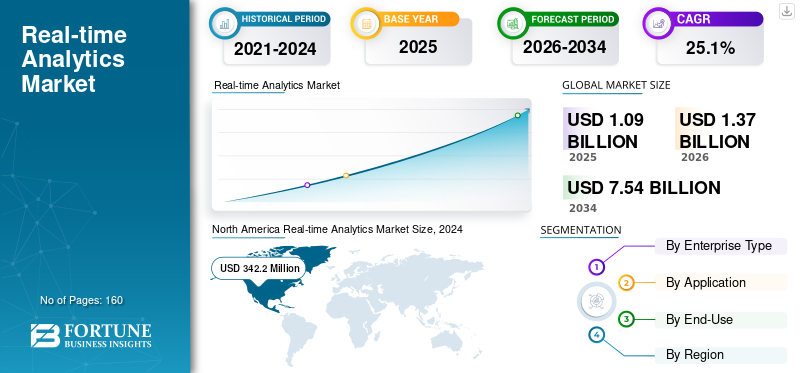
The global real-time analytics market size was valued at USD 1098.7 million in 2025 and is projected to grow from USD 1373.5 million in 2026 to USD 7,544.50 million by 2034, exhibiting a CAGR of 25.1% during the forecast period. North America dominated the real-time analytics market with a market share of 36.41% in 2024.
Real-time analytics market refers to the industry sector focused on technologies and services that enable the rapid collection, processing, and analysis of data as it is generated. This market encompasses tools and platforms that allow organizations to gain immediate insights and make timely decisions by leveraging data in motion across various applications and industries. In industries such as healthcare, BFSI, and others, real-time insights are critical for making decisions, this leads to increasing adoption of real-time analytics. The growth of internet of things (IoT) connected devices and mobile apps has noticeably increased the volume and velocity of data. Therefore, businesses are increasingly adopting real-time analytics to manage this data and provide actionable insights.
- According to IBM, the number of IoT connected devices is expected to reach USD 29 billion by 2030 globally.
- By 2025, experts predict that approximately 30% of generated data will be real-time, enabling organizations to derive actionable insights as the data is created.
Download Free sample to learn more about this report.
Real-time Analytics Market Key Takeways
 Global Market Size & Forecast
- 2025 Market Size: USD 1,098.7 million
- 2026 Market Size: USD 1,373.5 million
- 2034 Forecast Market Size: USD 7,544.50 million
- CAGR: 25.1% from 2026–2034
 Market Share
- North America dominated the real-time analytics market with a 36.41% share in 2024.
- Large enterprises accounted for the leading market share in 2024.
- Marketing analytics held the largest segment share in 2024.
 Key Regional Highlights
North America
North America led the market due to strong cloud adoption, AI integration, and advanced data infrastructure.
Asia Pacific
Asia Pacific is projected to register the highest CAGR during the forecast period, driven by rapid e-commerce expansion.
Europe
Europe is the second-largest regional market, supported by GDPR compliance and increasing real-time data monitoring.
U.S.
U.S. Growing IoT device deployment and rising real-time data generation are accelerating market adoption.
Japan
Japan Increasing digital transformation and enterprise AI adoption are expected to support steady market growth.
Read More

IMPACT OF GENERATIVE AI
Generative AI enhances predictive capabilities by analyzing historical and real-time data to forecast future trends, risks, and opportunities. The incorporation of generative AI into real-time analytics necessitates robust data governance and infrastructure. Integrating LLM into data pipelines helps businesses to process and analyze streaming data instantaneously. For instance, financial institutions can detect anomalies and assess risks in real-time data processing. At the same time, retailers can monitor social media trends and point-of-sale transactions to adjust marketing strategies and optimize inventory management promptly.
IMPACT OF RECIPROCAL TARIFF
The impact of reciprocal tariffs on real-time analytics is direct, particularly in sectors reliant on international trade and data-driven decision-making. Higher tariffs can lead to increased costs for businesses, which may lead to lower investment in advanced analytics tools and technologies. The unpredictability associated with changing trade policies can create an environment of uncertainty, making it challenging for businesses to rely on real-time analytics for forecasting and decision-making.
Trends Shaping the Real-time Analytics Market
Emergence of Data Fabric Architectures Drives Market Growth
Businesses' are struggling to manage the complexities and diverse nature of data as their data needs evolve, which exists across multiple applications and environments throughout the organization. Consequently, the adoption of data fabric architecture is on the rise.
- According to industry experts, global data generation and consumption volumes surpassed 149 zettabytes in 2024, with unstructured data comprising around 80% of this total.
Data fabric architecture is a modern data management framework developed to tackle the challenges of managing and utilizing data within complex, distributed, and hybrid computing environments. It connects various data sources, including on-premises systems, cloud platforms, and edge devices, allowing for seamless data flow and the elimination of data silos. As a result, industry experts recognized data fabric as one of the top 10 influential technologies in data and analytics in 2022.
MARKET DYNAMICS
MARKET DRIVERS
Growing Demand for Democratization of Analytics Propels Market Growth
Democratization of analytics facilitates faster, more informed decisions across all levels of the organization. Real-time analytics is only useful if decisions are made immediately. Still, when analytics is democratized, managers, front-line workers, and non-technical staff can access and interpret real-time data themselves.
- For instance, a retail store manager can adjust in-store promotions based on real-time sales data rather than waiting for a report from headquarters.
- As per industry experts, organizations that empower business users with real-time analytics observed 20% to 30% faster decision cycles and improved responsiveness to market dynamics.
The democratization of analytics increases the importance of real-time analytics by making it accessible, operational, and actionable across organizations. This results in more agile, data-driven businesses that adapt instantly in fast-paced environments.
Thereby, the growing demand for the democratization of analytics is driving the real-time analytics market growth.
Challenges in the Real-time Analytics Market
Challenges Related to Data Quality and Integration to Limit Market Expansion
Ensuring the quality, consistency, and accuracy of real-time data is critical, as incorrect or incomplete data leads to error-prone insights and decisions. Integrating diverse data sources, especially when dealing with structured and unstructured data, adds complexity to real-time analytics implementation. Therefore, challenges related to data quality and integration limit market expansion.
MARKET OPPORTUNITIES
Growing Popularity of Edge Analytics is Expected to Create Opportunities for Market Players
As companies adopt advanced manufacturing technologies such as the Industrial Internet of Things (IIoT), the volume of data generated can exceed the bandwidth capacity of traditional cloud-based solutions. To alleviate these challenges and enable real-time, low-latency responses necessary for advanced automation, many companies are shifting a significant amount of their data to the edge. Edge analytics refers to the method of analyzing data at or near the source of its generation, specifically, at the edge of the network rather than relying solely on a centralized data-processing warehouse or cloud.
Edge analytics stores data locally, addressing GDPR, CCPA, and HIPAA concerns by avoiding unnecessary data transmission to the cloud. Storing and transmitting huge amounts of raw data in the cloud is costly. Edge analytics reduces cloud bandwidth and storage usage by filtering or summarizing data locally. The popularity of edge analytics has created opportunities for the players. They are focusing on offering edge-compatible analytics tools optimized for IoT and are entering into partnerships with telecom providers to embed analytics in 5G edge infrastructure.
SEGMENTATION ANALYSIS
By Enterprise Type
Adoption of Real-time Analytics by Large Enterprises for Decision Making Helped the Segment to Dominate
Based on enterprise type, the market is classified into SMEs and large enterprises.
Among these, large enterprises dominated the market in 2024. Real-time analytics provides large enterprises with instant insights and helps decision-makers act quickly on emerging trends or anomalies. As per the Dresner Advisory Services survey, around 70% of organizations consider real-time data to be critical to their business operations.
SMEs are estimated to grow with the highest CAGR during the forecast period. As SMEs are attractive targets for cyber attackers, the adoption of real-time analytics increases. It assists SMEs in identifying suspicious behavior instantly. According to an Experian report, 1 in 4 SMEs have experienced fraud, and real-time monitoring has helped to reduce fraud risk by 40%.
By Application
Marketing Analytics to Dominate Owing to Increasing Adoption of Real-time Analytics for Enhancing Customer Experience
Based on application, the market is segmented into marketing analytics, financial analytics, operational analytics, customer analytics, and supply chain analytics.
Among these, marketing analytics dominated the market in 2024 and is estimated to grow with the highest CAGR during the forecast period. Businesses prioritize understanding and predicting customer behavior in real time to boost customer engagement, retention, and personalization. Real-time insights help businesses to offer personalized recommendations, dynamic pricing, and real-time support to their customers.
By End-Use
Adoption of Real-time Analytics to Identify Fraudulent Activity Boosted BFSI Segmental Growth
Based on end-use, the market is segmented into BFSI, retail, healthcare, government, manufacturing, media & entertainment, and research & development.
Among these, BFSI dominated the market in 2024. Real-time analytics adoption is increasing in the financial services sector due to rising demand for security, compliance, and personalization. As companies in this sector handle huge transactions every day, the demand for real-time analytics solutions is increasing for fraud detection.
Healthcare is estimated to register the highest CAGR during the forecast period. The adoption of real-time analytics is increasing in this sector due to increasing demand for improved patient outcomes, early diagnosis, regulatory compliance, and operational efficiency.
REAL-TIME ANALYTICS MARKET REGIONAL ANALYSIS
Based on geography, the market is categorized into North America, South America, Europe, the Middle East & Africa, and Asia Pacific.
North America
North America Real-time Analytics Market Size, 2024 (USD Million)
To get more information on the regional analysis of this market, Download Free sample
North America dominates with the highest real-time analytics market share, owing to the increasing adoption of cloud services, AI integration, and data infrastructure. According to industry experts, around 80% of enterprises in the region are investing in cloud services, and around 61% are investing in real-time analytics platforms.
Download Free sample to learn more about this report.
The U.S. is estimated to witness significant growth in the coming years, owing to the increasing number of connected devices that generate massive amounts of real-time data. The U.S. has over 3.5 billion IoT devices that generate huge amounts of real-time data. Therefore, the adoption of real-time analytics is increasing for smooth functioning.
Asia Pacific
Asia Pacific is estimated to grow with the highest CAGR during the forecast period. The e-commerce market is witnessing high growth in the region. Therefore, the adoption of real-time analytics is rising as it provides fraud prevention, dynamic pricing, customer targeting, and inventory management.
Europe
Europe is the second-largest market for real-time analytics. Europe has strict regulations regarding data, especially GDPR and organizations in the region are focusing on adopting real-time analytics to continuously monitor data usage, transfer, and maintain adherence to regulations.
Middle East & Africa
The Middle East & Africa is estimated to witness significant growth in coming years, as governments in the Middle Eastern countries are launching various initiatives to digitize public services and infrastructure, including UAE’s Smart Government Strategy, Saudi Arabia’s Vision 2030, and Qatar National Vision 2030. These initiatives rely heavily on real-time data to monitor progress.
South America
South America is expected to register a steady growth rate over the forecast period, owing to increasing digitalization, the need for operational efficiency, and the demand for enhanced customer experiences.
COMPETITIVE LANDSCAPE
KEY INDUSTRY PLAYERS
Key Companies Prioritize Innovation and New Product Launches to Strengthen Their Presence
Key players in the market form strategic alliances and collaborations to enlarge the business, products, technologies, and other offerings with year-on-year revenue growth. Partnerships and collaborations vary according to business requirements, such as the expansion of the product portfolio, which helps to expand the global presence and acquire a new customer base. Players are expanding their operations into emerging markets to tap into new customer bases. Companies are investing in research and development to innovate and improve their offerings and stay competitive in the market.
Key Players in Real Time Analytics Market
- IBM Corporation (U.S.)
- Microsoft Corporation (U.S.)
- SAP SE (Germany)
- Google (U.S.)
- Oracle Corporation (U.S.)
- Infosys (India)
- Amdocs (U.S.)
- Informatica (Canada)
- Alteryx (U.S.)
- Sedin Technologies (India)
- Sisense (U.S.)
- Sigma Software (Sweden)
- Accenture (Ireland)
- Databricks (U.S.)
- Latent View (India)
- Tableau Software (U.S.)
- SAS Institute (U.S.)
and more…
KEY INDUSTRY DEVELOPMENTS
- January 2025: SixWorks, an IBM Company, has partnered with KX Deliver to provide a secure and high-performance data analytics and visualization toolset for the United Kingdom Ministry of Defence (MOD) and other defense sectors.
- September 2024: Salesforce launched Tableau Einstein to speed up the transition from raw data to insights by incorporating autonomous and assistive agents into all areas of analytics to act directly on insights.
- September 2024: Accenture introduced the Personalized Experience solution on Salesforce, designed to leverage Artificial Intelligence (AI) to help organizations achieve a comprehensive understanding of their customers and create customized experiences across multiple channels. This solution utilizes real-time data and AI-driven insights, enabling businesses to remain competitive, unlock additional value, and enhance customer loyalty.
- June 2024: Amdocs collaborated with Google to speed up data transformations for Communications Service Providers (CSPs) and to deliver meaningful real-time business insights.
- May 2023: Alteryx launched the AiDIN generative AI engine with a range of capabilities in the Alteryx Analytics Cloud Platform that bring data analytics to a larger user base.
REPORT COVERAGE
The global real-time analytics market research report provides market size & forecast by all the segments. It includes details on the market dynamics and market trends expected to drive the market in the forecast period. It offers information on key regions/countries, key industry developments, new product launches, and details on partnerships, mergers & acquisitions. The report covers a detailed competitive landscape with information on the market share and profiles of key players.
Request for Customization to gain extensive market insights.
REPORT SCOPE & SEGMENTATION
|
ATTRIBUTE |
DETAILS |
|
Study Period |
2021-2034 |
|
Base Year |
2025 |
|
Estimated Year |
2026 |
|
Forecast Period |
2026-2034 |
|
Historical Period |
2021-2024 |
|
Growth Rate |
CAGR of 25.1% from 2026 to 2034 |
|
Unit |
Value (USD Million) |
|
Segmentation |
By Enterprise Type
By Application
By End-Use
By Region
|
Frequently Asked Questions
Fortune Business Insights says that the global market value stood at USD 1098.7 million in 2025 and is projected to reach USD 7,544.50 million by 2034.
In 2024, the market value stood at USD 324.2 million.
The market is expected to exhibit a CAGR of 25.1% during the forecast period of 2026-2034.
By application, marketing analytics led the market.
Growing demand for the democratization of analytics is propelling the market growth.
IBM Corporation, Oracle Corporation, Google, Amdocs, Microsoft Corporation, and Alteryx are the top players in the market.
North America dominated the market in 2024.
The healthcare segment is estimated to register the highest CAGR during the forecast period.



- 2021-2034
- 2025
- 2021-2024
- 160
Get 30-60 hrs Free Customization
Expand Regional and Country Coverage, Segments Analysis, Company Profiles, Competitive Benchmarking, and End-user Insights.




















Related Reports
-
US +1 833 909 2966 ( Toll Free )
-
Get In Touch With Us