Food Service Market Size, Share & Industry Analysis, By Type (Full Service Restaurants, Quick Service Restaurants, Institutes, and Others), By Restaurant Type (Chained and Independent), By Service Type (Dine-In, Takeaway, and Delivery), and Regional Forecast, 2026-2034
 Download Free Sample
(Offer valid till 30th Sep 2026)

KEY MARKET INSIGHTS
 Listen to Audio Version
The global food service market size was valued at USD 4027.61 million in 2025 and is projected to grow from USD 4339.38 million in 2026 to USD 7,634.64 million by 2034, exhibiting a CAGR of 7.32% during the forecast period. Asia Pacific dominated the global market with a share of 42.96% in 2025.
Food service establishments refer to businesses that prepare and distribute food for on-premise consumption, takeaway, and delivery. This industry includes food service retailers, counter and table servers, and food service providers. The market is experiencing rapid growth in fast food consumption globally, driven by rising household incomes, the number of working women, and the convenience foods offered by food service businesses.
McDonald’s, Yum! Brands (KFC, Pizza Hut, Taco Bell), Restaurant Brands International (Burger King, Tim Hortons), Domino’s, and Darden Restaurants, Inc. are major players operating in the global market. Mergers and acquisitions remain frequent, reflecting a drive for scale, diversification, and expanded service offerings.
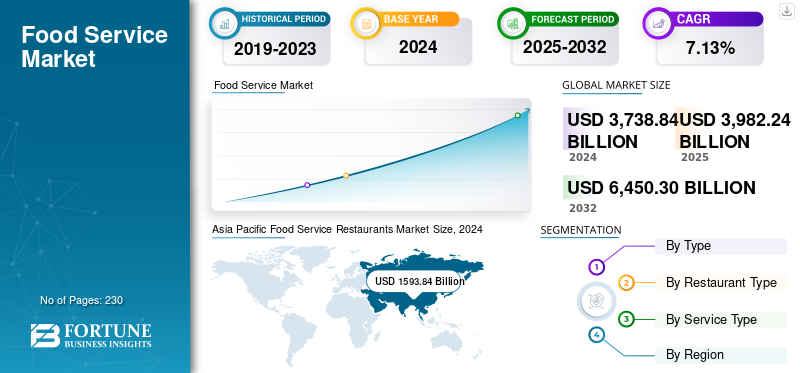
Download Free sample to learn more about this report.
Food Service Market KEY TAKEAWAYS
 Market Size & Forecast
- 2025 Market Size: USD 4,027.61 Million
- 2026 Market Size: USD 4,339.38 Million
- 2034 Forecast Market Size: USD 7,634.64 Million
- CAGR: 7.32% from 2026-2034
 Market Share
- Asia Pacific holds 42.96% market share in 2025.
- Full Service Restaurants holds 46.15% market share in 2026.
- Independent Restaurants holds 62.02% market share in 2026.
 Key Regional Highlights
Asia Pacific
Asia Pacific held 42.96% market share in 2025, driven by high population densities.
North America
North America held 28.92% market share in 2025, reaching USD 1,164.8 Million.
Europe
Europe held 17.93% market share, supported by growth across the U.K., Germany, France, and Italy.
U.S.
The U.S. market is projected to reach USD 1,074.68 million by 2026.
Japan
The Japan market is projected to reach USD 301.03 million by 2026.
Read More

MARKET DYNAMICS
Market Drivers
Increased Spending on Food Consumed Out of Home to Drive Market Growth
Changing consumer behavior, lifestyles, and growing incomes in developing countries are the main factors driving consumers to eat food away from home more frequently. Moreover, with the rising number of working women, families frequently visit restaurants or order coffee and snacks from outside. Considering the popularity of fast food among the young population, many international quick-service and hotel brands are expanding their presence in foreign markets. Opportunities for foreign food exporters to supply the HRI sector are improving as consumer demands for regional ethnic foods also increases. These are the major factors boosting the food service market growth.
- According to the U.S. Department of Agriculture, in the U.S., in 2023, the per-capita spending on Food Away From Home (FAFH) reached USD 4,485, up from USD 4,004 in 2022, a 12.0% increase from the previous year.
Market Restraints
Negative Impacts of Online Food Delivery May Hinder the Market Growth
Online food ordering, which most consumer groups have adopted, is increasing. However, some negative aspects associated with online food ordering may hinder customer adoption. Along with the many benefits of food delivery, certain drawbacks exist. For example, the quality of the delivered food often falls below that of the meal served in a restaurant. Transportation over long distances can lead to a loss of valuable vitamins in food. In addition, food from delivery services is often packaged in plastic, which is usually less appealing compared to the food neatly placed on plates in a restaurant. These factors are likely to impact and challenge the market growth.
Market Opportunities
Integration of AI and Automation in Food Service Operations to Offer Growth Opportunities
The integration of artificial intelligence and automation is profoundly reshaping the food service industry worldwide, enhancing operational efficiency, service speed, and personalization. Restaurants increasingly rely on AI analytics to forecast demand, optimize inventory, and personalize customer experiences. Companies such as Domino’s and McDonald’s utilize predictive algorithms to manage delivery logistics, predict peak hours, and tailor menu recommendations to their consumers. Automation technologies now play a central role in improving operational consistency and labor productivity.
For instance, Sweetgreen’s “Infinite Kitchen,” launched in 2025, features a fully automated makeline that assembles salads through conveyor-based robotics, reducing labor costs by half while doubling output capacity. Human staff oversee quality control and customer experience at the end of the line.
Food Service Market Trends
Rising Popularity of Ghost Kitchens and Cloud Kitchens
Ghost kitchens and cloud kitchens have emerged as one of the most transformative trends in the industry since the COVID-19 pandemic. These delivery-only restaurant models allow operators to prepare food exclusively for takeout and delivery, eliminating the need for physical dine-in infrastructure and significantly reducing operational costs and expanding market reach.
- For instance, in April 2025, the National Restaurant Association of India (NRAI) announced the launch of India's first-ever Cloud Kitchen Convention. This landmark event aimed to bring together key stakeholders in the cloud kitchen ecosystem, including entrepreneurs, technology providers, delivery aggregators, and investors.
Download Free sample to learn more about this report.
SEGMENTATION ANALYSIS
By Type
Full Service Restaurants Segment Dominates Driven by the Availability of Different Varieties on the Food Menu
Based on type, the market is divided into full-service restaurants, quick-service restaurants, institutes, and others.
The full-service restaurants (FSRs) segment will hold the largest food service market share of 46.15% in 2026, driven by increasing casual dining and experiential dining demand in urban centers. Full-service restaurants include establishments that provide table service in brick-and-mortar locations, offering a full meal menu, and thus constitute the highest share of the global market. They provide a variety of menus, including options for breakfast and a complete meal menu featuring selections for both lunch and dinner. These establishments, particularly fine dining and casual dining restaurants, focus on eclectic, high-quality interiors, high service standards, extensive beverage offerings, and sophisticated decor and ambience to attract customers. Moreover, staff members are typically highly trained and there is often a dress code in place for patrons.
The quick service restaurants segment is expected to grow at a high CAGR of 7.52% over the forecast period. These restaurants feature a limited menu that specializes in selective main entrees such as burgers, pizza, or chicken.
To know how our report can help streamline your business, Speak to Analyst
By Restaurant Type
Rising Demand for Authentic Dining Drives the Dominance of the Independent Restaurants Segment
Based on restaurant type, the market is bifurcated into chained and independent.
The independent restaurants segment is expected to capture a leading share of 62.02% share in 2026. Consumers increasingly seek authentic, unique dining experiences that reflect local culture and cuisine. Independent restaurants have the flexibility to craft personalized menus with locally sourced ingredients and regional culinary traditions. This local focus appeals to an increasing number of customers who prioritize authenticity and community support over standardized chains.
The chained segment, on the other hand, is expected to grow at a higher CAGR of 7.76% over the forecast period.
By Service Type
Dine-in Segment to Dominate Owing to Consumer Preferences for Experiential and Social Dining
In terms of service type, the market is fragmented into dine-in, takeaway, and delivery.
The dine-in segment will accounting for a 68.52% share in 2026, leading the global market share, as experiential dining and social gatherings continue to be key consumer activities. Experiential dining fosters community connections and serves as a key leisure activity, encouraging visits to restaurants for celebrations, business meetings, and casual social interactions. In addition, many establishments are innovating to create unique atmospheres, themed environments, and chef-driven experiences to attract customers back to dine-in settings.
The delivery segment is anticipated to grow at the fastest CAGR of 10.84% during the forecast period.
Food Service Market Regional Outlook
Regionally, the report covers the global market analysis across North America, Europe, Asia Pacific, South America, and the Middle East and Africa.
Asia Pacific
Asia Pacific Food Service Restaurants Market Size, 2025 (USD Million)
To get more information on the regional analysis of this market, Download Free sample
Asia Pacific contributed approximately USD 1730.43 Million to the global market in 2025, accounting for 42.96% share, and is expected to reach USD 1879.02 Million in 2026. China, India, Japan, and South Korea lead regional consumption due to their high population densities, dining-out frequencies, and vibrant street food cultures. The Japan market is projected to reach USD 301.03 million by 2026, the China market is projected to reach USD 858.84 million by 2026, and the India market is projected to reach USD 126.43 million by 2026. The rapid growth of online delivery platforms such as Meituan, Zomato, and Swiggy further enhances market penetration.
North America
In 2025, North America held 28.92% of the global market share, reaching a valuation of USD 1164.8 Million, and is projected to grow to USD 1247.73 Million in 2026. In this region, the U.S. is the largest market for food services and home to the largest food chains in the world, such as Starbucks, Chipotle Mexican Grill, Papa John's International, McDonald’s, Yum Brands, Domino’s, and Restaurant Brands International, further fueling the regional growth. The U.S. market is projected to reach USD 1074.68 million by 2026.
Europe
The market in Europe reached USD 715.04 Million in 2025, representing 17.75% of total market revenue, and is projected to reach USD 762.96 Million in 2026. Europe holds a 17.93% market share, sustained by industry growth across countries such as the U.K., Germany, France, and Italy. Sustainability, transparency, and high-end dining are strong priorities in the region. The UK market is projected to reach USD 85.33 million by 2026, while the Germany market is projected to reach USD 121.84 million by 2026.
South America
In 2025, South America represented USD 204.84 Million, accounting for 5.09% of the worldwide market, and is projected to grow to USD 220.19 Million in 2026. Markets such as Brazil and Argentina are expanding quickly, fueled by young, urban populations adopting digital food ordering and fast food.
Middle East & Africa
Moreover, rapid urbanization, high consumer spending in the Middle East & Africa region, and growing tourism in key cities fuel growth. The Middle East & Africa region captured 5.28% of the global market in 2025, generating USD 212.5 Million in revenue, and is projected to reach USD 229.48 Million in 2026. Food safety, halal certifications, and multicultural cuisine offerings are prominent characteristics.
COMPETITIVE LANDSCAPE
Key Industry Players
Innovation, Merger & Acquisitions (M&A), and Market Trends to Support the Growth of Key Players
The global market is highly fragmented and competitive, with a mix of international giants and regional operators. Key players focus on franchising, digital delivery, sustainability, and menu innovation to maintain market dominance. The market is led by McDonald’s, Yum! Brands, Restaurant Brands International, Domino’s Pizza Inc., and Darden Restaurants, Inc.
Key Players in the Food Service Market
|
Rank |
Company Name |
|
1 |
McDonald’s Corporation |
|
2 |
Yum! Brands, Inc. |
|
3 |
Restaurant Brands International |
|
4 |
Domino’s Pizza, Inc. |
|
5 |
Darden Restaurants, Inc. |
List of Key Food Service Companies Profiled
- McDonald’s Corporation (U.S.)
- Starbucks Corporation (U.S.)
- Restaurant Brands International Inc. (Canada)
- Costa Limited (U.K.)
- Tim Hortons (Canada)
- Dominos Pizza Inc. (U.S.)
- KFC Corporation (U.S.)
- Supermac’s (Ireland)
- Jollibee (Philippines)
- Baskin-Robbins (U.S.)
KEY INDUSTRY DEVELOPMENTS
- January 2024: Restaurant Brands International entered into an agreement to acquire all shares of Carrols Restaurant Group in an all-cash transaction. Carrols, Burger King’s largest U.S. franchisee, operates more than 1,000 Burger King units and more than 50 Popeyes units across 23 states in the U.S.
- September 2023: Fat Brands, a popular company in the polished dining segment, acquired Smokey Bones Bar & Fire Grill from Sun Capital Partners for USD 30 million. The acquisition is set to assist Fat Brands by increasing its EBITDA by about USD 10 million and expanding its control over 61 new locations.
- June 2023: Pizza Hut introduced a new crispy and cheese-loaded pizza on the menu designed solely for individual consumption. The newly launched pizza “Pizza Hut Melts” is a single-serving pizza best for snacking, and on-the-go eating.
- March 2023: Starbucks announced its plan to open around 100 new stores in the U.K. over the next year as part of the company’s Europe-wide investment program. Starbucks currently has more than 1,000 sites in the U.K., with an investment of around USD 35 million; the company also planned to refurbish its store estate over the next three years.
- February 2022: White Castle hamburger chain expanded its partnership with Miso Robotics to install “Flippy 2”, its robot making burgers in 100 more locations. White Castle's partnership with Miso's technology was solidified after a positive impact on daily operations. This increased employee productivity in the restaurant, following the testing of its first robot in the Chicagoland Area in 2021.
REPORT COVERAGE
The global market report analyzes the market in depth and highlights crucial aspects such as market segments, key trends, market dynamics, prominent companies, investment in research and development, and end-use. Besides this, the report also provides insights into the market analysis and highlights significant industry developments.
Request for Customization to gain extensive market insights.
Report Scope & Segmentation
|
ATTRIBUTE |
DETAILS |
|
Study Period |
2021-2034 |
|
Base Year |
2025 |
|
Estimated Year |
2026 |
|
Forecast Period |
2026-2034 |
|
Historical Period |
2021-2024 |
|
Growth Rate |
CAGR of 7.32% from 2026 to 2034 |
|
Unit |
Value (USD million) |
|
Segmentation |
By Type · Full Service Restaurants · Quick Service Restaurants · Institutes · Others |
|
By Restaurant Type · Chained · Independent |
|
|
By Service Type · Dine-In · Takeaway · Delivery |
|
|
By Region · North America (By Type, Restaurant Type, Service Type, and Country) • U.S. (By Type) • Canada (By Type) • Mexico (By Type) · Europe (By Type, Restaurant Type, Service Type, and Country) • Germany (By Type) • Spain (By Type) • Italy (By Type) • France (By Type) • U.K. (By Type) • Rest of Europe (By Type) · Asia Pacific (By Type, Restaurant Type, Service Type, and Country) • China (By Type) • Japan (By Type) • India (By Type) • Australia (By Type) • Pakistan (By Type) • Rest of Asia Pacific (By Type) · South America (By Type, Restaurant Type, Service Type, and Country) • Brazil (By Type) • Argentina (By Type) • Rest of South America (By Type) · Middle East & Africa (By Type, Restaurant Type, Service Type, and Country) • South Africa (By Type) • Saudi Arabia (By Type) • UAE (By Type) • Rest of the Middle East & Africa (By Type) |
Frequently Asked Questions
Fortune Business Insights says that the global market was USD 4027.61 million in 2025 and is anticipated to reach USD 7,634.64 million by 2034.
The global market will exhibit steady growth at a CAGR of 7.32% over the forecast period.
By type, the full service restaurant segment dominated the market in 2026.
Asia Pacific held the largest market share in 2025.
Increased spending on food consumed outside the home drives the market growth.
McDonalds Corporation (U.S.), Dominos Pizza, Inc. (U.S.), and Darden Restaurants, Inc. (U.S.) are the leading companies worldwide.
Rising popularity of ghost kitchens and cloud kitchens is a key trend shaping the industry.



- 2021-2034
- 2025
- 2021-2024
- 230
-
(Offer valid till 30th Sep 2026)
Get 30-60 hrs Free Customization
Expand Regional and Country Coverage, Segments Analysis, Company Profiles, Competitive Benchmarking, and End-user Insights.




















Related Reports
-
US +1 833 909 2966 ( Toll Free )
-
Get In Touch With Us