Gas Sensor Market Size, Share & Industry Analysis, By Product (Oxygen Sensor, Carbon Dioxide Sensor, Carbon Monoxide Sensor, NOx Sensor, Methyl Mercaptan Sensor, and Others), By Type (Wired and Wireless), By Technology (Solid State/MOS, Semiconductor, Electrochemical, Photo-Ionization Detector (PID), Infrared (IR), Catalytic, and Others), By End-Use (Automotive, Oil and Gas, Building Automation, Medical and Life-science, Energy and Utilities, and Others), and Regional Forecast, 2026–2034
 Download Free Sample
KEY MARKET INSIGHTS
 Listen to Audio Version
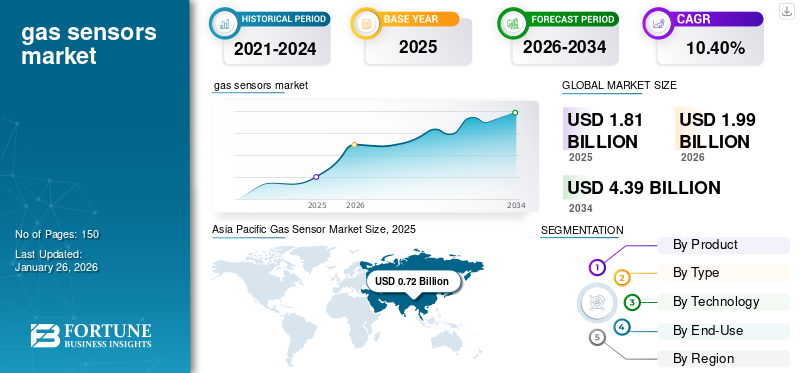
The global gas sensor market size was valued at USD 1.81 billion in 2025 and is projected to grow from USD 1.99 billion in 2026 to USD 4.39 billion by 2034, exhibiting a CAGR of 10.40% during the forecast period. Asia Pacific dominated the gas sensor market with a market share of 40.00% in 2025.
A gas sensor identifies a particular gas and assesses its presence in the vicinity of the sensor or its concentration in the environment. As a result, gas sensors are frequently crucial components in safety systems. There are various types of gas sensors, each capable of detecting different gases.
The growth of wireless and small gas sensors integrated with communication technologies is the main driving force for the global market. This enables their integration into different devices and machines, which can reliably detect harmful gases. Other drivers include increasing air pollution & health concerns, along with stringent environmental and safety regulations. In addition, rising hydrogen production and storage require robust hydrogen leakage detection, which further fuels the growth of the market.
Major market players included in this industry include Honeywell International, MSA Safety Incorporated, Alphasense Inc., Nissha Co., Ltd, Fuji Electric Co., Ltd, Infineon Technologies AG, Danfoss, Sensirion AG, Senseair, and Gasera.
Download Free sample to learn more about this report.
GAS SENSOR MARKET KEY TAKEAWAYS
 Market Size & Forecast
- 2025 Market Size: USD 1.81 billion
- 2026 Market Size: USD 1.99 billion
- 2034 Forecast Market Size: USD 4.39 billion
- CAGR: 10.40% from 2026–2034
 Market Share
- Asia Pacific dominated the gas sensor market with a 40.00% share in 2025.
- The oxygen sensor segment is projected to lead the market with a 32.89% share in 2026.
- The wired segment is expected to account for 59.23% of the global market in 2026.
 Key Regional Highlights
Asia Pacific
Asia Pacific is projected to reach USD 0.79 billion in 2026, driven by rising air-quality monitoring needs, urbanization, and growing investments in smart city initiatives.
North America
North America is projected to reach USD 0.62 billion in 2026, supported by stringent environmental regulations and increasing adoption of gas sensors in electric and hybrid vehicles.
Europe
Europe is projected to reach USD 0.36 billion in 2026, benefiting from industrial safety requirements and expanding environmental monitoring applications.
U.S.
The market is projected to reach USD 0.42 billion by 2026.
Japan
The market projected to reach USD 0.18 billion by 2026.
Read More

IMPACT OF GENERATIVE AI
Generative AI accelerates the discovery and design of materials that can be used in the calibration process and in anomaly detection by leveraging synthetic datasets for predictive maintenance. Generative AI reduces R&D costs while increasing accuracy, thereby enhancing sensors for IoT, healthcare, and industrial safety applications. Organizations such as Honeywell, Bosch, and Sensirion are currently integrating AI into their sensor systems to enable more sophisticated monitoring and analytical capabilities.
IMPACT OF RECIPROCAL TARIFFS
Reciprocal tariffs can increase the expense of raw materials and disrupt international supply chains, resulting in higher manufacturing costs for gas sensors. This may slow uptake in price-conscious sectors of consumer electronics, though industrial and safety markets will remain steady. On the other hand, tariffs can encourage domestic production and investment in research and development, offering opportunities for local sensor manufacturers to increase their market share.
Download Free sample to learn more about this report.
MARKET DYNAMICS
Market Drivers
Strict Environmental Rules and Regulations to Aid Market Growth
Governments around the globe are implementing strict regulations to limit the emission of harmful gases, including nitrogen oxides (NO), carbon monoxide (CO), and volatile organic compounds (VOCs). These rules promote the adoption of gas sensors in residential and commercial environments and are enforced by organizations such as the European Commission, OSHA, and the EPA. Manufacturers face pressure to integrate accurate gas monitoring systems into their processes to ensure compliance.
Market Restraints
Rising Issues with Sensor Calibration and Maintenance to Hinder Market Expansion
For optimal efficiency and accuracy, mainly in challenging environments, gas sensors must undergo regular maintenance. Sensors’ performance can be affected by variations in temperature, humidity, or interference from chemicals, potentially resulting in false alarms or missed detections.
Market Opportunities
Rising Integration with IoT and Smart Technologies to Present Lucrative Opportunities
One of the most significant changes in the gas sensors market is the incorporation of the Internet of Things (IoT) and smart technologies. The increasing use of IoT devices across different sectors presents a tremendous opportunity for gas sensors. These sensors can now connect to a network of smart devices, enabling real-time data transmission and remote oversight. As per industry experts, the introduction of IoT-enabled gas sensors in industrial settings can reduce operational costs by 25%, as they enhance efficiency through predictive maintenance.
Gas Sensor Market Trends
Growing Focus on Environmental Sustainability to Emerge as a Key Market Trend
The global market for gas sensors is experiencing significant growth due to increasing awareness of air quality and environmental sustainability. Heightened concerns over the negative health impacts of polluted air and the necessity to comply with regulatory air quality standards are propelling the uptake of advanced gas sensors. As reported by the World Bank, USD 100 billion is projected to be invested worldwide in air quality monitoring infrastructure and technologies by 2030.
SEGMENTATION ANALYSIS
By Product
Oxygen Sensors Segment Led the Market due to its Widespread Application
Based on product, the market is segmented into oxygen sensor, carbon dioxide sensor, carbon monoxide sensor, NOx sensor, methyl mercaptan sensor, and others.
The oxygen sensor segment is projected to reach the market in 2026 and is expected to lead with a 32.89% share in 2026. The segment dominated as they are mission-critical across automotive, healthcare, and industrial sectors, supported by regulatory requirements and broad application diversity.
The NOx sensor segment will achieve the highest compound annual growth rate (CAGR) of 13.72% during the forecast period.
By Type
Wired Segment Dominated due to its High Accuracy
Based on type, the market is segmented into wired and wireless.
The wired segment is projected to reach by type, contributing 59.23% globally in 2026. Wired gas sensors provide advantages such as minimal maintenance, a compact footprint, affordability, and improved accuracy. They establish a direct connection between the sensor and the receiving device, making them ideal for applications in automotive, utilities, oil rigs, and nuclear power facilities.
The wireless segment will achieve the highest compound annual growth rate (CAGR) of 13.66% during the forecast period.
By Technology
Minimal Power Usage and Other Improved Features Boosted the Expansion of the Electrochemical Segment
Based on technology, the market is segmented into Solid State/MOS, semiconductor, electrochemical, Photo-Ionization Detector (PID), Infrared (IR), catalytic, and others.
The electrochemical segment is projected to reach the market in 2026 and is expected to maintain its lead with a 38.71% share in 2026. This growth is mainly due to its minimal power usage, improved safety features, and high specificity for specific gases. Its capacity to identify harmful gases through effective electrochemical processes renders it particularly useful in dangerous settings such as the oil, gas, and mining industries.
The infrared (IR) segment will achieve the highest compound annual growth rate (CAGR) of 12.94% during the forecast period.
By End-Use
To know how our report can help streamline your business, Speak to Analyst
Automotive Segment Dominated the Market Due to Strict Emission Norms
Based on end-use, the market is categorized into automotive, oil and gas, building automation, medical and life-science, energy and utilities, and others.
The automotive segment held the major gas sensor market share in 2024 and is anticipated to dominate with a 28.2% share. The segment’s growth is due to its strict emissions norms, efficiency needs, and growing use in EVs for safety and comfort, backed by high vehicle production volumes worldwide.
The medical and life-science segment is growing at a CAGR of 13.91% during the forecast period.
GAS SENSOR MARKET REGIONAL OUTLOOK
By region, the market is divided into North America, Europe, South America, the Middle East & Africa, and Asia Pacific.
Asia Pacific
Asia Pacific Gas Sensor Market Size, 2025 (USD Billion) To get more information on the regional analysis of this market, Download Free sample
Asia Pacific maintained a strong presence in the global market, reaching USD 0.72 billion in 2025, accounting for 40.00% share, and is expected to reach USD 0.79 billion in 2026. Growing recognition of the effects of air pollutants on human health in Asia Pacific nations, including India and China, is fueling the need for gas sensors to monitor air quality. Ongoing urban development in the region is additionally elevating the demand for gas sensors. In addition, governments in the regions are making substantial investments in smart cities initiatives, thereby generating considerable opportunities for smart sensor technologies. The Japan market is projected to reach USD 0.18 billion by 2026, the China market is valued to reach USD 0.29 billion by 2026, and the India market is projected to reach USD 0.11 billion by 2026.
North America
In 2025, the North America market stood at USD 0.56 billion, representing 31.00% of global demand, and is projected to grow to USD 0.62 billion in 2026. This is due to the stringent environmental policies led by agencies such as the U.S. Environmental Protection Agency (EPA), which require industries to use sensors to monitor and control their emissions. The automobile industry is also undergoing a shift toward an electric and hybrid vehicle revolution, creating additional demand for gas sensors to ensure safety and compliance with emission regulations. Backed by these factors, the U.S. is expected to record the valuation of USD 0.42 billion, and Canada is expected to record USD 0.10 billion in 2025.
To know how our report can help streamline your business, Speak to Analyst
Europe
The Europe region captured 18.00% of the global market in 2025, generating USD 0.33 billion in revenue, and is projected to reach USD 0.36 billion in 2026, securing the position of the third-largest regional market. The UK market is projected to reach USD 0.08 billion by 2026 and the Germany market is projected to reach USD 0.07 billion by 2026.
South America
Over the forecast period, South America would witness a moderate growth in this market. The South American market in 2025 is set to record USD 0.07 billion in its valuation. The region’s growth is driven due to High demand from oil & gas, mining, and gas chemicals plants for leak detection and worker safety.
Latin America And Middle East & Africa
In the Middle East & Africa, GCC is set to attain the value of USD 0.05 billion in 2025. MEA gas sensor market growth is driven by strong demand from oil & gas, petrochemicals, and mining sectors for safety and emissions monitoring. Additionally, rising urbanization, smart-city air-quality initiatives, and hydrogen energy projects are accelerating the adoption of advanced and IoT-enabled sensors. The Middle East & Africa market accounted for USD 0.13 billion in 2025, representing 7.20% of the global industry, and is expected to reach USD 0.14 billion in 2026. In 2025, Latin America represented USD 0.07 billion, accounting for 3.70% of the worldwide market, and is projected to grow to USD 0.07 billion in 2026.
COMPETITIVE LANDSCAPE
KEY INDUSTRY PLAYERS
Notable Players are Implementing Strategic Strategies to Expand their Business Reach
Key players present in this market are offering gas sensors to provide users with enhanced safety through leak detection, improved air quality, environmental monitoring, and more. They concentrate on holding contracts with small and local businesses to grow their business. Moreover, such mergers & acquisitions, partnerships, and investments will create a surge in demand for this technology.
List of Key Gas Sensor Companies Studied (including but not limited to)
- Honeywell International (U.S.)
- MSA Safety Incorporated (U.S.)
- Alphasense Inc. (U.S.)
- Nissha Co, Ltd (Japan)
- Fuji Electric Co, Ltd (Japan)
- Infineon Technologies AG (Germany)
- Danfoss (Denmark)
- Sensirion AG (Switzerland)
- Senseair (Sweden)
- Gasera (Finland)
- ams-OSRAM AG (Austria)
- Amphenol Corporation (U.S.)
- Membrapor (Switzerland)
- Figaro Engineering Inc. (Japan)
- Teledyne Technologies (U.S.)
- ABB Ltd. (Switzerland)
- Nemoto & Co., Ltd. (Japan)
- Gastec Corporation (Japan)
- Emerson Electric Co. (U.S.)
- Thermo Fisher Scientific (U.S.)
…and more
KEY INDUSTRY DEVELOPMENTS
- February 2025: Sensirion introduced the SCD43, its newest Photoacoustic NDIR CO2 sensor. This sensor provides users with a small, highly accurate solution for measuring CO2 that meets the needs of the highest building regulations.
- January 2025: Kuva Systems was acquired by Sensirion to enhance its ability to monitor methane emissions.
- November 2024: Sensirion collaborated with Project Canary to launch cloud analytics and MOX-sensor cartridges in the U.S.
- October 2024: AlphaSense brought out PIDX, a new PID (Photoionization Detector) sensor technology meant to make gas sensing better. This sensor gives more sensitivity and accuracy for detecting Volatile Organic Compounds (VOCs) at low levels.
- March 2023: Sensorix GmbH showed its new series of toxic gas sensors at the Sensor + Test 2023 event. The show points to the firm’s wide range of gas sensors that find use in many fields.
INVESTMENT ANALYSIS AND OPPORTUNITIES
Companies are increasingly investing in miniaturized, low-power, multi-gas, IoT-enabled sensors and pursuing incremental innovation such as integrating AI and edge capabilities to address new use-cases. Key investment opportunities lie in MEMS-based miniaturized sensors, healthcare applications, and Asia Pacific expansion, with M&A and R&D fueling further innovation. While high ROI is expected, risks remain in the form of high R&D costs and regulatory certification delays.
- In February 2023, NevadaNano completed a Series C funding round, securing USD 30 million to advance the development and launch of its innovative gas sensor technologies for industrial and environmental monitoring.
REPORT COVERAGE
The report provides a detailed analysis of the market and focuses on key aspects, such as leading companies, product types, and the leading end-use of the product. Besides, it offers insights into the gas sensor market trends and highlights key industry developments. In addition to the factors mentioned above, the report encompasses several factors that have contributed to the market's growth in recent years.
Request for Customization to gain extensive market insights.
REPORT SCOPE & SEGMENTATION
|
ATTRIBUTE |
DETAILS |
|
Study Period |
2021-2034 |
|
Base Year |
2025 |
|
Estimated Year |
2026 |
|
Forecast Period |
2026-2034 |
|
Historical Period |
2021-2024 |
|
Growth Rate |
CAGR of 10.40% from 2026 to 2034 |
|
Unit |
Value (USD Billion) |
|
Segmentation |
By Product · Oxygen Sensor · Carbon Dioxide Sensor · Carbon Monoxide Sensor · NOx Sensor · Methyl Mercaptan Sensor · Others (Hydrogen, Ammonia, Hydrogen Sulfide) By Type · Wired · Wireless By Technology · Solid State/MOS · Semiconductor · Electrochemical · Photo-Ionization Detector (PID) · Infrared (IR) · Catalytic · Others (Zircona, Holographic, etc.) By End-Use · Automotive · Oil and Gas · Building Automation · Medical and Life-sciences · Energy and Utilities · Others (Mining, Consumer Electronics, etc.) By Region · North America (By Product, Type, Technology, End-Use, and Country) o U.S. (By End-Use) o Canada (By End-Use) o Mexico (By End-Use) · South America (By Product, Type, Technology, End-Use, and Country) o Brazil (By End-Use) o Argentina (By End-Use) o Rest of South America · Europe (By Product, Type, Technology, End-Use, and Country) o U.K. (By End-Use) o Germany (By End-Use) o France (By End-Use) o Italy (By End-Use) o Spain (By End-Use) o Russia (By End-Use) o Benelux (By End-Use) o Nordics (By End-Use) o Rest of Europe · Middle East & Africa (By Product, Type, Technology, End-Use, and Country) o Turkey (By End-Use) o Israel (By End-Use) o GCC (By End-Use) o North Africa (By End-Use) o South Africa (By End-Use) o Rest of the Middle East & Africa · Asia Pacific (By Product, Type, Technology, End-Use, and Country) o China (By End-Use) o Japan (By End-Use) o India (By End-Use) o South Korea (By End-Use) o ASEAN (By End-Use) o Oceania (By End-Use) o Rest of Asia Pacific |
Frequently Asked Questions
The market is projected to reach a valuation of USD 4.39 billion by 2034.
In 2025, the market was valued at USD 1.81 billion.
The market is projected to record a CAGR of 10.40% during the forecast period.
By technology, the electrochemical segment led the market in 2025.
Strict environmental rules and regulations are a key factor driving market growth.
Honeywell International, MSA Safety Incorporated, Alphasense Inc., Nissha Co., Ltd, Fuji Electric Co., Ltd, Infineon Technologies AG, Danfoss, Sensirion AG, Senseair, and Gasera are the top players in the gas sensor market.
Asia Pacific held the highest market share in 2025.
By end-use, the medical and life-science segment is expected to record the highest CAGR during the forecast period.



- 2021-2034
- 2025
- 2021-2024
- 150
Get 30-60 hrs Free Customization
Expand Regional and Country Coverage, Segments Analysis, Company Profiles, Competitive Benchmarking, and End-user Insights.




















Related Reports
-
US +1 833 909 2966 ( Toll Free )
-
Get In Touch With Us