Camel Dairy Products Market Size, Share & Industry Analysis, By Product Type (Fresh Milk, UHT Milk, Flavored Milk, Milk Powder, Cheese, Chocolate, Yogurt, and Others), By End-Use (Food Processing, Food Service, and Retail [Supermarkets/Hypermarkets, Convenience Stores, Specialty Stores, and Online Retail]), and Regional Forecast, 2026-2034
 Download Free Sample
(Offer valid till 15th Aug 2026)
Camel Dairy Products Market Size and Future Outlook
 Listen to Audio Version
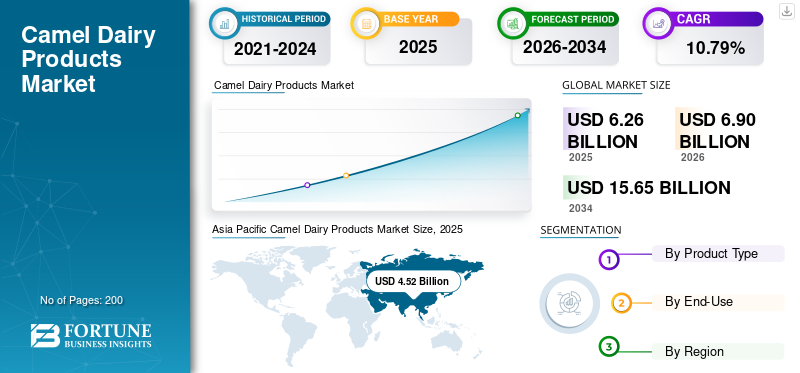
The global camel dairy products market size was valued at USD 6.26 billion in 2025. The market is projected to grow from USD 6.90 billion in 2026 to USD 15.65 billion by 2034, exhibiting a CAGR of 10.79% during the forecast period. Asia Pacific dominated the camel dairy products market with a market share of 72.20% in 2025.
Camel dairy products refer to milk and value-added dairy products derived from camels, including fresh milk, UHT milk, flavored milk, milk powder, cheese, chocolate, yogurt, butter, ice cream, and infant formula & supplements. Camel milk has recently gained immense popularity in international dairy markets owing to a rise in lactose intolerance and low-fat content among health-conscious consumers. The global market growth is gaining strong traction as camel milk is increasingly positioned as a premium functional dairy product, particularly among consumers looking for alternative dairy, digestive-friendly, wellness-focused nutrition, high-protein beverages, and traditional wellness-oriented foods.
Furthermore, Emirates Industry for Camelicious UAE, Xinjiang Wangyuan Camel Milk Industrial Co., Ltd., Sawani Company, Al Morooj Dairy Company, Ltd and Al Ain Farms are the major companies in the global market. This is due to their organized camel milk sourcing, processed product portfolios, retail availability, export orientation, and focus on value-added categories such as milk powder, chocolate, flavored milk, and UHT camel milk.
Download Free sample to learn more about this report.
CAMEL DAIRY PRODUCTS MARKET TRENDS
Strong Camel Milk Value Chains and Industry Formalization are Key Trends
The global market is witnessing increasing efforts toward value-chain formalization, quality standardization, and organized market development. Historically, camel milk production in many regions was characterized by fragmented supply chains, limited processing infrastructure, and informal distribution networks. However, governments, industry associations, research institutions, and private-sector participants are increasingly investing in milk collection systems, quality assurance frameworks, processing facilities, cold-chain infrastructure, and farmer integration programs to improve commercial scalability.
Similar investments in commercial camel dairy infrastructure are being observed across key producing regions, particularly in the Middle East and parts of Africa, where manufacturers are expanding processing capabilities and introducing standardized packaged products. The increasing formalization of the industry is improving product consistency, expanding market access, supporting regulatory compliance, and creating opportunities for domestic and global market growth.
- For instance, in August 2025, Sawani / NOUG, a Public Investment Fund-backed company, launched a model camel dairy farm and modern camel milk production facility in collaboration with GEA, a German milking systems specialist. The facility was reported to have a monthly production capacity of half a million liters of camel milk.
MARKET DYNAMICS
MARKET DRIVERS
Download Free sample to learn more about this report.
Rising Consumer Awareness of Nutritional and Functional Benefits of Camel Dairy Items to Support Market Growth
The mounting consumer interest in nutrient-dense and functional food products is supporting the product demand across both traditional and emerging markets, propelling camel dairy products market growth. Camel milk contains various nutrients and bioactive components, including vitamin C, iron, potassium, immunoglobulins, and antioxidant proteins, which have strengthened its positioning within the premium and specialty dairy segment. As consumers increasingly seek differentiated dairy products with perceived nutritional advantages, the demand for camel milk and value-added dairy products is expanding across health-conscious consumer groups and premium retail channels. Camel milk is also attracting attention due to its distinct protein composition compared to bovine milk. According to peer-reviewed studies published through the National Library of Medicine, camel milk lacks β-lactoglobulin, one of the major allergens present in cow milk, and contains a higher proportion of β-casein with lower κ-casein. These characteristics support its positioning as a differentiated dairy product among consumers seeking specialty, digestible, and premium dairy options.
- According to the Food and Agriculture Organization (FAO), the global camel milk production increased from approximately 3.68 million tonnes in 2013 to 4.12 million tonnes in 2023. The expanding production base is supporting the development of value-added camel dairy products and enabling manufacturers to cater to the growing consumer demand across both traditional and emerging markets.
|
Rank |
Market Driver |
Expected Impact on Market Growth |
Estimated Gross Market Growth Contribution (USD Billion) |
Impact: 2026-2028 |
Impact: 2029-2031 |
Impact: 2032-2034 |
|
1 |
Growing consumer awareness of the nutritional and functional benefits of camel dairy products, especially among health-conscious and premium dairy consumers |
High |
3.70 |
High |
High |
High |
|
2 |
Rising demand for camel milk powder and shelf-stable dairy products due to longer shelf life, easier transport, and wider retail reach |
High |
3.20 |
High |
High |
High |
|
3 |
Expansion of organized camel farms, dairy processing facilities, and cold-chain networks improving commercial supply and product availability |
Medium-High |
2.65 |
Medium |
High |
High |
|
4 |
Premium positioning of camel dairy as a specialty dairy product, supported by demand for natural, niche, and high-value dairy alternatives |
Medium |
2.05 |
Medium |
Medium |
High |
|
5 |
Growth in cross-border trade, e-commerce platforms, and branded export channels expanding access beyond traditional camel dairy-consuming regions |
Medium-Low |
1.65 |
Medium |
Medium |
High |
|
6 |
Others, including product innovation in flavored camel milk, fermented dairy products, chocolates, nutrition blends, and regional specialty formats |
Low |
0.85 |
Low |
Low |
Medium |
|
Total Gross Growth Contribution |
14.10 |
MARKET RESTRAINTS
Limited Commercial Supply Base and Low Production Efficiency to Hamper Market Growth
The global market is restrained by a narrow commercial supply base, as camel milk remains concentrated in a limited number of arid and semi-arid countries and is still largely linked to pastoral or semi-pastoral systems rather than organized dairy farms. Low production efficiency further limits market growth given that camel dairy systems often operate under harsh dryland conditions where water scarcity, feed shortages, animal-health constraints, and seasonal mobility affect milk availability.
- The Food and Agriculture Organization's Food Outlook estimated the global milk production at around 944 million tonnes in 2023, while FAOSTAT-based camel milk output was only about 4.1 million tonnes in 2023, equal to less than 0.5% of global milk production. This limited supply base reduces the ability of processors to secure consistent raw material for packaged milk, milk powder, cheese, fermented drinks, infant nutrition, and export-oriented products.
|
Rank |
Market Restraint |
Expected Impact on Market Growth |
Estimated Reduction in Market Size (USD Billion) |
Impact: 2026-2028 |
Impact: 2029-2031 |
Impact: 2032-2034 |
|
1 |
Limited commercial supply base and low production efficiency, as camel milk yields remain lower than those of conventional dairy animals |
High |
2.15 |
High |
High |
Medium |
|
2 |
High product pricing compared with cow milk and mainstream dairy products, limiting adoption among price-sensitive consumers |
Medium-High |
1.35 |
High |
Medium |
Medium |
|
3 |
Weak cold-chain infrastructure, fragmented milk collection, and quality standardization issues affecting consistent commercial supply |
Medium |
0.95 |
Medium |
Medium |
Medium |
|
4 |
Low consumer familiarity outside traditional camel dairy markets, reducing repeat purchases and slowing mainstream retail penetration |
Medium-Low |
0.55 |
Medium |
Low |
Low |
|
5 |
Others, including regulatory barriers, seasonal production variations, import documentation needs, and competition from other dairy alternatives |
Low |
0.35 |
Low |
Low |
Low |
|
Total Market Reduction |
5.35 |
MARKET OPPORTUNITIES
Expansion of Value-Added Dairy Products to Offer Potential Growth Opportunities
The expansion of value-added camel dairy products presents a strong growth opportunity for market players, as the category is moving beyond traditional raw milk consumption toward pasteurized milk, fermented milk, yogurt, milk powder, cheese, ice cream, chocolate, and specialty nutrition products. Camel milk production is already concentrated in regions with established pastoral supply, creating a raw-material base for formal processing. The formalization of camel milk processing is already visible in public-sector and standards-related initiatives. Kenya’s National Research Fund has supported a project on value-added camel milk products in Northern Kenya, covering food security, women’s group training, marketing partnerships, and the introduction of dairy and cosmetic products.
- For instance, in November 2025, the 48th Codex Alimentarius Commission (CAC) approved the UAE-led proposal to develop a standard for pasteurized camel milk at CAC48, which reactivated the Codex Committee on Milk and Milk Products for this work. This is important for market growth given that common standards can improve quality assurance, reduce adulteration concerns, support fair trade, and make packaged camel milk products more acceptable to retailers, regulators, and importers.
Segmentation Analysis
By Product Type
Milk Powder Segment Dominated the Market Owing to its Shelf Stability and Wider Commercial Use
By product type, the market is segmented into fresh milk, UHT milk, flavored milk, milk powder, cheese, chocolate, yogurt, and others.
The milk powder segment accounted for the largest market share in 2025, valued at USD 2.99 billion, supported by longer shelf life, easier transportation, strong urban consumer adoption in China and India, and use in nutritional formulations. Its powdered format allows manufacturers and distributors to reach markets where cold-chain infrastructure is limited, making it more commercially scalable across both domestic and export channels. The segment also benefited from strong demand in China and India, where camel milk powder is increasingly positioned as a premium nutritional product for children, adults, elderly consumers, and health-conscious buyers.
The yogurt segment is projected to grow at the fastest CAGR of 13.06% during 2026–2034.
To know how our report can help streamline your business, Speak to Analyst
By End-Use
Retail Segment Led the Market due to Strong Consumer-facing Sales across Specialty Stores and Online Channels
Based on end-use, the market is segmented into food processing, food service, and retail.
The retail segment accounted for the largest camel dairy products market share in 2025, valued at USD 4.55 billion, supported by the availability of fresh camel milk, UHT milk, milk powder, chocolate, yogurt, and supplements through supermarkets, specialty stores, convenience stores, and online channels. Within retail, online retail was the largest channel in 2025 with a value of USD 1.91 billion, reflecting the importance of e-commerce for premium, niche, and shelf-stable dairy products.
The food processing segment is projected to grow at the fastest CAGR of 13.12% during 2026–2034, driven by the use of camel milk ingredients in chocolates, powders, supplements, desserts, and formulated dairy products.
Camel Dairy Products Market Regional Outlook
Based on geography, the market is classified into North America, Europe, Asia Pacific, South America, and the Middle East & Africa.
North America
Asia Pacific Camel Dairy Products Market Size, 2025 (USD Billion)
To get more information on the regional analysis of this market, Download Free sample
North America accounted for a smaller but steadily growing share of revenues in 2025, valued at USD 0.14 billion. Camel dairy foods are experiencing a rise in popularity in North America, particularly in the U.S. and Canada. This is owing to the rising consumer awareness regarding the health benefits of camel milk and the growing trend of lactose-intolerant diet.
U.S. Camel Dairy Products Market
The U.S. market was valued at approximately USD 0.10 billion in 2025. The product demand is supported by specialty dairy consumers, online retail, functional nutrition positioning, and brands such as Desert Farms, which sources camel milk from U.S. farms and markets it through direct-to-consumer channels.
Europe
The Europe market was valued at USD 0.15 billion in 2025 and is projected to reach USD 0.34 billion by 2034. With the growing demand for functional foods offering specific health benefits beyond basic nutrition, camel milk and its products fit perfectly into this trend, fueling its market growth in the region. Moreover, the European Union had previously approved the export of camel milk and its derivatives from the UAE to European countries, further indicating a positive regulatory environment for market growth.
U.K. Camel Dairy Products Market
The U.K. market was valued at approximately USD 0.04 billion in 2025. The segment growth is supported by specialty nutrition, online availability, ethnic grocery channels, and premium lactose-free dairy alternatives. The mounting consumer awareness of camel milk’s nutritional, functional, and hypoallergenic positioning supports demand among health-conscious and specialty dairy consumers.
Germany Camel Dairy Products Market
The Germany market was valued at approximately USD 0.04 billion in 2025. The market benefits from strong specialty food retail, organic and functional product interest, and demand for premium imported dairy alternatives.
Asia Pacific
Asia Pacific held the largest regional market in 2025, valued at USD 4.52 billion. The region is expected to grow at the fastest CAGR of 11.21% during 2026–2034, reaching USD 11.64 billion by 2034. The regional market growth is supported by China’s organized camel milk powder market, India’s premium camel dairy and wellness positioning, and wider demand for powdered and functional dairy products. China remains central to the regional market due to strong camel milk powder commercialization, brand-led retail presence, and growing use of specialty dairy products.
China Camel Dairy Products Market
The China market was valued at approximately USD 1.70 billion in 2025. The market is supported by Xinjiang-based camel milk production, strong powder-format commercialization, specialty retail networks, and consumer interest in functional dairy nutrition.
India Camel Dairy Products Market
The India market stood at approximately USD 0.25 billion in 2025. The market is supported by camel milk sourcing from Rajasthan and Gujarat, premium online sales, powdered camel milk, camel milk chocolate, and small but growing demand from wellness-focused consumers.
South America and Middle East & Africa
South America remained a small regional market in 2025, valued at USD 0.01 billion, and is estimated to grow at a CAGR of 9.70% during 2026–2034. The region is still at an early stage for dairy products, with limited local production and dependence on imported premium products. The Middle East & Africa market was valued at USD 1.45 billion in 2025. The regional growth is supported by traditional camel milk consumption, organized camel dairy farms in GCC countries, government-backed commercialization, rising tourism, foodservice demand, and the strong cultural acceptance of camel milk.
UAE Camel Dairy Products Market
The UAE market was valued at approximately USD 0.20 billion in 2025. The country is one of the most organized camel dairy markets globally, supported by Camelicious, Al Ain Farms, and Al Nassma.
COMPETITIVE LANDSCAPE
Key Industry Players
Leading Players’ Organized Camel Milk Sourcing and Premium Dairy Portfolios to Strengthen their Market Positions
Emirates Industry for Camel Milk & Products LLC / Camelicious, Xinjiang Wangyuan Camel Milk Industrial Co., Ltd., Aadvik Foods, Sawani Company, and Al Ain Farms are the major companies operating in the global camel dairy products market. Their market position is supported by organized camel milk collection, processing capacity, product diversification, brand visibility, retail availability, and value-added categories such as camel milk powder, UHT milk, flavored milk, chocolate, ice cream, and nutritional products.
LIST OF KEY CAMEL DAIRY PRODUCTS COMPANIES PROFILED
- Camelicious (UAE)
- Xinjiang Wangyuan Camel Milk Industrial Co., Ltd. (China)
- Sawani Company (Saudi Arabia)
- Aadvik Foods and Products Private Limited (India)
- Al Ain Farms (UAE)
- Al Nassma Chocolate LLC (UAE)
- Al Morooj Dairy Company (Oman)
- Desert Farms Inc. (U.S.)
- Xinjiang Yili Nala Dairy Co., Ltd. (China)
- Inner Mongolia Desert God Biotechnology Co., Ltd. (China)
KEY INDUSTRY DEVELOPMENTS
- January 2026: SIG entered the camel milk category with the launch of NOUG Camel UHT Milk in 125 ml SIG MiniBloc aseptic cartons. The product is produced and co-packaged in Saudi Arabia by United National Dairy Co. for Sawani’s NOUG brand. SIG stated that this was its first camel milk in aseptic packaging, supporting long shelf life without refrigeration.
- September 2025: Camelicious relaunched its fresh-flavored camel milk range in the UAE. The relaunched portfolio included Dates, Chocolate, and Strawberry flavors, positioned as convenient ready-to-drink variants within the company’s fresh camel milk portfolio.
- August 2025: Sawani, a Public Investment Fund-backed camel dairy company and owner of NOUG, launched a model camel farm and camel milk production facility in collaboration with GEA Group. The facility was reported to house over 10,000 camels and produce up to 500,000 liters of camel milk per month.
- August 2025: Beder Camel Farm launched Somalia’s first camel milk yogurt factory. The yoghurt is sold under the Beder brand in urban supermarkets in Mogadishu. The company also announced plans to expand collection points and train pastoralists in modern milking and hygiene practices.
- April 2022: Aadvik Foods launched a new luxury lineup of camel milk chocolates in classic, roasted almond, and coffee variants. The company stated that camel milk and powder were its core products, contributing around 70–80% of the business.
REPORT COVERAGE
The global camel dairy products market report analyzes the market in depth and highlights crucial aspects such as global market trends, market dynamics, supply chains, prominent companies, investment in research and development, and end-uses. Besides this, the report also provides insights into the market analysis and highlights significant industry developments.
Request for Customization to gain extensive market insights.
Report Scope & Segmentation
| ATTRIBUTE | DETAILS |
| Study Period | 2021-2034 |
| Base Year | 2025 |
| Estimated Year | 2026 |
| Forecast Period | 2026-2034 |
| Historical Period | 2021-2024 |
| Growth Rate | CAGR of 10.79% from 2026 to 2034 |
| Unit | Value (USD Billion), Volume (Tonnes) |
| Segmentation | By Product Type, End-Use, and Region |
| By Product Type |
|
| By End-Use |
|
| By Region |
|
Frequently Asked Questions
Fortune Business Insights says that the global market value stood at USD 6.26 billion in 2025 and is projected to reach USD 15.65 billion by 2034.
In 2025, the market value in Asia Pacific stood at USD 4.52 billion.
The market is expected to grow at a CAGR of 10.79% over the forecast period of 2026-2034.
The milk powder segment led the market by product type in 2025.
The growing consumer awareness of the nutritional and functional benefits of camel dairy products is a key factor driving the market.
Emirates Industry for Camelicious UAE, Xinjiang Wangyuan Camel Milk Industrial Co., Ltd., Sawani Company, and Al Ain Farms are the prominent players in the market.
Asia Pacific dominated the market in 2025.



- 2021-2034
- 2025
- 2021-2024
- 200
-
(Offer valid till 15th Aug 2026)
Get 30-60 hrs Free Customization
Expand Regional and Country Coverage, Segments Analysis, Company Profiles, Competitive Benchmarking, and End-user Insights.




















Related Reports
-
US +1 833 909 2966 ( Toll Free )
-
Get In Touch With Us