Edible Animal Fat Market Size, Share & Industry Analysis, By Source (Cattle, Pig, and Others), By Type (Butter, Lard, Tallow, and Others), By Application (Food [Bakery & Confectionery, Processed Meat Products, Savory Foods & Snacks, Foodservice & Household Cooking, and Other Food Applications] and Non-Food [Biodiesel, Animal Feed & Pet Food, Oleochemicals & Personal Care]), and Regional Forecast, 2026-2034
 Download Free Sample
(Offer valid till 15th Aug 2026)
Edible Animal Fat Market Size and Future Outlook
 Listen to Audio Version
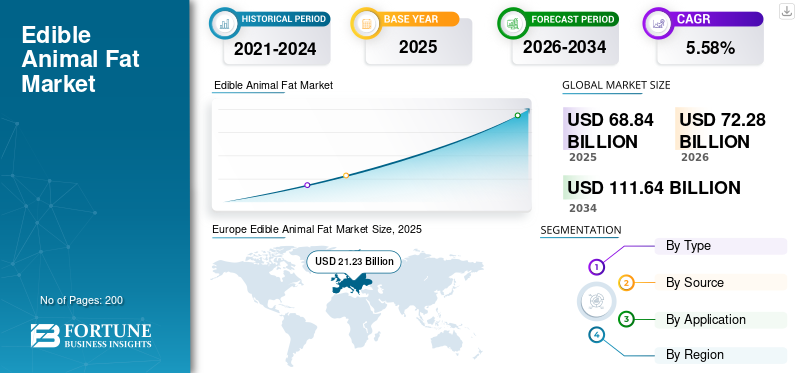
The global edible animal fat market size was valued at USD 68.84 billion in 2025. The market is projected to grow from USD 72.28 billion in 2026 to USD 111.64 billion by 2034, exhibiting a CAGR of 5.58% during the forecast period. Europe dominated the edible animal fat market with a market share of 30.83% in 2025.
Edible animal fat refers to food-grade fats derived from animal sources such as cattle, pigs, dairy animals, poultry, and other livestock. Animal fats such as tallow and lard offer a relatively high smoke point, making them suitable for frying, roasting, sautéing, and other high-heat cooking applications. The market includes butter, lard, tallow, and other edible animal fats used across bakery, confectionery, processed meat, savory snacks, foodservice, household cooking, animal feed, biodiesel, and oleochemical applications. Codex defines named animal fats such as lard and rendered pork fat as products derived from healthy animals and fit for human consumption, which provides an international reference for food-grade identity and quality requirements.
Cargill, Incorporated, JBS S.A., Sonac (Darling Ingredients Inc.), Ten Kate Vetten B.V., and Sanimax are among the major companies fueling the product demand due to their large rendering networks, slaughterhouse integration, broad edible fat portfolios, and global supply capabilities.
Download Free sample to learn more about this report.
EDIBLE ANIMAL FAT MARKET TRENDS
Pet Food and Animal Feed Expansion is a Key Market Trend
Pet food and animal feed expansion is creating new revenue channels for the global edible animal fat industry, particularly through the use of tallow, poultry fat, pork fat, and other rendered animal fats in feed and pet nutrition formulations. Animal fats are valued in these applications as they provide concentrated energy, improve palatability, enhance feed texture, reduce dust in dry feed, and support coating performance in kibble and compound feed. In pet food, fats also contribute to aroma and taste, which are important factors in product acceptance among dogs and cats.
- According to FEDIAF’s European pet population and market data for 2024, 140 million European households, representing 49% of households, owned one or more pets. The total pet population reached 306 million pets across Europe, indicating a large and stable consumption base for pet food products.
MARKET DYNAMICS
MARKET DRIVERS
Download Free sample to learn more about this report.
Increasing Demand from Bakery and Confectionery Applications is Bolstering Market Growth
The increasing consumer demand from bakery and confectionery applications is supporting the use of butter and lard in the global market. These fats play an important functional role in baked goods and confectionery products by improving texture, flavor release, mouthfeel, softness, layering, and overall product quality. Confectionery demand is also supporting butterfat consumption, particularly in chocolate-based products, caramels, toffees, creams, fillings, and premium confectionery ingredients. This is fueling the edible animal fat market growth.
- The National Confectioners Association reported that U.S. confectionery sales surpassed USD 54 billion in 2024 and are projected to exceed USD 70 billion by 2029, reflecting the continued expansion of categories where butterfat and other specialty fats are used for sensory enhancement and premium positioning.
|
Rank |
Market Driver |
Expected Impact on Market Growth |
Estimated Gross Market Growth Contribution (USD Billion) |
Impact: 2026-2028 |
Impact: 2029-2031 |
Impact: 2032-2034 |
|
1 |
Rising demand for butter, lard, tallow, and other animal fats in bakery, confectionery, foodservice, and household cooking |
High |
13.20 |
High |
High |
High |
|
2 |
Expansion of meat, dairy, and rendering industries, increasing the availability of cattle-, pig-, and poultry-derived fats |
High |
10.40 |
High |
High |
Medium |
|
3 |
Growing use of rendered animal fats in animal feed, pet food, biodiesel, renewable diesel, and oleochemical applications |
Medium-High |
8.50 |
Medium |
High |
High |
|
4 |
Increasing consumption of processed meat products, savory snacks, convenience foods, and industrial food formulations |
Medium |
6.70 |
Medium |
Medium |
High |
|
5 |
Rising demand from emerging economies due to urbanization, foodservice expansion, and higher animal-source food consumption |
Medium-Low |
6.00 |
Medium |
Medium |
High |
|
6 |
Others, including premium cooking fats, traditional cuisine demand, private-label food expansion, and circular rendering adoption |
Low |
3.20 |
Low |
Low |
Medium |
|
Total Gross Growth Contribution |
48.00 |
MARKET RESTRAINTS
Inconsistent Production and Price Fluctuations Due to Livestock Supply Volatility are Hindering Market Growth
Livestock supply volatility is limiting raw material availability in the global market as the production of tallow, lard, poultry fat, and other animal fats depends directly on slaughter volumes and livestock fat processing activity. When cattle, pig, or poultry inventories decline, or when slaughter rates fluctuate, the availability of recoverable fat also becomes inconsistent. This affects renderers, refiners, food processors, feed manufacturers, and biodiesel producers that rely on steady supplies of animal-derived fats. The restraint is particularly visible in cattle-based fat supply.
- USDA-NASS reported that the U.S. cattle and calves inventory declined to 86.7 million head as of January 1, 2025, down 1% from 87.2 million head in January 2024. Beef cows also declined to 27.9 million head, down 1% from the previous year.
|
Rank |
Market Restraint |
Expected Impact on Market Growth |
Estimated Reduction in Market Size (USD Billion) |
Impact: 2026-2028 |
Impact: 2029-2031 |
Impact: 2032-2034 |
|
1 |
Health concerns related to saturated fat consumption and increasing preference for vegetable oils and plant-based fat alternatives |
High |
3.30 |
High |
High |
Medium |
|
2 |
Volatility in livestock supply, slaughter volumes, dairy fat availability, feed costs, and animal fat prices |
Medium-High |
2.25 |
High |
Medium |
Medium |
|
3 |
Religious and cultural restrictions limiting penetration, as lard and certain tallow products are not acceptable across several consumer groups |
Medium |
1.85 |
Medium |
Medium |
Medium |
|
4 |
Others, including strict rendering regulations, food-grade traceability requirements, odor and handling concerns, export restrictions, and competition from modified fats |
Low |
1.24 |
Low |
Low |
Low |
|
Total Market Reduction |
8.64 |
MARKET OPPORTUNITIES
Biodiesel Expansion Creating Value-added Opportunities by Enabling Lower-grade Animal Fats to Be Utilized in Renewable Fuel Production
Biodiesel expansion is creating value-added opportunities for the global market by enabling lower-grade animal fats to be utilized in renewable fuel production. Tallow, white grease, poultry fat, and other rendered fats that may not meet edible-grade specifications can be redirected toward biodiesel and renewable diesel feedstock markets. This improves total value recovery for renderers and meat processors, as fat streams can be allocated across food, feed, oleochemical, and fuel applications depending on quality grade and market pricing. The opportunity is being strengthened by the rising use of animal fats, waste oils, and greases in biomass-based diesel production.
- USDA Economic Research Service reported that animal fats, waste oils, and greases accounted for 37% of total biofuel feedstock used for U.S. biomass-based diesel production in 2023, compared with 17% in 2020. This shift indicates that renewable fuel producers are increasingly using waste- and by-product-based lipid feedstocks instead of relying only on conventional vegetable oils.
Segmentation Analysis
By Type
Butter Segment Dominated Market Due to Its Increased Use in Food Processing Industries
By type, the market is segmented into butter, lard, tallow, and others.
The butter segment accounted for the largest share in 2025, valued at USD 40.65 billion, driven by strong use in bakery, confectionery, foodservice, retail cooking, and premium dairy-based food formulations. Butter is widely used to prepare various food items globally. It helps enhance the flavor of food items and complements food flavors. It is also used in preparing sauces and fluffy bakery food products.
The lard segment stood at USD 12.56 billion in 2025 and is projected to grow at the fastest 5.93% CAGR during the forecast period, supported by demand from bakery, frying, processed meat, and traditional foods.
To know how our report can help streamline your business, Speak to Analyst
By Source
Cattle Segment Led Market Due to Strong Tallow and Dairy Fat Availability
Based on the source, the market is segmented into cattle, pig, and others.
The cattle segment accounted for the largest global edible animal fat market share in 2025. The segment benefits from the large availability of dairy fats, beef-processing by-products, and cattle-derived tallow used in food, feed, biodiesel, oleochemicals, and personal care applications. The cattle segment is projected to grow at a 5.65% CAGR during 2026–2034, making it the leading source segment over the forecast period.
The pig segment is set to register a CAGR of 5.37% over the forecast period, supported by the use of lard in bakery, foodservice, processed meat, and traditional cooking.
By Application
Food Segment Led Market Due to High Consumption in Bakery, Processed Meat, and Cooking Applications
Based on application, the market is segmented into food and non-food.
The food segment accounted for the largest share in 2025, driven by the extensive use of butter, lard, tallow, and other animal-derived fats in bakery and confectionery products, processed meat, savory snacks, foodservice, and household cooking. Foodservice & household cooking was the largest food sub-segment, valued at USD 19.05 billion in 2025, and is projected to grow at the fastest 6.19% CAGR during 2026–2034 due to continued use of butter, lard, and tallow in frying, sautéing, baking, and regional cuisines.
The non-food segment is set to register a CAGR of 4.93% over the forecast period, with animal feed & pet food being the largest non-food sub-segment at USD 7.96 billion.
Edible Animal Fat Market Regional Outlook
Based on geography, the market is classified into North America, Europe, Asia Pacific, South America, and the Middle East & Africa.
Europe
Europe Edible Animal Fat Market Size, 2025 (USD Billion)
To get more information on the regional analysis of this market, Download Free sample
Europe held the largest regional market in 2025, valued at USD 21.23 billion, and is projected to reach USD 22.16 billion in 2026. The region has a mature butter, dairy fat, pork fat, and tallow value chain, supported by well-developed meat, dairy, bakery, and rendering industries. Europe is expected to reach USD 32.37 billion by 2034, growing at a 4.85% CAGR during 2026–2034.
U.K. Edible Animal Fat Market
The U.K. market was valued at approximately USD 2.46 billion in 2025. Demand is supported by butter, beef dripping, lard, bakery fats, foodservice cooking fats, and growing use of rendered fats in pet food and technical applications.
Germany Edible Animal Fat Market
Germany’s market was valued at approximately USD 3.78 billion in 2025. The market is supported by a large processed meat industry, bakery sector, dairy production base, and strong industrial rendering infrastructure.
North America
North America accounted for a significant share of revenues in 2025, valued at USD 16.37 billion. The region is projected to reach USD 26.35 billion by 2034, growing at a 5.50% CAGR during 2026–2034. North America is a major market with high consumption of edible animal fats such as butter and lard among consumers. Butter is the most widely used edible animal fat to cook various dishes in the region.
U.S. Edible Animal Fat Market
The U.S. market was valued at approximately USD 13.77 billion in 2025, supported by large-scale cattle, pig, poultry, and dairy processing.
Asia Pacific
Asia Pacific was valued at USD 19.09 billion in 2025 and is projected to reach USD 20.29 billion in 2026. The region is projected to grow at the fastest CAGR of 6.81% during 2026–2034, reaching USD 34.37 billion by 2034. The large consumption of animal fats can be attributed to the traditional cooking style in some countries, which uses butter and lard as their main cooking ingredients. Due to the rise in disposable income, more consumers purchase processed food products and bakery products.
India Edible Animal Fat Market
India’s market stood at approximately USD 3.94 billion in 2025. The market is primarily supported by butter, ghee-type dairy fat consumption, bakery, confectionery, and foodservice demand.
China Edible Animal Fat Market
China’s market was valued at approximately USD 6.49 billion in 2025. The country is one of the largest markets in Asia Pacific due to its large pork, beef, poultry, and food-processing industries.
South America and Middle East & Africa
South America reached USD 6.39 billion in 2025 and is projected to grow to USD 6.68 billion in 2026. The region is expected to reach USD 9.98 billion by 2034, growing at a 5.14% CAGR during 2026–2034. The market is supported by large cattle and meat-processing industries, especially in Brazil and Argentina, along with rising demand from food processing, animal feed, pet food, and biodiesel applications.
The Middle East & Africa market was valued at USD 5.76 billion in 2025 and is projected to reach USD 5.99 billion in 2026. The region is expected to grow to USD 8.57 billion by 2034, registering a 4.58% CAGR during 2026–2034. Growth is supported by foodservice expansion, bakery demand, imported butter and dairy fats, meat processing, and gradual development of rendering and animal by-product utilization systems.
Brazil Edible Animal Fat Market
Brazil’s market was valued at approximately USD 3.40 billion in 2025. Brazil is one of the major consumers of edible animal fat products in South America. Butter and lard are used in cooking various food products in the region. Furthermore, Brazil is one of the region's largest producers of rendered meat products.
COMPETITIVE LANDSCAPE
Key Industry Players
Integrated Meat Processing, Rendering Networks, and Product Portfolio Width to Enhance Market Shares of Key Players
Cargill, Incorporated, JBS S.A., Sonac (Darling Ingredients Inc.), Tyson Foods Inc., Ten Kate Vetten B.V., and Sanimax were among the major companies operating in the global edible animal fat market. Their position is supported by integrated sourcing from meat and dairy value chains, rendering capacity, wide geographic presence, and strong supply relationships with food processors, feed manufacturers, biodiesel producers, and oleochemical companies.
Companies are developing sustainable food ingredients devoid of trans fatty acids (TFA) due to rising health consciousness. Such a manufacturing process helps make the product healthy and suitable for consumption. Due to the popularity of edible fat products, such as lard and butter, the companies are developing new customized products to suit the growing demand.
LIST OF KEY EDIBLE ANIMAL FAT COMPANIES PROFILED
- Ten Kate Vetten B.V. (Netherlands)
- Sanimax (Canada)
- Hubberts Industries (Canada)
- Cargill, Incorporated (U.S.)
- Sonac (Darling Ingredients Inc.) (U.S.)
- JBS S.A. (Brazil)
- York Foods Pty Ltd (Australia)
- Leo Group Ltd. (U.K.)
- Boyer Valley Company, LLC. (The Lauridsen Group) (U.S.)
- Coast Packing Company (U.S.)
KEY INDUSTRY DEVELOPMENTS
- March 2026: JBS reported that its Óleo Amigo program had converted 50 million liters of used cooking oil into biodiesel through Biopower. The program collected 11.3 million liters in 2025 and supports JBS’s renewable fuel and waste valorization platform.
- May 2025: Fat of the Land launched its first product, tallow-cooked kettle chips. This development fits the savory snacks segment and reflects the growing use of animal fats in premium, clean-label snack positioning.
- April 2025: Sanimax inaugurated a USD 10 million investment at its Lévis plant, including a biofilter air-treatment facility and controlled raw-material storage infrastructure. The plant processes animal carcasses recovered from farms.
- February 2025: Coast Packing broke ground on a new edible fats and oils refinery and packaging facility in Amarillo, Texas. The company stated that the facility supports its animal-fat shortening business, including lard and beef tallow, and is being built with Food Tech, Inc.
- May 2024: South Chicago Packing and Restaurant Technologies partnered to bring All Fry liquid beef tallow to foodservice operators through a bulk oil management system. The development addressed the handling limitations of traditional solid tallow cubes.
REPORT COVERAGE
The global edible animal market report analyses the market in depth. It highlights crucial aspects such as global edible animal fat market trends, market dynamics, supply chains, prominent companies, investment in research and development, and end-use. Besides this, the report also provides insights into the global market analysis and highlights significant industry developments.
Request for Customization to gain extensive market insights.
Report Scope & Segmentation
| ATTRIBUTE | DETAILS |
| Study Period | 2021-2034 |
| Base Year | 2025 |
| Estimated Year | 2026 |
| Forecast Period | 2026-2034 |
| Historical Period | 2021-2024 |
| Growth Rate | CAGR of 5.58% from 2026 to 2034 |
| Unit | Value (USD Billion) |
| Segmentation | By Type, Source, Application, and Region |
| By Type |
|
| By Source |
|
| By Application |
|
| By Region |
|
Frequently Asked Questions
Fortune Business Insights says that the global market value stood at USD 68.84 billion in 2025 and is projected to reach USD 111.64 billion by 2034.
In 2025, the market value in Europe stood at USD 21.23 billion.
The market is expected to grow at a CAGR of 5.58% over the forecast period of 2026-2034.
The butter segment led the market by type.
The key driver of the market is the increasing demand from bakery and confectionery applications.
Cargill, Incorporated, JBS S.A., Sonac (Darling Ingredients Inc.), Tyson Foods Inc., Ten Kate Vetten B.V., and Sanimax are among the prominent players in the market.
Europe dominated the market in 2025.



- 2021-2034
- 2025
- 2021-2024
- 200
-
(Offer valid till 15th Aug 2026)
Get 30-60 hrs Free Customization
Expand Regional and Country Coverage, Segments Analysis, Company Profiles, Competitive Benchmarking, and End-user Insights.



















Related Reports
-
US +1 833 909 2966 ( Toll Free )
-
Get In Touch With Us