Animal Feed Market Size, Share & Industry Analysis, By Form (Mash, Pellets, Crumbles, and Others), By Livestock Type (Ruminants, Poultry, Aquaculture, Swine, Equine, and Others), By Ingredient Type (Cereals {Corn/maize, Wheat, Barley, and Others}, Oilseeds {Soybean meal, Rapeseed/canola meal, Sunflower meal, and Cottonseed meal}, Animal Protein Ingredients {Fishmeal, Meat and bone meal, and Others}, Feed Additives {Enzymes, Probiotics/Prebiotics, Antioxidants, and Others}, and Others), and Regional Forecast, 2026–2034
 Download Free Sample
(Offer valid till 30th Sep 2026)

Animal Feed Market Size and Future Outlook
 Listen to Audio Version
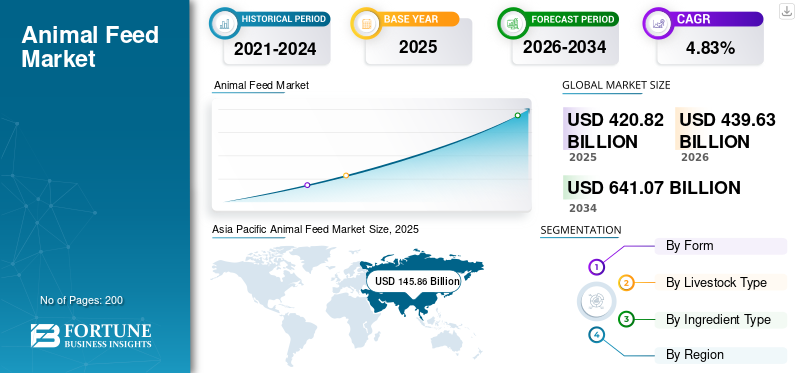
The global animal feed market size was valued at USD 420.82 billion in 2025 and is projected to grow from USD 439.63 billion in 2026 to USD 641.07 billion by 2034, exhibiting a CAGR of 4.83% during the forecast period. Asia Pacific dominated the animal feed market with a market share of 34.66% in 2025.
Animal feed is specialized food, such as compound rations, often containing grains, oilseed cakes, and essential supplements, produced for domesticated animals and livestock, such as cattle, poultry, and fish, to ensure optimal health, growth, and the production of products such as milk, meat, and eggs. Increasing livestock production to meet global food security and protein needs is significantly driving industry growth. Developing new products to enhance animal performance, innovation, mergers and acquisitions, geographical expansion, and scale-up of production capacity will positively change the industry outlook in the near future.
The market is dominated by Cargill Inc., BASF SE, Chr. Hansen Holding, Kemin Industries, Inc., Archer Daniels Midland Company and others.
Download Free sample to learn more about this report.
Animal Feed Market Key Takeaways
 Market Size & Forecast
- 2025 Market Size: USD 420.82 billion
- 2026 Market Size: USD 439.63 billion
- 2034 Forecast Market Size: USD 641.07 billion
- CAGR: 4.83% from 2026–2034
 Market Share
- Asia Pacific dominated the animal feed market with a 34.66% share in 2025.
- The Pellets segment was valued at USD 180.88 billion in 2025.
- The Poultry segment was valued at USD 141.16 billion in 2025.
 Key Regional Highlights
North America
North America market valued at USD 92.44 billion in 2025.
Asia Pacific
Asia Pacific held 34.66% share in 2025, valued at USD 145.86 billion.
Europe
Europe market valued at USD 107.46 billion in 2025.
U.S.
Market was valued at USD 71.46 billion in 2025.
Japan
Market was valued at USD 7.06 billion in 2025.
Read More

Animal Feed Market Trends
Research to Adopt Novel Technologies and Industry 4.0 Models to Change Market Outlook
The global industry is emerging by adopting various novel technologies and Industry 4.0 models. The adoption of novel technologies is transforming the industry from a traditional, commodity-based sector into a high-tech, precision-driven field, poised to drive the market growth. The adoption of AI, real-time tracking, precision feeding, and other novel technologies is overcoming challenges such as quality concerns, waste, production instability, improving yield, and enhancing business outcomes. Several universities and industry research associations are developing new concepts to help feed manufacturers reduce production costs, overcome regulatory complexities, and enhance their business operations. It will help companies such as Cargill, ADM, and others improve their profit margins.
- In March 2026, a team of North Carolina State University researchers, led by Mike Kudenov, embarked on a new project to use low-cost, real-time sensors paired with artificial intelligence to help feed mills lower costs while optimizing nutrition.
- In March 2026, the Association of American Feed Control Officials (AAFCO) launched AAFCO Virtual Assistant, an Agentic AI system built on SWARM Engineering's decision intelligence platform, to help regulators, manufacturers, and industry stakeholders navigate ingredient definitions, labeling requirements, and safety standards more quickly and consistently.
MARKET DYNAMICS
Market Drivers
Download Free sample to learn more about this report.
Increasing Livestock Production Globally to Drive Industry Growth
The global animal feed market growth is primarily driven by the growing livestock production worldwide, especially in emerging economies such as India, China, and Brazil. Livestock production is one of the dominant pillars in the agriculture sector. According to the Government of India, the segment accounted for nearly 31% of the total agricultural gross value added (GVA) in 2024. A growing population, rising incomes, and shifting dietary preferences toward high-protein animal products are primarily contributing to the industry's growth. Emerging demand for milk, eggs, and meat is driving global animal husbandry.
As milk, meat & egg production intensifies, the sector shifts toward cattle, pigs, and poultry husbandry, which require high-protein, cereal-based feedstuffs (e.g., soybean meal, corn) rather than fodder. This shift significantly raises the demand for feed products.
- According to the Indian Ministry of Fisheries, Animal Husbandry & Dairying, the production of key livestock products such as milk, egg, and meat has increased 3.58%, 4.44%, and 2.46% to reach 247.87 million tons, 149.11 billion nos., and 10.50 million tons, respectively, by the end of 2024-25 over the last year.
Market Restraints
Price Volatility and High Cost of Raw Materials to Hamper Market Growth
As feed accounts for more than 75% of total livestock production costs, fluctuations in ingredient prices directly limit industry profitability and growth. Agricultural commodities such as corn and soybean meal are significantly used in the production of feed products. Changes in the price of these ingredients will affect production costs and profit margins.
Additionally, growing demand for high-quality feed, combined with strict contamination control standards (e.g., FSMA in the U.S.), require significant investment in processing and safety, restricting operational flexibility for smaller producers.
- According to the USDA's National Agricultural Statistics Service report on agricultural prices, published in March 2025, the corn price for feed use has increased by 29 cents from last month and 22 cents from February 2024, reaching USD 4.58 per bushel in 2025.
Market Opportunities
Increasing Mergers & Acquisitions to Expand Industry Growth Opportunities
In the current unstable global economy and intense scenario, companies are focusing on merger & acquisition strategies. Key motives for feed manufacturers to adopt the strategy include reducing dependence on trade to reach international markets, sourcing ingredients from local markets, maintaining supply chain stability, and avoiding the uncertainties of tariffs. Mergers or acquisitions of regional players will help international players develop, expand, and strengthen their operations in the local market. Further, the strategy is also helping to offer a wide variety of products in accordance with the local preferences. Thus, the industry has experienced stable growth in merger & acquisition activity worldwide.
- In March 2026, De Heus Animal Nutrition, a multinational animal nutrition and feed manufacturer, acquired CJ Feed & Care, a major Asian animal nutrition and livestock company. The acquisition strengthens De Heus' presence in Vietnam, Indonesia, and Cambodia, key markets within its existing portfolio. Further, the acquisition helps to enter two new markets, Korea and the Philippines.
SEGMENTATION ANALYSIS
By Form
Wide Product Acceptance of Pellets Form to Hold Highest Share of Market
On the basis of form, the global market is segmented into mash, pellets, crumbles, and others.
The pellets form segment dominated the market in 2025, valued at USD 180.88 billion. Pellets hold the highest market share as they are the most efficient and widely accepted feed form in commercial livestock production. They reduce feed wastage, prevent ingredient separation, and are easier to store, transport, and use in automated feeding systems. Pellets also improve feed intake and feed conversion, especially in poultry and swine, helping farmers achieve higher productivity. Broad applicability across species, farm sizes, and economic price range is the main reason pellets dominate the market.
The crumbles segment is projected to grow at the fastest CAGR of 5.81% during 2026–2034. Crumbles have the highest growth rate as they are highly preferred for young animals, especially chicks, due to their smaller size and easier consumption. They support better early feed intake, uniform growth, and improved digestibility during the starter stage.
To know how our report can help streamline your business, Speak to Analyst
By Livestock Type
High Dependence on Feed Products Led to Poultry Segment Growth
Based on livestock type, the market is segmented into ruminants, poultry, aquaculture, swine, equine, and others.
The poultry segment led the global market in 2025, reaching USD 141.16 billion. Poultry feed holds the highest share of the market as commercial poultry birds depend almost entirely on compound feed for growth and productivity. Since broilers and layers are raised in intensive systems, farmers must supply nutritionally balanced feed throughout the production cycle. Poultry also has a short rearing cycle, so multiple production batches are completed in a year, which increases total feed turnover. At the same time, chicken meat and eggs are consumed widely as they are affordable and accepted across most regions. As a result, high production volume directly leads to the highest feed consumption per unit of poultry production.
The aquaculture segment is expected to grow at the fastest CAGR of 6.32% during the forecast period.
By Ingredient Type
Wide Availability of Cereals to Produce the Product Led to Market Growth
By ingredient type, the market is categorized into cereals, (corn/maize, wheat, barley, and others), oilseeds, (soybean meal, rapeseed/canola meal, sunflower meal, and cottonseed meal), animal protein ingredients (fishmeal, meat and bone meal, and others), feed additives, (enzymes, probiotics/prebiotics, antioxidants, and others), and others.
The cereal segment held the largest share of the market in 2025, valued at USD 206.08 billion. Cereals hold the highest share in the market as they are the primary energy source in most feed formulations. Since livestock and poultry require large amounts of digestible carbohydrates for growth, maintenance, and production, feed manufacturers use cereals such as corn, wheat, barley, and sorghum in high inclusion rates. Their wide availability and large-scale global production make them more economical and easier to source than many specialty ingredients. Cereals also blend well with proteins, vitamins, minerals, and additives, so they form the bulk base of compound feed across poultry, swine, and cattle segments. As they are used in wide feed recipes and in higher volumes than other ingredients, they naturally account for the largest market share.
The feed additives segment is projected to grow at the fastest CAGR of 6.86% during the forecast period.
Animal Feed Market Regional Outlook
Regionally, the report covers the global market analysis across North America, Europe, Asia Pacific, South America, and the Middle East & Africa.
Asia Pacific
Asia Pacific Animal Feed Market Size, 2025 (USD Billion)
To get more information on the regional analysis of this market, Download Free sample
Asia Pacific market reached USD 145.86 billion in 2025 and is the fastest-growing region, with a 3.93% CAGR over the study period. Asia Pacific holds the largest market share, supported by its enormous livestock population, expanding poultry, aquaculture industries, and rising demand for animal protein across developing economies. Commercial livestock farming is scaling up in many countries, especially in Southeast Asia, China, and India, reshaping the feed market during the forecast period.
China Animal Feed Market
China was valued at USD 80.09 billion in 2025. China is the largest market in the Asia Pacific due to the enormous scale of its pork, poultry, and aquaculture sectors, which together create a very broad feed demand base. Although feed production has seen cyclical pressure from swine-sector restructuring and disease-related adjustments, the country still consumes vast volumes of commercial feed and remains central to global feed demand. Growth is increasingly supported by industrial modernization, larger integrated farms, and a gradual shift toward more efficient feed use, higher-quality formulations, and better herd productivity.
Japan Animal Feed Market
Japan reached USD 7.06 billion in 2025. Japan is a comparatively mature market, but it remains important as it is highly organized, technologically advanced, and supported by strong livestock and dairy value chains. Government support mechanisms, including compound feed stabilization measures, also help cushion livestock producers from input-cost volatility and sustain commercial feed use.
North America
North America accounted for USD 92.44 billion in 2025 and is projected to grow at a CAGR of 5.02% during 2026–2034. The region's product demand is supported by its highly industrialized livestock system, large integrated poultry and swine operations, and advanced dairy and beef supply chains. The region benefits from abundant corn and soybean meal availability, sophisticated feed milling infrastructure, and a strong shift toward precision nutrition, specialty additives, and performance-enhancing formulations. Availability of raw materials and stable prices, along with regulated livestock production, are expected to drive market growth.
U.S. Animal Feed Market
The U.S. market was valued at approximately USD 71.46 billion in 2025 and is expected to expand at a CAGR of 4.23% during the forecast period. The U.S. accounts for the largest share of the North American market due to its scale in poultry, cattle, and swine production, and in pet food production, supported by one of the most efficient feed grain supply systems. Strong availability of corn and soybean meal, combined with large commercial feed mills and vertically integrated meat production, keeps the country at the center of regional feed consumption. Demand is further supported by productivity-focused feeding programs that use compound feed, premixes, and additives to improve feed conversion, animal health, and output consistency.
Europe
Europe dominates the market in both value and volume consumption of the product, accounting for USD 107.46 billion in 2025 and expanding at a CAGR of 5.36%. Europe remains one of the most structured and technically advanced markets, supported by a large industrial compound feed base and strong regulatory frameworks for traceability, feed safety, and nutritional quality. However, the region's growth profile is more measured than in emerging markets as environmental rules, animal disease pressures, and gradual livestock herd adjustments in some countries shape demand. Emerging demand for sustainable, plant-based products and changing farm economies are increasingly driven by specialty feed, enhanced feed efficiency, alternative proteins, and compliance-led innovation rather than broad-based volume expansion.
Spain Animal Feed Market
Spain accounted for approximately USD 22.72 billion in 2025, driven by high bread consumption and strong industrial baking infrastructure. Spain is one of the leading feed markets in Europe due to its large commercial livestock base, especially in swine and poultry, and its highly developed compound feed manufacturing sector. The country remained the EU's leading producer of compound feed, underscoring the scale of its industrial feed demand and its importance in regional meat production.
South America
South America accounted for USD 55.81 billion in 2025, growing at a CAGR of 6.07%. South America is a structurally attractive market as it combines large-scale livestock production with strong availability of agricultural raw materials, especially corn- and soybean-derived feed ingredients. Regional growth is supported by export-oriented poultry, pork, and beef industries, which require a consistent commercial feed supply and increasingly modern feed mill infrastructure.
Middle East & Africa
The Middle East & Africa market was valued at USD 19.25 billion in 2025, expanding at a CAGR of 3.47%. The demand in the Middle East & Africa is steadily expanding as poultry, dairy, and commercial livestock systems become more organized. Demand growth is primarily linked to urbanization, rising disposable incomes, population growth, rising poultry consumption, and the greater use of compound feed in place of informal feeding systems. Increasing investment in commercial poultry and ruminant production is gradually strengthening feed demand across the region.
South Africa Animal Feed Market
The South Africa market was valued at approximately USD 8.06 billion in 2025 and is projected to grow at a CAGR of 3.05% during 2026–2034. South Africa is one of the developing feed markets in the region, supported by its established poultry industry, commercial feed manufacturing base, and domestic maize-soy complex. Poultry remains the key demand engine, and lower feed grain costs in favorable crop years can significantly improve feed affordability and sector output. The market growth is driven by poultry demand, feed grain economics, and the continued formalization of livestock production and feed distribution.
COMPETITIVE LANDSCAPE
Key Industry Players
Key Players Are Focused on Innovation, Portfolio Expansion, and Strategic Partnerships
The global animal feed market share is moderately consolidated, dominated by a limited number of large global manufacturers and several regional players. Key players such as Cargill Inc., BASF SE, Chr. Hansen Holding, Kemin Industries, Inc., and Archer Daniels Midland Company are dominating the market. The companies are investing in new product development, expanding their production bases and geographical reach, and engaging in mergers and acquisitions to strengthen their market share.
Key Players in the Animal Feed Market
|
Rank |
Company Name |
|
1 |
Archer Daniels Midland Company |
|
2 |
Cargill Inc. |
|
3 |
BASF SE |
|
4 |
Chr. Hansen Holding |
|
5 |
Kemin Industries, Inc., |
List of Key Animal Feed Companies Profiled
- Archer Daniels Midland Company (U.S.)
- BASF SE (Germany)
- Land O Lakes Purina (U.S.)
- Nutreco N.V. (Trouw nutrition) (Netherlands)
- Cargill Inc. (U.S.)
- Kemin Industries, Inc. (U.S.)
- Westons Stockfeed (New Zealand)
- Charoen Pokphand Foods (Thailand)
- Hansen Holding (Denmark)
- Alltech, Inc. (U.S.)
KEY INDUSTRY DEVELOPMENTS
- March 2026: Cargill Animal Nutrition & Health, one of the leading global animal nutrition product manufacturers, opened a state-of-the-art dairy feed plant in Punjab, India. The new plant covered 15 acres and had an annual production capacity of 400,000 metric tons.
- February 2026: DSM-Firmenich, a global nutrition, health & beauty company, signed an agreement with CVC Capital Partners plc, a private equity company, to expand its Animal Nutrition & Health (ANH) business.
- October 2025: Bioiberica, a global human and animal health product manufacturer, launched three new products in its Nucleoforce range for science-backed animal immune and intestinal health. The solutions are Nucleoforce Immunity, Nucleoforce Performance, and Nucleoforce High Flowability (HF).
- August 2025: Cargill's Animal Nutrition and Health business opened its new retail feed facility in Granger, Washington. The company strategically planned to open this plant to offer effective services to its existing customers. The new plant has the capacity to produce and package 120,000 tons of animal feed annually.
- January 2025: Phytobiotics, an animal nutrition company that produces high-quality feed additives, signed a strategic partnership agreement with Feed Expert Sp. z o.o. to and launched a new wing, Phytobiotics CEE Sp. z o.o.. The new venture aims to bring cutting-edge technology and new products to the animal nutrition industry in Europe.
REPORT COVERAGE
The market report analyzes the market in depth and highlights key aspects, including global market trends, supply chain, market dynamics, prominent companies, investment in research and development, and end-use. In addition, the research report provides insights into the global market and highlights significant industry developments.
Request for Customization to gain extensive market insights.
Report Scope & Segmentation
| ATTRIBUTE | DETAILS |
| Study Period | 2021-2034 |
| Base Year | 2025 |
| Estimated Year | 2026 |
| Forecast Period | 2026-2034 |
| Historical Period | 2021-2024 |
| Growth Rate | CAGR of 4.83% from 2026 to 2034 |
| Unit | Value (USD Billion) |
|
Segmentation |
By Form
|
|
By Livestock Type
|
|
|
By Ingredient Type
|
|
|
By Region
|
Frequently Asked Questions
Fortune Business Insights says that the global market was USD 420.82 billion in 2025 and is anticipated to reach USD 641.07 billion by 2034.
At a CAGR of 4.83%, the global market will exhibit steady growth over the forecast period.
By form, the pellets segment led the market.
Asia Pacific held the largest market share in 2025.
The increasing livestock production to drive the industry growth.
Cargill Inc., BASF SE, Chr. Hansen Holding, Kemin Industries, Inc., and Archer Daniels Midland Company are the leading companies in the market.
Research to adopt novel technologies in the industry to change the outlook in the near future.



- 2021-2034
- 2025
- 2021-2024
- 200
-
(Offer valid till 30th Sep 2026)
Get 30-60 hrs Free Customization
Expand Regional and Country Coverage, Segments Analysis, Company Profiles, Competitive Benchmarking, and End-user Insights.




















Related Reports
-
US +1 833 909 2966 ( Toll Free )
-
Get In Touch With Us