Dental Implants Market Size, Share & Industry Analysis, By Material (Titanium, Zirconium, and Others), By Design (Tapered Implants and Parallel Walled Implants), By Type (Endosteal Implants, Subperiosteal Implants, and Transosteal Implants), By Price Tier (Premium, Value, and Discount), By Age Group (18-44 Years, 45-64 Years, and 65 Years & Above), By End-user (Solo Practices, DSO/ Group Practices, and Others), and Regional Forecast, 2026-2034
 Download Free Sample
 Dental Implants Market Size and Future Outlook
 Listen to Audio Version
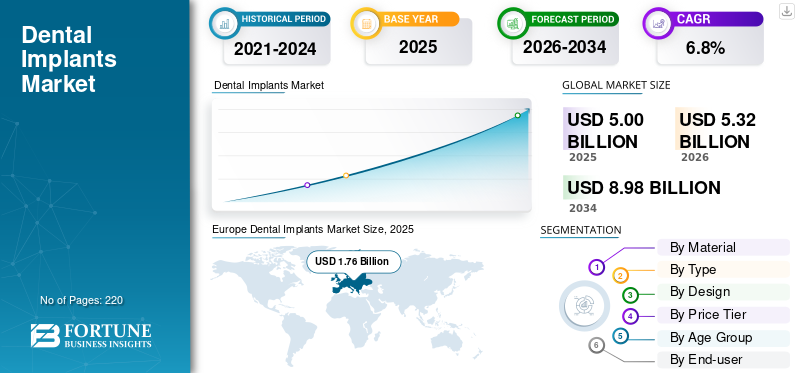
The global dental implants market size was valued at USD 5.00 billion in 2025. The market is projected to grow from USD 5.32 billion in 2026 to USD 8.98 billion by 2034, exhibiting a CAGR of 6.8% during the forecast period. Europe dominated the dental implants market with a market share of 35.2% in 2025.
Dental implants are devices used to support dental prosthetics/false teeth. They are surgically placed in the jaw, serving as a root for missing teeth and restoring a person's ability to chew. Moreover, they provide support for artificial teeth, which include crowns, bridges, or dentures.
Due to tooth loss, an individual can experience complications such as defective speech, rapid bone loss, or changes to chewing patterns, resulting in discomfort. Hence, tooth replacement utilizing dental implants improves a person's quality of life and overall oral health. The increase in the prevalence of oral disorders globally is expected to boost the demand for the product, thereby propelling the growth of the market.
- For instance, in March 2023, according to the World Health Organization (WHO), oral diseases affected approximately 3.5 billion people globally. This higher prevalence poses a major health burden for many countries and leads to an increase in the adoption of implants in various dental procedures.
The Institut Straumann AG, Envista Holdings Corporation (Danaher), and Dentsply Sirona held the major market share in 2025 due to a strong focus on digital dentistry integration, pricing strategy, and distribution reach.
Download Free sample to learn more about this report.
Dental Implants Market KEY TAKEAWAYS
 Global Market Size & Forecast
- 2025 Market Size: USD 5.00 billion
- 2026 Market Size: USD 5.32 billion
- 2034 Forecast Market Size: USD 8.98 billion
- CAGR: 6.8% from 2026–2034
 Market Share
- Europe dominated the dental implants market in 2025, driven by the presence of leading manufacturers.
- The Tapered Implants segment is projected to hold the largest market share with 77.3% in 2026.
- The Endosteal Implants segment is projected to account for the largest market share with 80.2% in 2026.
 Key Regional Highlights
Europe
The market was valued at USD 1.76 billion in 2025, driven by a strong presence of dental implant manufacturers.
North America
The market is projected to reach USD 1.65 billion in 2026, supported by a high prevalence of edentulism.
Asia Pacific
The market is projected to reach USD 1.27 billion in 2026, driven by rising adoption of advanced dental implants.
U.S.
The market is projected to reach USD 1.48 billion in 2026.
Japan
The market is projected to reach USD 0.95 billion in 2026.
Read More

DENTAL IMPLANTS MARKET TRENDS
Growing Demand for Antibacterial-Coated Implants to Boost Market Growth
Rising demand for antibacterial-coated implants is one of the most significant trends in the global market. Factors such as durability are an important concern associated with implants for dental procedures. Antibacterial coatings improve implant durability, thereby boosting the adoption of antibacterial-coated implants. Furthermore, these coatings protect against harmful oral bacteria responsible for tooth decay and other serious dental problems, boosting their demand and improving patient outcomes.
- For instance, according to research published in March 2022 in Materials Today, researchers invented an antibacterial coating for implants combining antimicrobial peptides (AMPs) and silver nanoparticles (AgNPs) to achieve a dual antibacterial effect. This invention has made these products safer and more effective for dental procedures, driving their adoption.
In addition, various coating materials, such as silica, carbon, bioactive glasses, hydroxyapatite, bisphosphonates, calcium phosphates, titanium, and fluoride, have been studied for utilization in dental implant devices. Properties such as a porous structure, tunable particle size, and ease of adhesion to implant surfaces are expected to create opportunities for the increased adoption of such products.
MARKET DYNAMICS
MARKET DRIVERS
Download Free sample to learn more about this report.
Rising Prevalence of Tooth Loss, Periodontitis, Edentulism, and Age-related Oral Health Conditions to Boost Market Growth
One of the most significant drivers influencing the global dental implants market growth is the rising prevalence of dental disorders. The growing aging population is the most common factor behind the rising prevalence of dental disorders, particularly edentulism and dental caries.
- For instance, in March 2023, according to the World Health Organization (WHO), the prevalence of edentulism was almost 7.0% among people aged 20 years or older and 23.0% among those aged 60 years or older.
In addition, increasing incidence of tooth loss, growing demand for aesthetic dentistry, rising healthcare expenditure, and the launch of technologically advanced products are the major factors contributing to market growth. The preferred treatment for missing teeth includes dental implant placement.
Moreover, the increase in the number of oral disorders, such as tooth decay and periodontitis, is also expected to increase the adoption of these products during the forecast period.
Market Drivers - Impact & CAGR Contribution (2026–2034)
| Rank | Market Drivers | Overall Impact Rank | CAGR Contribution (2026–2034) |
Impact 2026–2028 |
Impact 2029–2031 |
Impact 2032–2034 |
|---|---|---|---|---|---|---|
| 1 | Growing prevalence of tooth loss and edentulism due to aging population | High | 3.00% | High | High | High |
| 2 | Increasing adoption of cosmetic and restorative dentistry | High | 2.40% | High | High | Medium |
| 3 | Continuous technological advancements in dental implants (CAD/CAM, digital dentistry, guided implant surgery, 3D printing, improved biomaterials) | Medium-High | 2.00% | Medium | High | High |
| 4 | Rising dental tourism and improving access to advanced dental care in emerging markets | Medium | 1.50% | Medium | Medium | High |
| 5 | Increasing awareness of oral health and higher disposable incomes | Medium-Low | 1.10% | Medium | Medium | Medium |
| 6 | Others (favorable reimbursement in select markets, expansion of dental clinics, strategic partnerships, product launches, increasing implant-trained dentists, etc.) | Low | 0.80% | Low | Low | Medium |
| Total Positive Growth Contribution | 10.80% | |||||
MARKET RESTRAINTS
High Upfront Cost of Dental Implant Procedures and Limited Insurance Reimbursement to Hamper Market Growth
Dental implant procedures are considerably more expensive than conventional tooth replacement options such as dentures and bridges, as the total treatment cost includes implant fixtures, abutments, crowns, imaging, surgical placement, bone grafting (when required), and follow-up care.
- For instance, according to the ANTALYA DENTAL POLYCLINIC, in March 2026, full-arch dental implants using the All-on-4 approach typically cost between USD 14,000 and USD 22,000, while full-mouth implant reconstruction involving both the upper and lower arches generally ranges from USD 30,000 to USD 55,000.
In many countries, dental implants are considered elective or cosmetic procedures and receive limited or no reimbursement from public or private insurance plans. As a result, patients often need to pay a large portion of the treatment cost out of pocket, which is expected to limit the adoption of the product among middle- and low-income populations.
Market Restraints - Impact & Negative CAGR Contribution (2026–2034)
| Rank | Market Restraints | Overall Impact Rank | Negative CAGR Contribution (2026–2034) |
Impact 2026–2028 |
Impact 2029–2031 |
Impact 2032–2034 |
|---|---|---|---|---|---|---|
| 1 | High cost of dental implant procedures and limited reimbursement | High | -1.9% | High | High | Medium |
| 2 | Risk of implant failure and post-surgical complications | Medium-High | -1.2% | Medium | Medium | Medium |
| 3 | Shortage of skilled implantologists in developing regions | Medium | -0.6% | High | Medium | Low |
| 4 | Others (patient anxiety, lengthy treatment duration, regulatory challenges, alternative restorative options, etc.) | Low | -0.3% | Low | Low | Low |
| Total Negative Growth Impact | -4.0% | |||||
MARKET OPPORTUNITIES
Large Untreated Patient Pool to Create Numerous Growth Opportunities
Countries across Asia Pacific, Latin America, and the Middle East & Africa have a large untreated patient pool suffering from tooth loss, edentulism, and severe periodontal disease. However, implant adoption remains comparatively low due to affordability constraints and limited reimbursement coverage. This is creating a large addressable base for implant-supported restorations.
As a result, manufacturers are expanding their presence in these regions through affordable implant portfolios, localized distribution, dentist training programs, and partnerships with DSOs. Moreover, as value implant systems become more clinically reliable and widely available, their adoption is expected to expand beyond premium urban clinics to include mid-income patient groups. Furthermore, this opportunity is supported by a growing aging population, as they are more prone to conditions such as tooth loss.
- For instance, as per the UNFPA June 2024 data, the global share of people aged 65 and above would rise from 10.3% in 2024 to 20.7% by 2074.
MARKET CHALLENGES
Risks Associated with Implant Procedures and High Cost of Treatment Might Hinder Market Growth
Despite their several benefits, dental implantation procedures are associated with certain risks and safety issues, such as infection at the implant site, injury or damage to surrounding structures, and nerve damage that may result in pain, numbness, or tingling. These side effects are expected to limit the adoption of the product, thereby hampering market growth during the forecast period.
- For instance, according to the National Center for Biotechnology Information (NCBI), in April 2022, the incidence of peri-implant mucositis and peri-implantitis following dental implant placement ranged from 46% to 63% and 19% to 23%, respectively.
Moreover, dental implants are typically more expensive compared to other tooth replacement solutions due to their longevity and higher success rates. These higher treatment costs are expected to act as a financial burden for a number of individuals seeking tooth replacement procedures, thereby limiting the growth of the market.
Segmentation Analysis
By Material
Titanium Segment Dominated the Market Due to High Biocompatibility
Based on material, the market is categorized into titanium, zirconium, and others.
The titanium segment held the largest share of the market in 2025. This dominance is attributed to the high biocompatibility of titanium with the bony structure, suitability for a number of procedures, and non-allergic nature. Additionally, the high success rate and cost-effectiveness of titanium implants over other implants have increased their utilization in dental procedures, which is projected to boost market growth during the forecast period. The segment is estimated to hold an 84.0% share in 2026.
- For instance, according to an article published by the American Academy of Implant Dentistry in July 2022, more than 2.5 million dental implants occur every year in the U.S. This high procedure volume has contributed to the widespread utilization of titanium implants, supporting the growth of the segment.
The zirconium segment is expected to grow at a CAGR of 6.1% during the forecast period.
By Design
Tapered Implant Segment Led Due to Increasing Product Approvals
On the basis of design, the market is bifurcated into tapered implants and parallel walled implants.
In 2025, the tapered implants segment accounted for the largest share of the market. This significant growth is attributed to the benefits they offer over parallel implants, such as greater implant stability, excellent soft tissue attachment, and maximum bone maintenance. These benefits have greatly increased their acceptance, inspiring the companies to increase their manufacturing facilities, which significantly contributes to segment growth. Moreover, the increasing number of regulatory approvals for tapered implant products across several countries also contributes to the growth of the segment. The segment is projected to hold a 77.3% share in 2026.
The parallel walled implants segment is expected to grow at a CAGR of 5.6% during the forecast period.
By Type
Endosteal Implants Segment Held the Largest Market Share Due to Their Clinical And Economic Advantages
Based on type, the market is segmented into endosteal implants, subperiosteal implants, and transosteal implants.
The endosteal implants segment held the highest market share in 2025. Endosteal implants are the most common type of devices used in dentistry due to their clinical and economic benefits. The growth of these devices can be highly attributed to the high success rates of endosteal implant procedures, their long-term durability, and continuous advancements in implant designs. These benefits associated with endosteal implants make them a treatment of choice in a number of dental procedures, which propels the segment’s growth. The segment is projected to hold an 80.2% share in 2026
- For instance, in April 2022, Straumann combined its TLX implant system with an implant-abutment connection design, introducing an innovative endosteal design that helps improve CAD/CAM workflows for clinicians.
To know how our report can help streamline your business, Speak to Analyst
The subperiosteal implants segment is projected to grow at a CAGR of 7.9% during the forecast period.
By Price Tier
Stronger Adoption of Premium Implants in North America and Europe Boosted the Segment’s Growth
On the basis of price tier, the market is trifurcated into premium, value, and discount.
In 2025, the premium segment accounted for the largest share of the market. These implants have significantly higher adoption in North America and Europe due to higher patient affordability and well-established clinician training programs, which are anticipated to drive the segment’s growth. The segment is projected to hold a 45.2% share in 2026.
The value segment is expected to grow at a CAGR of 8.0% during the forecast period.
By Age Group
High Incidence of Tooth Loss Encouraged the 45-64 Years Segment Growth
On the basis of age group, the market is divided into 18-44 years, 45-64 years, and 65 years & above.
In 2025, the 45-64 years segment accounted for the largest share of the market. This dominance is attributed to the high incidence of tooth loss, stronger purchasing power, and higher acceptance of implant-based restorations among individuals in this age group compared to younger adults. This group also includes many patients seeking single-tooth and multiple-tooth replacements before progressing to full or partial edentulism. The segment is projected to hold a 46.0% share in 2026.
The 65 years & above segment is expected to grow at a CAGR of 8.0% during the forecast period.
By End-user
Solo Practices Segment Held the Largest Market Share Owing to Increasing Number of Dentists Globally
Based on end-user, the market is segregated into solo practices, DSO/group practices, and others.
The solo practices segment accounted for the largest global dental implants market share. This dominance is attributed to the increasing number of dentists globally, which is estimated to drive the establishment of well-resourced dental clinics during the forecast period. Moreover, the segment’s growth is also influenced by the rising prevalence of dental ailments globally. The segment is projected to hold a 46.0% share in 2026.
- For instance, according to the American Dental Association, there were 202,485 professionally active dentists in the U.S. as of 2024. This rising number of dentists will support the establishment of well-equipped dental clinics, thereby contributing to the growth of solo practices.
The DSO/group practices segment is expected to grow at a CAGR of 7.9% during the forecast period.
Dental Implants Market Regional Outlook
Geographically, the market is categorized into North America, Europe, Asia Pacific, Latin America, and the Middle East & Africa.
Europe
Europe Dental Implants Market Size, 2025 (USD Billion)
To get more information on the regional analysis of this market, Download Free sample
Europe accounted for the largest market share in 2024, valued at USD 1.67 billion, and maintained its leading position in 2025, reaching USD 1.76 billion. The region’s market growth is primarily driven by the presence of a large number of dental implant manufacturers and favorable reimbursement policies. Moreover, the continuously growing geriatric population, resulting in the increasing prevalence of dental disorders, is driving the adoption of dental implants, and consequently, the demand for these devices across Europe.
- For instance, in February 2024, according to Eurostat, individuals aged 65 years and over accounted for more than one-fifth (21.1 %) of Europe's population in 2022. The growing number of aged individuals is therefore anticipated to increase the demand for these devices in dental procedures.
U.K. Dental Implants Market
The U.K. market is projected to reach USD 0.10 billion in 2026, representing approximately 1.8% of the global revenues.
Germany Dental Implants Market
The German market is expected to reach USD 0.33 billion in 2026, accounting for approximately 6.2% of the global revenues.
North America
In 2026, the North America market is projected to reach approximately USD 1.65 billion, making it the second-largest market worldwide. The growth of this region is significantly attributed to the high prevalence of edentulism in the U.S. Furthermore, the growing number of dentists, increasing availability of advanced dental equipment, and high acceptance of digital dentistry are expected to spur market growth in the region.
U.S. Dental Implants Market
In 2026, the U.S. is anticipated to reach USD 1.48 billion, accounting for approximately 27.9% of the global market.
Asia Pacific
Asia Pacific is projected to record a CAGR of 7.9% during the forecast period, the third-highest globally, reaching USD 1.27 billion in 2026. The growth is due to the growing adoption of advanced implants in dentistry and the presence of a large patient pool across this region. Moreover, rising medical tourism in countries such as China, India, and Singapore is expected to further support market growth in the region.
- For instance, according to an article published by the International Journal of Travel Medicine and Global Health in June 2023, demand for dental tourism has increased in developed nations such as India, China, and Thailand due to the affordability of oral healthcare services in these countries.
Japan Dental Implants Market
The Japan market is projected to reach approximately USD 0.95 billion in revenue in 2026, representing nearly 1.8% of the global sales.
China Dental Implants Market
The China market is anticipated to reach around USD 0.24 billion in 2026, accounting for nearly 4.5% of the global revenues.
India Dental Implants Market
The Indian market is expected to reach approximately USD 0.07 billion in 2026, accounting for around 1.3% of the global revenues.
Latin America and Middle East & Africa
Both Latin America and the Middle East & Africa are anticipated to witness moderate growth during the forecast period. The Latin America market is estimated to reach approximately USD 0.34 billion in 2026 due to rising medical tourism and increasing healthcare expenditure in countries such as Brazil and Mexico. Furthermore, growing partnerships between hospitals and dental academic institutions across GCC countries and South Africa to increase awareness of dental care are expected to propel market growth.
GCC Dental Implants Market
By 2026, the GCC market is estimated to reach approximately USD 0.02 billion, representing around 0.5% of the global revenues.
COMPETITIVE LANDSCAPE
Key Industry Players
Industry Participants are Forging Partnerships to Boost Their Market Presence
Institut Straumann AG, Envista Holdings Corporation (Danaher), and Dentsply Sirona dominated the market in 2025, primarily due to their broad product portfolio in the industry's premium segment. Moreover, these companies deliver an extensive range of implants at premium prices. Their strong presence across major regions, including North America, Europe, Asia Pacific, and Latin America, has further boosted their revenue generation and reinforced their leading positions in the global market.
Other key players also mark a significant presence in the global market through a strong focus on collaboration, partnerships, and new product launches.
LIST OF KEY DENTAL IMPLANTS COMPANIES PROFILED
- Institut Straumann AG (Switzerland)
- Dentsply Sirona (U.S.)
- Henry Schein, Inc. (U.S.)
- ZimVie Inc. (Zimmer Biomet) (U.S.)
- Osstem Implant (South Korea)
- BioHorizons (U.S.)
- CeraRoot SL (Spain)
- Envista Holdings Corporation (Danaher) (U.S.)
- Cortex (Israel)
- Dentium (South Korea)
- Zest Dental Solutions (U.S.)
KEY INDUSTRY DEVELOPMENTS
- June 2025: ZimVie Inc. launched RealGUIDE Dental Implant Software Suite and Implant Concierge service in Japan.
- April 2025: ZimVie Inc. launched the Immediate Molar Dental Implant System in the U.S.
- November 2024: Neoss expanded its biomaterials portfolio with NeoGenix Extraction Allograft, supporting bone regeneration in implant procedures.
- July 2024: ZimVie Inc. released RealGUIDE 5.4 software update for treatment planning and implant restoration.
- July 2024: ZimVie Inc. received FDA clearance and launched GenTek Genuine Restorative Components in the U.S.
- February 2024: ZimVie Inc. launched the next-generation TSX Implant in Japan, expanding its premium implant offering in Asia Pacific.
- November 2023: Keystone Dental Group launched GENESIS ACTIVE Dental Implant System, a new surgical and prosthetic implant solution.
REPORT COVERAGE
The research report includes a detailed global dental implants market analysis. It focuses on key aspects such as prominent players and segmentations such as material, type, design, price tier, age group, and end-user. Furthermore, the report offers insights into key market trends, drivers, opportunities, restraints, and challenges. It also provides an analysis of the prevalence of dental disorders, the number of implantation procedures, and the number of practicing dentists. Moreover, the report covers the key factors that have contributed to the growth of the market in recent years.
Request for Customization to gain extensive market insights.
Report Scope & Segmentation
| ATTRIBUTE | DETAILS |
| Study Period | 2021-2034 |
| Base Year | 2025 |
| Estimated Year | 2026 |
| Forecast Period | 2026-2034 |
| Historical Period | 2021-2024 |
| Growth Rate | CAGR of 6.8% for 2026-2034 |
| Unit | Value (USD Billion) |
| Segmentation | By Material, Design, Type, Price Tier, Age Group, End-user, and Region |
| By Material |
|
|
By Design
|
|
| By Type |
|
| By Price Tier |
|
| By Age Group |
|
| By End-user |
|
| By Geography |
|
Frequently Asked Questions
Fortune Business Insights says that the global market stood at USD 5.00 billion in 2025 and is projected to reach USD 8.98 billion by 2034.
The market will exhibit steady growth at a CAGR of 6.8% during the forecast period.
By material, the titanium segment led the market.
Rising prevalence of tooth loss, periodontitis, edentulism, and age-related oral health conditions are the key factors driving the market.
Institut Straumann AG, Dentsply Sirona, and Envista Holdings Corporation (Danaher) are the major players in the market.



- 2021-2034
- 2025
- 2021-2024
- 220
Get 30-60 hrs Free Customization
Expand Regional and Country Coverage, Segments Analysis, Company Profiles, Competitive Benchmarking, and End-user Insights.













.webp)






Related Reports
-
US +1 833 909 2966 ( Toll Free )
-
Get In Touch With Us