Biotechnology Market Size, Share & Industry Analysis, By Technology (Genomics & Genetic Analysis Technologies, Synthetic Biology & Genetic Engineering Technologies, Gene Editing Technologies, Cell Engineering & Cell Culture Technologies, Bioprocessing Technologies, & Others), By Application (Biopharmaceutical Discovery & Preclinical Research, Cell & Gene Therapy, Molecular Diagnostics, RNA Therapeutics & Nucleic Acid Medicines, Precision Medicine & Biomarker Development, Regenerative Medicine & Tissue Engineering, & Others), By End-user, and Regional Forecast, 2026-2034
 Download Free Sample
Biotechnology Market Size and Future Outlook
 Listen to Audio Version
The global biotechnology market size was valued at USD 1,376.1 billion in 2025 and is projected to grow from USD 1,491.5 billion in 2026 to USD 4,334.8 billion by 2034, exhibiting a CAGR of 14.3% during the forecast period. North America dominated the biotechnology market with a market share of 43.34% in 2025.
Biotechnology is the application of biological systems, living organisms, or their components to develop products and technologies that improve healthcare, agriculture, industry, and the environment. Growth of the biotechnology industry is attributed to the expanding applications beyond healthcare with wider adoption in sectors such as agriculture and industrial processing and accelerated innovation with breakthroughs in genomics, gene editing and bioinformatics.
R&D investment in the biotechnology sector continues to grow steadily with biotechnology companies consistently reinvesting a significantly higher share of revenues into research than most other industries and increasing government support and funding for the biotechnology sector through public R&D budgets and strategic policy initiatives accelerating innovation, commercialization, and access to cutting-edge technologies.
Furthermore, major players, such as Eli Lilly & Company, Abbvie Inc., F. Hoffmann-La Roche Ltd, and Pfizer Inc., are focusing on significantly expanding their efforts for the development of innovative product offerings, leading to new product launches.
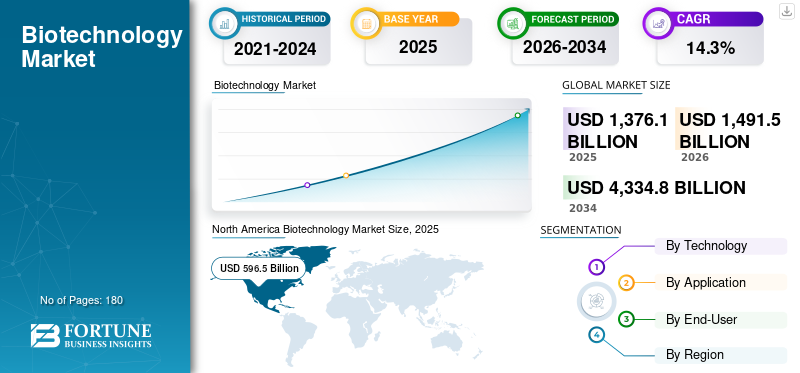
Download Free sample to learn more about this report.
BIOTECHNOLOGY MARKET KEY TAKEAWAYS
 Market Size & Forecast
- 2025 Market Size: USD 1,376.1 billion
- 2026 Market Size: USD 1,491.5 billion
- 2034 Forecast Market Size: USD 4,334.8 billion
- CAGR: 14.3% from 2026–2034
 Market Share
- North America dominated the biotechnology market with a 43.34% share in 2025.
- The bioprocessing technologies segment held the largest market share in 2025.
- Pharmaceutical & biotechnology companies are projected to account for 53.8% of the market in 2026.
 Key Regional Highlights
North America
North America reached USD 596.5 billion in 2025.
Europe
Europe is projected to reach USD 386.6 billion in 2026.
Asia Pacific
Asia Pacific is expected to attain USD 293.9 billion by 2026.
U.S.
The market is projected to reach USD 615.5 billion in 2026.
Japan
The biotechnology market is anticipated to reach nearly USD 54.0 billion in 2026.
Read More

BIOTECHNOLOGY MARKET TRENDS
Expansion of Single-Use and Flexible Manufacturing is a Prominent Trend Observed in Market
Single-use and flexible manufacturing represent a crucial trend in biotechnology as they lessen the cleaning/validation requirements, shorten changeover times, and allow facilities to conduct multi-product, multi-modality operations with decreased contamination risk—enhancing speed-to-market and capacity use. ISPE observes that the adoption of single-use technology has sped up due to diminished risk, adaptable process equipment tweaks, and decreased capital expenses. Furthermore, according to BioPlan Associate’s public survey report for 2024, single-use is now mainstream manufacturing technology. The same source further stated that single-use systems were used in 87% of biopharma manufacturing facilities in 2024. Additionally, increasing new product launches by key players also supported this trend.
- For instance, in March 2025, Cytiva expanded its Xcellerex X-platform with 500 L and 2,000 L single-use bioreactors to help customers scale from 50 L to 2,000 L, explicitly positioning it around reliability, scalability, and flexibility for advanced therapeutics.
- Similarly, chart below from shows that the single-use use consumables such as single-use bags and connectors have higher usage in biomanufacturing.
Download Free sample to learn more about this report.
MARKET DYNAMICS
MARKET DRIVERS
Growth in Demand for Biopharmaceutical Drugs to Accelerate Market Growth
Higher efficacy, better target specificity, and improved safety profiles provide a clinical superiority to biopharmaceuticals over small molecule drugs. The benefits offered by biopharmaceuticals support premium pricing, longer treatment duration, accelerated approvals and favorable reimbursement support.
Download Free sample to learn more about this report.
MARKET RESTRAINTS
High Research & Development Costs to Restrict Market Growth
Developing new biotech products such as biologics, cell and gene therapies requires huge level of investment. The cost of developing a drug can exceed billions of dollars and take many years due to the lengthy preclinical work, multi-phase clinical trials, and the need for specialized facilities. The failure rate in the development of biotech product is very high.
Development Time & Cost for Small Molecule Drugs versus Biologics
|
|
Small Molecule Drugs |
Biologics |
|
Development Time |
8-10 years |
10-12 years |
|
Development Cost |
USD 1-2 billion |
USD 2-4 billion |
MARKET OPPORTUNITIES
Industry’s Transition Toward Sustainable, Low-carbon and Resource-efficient Production Models to Create Lucrative Opportunities
Industries are seeking alternatives to fossil-based processes and materials leading to a global shift toward sustainable, low-carbon, and resource-efficient production models, which is creating strong biotechnology market growth opportunities. Bio-based chemicals, enzymes, and advanced biofuels are increasingly being adopted to reduce greenhouse gas emissions, improve energy efficiency, and lower waste generation across sectors such as chemicals, materials, agriculture, and energy. Industrial biotech enables the use of renewable feedstock and precision fermentation to produce high-value products that have smaller environmental footprints and are compliant with tightening environmental regulations.
Download Free sample to learn more about this report.
Six out of the top 10 best-selling drugs in H1 2025 were biopharmaceuticals – Keytruda, Mounjaro, Dupixent, Skyrizi, Darzalex, and Opdivo
MARKET CHALLENGES
Regulatory Complexity Create Uncertainty for Novel Modalities
Biotechnology companies must navigate multiple regulatory frameworks that differ significantly across geographies, increasing cost, timelines, and execution risk. For instance, a gene therapy approved by the U.S. FDA may still require additional clinical data or localized trials to meet EMA or CDSCO (India) requirements, delaying global commercialization and fragmenting launch strategies. Differences in standards for clinical endpoints, manufacturing validation, and long-term safety monitoring complicate global development plans.
- Bluebird bio’s gene therapies (for beta-thalassemia and cerebral adrenoleukodystrophy) faced years of regulatory delays due to concerns around risk of cancer from viral vectors, which required extended follow-up studies (up to 15 years), additional manufacturing controls, and post-approval commitments.
- Due to rapidly evolving regulatory standards, CureVac’s first-generation mRNA COVID-19 vaccine failed to meet efficacy expectations as competitor vaccines set higher efficacy benchmarks.
INVESTMENT ANALYSIS
The Venture Capital (VC) funding in the biopharmaceuticals industry was around USD 34 billion in 2025. The VC funding in 2025 is considerably lower than 2021 which was valued at USD 56 billion respectively which highlights the need for a resurgence in early-stage VC funding in the biopharma sector to sustain the biotech ecosystem and renew development pipelines. Some of the top VC funding rounds in 2024 were as follows:
- USD 1 billion for Xaira Therapeutics
- USD 0.42 billion for Treeline Biosciences
- USD 0.40 billion for Kailera Therapeutics
- USD 0.37 billion for Formation Bio
Download Free sample to learn more about this report.
The VC funding in the biopharmaceutical sector grew by around 6% in 2025.
IMPACT OF AI ON BIOTECHNOLOGY MARKET
The impact of AI on the biotechnology market is staggering with the use of the technology helping companies to accelerate discovery timelines, improve success rates, and cut R&D costs across drug development and industrial biotech.
Biotechnology R&D accounted for roughly 17% of the USD 782 billion invested by the U.S. business sector on R&D in 2024
To know how our report can help streamline your business, Speak to Analyst
AI is expected to have a huge impact on target identification, which involves reviewing published evidence, developing biological hypotheses and validating them through repeated laboratory experiments. The dependency of early target selection on computational analysis is increasing, which will enable the interrogation of large biological datasets in a considerably shorter time. Development of drug targets, which previously took around 3-6 years can now be done in 1-2 years with the help of AI tools.
- Insilico Medicine developed a novel drug candidate for idiopathic pulmonary fibrosis in 18 months.
- Exscientia designed a really potent inhibitor for a target called PKC-Theta in 11 months.
Segmentation Analysis
To know how our report can help streamline your business, Speak to Analyst
By Technology
Launch of New Production Facilities Boosted Bioprocessing Technologies Segment Growth
In terms of technology, the market is divided into genomics & genetic analysis technologies, synthetic biology & genetic engineering technologies, gene editing technologies, cell engineering & cell culture technologies, bioprocessing technologies, nanobiotechnology, and others.
Bioprocessing technologies segment dominated the global market in 2025s. Key factors such as increasing investments by operating players, launch of new production facilities, and rising demand for biologics have supported the segment growth.
- For instance, in April 2024, FUJIFILM Holdings Corporation announced USD 1.2 billion additional investment to expand large-scale cell-culture CDMO manufacturing in North Carolina, U.S.
- Similarly, chart below from shows global comparison of biomanufacturing capacity across key regions.
The genomics & genetic analysis technologies segment is anticipated to rise with a CAGR of 12.1% over the forecast period.
Download Free sample to learn more about this report.
By Application
Focus on Innovative Product Development Accelerated Biopharmaceutical Discovery & Preclinical Research Segment Growth
Based on application, the market is segmented into biopharmaceutical discovery & preclinical research, cell & gene therapy, molecular diagnostics, industrial biotechnology, RNA therapeutics & nucleic acid medicines, precision medicine & biomarker development, regenerative medicine & tissue engineering, and others.
In 2025, the biopharmaceutical discovery & preclinical research segment dominated the global market, attributed to the substantial investment, shifting focus on innovative product development, and increasing research funding from various authorities.
- For instance, chart below shows PhRMA member companies’ total R&D spend rose from around USD 79.6 billion (2018) to approx. USD 102.3 billion (2021) and remained around USD 100.8 billion (2022), sustaining a very large early-pipeline spend base.
Download Free sample to learn more about this report.
- The cell & gene therapy segment is anticipated to rise with a CAGR of 19.7% over the forecast period.
By End-User
Increasing R&D Spending by Pharmaceutical & Biotechnology Companies Boosted Segment Growth
Based on end-user, the market is segmented into pharmaceutical & biotechnology companies, CROs & CDMOs, academic & research institutes, and others.
In 2025, pharmaceutical & biotechnology companies held the highest biotechnology market share. Key factors such as increasing R&D spending, expansion of manufacturing capabilities, and focus on innovative product launch by these entities have propelled the segment growth. Furthermore, the segment is set to hold a 53.8% share in 2026.
- For instance, in October 2024, Johnson & Johnson announced it will invest more than $2B to build a state-of-the-art biologics manufacturing facility in North Carolina to expand production for its biologics portfolio and pipeline.
- In addition, the CROs & CDMOs segment is projected to grow at a CAGR of 17.5% during the study period.
Biotechnology Market Regional Outlook
By geography, the market is segmented into Europe, North America, Asia Pacific, Latin America, and the Middle East & Africa.
North America
North America Biotechnology Market Size, 2025 (USD Billion)
To get more information on the regional analysis of this market, Download Free sample
North America established itself as the leading market, achieving a valuation of USD 554.8 billion in 2024 and growing to USD 596.5 billion in 2025. This ongoing supremacy is fueled by strong biopharma R&D intensity, a substantial biologics/advanced-therapy manufacturing foundation, and quicker integration of advanced manufacturing technologies.
U.S. Biotechnology Market
As the foundation of North America's performance, the U.S. remains at the forefront of regional growth. The U.S. market is projected to reach around USD 615.5 billion in 2026, accounting for almost 41.3% of global revenue.
Europe
Europe is expected to grow at a steady trajectory, registering a CAGR of 14.0% in the coming years, and reaching a market size of USD 386.6 billion in 2026. Strong biologics manufacturing footprint, increasing public funding, and expansion of biosimilars are key factors accelerating market expansion in the region.
U.K. Biotechnology Market
The U.K. market is expected to reach USD 86.4 billion in 2026, representing roughly 5.8% of global market revenues.
Germany Biotechnology Market
The German market is expected to reach USD 79.1 billion in 2026, equivalent to around 5.3% of global market sales.
Asia Pacific
Asia Pacific is projected to touch USD 293.9 billion by 2026, cementing its position as the third-largest regional market. Rapid GMP capacity build-out, growing clinical trial volumes and increasing regional R&D investments are expected to act as key growth catalysts across the region.
Japan Biotechnology Market
The Japan market is anticipated to reach nearly USD 54.0 billion in 2026, contributing about 3.6% of global revenues.
China Biotechnology Market
China is poised to be among the world’s largest markets, with projected revenues of nearly USD 88.3 billion in 2026, translating to about 5.9% of global sales.
India Biotechnology Market
The Indian market is estimated at around USD 52.3 billion in 2026, accounting for roughly 3.5% of global market revenues.
Latin America and Middle East & Africa
Latin America and the Middle East & Africa are anticipated to post moderate growth rates. The Latin American market is expected to reach USD 86.2 billion in 2026, while the GCC in the Middle East & Africa is expected to achieve a valuation of USD 32.2 billion. The markets in these regions are expected to grow owing to improvement in healthcare infrastructure coupled with increasing access to advanced diagnostic and pharmaceutical technologies.
South Africa Biotechnology Market
The South Africa market is projected to reach around USD 29.9 billion in 2026, representing roughly 2.0% of global market revenues.
COMPETITIVE LANDSCAPE
Key Industry Players
Major Companies Focus on Pipeline Expansion & Strategic Partnerships to Drive Growth in Market Revenues
In a highly competitive environment, biotechnology companies are broadening their pipeline; collaborating with large companies; getting into co-development & out-licensing deals and focusing on high-value indications such as oncology, rare diseases, etc.
- Amgen acquired Horizon Therapeutics in 2023 with the aim to strengthen their portfolio with established rare-disease drugs as Tepezza.
- Vertex Pharmaceuticals focus on cystic fibrosis has assisted the company in building a dominant revenue base
LIST OF KEY BIOTECHNOLOGY COMPANIES PROFILED IN REPORT
- Eli Lilly and Company (U.S.)
- AbbVie Inc. (U.S.)
- Hoffmann-La Roche Ltd (Switzerland)
- Pfizer Inc. (U.S.)
- AstraZeneca (U.K.)
- Amgen Inc. (U.S.)
- Gilead Sciences, Inc. (U.S.)
- Vertex Pharmaceuticals Incorporated (U.S.)
- Moderna, Inc. (U.S.)
- BioNTech SE (Germany)
- Alnylam Pharmaceuticals, Inc. (U.S.)
- argenx (Netherlands)
- Genmab A/S (Denmark)
- Insmed Incorporated (U.S.)
- CELLTRION INC. (South Korea)
|
Leaders
Challengers
Visionaries
Niche Players
|
KEY INDUSTRY DEVELOPMENTS
- January 2026: Sartorius AG expanded its bio-circular portfolio of bio-based single-use fluid management technologies/filters for more sustainable bioprocessing.
- December 2025: Thermo Fisher Scientific Inc. announced expansion of Bioprocess Design Centers across Asia with new Hyderabad center and expanded Korea/Singapore sites to support regional biomanufacturing.
- September 2025: Merck KGaA opened an USD 176.8 million (€150M) filtration manufacturing facility in Cork (Blarney), expanding filter manufacturing capacity and supply resilience.
- September 2025: Agilent released Altura Ultra Inert HPLC Columns aimed at biotherapeutics testing, in turn supporting development and QC workflows.
- August 2025: Cytiva and Culture Biosciences expanded strategic collaboration to include global commercialization of Culture’s Stratyx 250 hardware and joint development of additional bioreactor formats.
REPORT COVERAGE
The global biotechnology market analysis encompasses an extensive examination of the market size and projections for all market segments featured in the report. It provides information on the market dynamics and trends that are anticipated to propel the market during the forecast period. It offers insights into crucial elements, such as innovations in products, the regulatory landscape, and the introduction of new products. Furthermore, it outlines collaborations, mergers & acquisitions, along with significant advancements in the industry within the market. The global market forecast report additionally offers a comprehensive competitive landscape with details on market share and profiles of major active participants.
Request for Customization to gain extensive market insights.
Report Scope & Segmentation
| ATTRIBUTE | DETAILS |
| Study Period | 2021-2034 |
| Base Year | 2025 |
| Estimated Year | 2026 |
| Forecast Period | 2026-2034 |
| Historical Period | 2021-2024 |
| Growth Rate | CAGR of 14.3% from 2026-2034 |
| Unit | Value (USD Billion) |
| Segmentation | By Technology, Application, End-User, and Region |
| By Technology |
|
| By Application |
|
| By End-User |
|
| By Region |
|
Frequently Asked Questions
According to Fortune Business Insights, the global market value stood at USD 1,376.1 billion in 2025 and is projected to reach USD 4,334.8 billion by 2034.
In 2025, the market value stood at USD 596.5 billion.
The market is expected to exhibit a CAGR of 14.3% during the forecast period of 2026-2034.
Growth in demand for biopharmaceutical drugs, coupled with the rising prevalence of chronic diseases is driving market expansion.
Eli Lilly & Company, Abbvie Inc., F. Hoffmann-La Roche Ltd, and Pfizer Inc. are the top players in the global market.
North America held the largest market share in 2025.



- 2021-2034
- 2025
- 2021-2024
- 180
Get 30-60 hrs Free Customization
Expand Regional and Country Coverage, Segments Analysis, Company Profiles, Competitive Benchmarking, and End-user Insights.













.webp)






Related Reports
-
US +1 833 909 2966 ( Toll Free )
-
Get In Touch With Us