Nanobiotechnology Market Size, Share & Industry Analysis, By Offering (Products {Instruments and Consumables}, & Services), By Type (Nanoparticles {Liposomes, Polymers & Polymer Drug Conjugates, Hydrogel Nanoparticles, & Others}, Nanoshells, Nanotubes, & Nanodevices), By Application (Therapeutics {Clinical Oncology, Infectious Diseases, Clinical Cardiology, Regenerative Medicines, & Others}, Diagnostics & Biosensing {IVD, Imaging, & Others}, Research, & Others), By End User (Pharmaceutical & Biotechnology Companies, Diagnostics Laboratories, & Others), and Regional Forecast, 2026-2034
 Download Free Sample
Nanobiotechnology Market Size and Future Outlook
 Listen to Audio Version
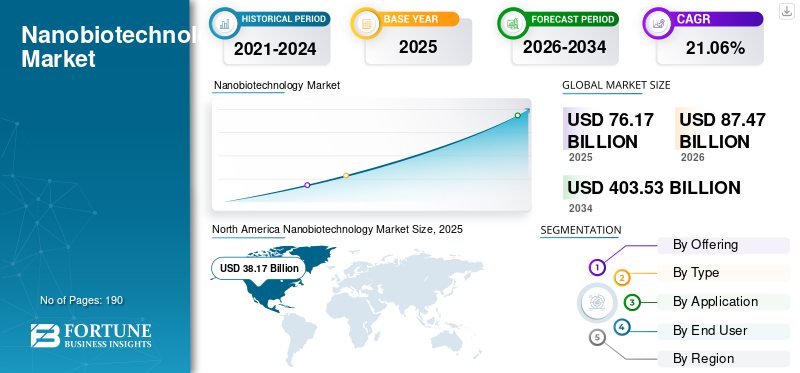
The global nanobiotechnology market size was valued at USD 76.17 billion in 2025. The market is projected to grow from USD 87.47 billion in 2026 to USD 403.53 billion by 2034, exhibiting a CAGR of 21.06% during the forecast period. North America dominated the nanobiotechnology market with a market share of 50.11% in 2025.
The nanobiotechnology market in the pharmaceutical industry sits at the intersection of nanomaterials and life sciences, leveraging engineered particles and nano-enabled systems to improve the detection, monitoring, and treatment of diseases. The industry is anticipated to experience strong growth in the coming years, driven by the growing focus of key players and rising investment in the sector. The ever-increasing adoption of nanotherapeutics, expanding applications in medical diagnostics and biosensing, and advancements in imaging and theranostics are among the factors driving global market growth.
Furthermore, major operating players in the region are expanding their manufacturing capabilities, underscoring the growth opportunities in nanotherapeutics and diagnostics and reinforcing market growth.
- For instance, in July 2023, Cytiva launched the NanoAssemblr commercial formulation system, purpose-built for clinical and commercial manufacturing of lipid nanoparticle Companies can use these commercial formulation systems to bring these medicines to market using a single, scalable mixing technology for all stages of development, from research to product development to large-scale manufacturing. Such developments are anticipated to boost the overall market growth.
Furthermore, leading players in the industry, such as Cytiva, Merck KGaA, Waters Corporation, and IZON Science LTD, are directing their resources toward technological advancement and new product launches to strengthen their market positions.
Download Free sample to learn more about this report.
Nanobiotechnology Market Key Takeaways
 Global Market Size & Forecast
- 2025 Market Size: USD 76.17 billion
- 2026 Market Size: USD 87.47 billion
- 2034 Forecast Market Size: USD 403.53 billion
- CAGR: 21.06% from 2026–2034
 Market Share
- North America dominated the nanobiotechnology market with a 50.11% share in 2025.
- The therapeutics segment accounted for the largest market share in 2025.
- The pharmaceutical & biotechnology companies segment dominated the global market in 2025.
 Key Regional Highlights
North America
North America maintained its leading position, with the market valued at USD 38.17 billion in 2025.
Europe
Europe is projected to reach USD 23.54 billion in 2026, expanding at a CAGR of 20.63%.
Asia Pacific
Asia Pacific is expected to reach USD 18.26 billion in 2026, making it the third-largest regional market.
U.S.
U.S. The nanobiotechnology market is estimated to reach USD 41.71 billion in 2026.
Japan
Japan The nanobiotechnology market is estimated to reach USD 2.98 billion in 2026.
Read More

NANOBIOTECHNOLOGY MARKET TRENDS
Increased Adoption of Artificial Intelligence for Nanomaterial Design and Predictive Nanotoxicology is a Prominent Market Trend
A significant global market trend observed is the increasing adoption of AI/ML for nanomaterial design and predictive nanotoxicology. AI/ML is increasingly embedded in nanobiotechnology, as nanoparticle performance and safety depend on many interacting variables, making trial-and-error development slow and expensive. By learning from formulation, screening, and biological response datasets, ML models help teams reduce failed experiments and reduce rework for formulation decisions.
- For instance, in June 2024, the Royal Society of Chemistry published an article titled ‘Machine learning-guided high throughput nanoparticle design’ that demonstrated an integrated workflow combining microfluidic nanoparticle formulation, high-content imaging, and active machine learning to enable machine-learning-guided high-throughput nanoparticle design, accelerating nanoformulation optimization. Such developments are expected to boost market growth.
MARKET DYNAMICS
MARKET DRIVERS
Download Free sample to learn more about this report.
Rising Clinical Adoption of Nanomedicines in Oncology and Infectious Diseases is Driving Market Growth
Rising clinical adoption of nanomedicines in oncology and infectious diseases is a key market driver. These formulations are increasingly used to bridge treatment gaps as they overcome challenges such as poor solubility, short circulation time, and high off-target toxicity associated with conventional drugs. As hospitals and specialists prioritize therapies that improve response rates while reducing systemic side effects, nano-enabled delivery, such as liposomes, lipid nanoparticles, and polymer conjugates, becomes a preferred approach for patients with harder-to-treat conditions. This clinical pull results in increased demand for scalable manufacturing, validated characterization methods, and expanding commercial spend.
- For instance, in December 2025, Oncotelic Therapeutics, Inc., in collaboration with Sapu Nano, showcased new data demonstrating that its proprietary Deciparticle platform enabled consistent formulation of structurally diverse hydrophobic therapeutics including macrolide mTOR inhibitors, cyclic peptides, linear peptides, ascomycin macrolactams, and polyketides while maintaining a precise sub-20 nm nanoparticle profile suitable for Intravenous (IV) delivery. Such factors highlight the expected drivers of market growth.
MARKET RESTRAINTS
High Development Cost of Nanobiotechnology to Hamper Market Growth
High development costs and complex manufacturing restrain the nanobiotechnology market growth. Many nano-enabled therapeutics and diagnostics require specialized formulation tight control of particle attributes, and advanced analytics to prove consistency batch-to-batch. These requirements increase the CMC (chemistry, manufacturing, and controls) workload, extend development timelines, and raise the cost of scale-up and tech transfer compared to conventional small molecules. As a result, smaller innovators face greater capital needs and greater dependence on partnering. This slows broader clinical translation and limits how fast pipelines can convert into commercial products.
- For instance, in June 2019, ResearchGate published an article titled ‘Cost–Effectiveness of Nanomedicine: Estimating the Real Size of Nano-Costs’ that reported nanotherapy cycle could cost USD 15,000-20,000. Such high cost slows down adoption and adversely impacts the market.
MARKET OPPORTUNITIES
Increased R&D Funding and Strategic Partnerships in Nano-Biotechnology Innovation Offer New Growth Opportunities
Increased R&D funding and strategic partnerships are among the key factors offering lucrative opportunities for the market. It improves the economics of innovation in a capital-intensive, scientifically complex area. Increased funding also encourages more pharmaceutical and start-up players to run larger validation studies, invest in specialized characterization and toxicology, and build repeatable formulation/manufacturing processes. These trends create a stronger pipeline of clinically relevant nano-therapeutics and nano-diagnostics. Funding also supports infrastructure, including core labs, GMP pilot lines, and translational networks. Over time, these factors collectively result in faster innovation cycles, more validated products reaching trials, and higher deal activity across licensing and co-development.
- For instance, in September 2024, NanoSyrinx, a company developing nanosyringes as a novel platform for targeted intracellular delivery of biologic therapeutics, received USD 13.0 million in investment to accelerate the development of biologic therapeutics. Such developments offer market growth opportunities.
MARKET CHALLENGES
Ambiguity in Regulatory Guidelines to Extend Timelines Challenges Market Growth
One of the major challenges to the growth of the market is regulatory uncertainty. They are at the intersection of conventional drugs/biologics, devices, and chemicals, resulting in manufacturers facing inconsistent expectations for defining Nano forms, characterizing critical attributes, and proving comparability as processes scale. Such fragmented guidance often leads to additional studies to de-risk approvals, thereby lengthening timelines. This uncertainty also complicates regulatory questions around safety, biodistribution, and immunogenicity factors that pose challenges for market growth.
- For instance, in January 2026, the European Observatory for Nanomaterials (EUON, hosted by ECHA) noted that experts reviewing REACH readiness for Multicomponent Nanomaterials (MCNMs) highlighted the need for clearer definitions to reduce regulatory uncertainty, underscoring ongoing ambiguity in how complex nanomaterials are handled in practice.
Segmentation Analysis
By Offering
New Product Launches Position Products in Leading Position in Terms of Offering
Based on offering, the market is categorized into products and services.
Among these, the product segment accounted for the largest share in 2025. The products dominated the market as nanobiotechnology adoption is heavily driven by physical, repeat-use inputs, nanoparticles/lipids, nano-reagents, characterization kits, and instrumentation used across discovery, preclinical, and translational workflows. As more programs move into RNA delivery, the need for validated toolkits, targeted therapeutics, and advanced diagnostics, labs, and manufacturers purchasing advanced materials to improve reproducibility and speed screening also increases. This creates a higher and more recurring revenue base of products. Such factors drive growth in the segment. Additionally, new product launches by key companies to meet the global market demands are driving growth in the segment.
- For instance, in February 2024, Cayman Chemical, a supplier of research tools for Lipid Nanoparticles (LNPs), launched LipidLaunch research-ready LNPs and reagent kits. The development expanded the company's portfolio of LNP research tools and reflected its legacy of providing high-quality lipids to academic, pharma, and biotech researchers globally. Such developments are expected to drive the segment's growth.
The services segment is expected to grow at a CAGR of 23.74% over the forecast period.
To know how our report can help streamline your business, Speak to Analyst
By Type
Clinical Validation and Advantages of Nanoparticles Boosted Segmental Growth
Based on type, the market is segmented into nanoparticles, nanoshells, nanotubes, and nanodevices.
Among these, nanoparticles accounted for the largest share by type. Nanoparticles are the most versatile and clinically validated nano-format across imaging and targeted drug delivery, with scalable design options and tunable properties for targeting and controlled release. Additionally, they also have broader manufacturability pathways and more established analytics, making them the default choice for most translational programs. Such factors drive innovative product launches by key companies, boosting their revenue share and cementing their dominant position.
- For instance, in February 2024, CordenPharma International launched a new Lipid NanoParticle (LNP) Starter Kit for effective mRNA formulation in the development of mRNA-based therapeutics such as mRNA vaccines or gene therapies.
In addition, the nanotubes segment is projected to grow at a CAGR of 20.80% over the study period.
By Application
High Commercial Pull Arising from Treating High-Burden Diseases Fueled Therapeutics Segmental Growth
Based on application, the market is segmented into therapeutics, diagnostics & biosensing, research, and others.
In 2025, the therapeutics segment dominated the market based on application. The segment's share is attributed to high commercial pull arising from treating high-burden diseases, where nano-enabled delivery is used. These delivery methods measurably improve outcomes by offering better tissue targeting, lower toxicity, improved stability, and enhanced bioavailability. Clinical-stage therapeutics also attract the largest funding and partnering activity, expanding demand.
- For instance, in July 2024, ForDoz Pharma Corp. received approval from the U.S. FDA for DOXOrubicin Hydrochloride Liposome Injection (a liposomal/nano-enabled oncology therapeutic), reinforcing continued clinical and commercial activity in nanomedicine therapeutics.
In addition, the diagnostics & biosensing segment is projected to grow at a CAGR of 22.18% over the study period.
By End User
High Investment by Pharmaceutical & Biotechnology Companies Led Growth in Segment
Based on end user, the market is segmented into pharmaceutical & biotechnology companies, diagnostics laboratories, academic & research institutions, CDMOs & CROs, and others.
In 2025, pharmaceutical & biotechnology companies dominated the global market. The high share is attributed to the segment, which controls the largest budgets for clinical translation and commercialization, where nanobiotechnology value is realized through differentiated therapeutics and platforms. Additionally, they also invest most in regulatory suites and late-stage trials activities that drive sustained demand for nanoformulation development, analytics, scale-up, and partnering with specialized vendors/CDROs.
- For instance, in November 2024, Flashpoint Therapeutics announced a USD 50.0 million partnership with KAIMRC and pipeline expansion around its structural nanomedicines platform, reflecting strong biopharma-led investment and commercialization intent in nanobiotech innovation.
The CDMOs & CMOs segment is projected to grow at a CAGR of 28.08% over the study period.
Nanobiotechnology Market Regional Outlook
By geography, the market is categorized into Europe, North America, Asia Pacific, Latin America, and the Middle East & Africa.
North America
North America Nanobiotechnology Market Size, 2025 (USD Billion)
To get more information on the regional analysis of this market, Download Free sample
North America held the dominant nanobiotechnology market share in 2024, at USD 33.53 billion, and maintained its leading position in 2025, at USD 38.17 billion. The market in North America is expected to grow significantly over the forecast period, driven by strong pharmaceutical and biotechnology funding and high demand for nano-enabled therapeutics and diagnostics.
U.S. Nanobiotechnology Market
Given North America’s substantial contribution and the U.S. dominance in the region, the U.S. market can be estimated at around USD 41.71 billion in 2026, accounting for roughly 47.68% of the global market.
Europe
Europe is projected to grow at 20.63% over the coming years, the second-highest among all regions, and reach a valuation of USD 23.54 billion by 2026. The area is expected to experience robust growth due to public research programs and strong university-industry collaboration to promote nanomedicine innovation and validation.
U.K. Nanobiotechnology Market
The U.K. market is estimated at around USD 4.67 billion in 2026, representing roughly 5.33% of the global market.
Germany Nanobiotechnology Market
Germany’s market is projected to reach approximately USD 4.27 billion in 2026, equivalent to around 4.88% of the global market.
Asia Pacific
Asia Pacific is expected to reach USD 18.26 billion in 2026 and secure the position of the third-largest region in the market. The region's growth is driven by the rapid expansion of pharmaceutical manufacturing, biosimilars/biologics, and the need for increased vaccine capacity, which increases the need for nanodelivery platforms.
Japan Nanobiotechnology Market
The Japanese market is estimated at around USD 2.98 billion in 2026, accounting for approximately 3.40% of the global market.
China Nanobiotechnology Market
China’s market is projected to be among the largest globally, with 2026 revenues estimated at around USD 5.49 billion, representing approximately 4.87% of global sales.
India Nanobiotechnology Market
The Indian market is estimated at around USD 2.88 billion in 2026, accounting for roughly 3.30% of global revenue.
Latin America and the Middle East & Africa
The Latin America and Middle East & Africa regions are expected to witness moderate growth in this market during the forecast period. The Latin America market is set to reach a valuation of USD 3.60 billion in 2026. The region is experiencing growth in the market driven by increasing access to specialty care, and rising cancer/chronic disease incidence supports demand for improved treatment options.
GCC Nanobiotechnology Market
The GCC is set to reach USD 1.23 billion in 2026.
South Africa Nanobiotechnology Market
The South African market is projected to reach approximately USD 1.15 billion by 2026, accounting for roughly 1.31% of global revenue.
COMPETITIVE LANDSCAPE
Key Industry Players
New Product Launches by Key Players to Propel Market Progress
The global nanobiotechnology market is semi-consolidated, with companies such as Cytiva, Merck KGaA, Waters Corporation, IZON Science LTD, and Unchained Labs. holding a significant market share. Strategic partnerships, new product launches, and increased investments and strategic acquisitions in the sector drive these companies' market share gains.
- For instance, in September 2024, Cytiva launched the RNA delivery LNP kit, designed for use with the NanoAssemblr Ignite and Ignite+ systems. These new products complement the GenVoy-ILM off-the-shelf LNP kits product line and assist in RNA-LNP delivery, particularly in infectious disease vaccine Such developments are aimed at driving market growth.
Other notable players in the global market include Malvern Panalytical Ltd and Oxford Nanopore Technologies plc., and nanoComposix. These companies are expected to prioritize technological advancements, strategic collaborations, and new product launches to strengthen their position during the forecast period.
LIST OF KEY NANOBIOTECHNOLOGY COMPANIES PROFILED IN REPORT
- Cytiva (U.S.)
- Merck KGaA (Germany)
- Waters Corporation (U.S.)
- IZON Science LTD (New Zealand)
- Unchained Labs. (U.S.)
- Malvern Panalytical Ltd (U.K.)
- Oxford Nanopore Technologies plc. (U.K.)
- nanoComposix (U.S.)
- Nanospectra Biosciences, Inc. (U.S.)
KEY INDUSTRY DEVELOPMENTS
- January 2026: Nona Biosciences collaborated with Link Cell Therapies. This collaboration aimed to leverage the company’s human HCAb Harbour Mice platform and its innovative direct CAR-function-based HCAb library screening platform, NonaCarFx, to generate novel CAR-T cell therapy candidates.
- September 2024: NanoVation Therapeutics partnered with Novo Nordisk to advance the development of novel genetic medicines targeting cardiometabolic and rare diseases. The partnership combined NanoVation Therapeutics’ proprietary Lipid Nanoparticle (LNP) technology for RNA delivery to cells outside of the liver with Novo Nordisk’s expertise in cardiometabolic and rare disease R&D and clinical translation.
- July 2024: ME Therapeutics Holdings Inc. collaborated with NanoVation Therapeutics Inc. to test the delivery and efficacy of Lipid Nanoparticle (LNP) mRNA-based drug candidates targeted to myeloid cells.
- December 2023: NANOBIOTIX received investment from Johnson & Johnson Innovation – JJDC, Inc. of USD 4.8 million.
- February 2023: Biocytogen Pharmaceuticals (Beijing) Co., Ltd. launched the “Nano 100 Project,” which aims to develop fully human nanobody drugs for more than 100 targets.
REPORT COVERAGE
The global nanobiotechnology market analysis includes a comprehensive study of market size & forecast across all market segments covered in the report. It contains details on the market dynamics and trends expected to drive the global market over the forecast period. It provides information on key aspects, including technological advancements and new product launches. Additionally, it details partnerships, mergers & acquisitions, and key industry developments. The global market research report also provides a detailed competitive landscape, including market share and profiles of major operating players.
Request for Customization to gain extensive market insights.
Report Scope & Segmentation
| ATTRIBUTE | DETAILS |
| Study Period | 2021-2034 |
| Base Year | 2025 |
| Estimated Year | 2026 |
| Forecast Period | 2026-2034 |
| Historical Period | 2021-2024 |
| Growth Rate | CAGR of 21.06% from 2026 to 2034 |
| Unit | Value (USD Billion) |
| Segmentation | By Offering, Type, Application, End User, and Region |
| By Offering |
|
| By Type |
|
| By Application |
|
| By End User |
|
| By Region |
|
Frequently Asked Questions
According to Fortune Business Insights, the global market value stood at USD 76.17 billion in 2025 and is projected to reach USD 403.53 billion by 2034.
In 2025, the North Americas market value stood at USD 38.17 billion.
The market is expected to grow at a CAGR of 21.06% over the forecast period of 2026-2034.
The product segment is expected to lead the market based on its offerings.
The increasing adoption of nanotherapeutics is driving market growth.
Cytiva, Merck KGaA, Waters Corporation, and IZON Science LTD are the top players in the global market.
North America held the largest market in 2025.



- 2021-2034
- 2025
- 2021-2024
- 190
Get 30-60 hrs Free Customization
Expand Regional and Country Coverage, Segments Analysis, Company Profiles, Competitive Benchmarking, and End-user Insights.













.webp)






Related Reports
-
US +1 833 909 2966 ( Toll Free )
-
Get In Touch With Us