Nanotechnology in Medical Devices Market Size, Share & Industry Analysis, By Product (Implantable Devices, Interventional & Surgical Devices, Diagnostics & Monitoring Devices, and Others), By Material (Metal/metal oxide, Carbon-based, and Others), By Application (Therapeutic Applications, Diagnostic Applications, and Research Applications), By End User (Hospitals & ASCs, Specialty Clinics, Clinical Laboratories, and Others), and Regional Forecast, 2026-2034
 Download Free Sample
Nanotechnology in Medical Devices Market Size and Future Outlook
 Listen to Audio Version
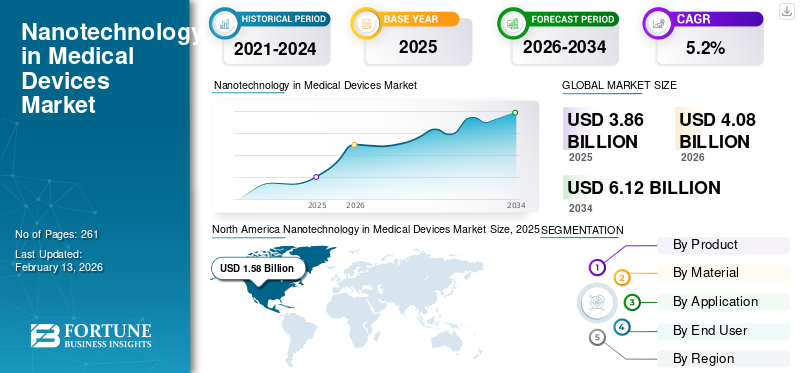
The global nanotechnology in medical devices market size was valued at USD 3.86 billion in 2025 and is projected to grow from USD 4.08 billion in 2026 to USD 6.12 billion by 2034, exhibiting a CAGR of 5.2% during the forecast period. North America dominated the global nanotechnology in medical devices market with a market share of 40.93% in 2025.
Nanotechnology in medical devices includes sensing elements, coatings, and cover materials developed at the nanoscale to improve the functioning of devices on the body. Increasing prevalence of chronic diseases, growing technological advancements, and expansion of healthcare infrastructure are resulting in the growing development of these nanosized products in the market.
- For instance, according to the 2024 data published by the Centers for Disease Control and Prevention (CDC), about 1 in 20 adults aged 20 and older has coronary artery disease in the U.S.
Furthermore, the growing integration collaborations among the major players, such as Medtronic and Abbott, among others, are further contributing to the demand of these devices in the market.
Download Free sample to learn more about this report.
Nanotechnology in Medical Devices Market Takeaways
 Global Market Size & Forecast
- 2025 Market Size: USD 3.86 billion
- 2026 Market Size: USD 4.08 billion
- 2034 Forecast Market Size: USD 6.12 billion
- CAGR: 5.2% from 2026–2034
 Market Share
- North America dominated the market with a 40.93% share in 2025.
- The Implantable Devices segment accounted for the largest market share in 2025.
- The Hospitals & ASCs segment is projected to hold a 56.6% share in 2026.
 Key Regional Highlights
North America
North America remained the leading region, generating USD 1.58 billion in 2025, supported by advanced healthcare infrastructure and rapid adoption of nanotechnology-enabled devices.
Europe
Europe is projected to reach USD 1.26 billion in 2026, expanding at a 4.5% CAGR due to increasing investments in medical innovation and healthcare technologies.
Asia Pacific
Asia Pacific is expected to reach USD 0.80 billion in 2026, driven by manufacturing expansion and rising adoption of advanced medical devices in China and India.
U.S.
The U.S. market is projected to reach USD 1.51 billion in 2026, supported by strong R&D activity, favorable regulatory approvals, and growing demand for implantable medical devices.
Japan
Japan's market is estimated at USD 0.18 billion in 2026, driven by increasing chronic disease prevalence and continued investments in nanotechnology-based medical device research and development.
Read More

Nanotechnology in Medical Devices Market Trends
Shift Towards Surface Nanomodification for Improved Device Performance
There is an increasing focus on using surface nanomodification in medical devices in the market, which enhances the product efficiency. The key players are emphasizing the application of surface treatments and nanoscale coatings to improve biocompatibility and enhance long-term performance.
This method enables players to upgrade installed devices while reducing regulatory risk compared to introducing entirely new systems. Nanostructured coatings have also shown results in minimizing bacterial adhesion and enhancing hemocompatibility, especially in cardiovascular and implantable products.
- In January 2026, Curiteva, Inc., a technology-driven manufacturing company, received 510(k) clearance from the FDA for a nanotechnology designation for its Inspire 3D Printed Trabecular PEEK family of implants, featuring proprietary HAFUSE Surface Technology.
Download Free sample to learn more about this report.
Market Dynamics
Market Drivers
Growing Demand for Advanced Nanosized Devices for Minimally Invasive Procedures to Fuel Market Growth
The rising demand for catheter-based procedures and minimally invasive procedures is a prominent driver fueling the market. Nanotechnology improves product miniaturization while maintaining its functional performance and structural integrity, which is crucial for complex procedures, including transcatheter cardiac procedures.
- For instance, in July 2024, according to the article published by Nature Nanotechnology, researchers at Karolinska Institutet have developed nanorobots that kill cancer cells in mice. The robot’s weapon is hidden in a nanostructure and is exposed only in the tumour microenvironment, sparing healthy cells.
Devices integrating nanostructured surfaces have shown reduced thrombogenicity, enhanced endothelialization, and improved long-term durability. Therefore, the factors above, coupled with the growing focus of key players on introducing research and development initiatives to launch innovative nanosized products, are anticipated to drive the penetration rate of these devices, thereby contributing to the global market size.
Other Prominent Drivers
- Increasing R&D and public funding for nano-bio interfaces and biosensors.
- Commercialisation focus through collaborations between large medtech and nanotech specialists.
- Regulatory advances and guidance shaping translation pathways for nano-enabled devices.
Market Restraints
High Developmental Cost and Regulatory Complexity to Hamper the Market Growth
Despite its significant potential, the integration of nanotechnology in medical devices faces certain restraints, related to its development costs and stringent regulatory policies. The incorporation of nanomaterials into these devices requires advanced manufacturing facilities, specialized testing, and extensive validation to ensure efficacy and safety.
These requirements increase the research and development expenses, especially for interventional and implantable products. Regulatory authorities often demand additional preclinical and clinical evidence for nano-enabled products owing to concerns related to long-term toxicity, nanoparticle migration, and biological interactions at the cellular level. Therefore, all the above factors are limiting the adoption and thereby hampering the nanotechnology in medical devices market growth globally.
- For instance, according to various articles, it was reported that regulatory and cost-related restraints remain significant for nano-enabled medical products, as regulatory approval timelines for high-risk implantable devices range from 3 to 7 years, with the total development and clinical validation costs often exceeding USD 100–300 million for a single product.
Market Opportunities
Increasing Demand for Personalized Medicine to Create Lucrative Growth Opportunities
The increasing demand for personalized medicine presents a lucrative growth opportunity for nanotechnology in medical products. There is a shift toward personalized patient care plans, resulting in growing demand for nano-enabled platforms that integrate diagnostics, sensing, and targeted therapy.
Nanotechnology enriches this paradigm by enabling devices that cater to individual patient biology, including nano-coated implants that precisely interact with targeted tissues and nanoscale biosensors that monitor biomarkers in real time, which minimizes adverse reactions among the patient population. In wearable health technology products, nano-sensors enable continuous monitoring of biochemical markers and vital signs, further enabling proactive disease management beyond traditional clinical environments.
- According to a 2021 survey published by EnsembleIQ, 85% of respondents said they believe personalized medicine can enhance care delivery.
Market Challenges
Safety Concerns and Scaling Manufacturing to Limit the Market Growth
A crucial challenge in the nanotechnology in the medical devices market growth lies in ensuring the scaling up manufacturing processes and their safety. Nanomaterials often exhibit unique biological interactions that necessitate comprehensive safety evaluations, such as long-term biocompatibility and environmental impact assessments.
These evaluations require multidisciplinary research and extended clinical studies to satisfy regulatory approval, which further slows innovation cycles. Moreover, increasing production of nanoscale materials with improved quality becomes technically challenging, even the small variances at the nanoscale can alter device performance or safety profiles.
- For instance, according to various studies, scaling commercial production of nanotechnology enabled devices remains challenging, as there is an observed 15–30% yield loss during scaling-up of nanomaterials, driven by inconsistencies in particle size, surface properties, and aggregation.
Other Prominent Challenges
- Regulatory complexity and limited precedent for many nano-enabled devices.
- Demonstrating safety/biocompatibility and long-term behaviour of nanomaterials in vivo.
SEGMENTATION ANALYSIS
By Product
Increasing Product Launches Led to the Implantable Devices Segment’s Dominance
Based on the product, the market is classified into implantable devices, interventional & surgical devices, diagnostics & monitoring devices, and others.
The implantable devices segment held the largest revenue share in 2025. The growth is due to the increasing prevalence of chronic conditions, resulting in a growing demand for implantable devices. This, along with the rising focus of key players on launching innovative nanotechnology products, is further expected to contribute to the global market growth.
- For instance, Xēnix Medical received 510(k) clearance from the U.S. Food and Drug Administration (FDA) for nanotechnology designation of its neoWave line of interbody fusion implants featuring proprietary NANOACTIV surface technology.
The diagnostics & monitoring devices segment is expected to grow at a CAGR of 6.0% over the forecast period.
To know how our report can help streamline your business, Speak to Analyst
By Material
Increasing Product Launches Boosts the Dominant Positioning of the Metal/Metal-oxide Segment
Based on material, the market is segmented into metal/metal-oxide, carbon-based, and others.
The metal/metal-oxide segment dominated the global market in 2025, accounting for 47.0%. The growth is due to the increasing benefits of metal and metal oxide, such as antimicrobial properties and others, resulting in a growing number of product launches, thereby supporting the adoption rate of these devices in the market.
- For instance, in October 2021, SkyWater Technology, partnered with NanoDx, Inc., a privately held medical device company developing breakthrough, point-of-care diagnostic solutions, announced technology transfer for qualification and production ramp of nanoscale sensors to enhance and expand accurate, rapid testing for several indications, including COVID-19, traumatic brain injury (TBI), sepsis, and stroke.
The segment of carbon-based is set to flourish with a growth rate of 6.3% across the forecast period.
By Application
Increasing Number of Chronic Conditions Propels the Therapeutic Applications’ Leadership
Based on application, the market is segmented into therapeutic applications, diagnostic applications, and research applications.
The therapeutic applications segment accounted for the largest share of the global market in 2025, accounting for 60.1%. The growth is due to the increasing prevalence of chronic disorders such as cardiovascular diseases, and others, resulting in rising demand for nano-enabled drug-eluting devices, implants, and localized therapy platforms.For instance, according to the 2024 statistics published by the Centers for Disease Control & Prevention (CDC), it was reported that about 805,000 people have a heart attack in the U.S.
The segment of diagnostic applications is set to flourish with a growth rate of 5.6% across the forecast period.
By End-user
Increasing Number of Hospitals & ASCs Steered Its Leadership in the End User Segment
Based on end user, the market is divided into hospitals & ASCs, specialty clinics, clinical laboratories, and others.
The hospitals & ASCs segment dominated the market in 2025. The increasing prevalence of chronic diseases, the growing number of hospitals, among others, are some of the vital factors supporting the growth of the segment in the market. Furthermore, the segment is set to hold a 56.6% share in 2026.
- For instance, according to 2025 statistics published by Statistisches Bundesamt, it was reported that there are about 1,874 hospitals in Germany.
In addition, specialty clinics’ end users are projected to grow at a 5.4% CAGR during the forecast period.
Nanotechnology in Medical Devices Market Regional Outlook
Based on region, the market has been studied across North America, Europe, Asia Pacific, Latin America, and the Middle East & Africa.
North America
North America Nanotechnology in Medical Devices Market Size, 2025 (USD Billion)
To get more information on the regional analysis of this market, Download Free sample
The North America market held the dominant nanotechnology in medical devices market share in 2024, valued at USD 1.49 billion, and also took the leading share in 2025 with USD 1.58 billion. The growing prevalence of chronic diseases, presence of largest R&D base, regulatory activity (FDA), commercial adoption, among others, are some of the factors supporting the regional market growth.
U.S. Nanotechnology in Medical Devices Market
Based on North America’s strong contribution and the U.S. dominance within the region, the U.S. market can be analytically approximated at around USD 1.51 billion in 2026, accounting for roughly 37.0% of global market sales. For instance, according to 2024 data published by the Centers for Disease Control & Prevention (CDC), the prevalence of Inflammatory Bowel Disease (IBD) is estimated between 2.4 and 3.1 million among patients in the U.S.
Europe
Europe is projected to record a growth rate of 4.5% in the coming years, which is the second highest among all regions, and reach a valuation of USD 1.26 billion by 2026. The strong research ecosystem and regulatory frameworks (EMA), active nano-programmes, and others are some of the factors supporting the regional market growth.
U.K Nanotechnology in Medical Devices Market
The U.K. market in 2026 is estimated at around USD 0.24 billion, representing roughly 5.8% of global market revenues.
Germany Nanotechnology in Medical Devices Market
Germany’s market is projected to reach approximately USD 0.26 billion in 2026, equivalent to around 6.4% of global market sales.
Asia Pacific
Asia Pacific is estimated to reach USD 0.80 billion in 2026 and secure the position of the third-largest region in the market. The rapid manufacturing scale-up and increasing adoption in China & India are likely to support the growth of the market in the region. India and China are both estimated to reach USD 0.13 billion and USD 0.29 billion, respectively, in 2026.
Japan Nanotechnology in Medical Devices Market
The Japan market in 2026 is estimated at around USD 0.18 billion, accounting for roughly 4.5% of global revenues. Japan has historically reported a relatively growing prevalence of chronic diseases, with a strong focus on R&D activities among the key players.
China Nanotechnology in Medical Devices Market
China’s market is projected to be one of the largest globally, with 2026 revenues estimated at around USD 0.29 billion, representing roughly 7.0% of global sales.
India Nanotechnology in Medical Devices Market
The India market size in 2026 is estimated at around USD 0.13 billion, accounting for roughly 3.1% of global revenues.
Latin America and the Middle East & Africa
The Latin America and Middle East & Africa regions are expected to witness moderate growth in this market space during the forecast period. The Latin America market is set to reach a valuation of USD 0.20 billion in 2026. The growth is due to the gradually increasing demand for nanosized medical devices for various applications in these regions. In the Middle East & Africa, the GCC is set to reach USD 0.08 billion in 2026.
South Africa Nanotechnology in Medical Devices Market
The South Africa market is projected to reach around USD 0.03 billion in 2026, representing roughly 0.8% of global revenues.
Competitive Landscape
Key Industry Players
Increasing Acquisitions and Mergers Among the Key Players is Support Their Positions in the Market
Medtronic and Abbott are major companies in the market in 2025. A significant product portfolio, along with a significant focus on strategic initiatives globally, are some of the vital factors supporting the dominance of these companies in the market. Furthermore, the increasing focus of some of the other prominent companies on acquisitions and mergers among the key players is likely to strengthen their presence and further support their share in the nanotechnology in medical devices market.
- For instance, in February 2025, Medtronic acquired nano surface technology and certain IP rights from Nanovis for interbody fusion systems with an aim to strengthen its presence.
Other key players, including Stryker and others, are also growing in the market, primarily due to their increasing focus on R&D activities to strengthen their presence in the market.
List of Key Nanotechnology in Medical Devices Companies Profiled
- Medtronic (U.S.)
- Stryker (U.S.)
- Abbott (U.S.)
- 3M (U.S.)
- Smith+Nephew (U.K.)
- Zimmer Biomet (U.S.)
- Starkey Laboratories, Inc. (U.S.)
- Microtrac Retsch GmbH (Germany)
- Boston Scientific Corporation (U.S.)
- Cochlear Ltd. (Australia)
KEY INDUSTRY DEVELOPMENTS:
- November 2025: NANO-X IMAGING LTD, an innovative medical imaging technology company, announced that it will showcase its Nanox.ARC X multi-source digital tomosynthesis system and highlight the development of new solutions for its AI portfolio at the Radiological Society of North America (RSNA) 2025.
- October 2025: LMU researchers have developed tiny robots out of folded DNA molecules, which can act depending on various environmental stimuli such as light or enzymes.
- May 2025: Nanoscience Instruments and Xplore Instruments BV announce strategic partnership for distribution of polymer micro compounding equipment in the U.S.
- May 2025: SenseAI, the compressed sensing software transforming the way electron microscopy images are captured and will announce a new exclusive distribution agreement with Nanoscience Instruments who are leaders in microscopy and surface science instrumentation.
- January 2024: Nanowear secured USDA FDA 510(k) clearance for SimpleSense-BP, a cuffless, continuous blood pressure monitor built on nanosensor technology that integrates AI-based diagnostics and expands wearable utility.
- January 2024: Nanowear, a healthcare-at-home remote diagnostics, announced that its nanotechnology-enabled wearable and software platform, SimpleSenseTM, has received FDA 510(k) clearance for a novel AI-enabled Software-as-a-Medical Device (SaMD).
- November 2020: Nanowear, the leading connected-care and remote diagnostic platform, today announced it has received FDA Class II 510(k) clearance for a first-of-its-kind cloth-based diagnostic platform, SimpleSENSE.
REPORT COVERAGE
The report provides a detailed global nanotechnology in medical devices market analysis and focuses on key aspects such as leading companies and market segmentation, including product, material, application, and end user. Besides this, the global report offers insights into the market growth trends and highlights key industry developments. In addition to the aforementioned factors, the report encompasses several factors that have contributed to the growth and advancement of the market over recent years.
Request for Customization to gain extensive market insights.
Report Scope & Segmentation
|
ATTRIBUTE |
DETAILS |
|
Study Period |
2021-2034 |
|
Base Year |
2025 |
|
Estimated Year |
2026 |
|
Forecast Period |
2026-2034 |
|
Historical Period |
2021-2024 |
|
Growth Rate |
CAGR of 5.2% from 2026-2034 |
|
Unit |
Value (USD Billion) |
|
Segmentation |
By Product, Material, Application, End User, and Region |
|
By Product |
· Implantable Devices · Interventional & Surgical Devices · Diagnostics & Monitoring Devices · Others |
|
By Material |
· Metal/metal oxide · Carbon-based · Others |
|
By Application |
· Therapeutic Applications · Diagnostic Applications · Research Applications |
|
By End User |
· Hospitals & ASCs · Specialty Clinics · Clinical Laboratories · Others |
|
By Region |
· North America (By Product, By Material, By Application, By End User, and by Country) o U.S. (By Application) o Canada (By Application) · Europe (By Product, By Material, By Application, By End User, and by Country/Sub-region) o U.K. (By Application) o Germany (By Application) o France (By Application) o Italy (By Application) o Spain (By Application) o Scandinavia (By Application) o Rest of Europe (By Application) · Asia Pacific (By Product, By Material, By Application, By End User, and by Country/Sub-region) o China (By Application) o Japan (By Application) o India (By Application) o Australia (By Application) o Southeast Asia (By Application) o Rest of Asia Pacific (By Application) · Latin America (By Product, By Material, By Application, By End User, and by Country/Sub-region) o Brazil (By Application) o Mexico (By Application) o Rest of Latin America (By Application) · Middle East & Africa (By Product, By Material, By Application, By End User, and by Country/Sub-region) o GCC (By Application) o South Africa (By Application) o Rest of the Middle East & Africa (By Application) |
Frequently Asked Questions
Fortune Business Insights says that the global market size was USD 3.86 billion in 2025 and is projected to reach USD 6.12 billion by 2032.
In 2025, the North America regional market value stood at USD 1.58 billion.
Growing at a CAGR of 5.2%, the market will exhibit steady growth over the forecast period.
By product, the implantable devices segment is the leading segment in this market.
The integration of nanotechnology in medical devices is one of the major factors driving the market growth.
Medtonic and Abbott are the major players in the global market.
North America dominated the market share in 2025.
The growing prevalence of chronic conditions, the growing R&D activities, among others, are some of the vital factors expected to boost the adoption of these products globally.



- 2021-2034
- 2025
- 2021-2024
- 261
Get 30-60 hrs Free Customization
Expand Regional and Country Coverage, Segments Analysis, Company Profiles, Competitive Benchmarking, and End-user Insights.













.webp)






Related Reports
-
US +1 833 909 2966 ( Toll Free )
-
Get In Touch With Us