Genomics Market Size, Share & Industry Analysis, By Type (Products (Instruments & Software and Consumables) and Services), By Technology (Polymerase Chain Reaction (PCR), Next Generation Sequencing (NGS), Microarray, Sanger Sequencing, and Others), By Application (Diagnostics, Research, and Others), By End User (Research Institutes, Healthcare Facilities & Diagnostic Centers, Pharmaceutical & Biotechnological Companies, Contract Research Organization (CROs)), and Regional Forecast, 2026-2034
 Download Free Sample
KEY MARKET INSIGHTS
 Listen to Audio Version
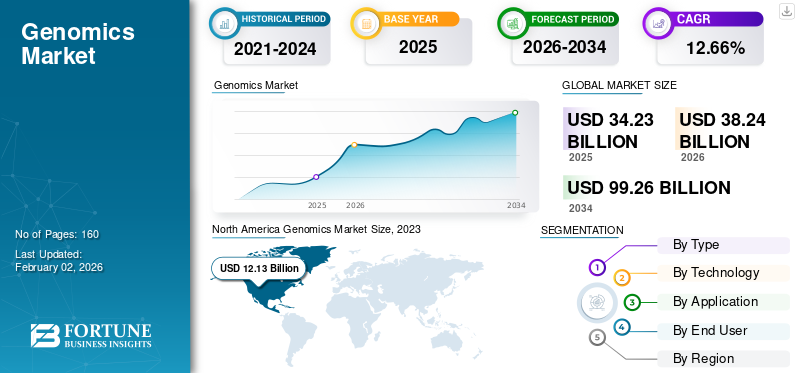
The global genomics market was valued at USD 34.23 billion in 2025 and is projected to grow from USD 38.24 billion in 2026 to USD 99.26 billion by 2034, exhibiting a CAGR of 12.66% during the forecast period. North America dominated the genomics market with a market share of 43.04% in 2025.
Genomics has scientifically proven its ability to prevent, manage, and treat diseases. Over the last few years, the healthcare environment has gradually shifted from conventional treatment methods to precision medicine, with exceptional clinical properties driving this transition forward.
Whole genome sequencing has emerged as a useful tool for the diagnosis of critical diseases such as cancer. For example, as per National Cancer Institute, by 2040, it is anticipated that the number of new cancer cases will increase by 29.5 million, and the number of cancer-related deaths to 16.4 million per year. The need for storage, sequencing, and analysis of large DNA information has paved the way for newer products and software. The aforementioned factors have significantly contributed to driving the market in recent years.
The market's growth opportunities are expected to expand as genomics become more widely accepted and applied in agricultural biotechnology and environmental sciences. Innovations like genomic-assisted breeding and environmental genomics are gaining popularity.
In addition, several start-ups and service providers are emerging, offering direct-to-consumer (DTC) sequencing, ancestry, and other services. For example, in May 2021, NGeneBio, a South Korean telecommunications company, partnered with Direct-to-Consumer genetic testing companies. This collaboration was designed to deliver test results to consumers' mobile devices. Furthermore, increased research spending and bioinformatics advancements will boost genomics growth in the coming years.
Download Free sample to learn more about this report.
Genomics Market KEY TAKEAWAYS
 Global Market Size & Forecast
- 2025 Market Size: USD 34.23 Billion
- 2026 Market Size: USD 38.24 Billion
- 2034 Forecast Market Size: USD 99.26 Billion
- CAGR: 12.66% from 2026–2034
 Market Share
- North America accounted for 43.04% market share in 2025.
- PCR accounted for 47.25% market share in 2026.
- Diagnostics accounted for 50.42% market share in 2026.
 Key Regional Highlights
Asia Pacific
Asia Pacific reached USD 7.09 billion in 2025 and is projected to reach USD 8.07 billion in 2026, driven by genetic testing and sequencing growth.
North America
North America reached USD 14.73 billion in 2025 and is projected to reach USD 16.33 billion in 2026, supported by personalized medicine adoption.
Europe
Europe reached USD 9.45 billion in 2025 and is projected to reach USD 10.6 billion in 2026, driven by genomic research investments.
U.S.
The U.S. market growth is supported by government funding and advancements in genomic sequencing technologies.
Japan
The Japan market is witnessing growth due to increasing adoption of genomic diagnostics and precision medicine.
Read More

Covid-19 Analysis
The COVID-19 pandemic has accelerated research and investment efforts to develop an effective vaccine or novel treatment for COVID-19. Monitoring the coronavirus genome sequence can help track how the infection spreads and affects the human genome. This data can then be used to create an effective treatment for the infection. Researchers are using virus genome data to track the origins of COVID-19 infection in their respective countries, as well as the onset of community transmission.
The effort to study the genetic structure of coronavirus has increased dramatically. Several countries, including China, the United States, Vietnam, and Nepal, had shared the entire genome sequence data obtained from the patients. This will enable researchers all over the world to study various aspects of the coronavirus, including its origin and drug development. Genome Canada announced the Canadian COVID-19 Genomics Network (CanCOGeN) in April 2020, with a USD 40 million funding commitment. The initiative includes a collaboration between Genome Canada and six regional Genome Centres to expand existing genome-based COVID-19 research in Canada and around the world.
Furthermore, the growing number of genomics-based research activities aimed at developing effective medications to treat COVID-19 infection has provided new opportunities for several start-ups and established businesses. As a result, increased government funding and a recent surge in research activities will drive up demand for genomics-based sequencing products, software, and services. For example, deCODE genetics conducted coronavirus demonic analysis and collaborated with the Icelandic government to sequence the genomes of COVID-19 patient samples. Similarly, HaystackAnalytics, a start-up company, was using genomics to study virus transmission and assist the Government of India. The market is expected to grow steadily between 2024 and 2032.
Genomics Market Trends
Technological Advancements in the Field of Genomics to Advance Market Growth
The massive potential of genome sequencing has resulted in a surge of start-ups in recent years. Several companies have begun to provide sequencing services for a wide range of genomics applications, including nutrition, ancestry, genetic diseases, and others. Furthermore, these companies are focusing on the development of advanced tools, such as NGS solutions for high-throughput and low-cost sequencing. Along with this, investments from the government and operating companies bolster this trend. The National Institutes of Health (NIH) is a leading organization that provides funding to start-ups.
23andMe is one such company, which has registered notable growth. Increasing funding in a start-up business is expected to foster market growth. For example, in July 2020, Genome Medical, a startup that provides telehealth genetic consultations, raised a US$ 14 million extensions for its US$ 23 million series B round. It plans to use the funds to expand its telehealth platform and clinical operations. It starts with an initial consultation to see if the individual would benefit from genetic testing and what tests would be most suitable.
The rise of CRISPR-based technologies is another significant trend driving market growth. CRISPR gene-editing techniques allow for more precise genetic modifications, and they are increasingly being used in research to better understand genetic disorders, potential treatments, and disease prevention. The use of CRISPR in precision medicine, particularly for genetic diseases, is expected to drive up demand for genomics services.
Download Free sample to learn more about this report.
Genomics Market Growth Factors
Rising Number of Government-aided Genome Projects to Aid Growth
The increasing number of government-funded genome projects is one of the key factors driving market growth. Genomic research is an important tool for the development of effective therapies, which is why several government agencies are investing in genome projects. For example, in January 2020, the Department of Biotechnology (DBT), Union Ministry of Science and Technology, India, launched the Genome India Project (GIP). The goal was to map 10,000 genetic samples from Indian citizens to create a reference genome. In February 2024, the Indian government announced that this project was completed successfully. Similarly, Genomics England partnered with the NHS to establish the Genomic Medicine Service, which integrated whole genome sequencing into routine medical care.
Similarly, there are several projects, including The Saudi Human Genome Program, Personalized Medicine Program, France Génomique, and others. For example, according to the Press Information Bureau, in March 2020, the Department of Biotechnology (DBT) approved a three-year project to catalogue genetic variation in Indians at 20 institutions across the country. This project's proposed target is 10,000 individuals representing the country's diverse population over three years.
The data generated from whole genome sequencing can accelerate forthcoming human genetics research in the country with better precision, and to design a genome wide association array for the Indian population to develop precision healthcare and diagnostics for major diseases at reasonable costs. This will emerge in favor of market growth during the forecast period.
Collaborations between private companies and government agencies to facilitate global genomic data exchange will boost the market's research capacity and innovation potential, accelerating the path to precision medicine.
New Products and Innovative Services to Favor Adoption of Genomic Sequencing
The shift towards personalized medicines and decreasing costs of sequencing owing to the introduction of NGS technology, have yielded several new products and services. The market is gradually becoming more competitive with new players entering the market, and hence the companies are introducing advanced products and services to consolidate their position. The exponentially growing demand, coupled with increasing competition, has led to the launch of innovative products & services, such as direct-to-consumer products. The Product segment will account for 71.53% market share in 2026.
For example, in June 2022, PerkinElmer announced the release of the BioQule NGS System, an automated benchtop system for NGS research. Similarly, in July 2020, Illumina announced the release of the TruSight Software Suite, which includes ready-to-use infrastructure for whole genome sequencing that can be used to detect genetic diseases. This is expected to boost market growth.
The growing trend of combining AI and ML with genomic data analytics is improving data interpretation and predictive accuracy. These technologies allow for faster and more efficient analysis of complex genomic data, which is critical for progress in personalized medicine and disease management. Pharmaceutical companies are increasingly using AI-powered genomics platforms for drug discovery and precision medicine.
RESTRAINING FACTORS
Lack of Trained Technicians Pose a Major Hindrance to Market Growth
Despite the enormous potential, a shortage of trained technicians is a major impediment to market growth in developing countries. Many emerging nations either have fewer technicians or lack the skill set required to use sophisticated sequencers. Aside from that, the high cost of instruments is another factor impeding market growth.
Aside from that, the challenges associated with the secure storage of large amounts of generated data are another source of concern, limiting market growth to some extent. Various genome projects generate large amounts of data. Many research institutes and biopharmaceutical companies find it prohibitively expensive. Thus, concerns about the secure storage of this data are impeding market growth.
Additionally, the stringent regulatory framework to develop new products is limiting the market growth. With the continuous rise in COVID-19 infections globally, the demand for improved, safer, and earlier detection instruments to deliver successful treatment to patients has created havoc in the market, however, manufacturers have to pass stringent regulatory restrictions to launch new products.
For example, every country has its own regulatory authority applying different regulations and guidelines for manufacturers. To make sure the safety of products, the Centers for Disease Control and Prevention (CDC), the U.S Food and Drug Administration (FDA), and other regulatory bodies have restructured their guidelines.
Genomics Market Segmentation Analysis
By Type Analysis
Launch of New Software and Automated Sequencer to Foster the Products Segment
Based on type, the market is segmented into products and services.
The products segment is further categorized into instruments & software and consumables. The product segment is estimated to dominate the market throughout the forecast period of 2024-2032. The factors that can be attributed to the growth of this segment are the high volume demand and usage of consumables, as well as the introduction of several new products in recent years. The increasing need for new platforms to analyze the huge amount of genetic information has resulted in the launch of new software and fully automated products.
10x Genomics, Inc. unveiled a slew of new products and technology demonstrations at the Advances in Genome Biology and Technology (AGBT) General Meeting in early 2024, highlighting its most recent advances in single-cell and spatial biology. This demonstrates the growing emphasis on increasing sequencing precision and throughput, making sequencing more accessible and affordable to researchers worldwide.
However, the services sector is expected to expand rapidly in the near future. This can be attributed to an increase in the number of service providers, as well as the availability of cost-effective innovative services. Furthermore, the proliferation of cloud-based genomics platforms that enable collaboration and data storage will drive up demand for sequencing services.
To know how our report can help streamline your business, Speak to Analyst
By Technology Analysis
NGS Segment to Witness Considerable Growth Owing to Rising R&D Activities
Based on technology, the market is bifurcated into polymerase chain reaction, next-generation sequencing, microarray, Sanger sequencing, and others.
The PCR segment segment will account for 47.25% market share in 2026, owing to its widespread use and availability around the world. The NGS segment is expected to grow significantly due to an increase in government projects and funding for understanding and developing COVID-19 treatments. The increasing use of NGS in diagnostics, particularly in oncology and rare genetic disorders, is expected to boost its adoption in clinical settings. The microarray and Sanger sequencing segments are expected to grow as these sequencing technologies are increasingly used for disease diagnosis, as well as the growing number of genome projects in countries such as the United Kingdom, the United States, India, and others.
By Application Analysis
Rising Demand for Whole Genome Sequencing to Propel Growth of Research Segment
Based on application, the market is segmented into diagnostics, research and others.
The diagnostics segment will account for 50.42% market share in 2026. Emergence of direct-to-consumer genetic testing and the use of NGS technology for clinical diagnostics are factors contributing to the expansion of the diagnostic segment. Furthermore, the increasing number of nutrigenomics services providers that provide diet plans for disease conditions based on the unique genes of the patients is propelling the diagnostics segment growth.
Whole genome sequencing is being investigated for the treatment of a variety of diseases. Currently, many countries are contributing to COVID-19 data through whole genome analysis of patients. This is critical not only for researching disease variants, but also for developing personalized treatment strategies, particularly in oncology and precision medicine. The rising prevalence of chronic diseases, combined with the decreasing cost of sequencing, are expected to accelerate the growth of the other segment.
By End User Analysis
Increasing Research Funding by Government to Drive Research Institutes Segment
In terms of end user, the market is bifurcated into research institutes, healthcare facilities & diagnostic centers, pharmaceutical & biotechnological companies, and contract research organizations. The Research Institutes segment will account for 39.32% market share in 2026.
The government's increased research funding and strong support are likely to propel the research institutes segment. The emergence of public-private partnerships in genomics research, particularly in the development of advanced genomic therapies and precision diagnostics, is expected to accelerate the pace of research and innovation in this field.
The rapid application of genome analysis for disease treatment and early detection is expected to drive growth in the healthcare facilities and diagnostic centers segment. Pharmaceutical giants' increased R&D investment in developing novel gene therapies to treat cancer and immunological diseases is likely to benefit pharmaceutical and biotech companies, as well as contract research organizations. Furthermore, the increased focus on biologics and gene therapies in clinical trials, combined with regulatory support in key markets, will significantly boost the pharmaceutical and biotechnology segments.
REGIONAL INSIGHTS
North America
North America Genomics Market Size, 2025 (USD Billion)
To get more information on the regional analysis of this market, Download Free sample
The market in North America reached USD 14.73 billion in 2025, representing 43.04% of total market revenue, and is projected to reach USD 16.33 billion in 2026. The rapid adoption of new sequencing technologies and shift towards personalized medicines are expected to render a leading position to North America. Additionally, government support is playing a pivotal role. For example, In April 2021, Biden Administration made an announcement of the USD 1.7 billion investment to Fight COVID-19 Variants of which USD 1 billion investment is for the expansion of genomic sequencing and USD 400 million to back the innovation initiatives including the launch of new innovative centers of excellence in genomic epidemiology. This is further anticipated to boost the growth of the market in North America.
Active government support through research funding, genomic analysis, and research and academic institutes, particularly in the United Kingdom and England, is expected to favor market expansion in Europe. Furthermore, Europe is positioning itself as a center for genomics innovation, with countries such as Germany and France increasing their investments in genomic medicine and diagnostics.
Europe
Europe contributed approximately USD 9.45 billion to the global market in 2025, accounting for 27.60% share, and is expected to reach USD 10.6 billion in 2026.
Asia Pacific
In 2025, the Asia Pacific market stood at USD 7.09 billion, representing 20.70% of global demand, and is projected to grow to USD 8.07 billion in 2026. Asia Pacific is expected to have the highest CAGR over the forecast period, owing to increased demand for genetic sequencing and testing in China and advances in bioinformatics. Furthermore, the increasing prevalence of drug development for rare diseases, as well as technological advancements such as next-generation sequencing and companion diagnostics in this field, are accelerating market growth. This region's growth is aided by China and India's rapidly expanding biotechnology sectors, which are investing heavily in genomic research and applications for both domestic and global markets.
Middle East & Africa
Middle East & Africa maintained a strong presence in the global market, reaching USD 1.14 billion in 2025, accounting for 3.32% share, and is expected to reach USD 1.24 billion in 2026. Middle East, and Africa is expected to grow significantly due to active government support and improved healthcare scenarios. Increased government focus on expanding genetic testing capabilities in the Middle East, particularly in the UAE and Saudi Arabia, will drive market growth in this region.
Latin America
The Latin America market accounted for USD 1.82 billion in 2025, representing 5.33% of the global industry, and is expected to reach USD 2 billion in 2026.
List of Key Companies in Genomics Market
Recent Acquisition of Pacific Biosciences to Strengthen Market Position of Illumina, Inc.
Illumina, Inc. dominated the market due to its diverse product portfolio, strong geographic presence, competitive landscape, and prominent position in sequencing services. In August 2021, Illumina, Inc., a global leader in DNA sequencing, announced the acquisition of GRAIL, a healthcare company dedicated to the early detection of multiple cancers. This acquisition will help by making the test available to as many people as possible. The first COVID-19 viral sequence was generated on an Illumina machine, and genomic surveillance has evolved into an essential tool in the global fight against the pandemic. Furthermore, Illumina's increased use of AI technologies in genomic analysis is expected to improve diagnostic accuracy and accelerate the market's growth.
Thermo Fisher Scientific Inc. held the second most prominent position in the market. The COVID-19 pandemic is expected to increase demand for the company's sequencers and consumables, resulting in profitable growth. Thermo Fisher's commitment to expanding its reach through acquisitions, such as the purchase of Qiagen in 2021, will strengthen its presence across multiple genomics applications, positioning it as a formidable player in this growing market.
LIST OF KEY COMPANIES PROFILED:
- Illumina, Inc. (U.S.)
- Thermo Fisher Scientific Inc. (U.S.)
- F. Hoffmann-La Roche Ltd. (Switzerland)
- Agilent Technologies, Inc. (U.S.)
- Oxford Nanopore Technologies (U.K.)
- Danaher (U.S.)
- QIAGEN (Germany)
- BGI (China)
- IntegraGen (France)
- General Electric Company (U.S.)
KEY INDUSTRY DEVELOPMENTS:
- January 2024 – Gencove and Ferris Genomics announced the collaboration for end-to-end genomics sequencing services.
- November 2023 – MedGenome and PacBio announced a grant for the De Novo Genome Assembly and Annotation.
- December 2022 – The U.K. government announced an investment of USD 190 million for genomic research.
- January 2022 – Illumina Inc. and Nashville Biosciences, LLC collaborated to establish a preeminent clinico-genomic resource and drug development using genomics.
- February 2020 - Nebula Genomic launched a new product that will offer whole genome sequencing at USD 299 to its customers.
- July 2020 – Illumina, Inc. announced the launch of e TruSight Software Suite and provides ready-to use infrastructure for whole genome sequencing that can be used to identify genetic diseases.
- April 2020 – Eurofins announced the launch of its “SARS-CoV-2 Full-length Genome Sequencing” service, a new next generation sequencing (NGS) service enabling end-to-end surveillance of the coronavirus genome sequence and mutational drift.
REPORT COVERAGE
The global genomics market research report gives a comprehensive assessment of the global market by presenting valuable insights, facts, industry-related information, and historical data. Numerous methodologies and approaches are implemented to make significant conventions and prospects. Moreover, the report offers a detailed analysis and information as per market segments, helping our readers to get a comprehensive overview of the global market. In addition to this, the report also provides various key insights such as the overview of genomic projects for key countries, overview of service providers, new product launch, regulatory scenario for key countries, start-ups with their funding overview, recent industry developments such as mergers & acquisitions and partnerships, and key industry trends.
Request for Customization to gain extensive market insights.
Report Scope & Segmentation
|
ATTRIBUTE |
DETAILS |
|
Study Period |
2021-2034 |
|
Base Year |
2025 |
|
Estimated Year |
2026 |
|
Forecast Period |
2026-2034 |
|
Historical Period |
2021-2024 |
|
Growth Rate |
CAGR of 12.66% from 2026-2034 |
|
Unit |
Value (USD billion) |
|
Segmentation |
By Type
|
|
By Technology
|
|
|
By Application
|
|
|
By End User
|
|
|
By Region
|
Frequently Asked Questions
The value of the global market was USD 34.23 billion in 2025.
Fortune Business Insights says that the market is projected to reach USD 99.26 billion by 2034.
The value of the market in North America was USD 14.73 billion in 2023.
The market is projected to rise at a CAGR of 12.66% during the forecast period (2026-2034).
The product segment is the leading segment in this market.
The rising number of government genome projects and new product launches are the key factors driving the global market.
Illumina, Inc. and Thermo Fisher Scientific Inc. are the top players in the global market.
North America is expected to hold the highest market share.
The increasing number of start-up businesses is the key trend of the market.



- 2021-2034
- 2025
- 2021-2024
- 160
Get 30-60 hrs Free Customization
Expand Regional and Country Coverage, Segments Analysis, Company Profiles, Competitive Benchmarking, and End-user Insights.













.webp)






Related Reports
-
US +1 833 909 2966 ( Toll Free )
-
Get In Touch With Us