Personalized Medicine Market Size, Share & Industry Analysis, By Offering (Diagnostics & Testing, Therapeutics, Software & Data Analytics, & Others), By Technology (Genomics & Molecular Testing, Pharmacogenomics, Biomarker-Based Profiling, Liquid Biopsy, Clinical Decision Support & Interpretation Software, & Others), By Application (Oncology, Rare & Genetic Diseases, Neurology, Cardiology, Infectious Diseases, & Others), By End User (Hospitals, Specialty Clinics, Diagnostic Labs, Academic & Research Institutes, Pharmaceutical & Biotech Companies, & Others), and Regional Forecast, 2026-2034
 Download Free Sample
Personalized Medicine Market Overview
 Listen to Audio Version
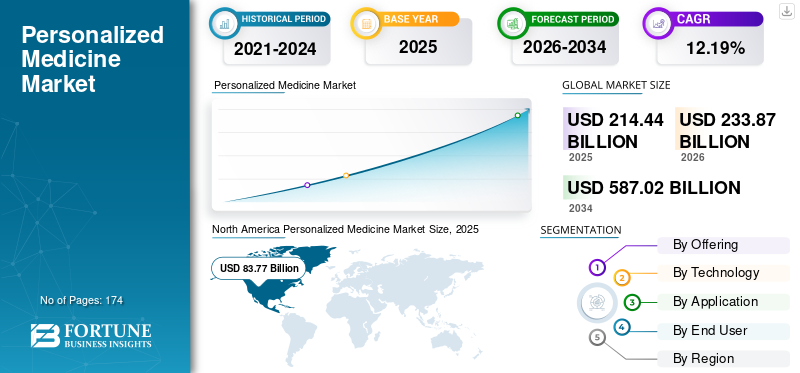
The global personalized medicine market size was valued at USD 214.44 billion in 2025 and is projected to grow from USD 233.87 billion in 2026 to USD 587.02 billion by 2034, exhibiting a CAGR of 12.19% during the forecast period. North America dominated the personalized medicine market with a market share of 39.11% in 2025.
Personalized medicine utilizes genomic, molecular, biomarker, and individual patient data to enhance disease identification, therapy choice, and treatment oversight. The market is growing as a result of the increasing implementation of companion diagnostics, wider acceptance of genomic and molecular testing, and heightened demand for biomarker-driven targeted therapies. Additional factors supporting industry expansion comprise the greater utilization of liquid biopsy in cancer treatment and enhanced integration of AI-driven clinical decision support and interpretation tools into care processes.
Major participants in the industry comprise F. Hoffmann-La Roche Ltd, Myriad Genetics, Inc., Thermo Fisher Scientific Inc., AstraZeneca, and others. These firms are concentrating on extensive genomic profiling, biomarker-driven testing, liquid biopsy, integrated clinical and molecular data platforms, pharmacogenomics, and interpretation software to facilitate therapy matching, precision oncology processes, and research-driven drug development.
Download Free sample to learn more about this report.
Personalized Medicine Market KEY TAKEAWAYS
 Market Size & Forecast
- 2025 Market Size: USD 214.44 billion
- 2026 Market Size: USD 233.87 billion
- 2034 Forecast Market Size: USD 587.02 billion
- CAGR: 12.19% from 2026–2034
 Market Share
- North America dominated the market with a 39.11% share in 2025.
- Software & data analytics segment is projected to grow at a CAGR of 15.82%.
- Liquid biopsy segment is projected to grow at a CAGR of 13.76%.
 Key Regional Highlights
North America
North America USD 83.77 billion in 2025. Advanced genomics infrastructure and strong adoption of biomarker-based testing and targeted therapies leading global market.
Europe
Europe Growth rate 10.54%. Government-backed genomics initiatives and integration of genomic data into healthcare systems supporting expansion.
Asia Pacific
Asia Pacific USD 62.05 billion in 2026. Rapid healthcare modernization, genomics investment, and strong policy support driving precision medicine growth.
U.S.
U.S. USD 83.56 billion in 2026. Strong precision medicine programs and high adoption of targeted therapies and genomic testing driving dominance.
Japan
Japan USD 12.71 billion in 2026. Expanding precision medicine adoption supported by sequencing capacity and healthcare modernization.
Read More

PERSONALIZED MEDICINE MARKET TRENDS
Increasing Adoption of Targeted Therapy is a Significant Trend Observed in the Global Market
The growing use of targeted therapy is a significant market trend as personalized medicine shifts from universal treatments to therapies tailored to particular biomarkers, mutations, or protein expression patterns. This enhances treatment outcomes, aids in optimal patient selection, and minimizes undue exposure to inefficient therapies. With the increasing availability of companion diagnostics and molecular profiling tests, doctors can more accurately identify qualifying patients, thereby broadening the commercial application of targeted therapies in oncology and other high-value areas. The trend is motivating biopharma firms to allocate more resources toward biomarker-driven drug development and label expansions, enhancing both the therapeutic and diagnostic aspects of the market. The growing adoption of targeted therapy enhances the significance of personalized medicinal practices by directly correlating testing with treatment selection and improved clinical results. These factors are supporting the global personalized medicine market growth.
- For instance, in May 2025, Roche announced that the VENTANA MET (SP44) RxDx Assay received the U.S. FDA approval as a companion diagnostic to identify patients with MET protein overexpression who may respond to a c-Met-targeted therapy in non-small cell lung cancer.
MARKET DYNAMICS
MARKET DRIVERS
Download Free sample to learn more about this report.
Increasing Prevalence of Chronic and Genetic Diseases to Drive Market Expansion
The rising incidence of chronic and genetic conditions is a significant market catalyst as it broadens the population of patients requiring earlier diagnosis, risk assessment, and more customized treatment options. Chronic illnesses such as cardiovascular diseases, cancer, diabetes, and chronic respiratory conditions continue to represent the primary global health burden, driving the need for biomarker testing, molecular diagnostics, and targeted treatments. Simultaneously, genetic and rare diseases are gaining greater commercial attention as enhanced genomic screening and sequencing allow for the identification of more patients. As these patient groups expand and diagnosis rates enhance, healthcare systems and drug developers are allocating additional resources to personalized medicine tools that can direct more accurate treatment pathways. This directly fosters increased demand for genomics, companion diagnostics, liquid biopsy, and interpretation software throughout the market. All these factors cumulatively drive the global market growth.
- For instance, according to data published by the National Institute of Health (NIH) in January 2025, rare diseases collectively affect an estimated 25–30 million Americans.
MARKET RESTRAINTS
High Cost of Treatment to Limit Market Growth
High cost of treatment is a major market restraint as many personalized therapies, especially targeted biologics, cell and gene therapies, and biomarker-linked oncology drugs, carry very high prices that can limit patient access and payer adoption. High treatment costs also make reimbursement negotiations more difficult and can slow uptake even when clinical outcomes are strong. In addition, personalized medicine often requires companion diagnostics, molecular profiling, and specialized care pathways, which further raise the total cost of treatment. OECD notes that rising costs of oncology medicines are straining even affluent health systems and making affordability a broad access challenge. As a result, hospitals, payers, and governments may delay or restrict use, which can reduce the pace of market expansion despite strong clinical demand. Overall, cost remains one of the biggest barriers to wider penetration of personalized medicine across both developed and emerging markets.
- For instance, in December 2025, Novartis AG announced that it reached an agreement with the U.S. government aimed at lowering drug prices in the U.S. and expanding direct-to-patient access channels.
MARKET OPPORTUNITIES
Soaring Investment in Personalized Medicine Research to Offer Market Growth Opportunities
The increasing investments in personalized treatment research are generating a significant market opportunity as they broaden the pipeline of novel biomarkers, targeted treatments, genomic assessments, and AI-driven analysis tools. With increased investment in research collaborations, clinical trials, sequencing technologies, and real-world data initiatives, the market obtains more robust proof for employing patient-specific data in diagnostic and treatment decisions. This additionally assists companies in extending personalized medicine from oncology into cardiology, neurology, rare conditions, and preventive healthcare. Increased research investment enhances product innovation, accelerates the validation of new precision instruments, and fosters greater collaboration among technology companies, diagnostic firms, and biopharmaceutical entities. Gradually, this enhances commercialization prospects in testing, software, services, and therapy advancement. In general, increasing research funding is creating new sources of revenue by enhancing the scalability, clinical validation, and accessibility of personalized medicine within healthcare systems. All these factors would drive the market growth in the coming years.
- For instance, in December 2025, Illumina Inc. collaborated with MyOme that includes a strategic investment by Illumina to support MyOme’s clinical trial.
MARKET CHALLENGES
Concerns Associated with Data Privacy Pose a Significant Challenge to Market Growth
Issues related to data privacy pose a significant challenge in the market, as personalized medicine relies on gathering and connecting sensitive genomic, molecular, and clinical information from testing labs, software systems, hospitals, and drug development processes. In contrast to standard health records, genetic data can indicate long-term disease susceptibility, hereditary characteristics, and other extremely personal information, increasing the potential for misuse, unauthorized access, or insufficient consent processes. As personalized medicine expands, companies require enhanced cybersecurity, governance, consent management, and international data controls, potentially raising compliance expenses and delaying adoption. These issues are particularly significant for genomics platforms, AI-driven interpretation tools, and data-sharing collaborations that depend on extensive amounts of patient-specific data. In general, privacy risk can hinder market expansion by undermining patient confidence, heightening regulatory oversight, and prompting providers to be more careful with data-heavy personalized medicine approaches. All the factors cumulatively affect the market growth.
- For instance, in May 2025, CareNexa, LLC dba Molecular Testing Labs issued a Notice of Data Security Incident stating that a ransomware incident involving a data hosting and security vendor may have affected information in its possession.
Segmentation Analysis
By Offering
Expanding Use of Biomarker-Guided Therapies to Support Segmental Leadership
In terms of offering, the market is divided into diagnostics & testing, therapeutics, software & data analytics, and others.
The therapeutics segment dominated the global market in 2025. The expansion of this segment is due to the significant commercial potential of targeted therapies, increased adoption of biomarker-driven treatment selection, and the ongoing growth of precision therapeutics in oncology and other intricate disease domains. In comparison to diagnostics or software, therapeutics yield greater revenue per patient due to higher pricing, ongoing dosing, and extended treatment periods. Furthermore, the rising application of companion diagnostics and molecular profiling is assisting doctors in aligning patients with more tailored therapies, thereby enhancing treatment adoption. The increase in product approvals, expansion of indications, and activity in the late-stage pipeline are also fostering growth in the personalized medicine therapeutics segment.
- For instance, in February 2026, Merck’s KEYTRUDA and KEYTRUDA QLEX were approved for certain adults with PD-L1+ platinum-resistant ovarian carcinoma, making them the first and only PD-1 inhibitors approved for this patient group.
The software & data analytics segment is anticipated to rise with a CAGR of 15.82% over the forecast period.
To know how our report can help streamline your business, Speak to Analyst
By Technology
Wider Use of Genomic Profiling and Sequencing Workflows to Support Genomics & Molecular Testing Segmental Dominance
Based on technology, the market is classified into pharmacogenomics, biomarker-based profiling, genomics & molecular testing, liquid biopsy, clinical decision support & interpretation software, and others.
The genomics & molecular testing segment led the global market in 2025. The growth of this segment is attributed to its central role in identifying disease-causing mutations, therapy-response markers, and patient-specific molecular changes before treatment selection. Since personalized medicine depends on understanding the genetic and molecular profile of each patient, this technology remains the first and most widely adopted step in the care pathway. It is also used across multiple applications such as oncology, rare diseases, neurology, and pharmacogenomics, which supports broader revenue generation than narrower technology categories. In addition, falling sequencing costs, wider availability of next-generation sequencing, and rising demand for comprehensive genomic profiling are further strengthening adoption. Furthermore, the segment is set to hold a share of 34.8% in 2026.
- For instance, in March 2026, Illumina announced that it expanded its collaboration with Labcorp to broaden access to precision oncology testing through next-generation sequencing applications across the healthcare ecosystem.
The liquid biopsy segment is anticipated to rise with a CAGR of 13.76% over the forecast period.
By Application
Rising Cancer Burden and Wider Use of Biomarker Testing to Support Oncology Segmental Leadership
On the basis of application, the market is divided into oncology, rare & genetic diseases, neurology, cardiology, infectious diseases, and others.
The oncology segment captured the largest global personalized medicine market share in 2025. The dominance of this segment can be attributed to the significant global impact of cancer, rising prevalence of biomarker testing, and greater acceptance of targeted and immuno-oncology treatments. Moreover, oncology has experienced more rapid incorporation of companion diagnostics, molecular profiling, and genomics into standard treatment choices. This assists physicians in determining the appropriate patients for suitable treatments and enhances the market application of personalized medicine resources. Furthermore, cancer treatment creates a high demand for liquid biopsy, tumor profiling, and analysis software, which additionally fosters segment expansion. Furthermore, the segment is set to hold a share of 60.8% in 2026.
- For instance, in January 2026, Guardant Health announced the U.S. FDA approval for its Guardant360 CDx as a companion diagnostic for patients with BRAF V600E-mutant metastatic colorectal cancer who may benefit from a BRAFTOVI-based combination treatment.
The rare & genetic diseases segment is anticipated to rise with a CAGR of 15.83% over the forecast period.
By End User
Strong Integration of Testing and Treatment Workflows in Hospitals to Support Segment Growth
Based on end user, the market is segmented into hospitals, specialty clinics, diagnostic laboratories, academic & research institutes, pharmaceutical & biotechnology companies, and others.
The hospitals segment dominated the market in 2025. Hospitals serve as the primary hubs for sophisticated diagnosis, biomarker analysis, treatment strategies, and the delivery of targeted therapies. Hospitals also handle a greater number of intricate cancer, rare disease, and chronic disease cases where personalized medicine is predominantly applied. They enjoy improved access to multidisciplinary teams, genomic testing facilities, and specialized doctors, facilitating quicker adoption of precision-guided care. Moreover, numerous treatment decisions based on companion diagnostics occur in hospital environments, particularly for cancer patients. All these factors support the dominance of the segment. Furthermore, the segment is set to hold a share of 38.3% in 2026.
- For instance, in January2025, Frederick Health announced that its Precision Medicine & Genetics program is being used across areas such as cancer, heart disease, behavioral health, endocrinology, neurology, rare conditions, and pharmacogenomics.
In addition, the pharmaceutical & biotechnology companies segment is expected to grow at a CAGR of 15.35% during the forecast period.
Personalized Medicine Market Regional Outlook
By geography, the market is divided into Asia Pacific, Europe, Latin America, North America, and the Middle East & Africa.
North America
North America Personalized Medicine Market Size, 2025 (USD Billion)
To get more information on the regional analysis of this market, Download Free sample
The North America market size was valued at USD 77.72 billion in 2024 and led the global market. In 2025, the region maintained its leading position, with a value of USD 83.77 billion. The regional growth is mainly driven by advanced genomics infrastructure, strong adoption of biomarker-based testing, high use of targeted therapies, and large-scale precision medicine programs.
U.S. Personalized Medicine Market
The U.S. market led the North American region and is projected to be approximately USD 83.56 billion in 2026, representing about 35.7% of the global market.
Europe
The Europe market is expected to witness a growth rate of 10.54% over the forecast period. Europe is growing due to strong government-backed genomics initiatives, wider integration of genomic data into healthcare systems, and a coordinated push toward personalized treatment.
U.K. Personalized Medicine Market
The U.K. market is estimated to touch around USD 12.47 billion in 2026, representing roughly 5.3% of the global revenues.
Germany Personalized Medicine Market
The Germany market size is projected to reach approximately USD 13.92 billion in 2026, equivalent to around 6.0% of global sales.
Asia Pacific
The Asia Pacific market size is expected to reach a valuation of USD 62.05 billion by 2026. Rapid healthcare modernization, rising precision medicine investments, expanding sequencing capacity, and strong policy support in markets such as Singapore, Japan, China, South Korea, and Australia are key factors supporting the growth of the Asia Pacific region.
Japan Personalized Medicine Market
The Japan market is estimated to touch around USD 12.71 billion in 2026, accounting for roughly 5.4% of global revenues.
China Personalized Medicine Market
The China market is projected to reach revenues of around USD 16.51 billion in 2026, representing roughly 7.1% of global sales.
India Personalized Medicine Market
The India market is estimated to reach around USD 6.69 billion in 2026, accounting for roughly 2.9% of global revenues.
Latin America and Middle East & Africa
The Latin America and Middle East & Africa regions are likely to witness a slower growth over the study period. The market growth is supported by rising awareness of genomic medicine, improving access to cancer diagnostics and targeted therapies, and gradual expansion of precision medicine in leading urban hospitals and private lab networks. The Latin America market is estimated to touch around USD 10.58 billion in 2026.
GCC Personalized Medicine Market
In the Middle East and Africa region, the GCC market is projected to reach approximately USD 4.87 billion by 2026, representing about 2.1% of global revenues.
COMPETITIVE LANDSCAPE
Key Industry Players
Major Players Focus on AI-Integrated Platforms to Strengthen Market Position
The global personalized medicine market is moderately fragmented, with major players such as F. Hoffmann-La Roche Ltd, Myriad Genetics, Inc., Thermo Fisher Scientific Inc., AstraZeneca, and Guardant Health, Inc. accounting for a significant market share. This is due to their strong capabilities in genomic testing, liquid biopsy, companion diagnostics, AI-enabled interpretation, and biomarker-guided therapy support. These companies are focusing on strategic collaborations, regulatory approvals, and portfolio expansion to strengthen their presence across diagnostics, therapeutics, software, and services.
- For instance, in December 2025, Foundation Medicine announced that it had achieved 100 approved and active companion diagnostic indications across the U.S. and Japan, strengthening its leadership in precision medicine and helping match more patients to targeted therapies.
Other significant participants include Pfizer Inc. Novartis AG, Illumina, Inc., and others. Their competitive strength is also supported by integrated precision oncology platforms, multimodal data assets, and growing relationships with biopharma companies for biomarker discovery and clinical development.
LIST OF KEY PERSONALIZED MEDICINE COMPANIES PROFILED
- Hoffmann-La Roche Ltd(Switzerland)
- Myriad Genetics, Inc. (U.S.)
- Thermo Fisher Scientific Inc. (U.S.)
- AstraZeneca (U.K.)
- Guardant Health, Inc. (U.S.)
- Agilent Technologies Inc. (U.S.)
- Pfizer Inc. (U.S.)
- Novartis AG (Switzerland)
- Illumina Inc. (U.S.)
- Bristol-Myers Squibb Company (U.S.)
KEY INDUSTRY DEVELOPMENTS
- March 2026: Natera announced the commercial launch of Zenith Genomics for rare disease diagnosis. The company said that the test is designed to shorten diagnostic journeys for patients and families and support diagnosis of many rare and ultra-rare diseases.
- March 2026: Tempus AI and Merck announced an expanded multi-year collaboration in to accelerate precision medicine biomarker discovery.
- January 2026: Guardant Health announced a multi-year strategic collaboration with Merck. The agreement uses the Guardant Infinity Smart Platform to support the development of companion diagnostics and commercialization of new cancer therapies.
- September 2025: Illumina Inc. announced new pharma development partnerships for companion diagnostics on TruSight Oncology Comprehensive.
- September 2025: Roche received CE-IVDR approval for its VENTANA HER2 (4B5) companion diagnostic test. This test can help identify HER2-ultralow metastatic breast cancer and biliary tract cancer patients who may be eligible for treatment with ENHERTU.
REPORT COVERAGE
The global personalized medicine market analysis includes a thorough evaluation of the market size and forecasts for every segment highlighted in the report. It offers insights into the market dynamics and trends expected to drive the market throughout the forecast period. It provides understanding of essential factors, including technological progress, product innovations, the regulatory environment, and the launch of new products. Additionally, it details partnerships, mergers & acquisitions, technological advancements, as well as key developments in the industry within the market. The global market forecast report also provides an in-depth competitive landscape, including information on market share and profiles of key active players.
Request for Customization to gain extensive market insights.
Report Scope & Segmentation
| ATTRIBUTE | DETAILS |
| Study Period | 2021-2034 |
| Base Year | 2025 |
| Estimated Year | 2026 |
| Forecast Period | 2026-2034 |
| Historical Period | 2021-2024 |
| Growth Rate | CAGR of 12.19% from 2026-2034 |
| Unit | Value (USD Billion) |
| Segmentation | By Offering, Technology, Application, End User, and Region |
| By Offering |
|
| By Technology |
|
| By Application |
|
| By End User |
|
| By Region |
|
Frequently Asked Questions
According to Fortune Business Insights, the global market value stood at USD 214.44 billion in 2025 and is projected to reach USD 587.02 billion by 2034.
In 2025, the market value stood at USD 83.77 billion.
The market is expected to exhibit a CAGR of 12.19% during the forecast period of 2026-2034.
By offering, the therapeutics segment led the market in 2025.
The increasing prevalence of chronic and genetic diseases, rapid advancements in biotechnology, and government initiatives supporting genomic research and personalized healthcare are key factors driving market expansion.
F. Hoffmann-La Roche Ltd, Myriad Genetics, Inc., Thermo Fisher Scientific Inc., and AstraZeneca are the prominent players in the global market.
North America dominated the market in 2025.



- 2021-2034
- 2025
- 2021-2024
- 174
Get 30-60 hrs Free Customization
Expand Regional and Country Coverage, Segments Analysis, Company Profiles, Competitive Benchmarking, and End-user Insights.













.webp)






Related Reports
-
US +1 833 909 2966 ( Toll Free )
-
Get In Touch With Us