 Download Free Sample



Get a Quote
Receive a tailored pricing based on your needs.
- Choose license type
- Multiple user options
- Custom scope & coverage
- Fast turnaround
"Designing Growth Strategies is in our DNA"
Autism, now also referred to as autism spectrum disorder, refers to a diverse group of neurodevelopmental disorders that is generally diagnosed during the individual’s adolescent years. Autism particularly relates to the brain development and impacts how an individual interacts or communicates in a social situation. The phrase of spectrum in the ‘autism spectrum disorder’, reflects the diverse range of symptoms and their severity. Some of the disorders that comes under autism spectrum disorder includes:
Several recent studies have strongly indicated that the prevalence of autism is rising rapidly, however, there is a lack of consensus in terms of understanding what causes this diseases. For instance, certain studies have indicated that genetic influences and environmental factors which includes social determinants such as limited healthcare insurance coverage, and lower socioeconomic status may cause this condition. According to the data published by the World Health Organization (WHO) in November 2023, an estimated 1 in 100 children suffer from this disease globally. Also, the WHO goes on to reiterate that the reported prevalence of this disease vastly differs across various geographies.
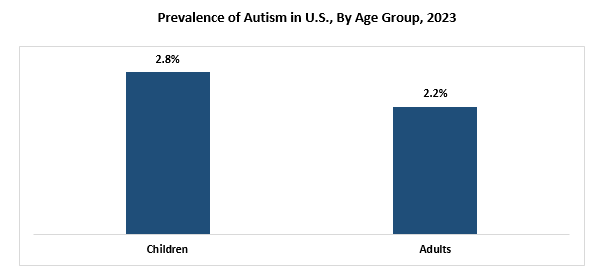
According to the data published by Centers for Disease Control and Prevention (CDC) in 2023, the prevalence of autism has increased in the U.S. Currently, the prevalence of autism in the U.S. is 1 in 36 children, which is considerably higher than the previously reported prevalence of 1 in 44 children in the U.S. Furthermore, the CDC also states that in the U.S., 4 in 100 boys and 1 in 100 girls suffer from this condition.
According to the Centers for Disease Control and Prevention (CDC) of the U.S., the diagnosis of this condition relies on two sources of information: the parents’ or the child’s caregiver’s description of the child’s development or the professional’s assessment of the child’s behaviour. The CDC also states that the American Psychiatric Association's Diagnostic and Statistical Manual, Fifth Edition (DSM-5) gives a standardized criteria for the diagnosis of autism spectrum disorder. In terms of the DSM-5’s criteria for autism diagnosis, the child must have persistent deficits in each of the three areas of social communication and interaction. Similarly in Europe, the diagnosis of autism spectrum disorder generally entails the involvement of a multidisciplinary team of psychiatrists, speech therapists and psychologists. Even in Europe, the criteria for diagnosis of autism is standardized with adherence to guidelines published by Diagnostic and Statistical Manual of Mental Disorders (DSM-5) or the International Classification of Diseases (ICD-11).
In terms of the treatment of autism, often a multi-pronged treatment approach is considered. This includes the utilization of communication & behavioural therapies and the drug therapies. Several research studies have demonstrated the strong efficacy of the adoption of combination therapies for autism. Some of the communication & behavioural therapies utilized for the autism spectrum disorder includes speech & language therapy, applied behavioral analysis (ABA), occupational therapy, cognitive behavioral therapy (CBT), and others. In terms of drug therapies, as of now, no drug has been approved to treat or cure autism. However, certain medications are utilized to help the healthcare professionals manage the symptoms of this condition such as irritability, insomnia, depression, and lack of focus. Some of these mentioned drug therapies have received regulatory approvals from agencies from the U.S. FDA, while the others are used off-label.
The drugs that have received approval from the U.S. FDA for autism spectrum disorder treatment are risperidone, and aripiprazole. While risperidone can be prescribed for children between the ages of 5 to 16 years to help with aggression and irritability, aripiprazole can be given to children between the ages of 6 to 17 years. However, in Europe, there are no approved medications for the treatment of autism symptoms, while certain guidelines support their utilization.
Some of the major players in the autism market are Janssen Global Services, LLC, Amneal Pharmaceuticals LLC, Bristol-Myers Squibb Company, Aurobindo Pharma, and other companies.
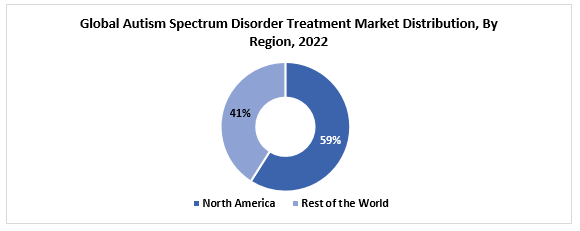
The global autism spectrum disorder treatment market size was valued at USD 6.94 billion in 2022. The market is projected to grow from USD 7.41 billion in 2023 to USD 13.14 billion by 2030, exhibiting a CAGR of 8.5% during 2023-2030. North America region is the most dominant region in the global market. Some of the factors which contribute to the growth of the global market is the presence of potential pipeline candidates that may be approved, the strong sustained increase of autism prevalence, and the boost in the awareness amongst the general population.

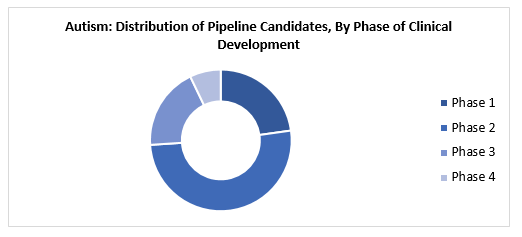
At present around 75% of the pipeline candidates for autism are in the phase-1 and phase-2 stages of clinical trials combined. Majority of the studies are sponsored by industry and governmental institutions.
The mechanism of action of the earliest therapies that have gained regulatory approvals for autism such as risperidone, and aripiprazole are the blockade of serotonin 2A and dopamine D2 receptors for risperidone. For aripiprazole, the mechanism of action is the stimulation and the inhibition of dopamine as it engages the D2 receptor. In terms of research activity, several players have focused on the genetic mechanisms influencing autism. In recent times, some of the companies have focused on the following mechanism of actions:
In terms of the route of administration of the pipeline drugs, a significant number of these drugs under clinical trials for autism treatment, have the oral route of administration. This is because, as a number of the patients of autism are adolescents, the oral form of medication administration will be easier for them, and will make them more treatment adherent as they can be administered by their parents or caregivers at the homecare settings.
The majority of the players engaged in the clinical trials for autism treatment have focused on the development of the small molecule drugs. Some of the players with small molecule drugs in their product pipelines for autism includes the emerging company of Axial Therapeutics.
In terms of pipeline drugs for autism treatment, the number of these drugs in the advanced stages of clinical studies are limited. A number of the companies with pipeline candidates for autism treatment, are emerging biopharmaceutical companies that based in the U.S. Some of the companies with pipeline drugs are Yamo Pharmaceuticals, Curemark, and Astrogen, Inc.
Ongoing Clinical Trials: Some of the key pipeline candidates under clinical trials are as follows:
Phase 1:
Phase 2:
Phase 3:
Future Trial Prospects:

Get 30-60 hrs Free Customization
Expand Regional and Country Coverage, Segments Analysis, Company Profiles, Competitive Benchmarking, and End-user Insights.













.webp)






Get In Touch With Us
US +1 833 909 2966 ( Toll Free )
Receive a tailored pricing based on your needs.
Discuss your questions with our industry experts.
Have questions? Get quick answers before you purchase.

