Beef Market Size, Share & Industry Analysis, By Processing Type (Fresh and Processed [Frozen, Canned, and Chilled]), By Product Type (Ground, Roasts, Steaks, and Others), By Distribution Channel (Foodservice and Retail [Supermarkets & Hypermarkets, Convenience Stores, Butcher Shops, Online Retail, and Others]), and Regional Forecast, 2026-2034
 Download Free Sample
(Offer valid till 31st Oct 2026)

Beef Market Size and Future Outlook
 Listen to Audio Version
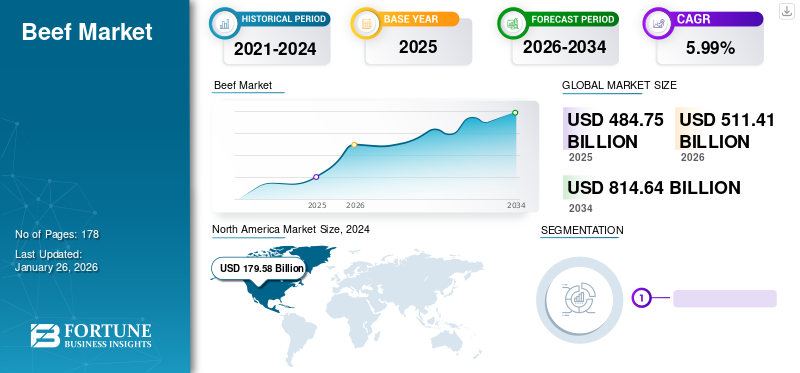
The global beef market size was valued at USD 465.22 billion in 2025 and is projected to grow from USD 485.60 billion in 2026 to USD 711.62 billion by 2034, exhibiting a CAGR of 4.89% during the forecast period. North America dominated the beef market with a market share of 32.77% in 2025.
Beef refers to meat derived from cattle and is consumed across fresh, frozen, chilled, canned, and processed formats. The market covers widely consumed product types such as ground beef, roasts, steaks, and other cuts, distributed through foodservice and retail channels including supermarkets, convenience stores, butcher shops, online retail, and other formats. Beef remains one of the most important animal protein categories globally due to its strong culinary role, high protein content, established RFID livestock tracking supply chains, and broad use in household cooking, restaurants, QSR menus, hotels, institutional catering, and processed meat products.
The market is witnessing steady growth due to increasing demand for steaks, ground cuts, burgers, rolls, and other meat-based convenience foods, especially across urban foodservice and retail channels. Ground beef continues to benefit from affordability and versatility, while steaks and premium cuts are supported by higher spending on restaurant meals, grilling occasions, and branded meat programs. Demand is also supported by rising disposable income in emerging economies, continued preference for animal-based protein, expansion of modern meat retailing, and wider availability of chilled and frozen beef products.
The global market growth is supported by large-scale beef processors and meat companies such as JBS S.A., Tyson Foods, Inc., Cargill, Incorporated, National Beef Packing Company, LLC, and Marfrig Global Foods S.A. These companies operate across slaughtering, processing, boxed beef, portion-controlled cuts, frozen beef, chilled products, foodservice supply, and retail-ready packaging. The market is also shaped by regional cattle availability, feed prices, herd cycles, export access, halal and kosher certification, food safety compliance, precision livestock farming, and consumer demand for traceable, branded, natural, grass-fed, and antibiotic-free beef products.
Download Free sample to learn more about this report.
BEEF MARKET TRENDS
Branded and Natural Claims-Based Beef to Strengthen Premiumization Trend
The commercial beef industry is increasingly moving toward premiumization, where consumers are willing to pay more for products that offer clear quality, safety, origin, and production-related assurances. Branded beef products such as Certified Angus Beef, grass-fed beef, organic beef, antibiotic-free beef, hormone-free beef, and region-specific beef labels are gaining importance as they help consumers differentiate premium products from standard commodity beef. These claims create higher trust, especially among urban, health-conscious, and higher-income consumers who are more selective about meat quality and sourcing.
This trend is also being supported by retailers and meat processors, as branded beef programs allow them to improve product positioning and margins. Instead of selling beef only by cut type or price, companies are increasingly promoting attributes such as tenderness, marbling, traceability, animal welfare, natural feed, and no added hormones or antibiotics. For premium cuts such as steaks, roasts, ribs, and brisket, these claims are particularly important as consumers associate them with better eating quality and safer sourcing.
- A strong example is Certified Angus Beef, which reported 1.23 billion pounds of sales in 2024, marking its second-best sales year. This shows that branded premium beef continues to perform well despite higher beef prices.
MARKET DYNAMICS
MARKET DRIVERS
Download Free sample to learn more about this report.
Rising Demand for Protein-Rich Diets is Driving Market Growth
Rising demand for protein-rich diets is one of the key drivers for global beef market growth, as consumers increasingly associate beef with high-quality animal protein, satiety, muscle maintenance, and overall nutrition. Beef is naturally rich in complete protein and provides essential micronutrients such as iron, zinc, selenium, and vitamin B12, which makes it attractive fo`r consumers following high-protein, fitness-oriented, low-carbohydrate, or nutrient-dense diets.
This driver is especially strong in developed markets such as the U.S., Canada, Australia, and parts of Europe, where consumers are not only looking for higher protein intake but also better-quality protein sources. Beef benefits from this trend as it is widely used across household meals, restaurants, quick-service restaurants (QSRs), premium steakhouses, and ready-to-cook products. As a result, demand is supported across both everyday products such as ground beef and burgers, as well as premium cuts such as steaks, ribs, brisket, and roasts.
- According to Beef Checkoff/NCBA consumer insights reported in 2024, around 70% of U.S. consumers eat beef at least once a week. This shows that beef remains a regular part of consumer diets despite higher retail prices.
|
Rank |
Market Drivers |
Expected Impact on Market Growth |
Estimated Gross Market Growth Contribution (USD Billion) |
Impact: 2026-2028 |
Impact: 2029-2031 |
Impact: 2032-2034 |
|
1 |
Rising demand for protein-rich diets, ground beef, steaks, burgers, and other beef-based food products across retail and foodservice channels |
High |
71.50 |
High |
High |
High |
|
2 |
Expansion of foodservice, QSR chains, hotels, restaurants, cafés, and institutional catering using beef in burgers, steaks, kebabs, roasts, sandwiches, and ready meals |
High |
58.20 |
High |
High |
Medium |
|
3 |
Growth in premium cuts, branded beef, grass-fed beef, natural claims, halal beef, and certified quality products across developed and high-income urban markets |
Medium-High |
44.80 |
Medium |
High |
High |
|
4 |
Increasing demand from emerging economies due to urbanization, income growth, modern retail expansion, cold-chain logistics, and higher animal protein consumption |
Medium-High |
39.40 |
Medium |
High |
High |
|
5 |
Wider availability of chilled, frozen, packaged, portion-controlled, and processed beef products through supermarkets, butcher shops, online retail, and export channels |
Medium |
31.60 |
Medium |
Medium |
High |
|
6 |
Others, including improved cattle productivity, higher carcass weights, export market access, private-label meat expansion, and convenience-oriented beef formats |
Low |
14.50 |
Low |
Medium |
Medium |
|
Total Gross Growth Contribution |
260.0 |
MARKET RESTRAINTS
Health and Environmental Concerns May Moderate Beef Consumption in Mature Markets
Growing health, sustainability, and environmental awareness is gradually moderating beef consumption in mature markets such as North America and Western Europe. While beef remains an important source of high-quality protein, increasing consumer concerns regarding greenhouse gas emissions, animal welfare, cardiovascular health, and excessive red meat consumption are encouraging some consumers to reduce beef intake or substitute it with poultry, seafood, or plant-based proteins. This trend is particularly evident among younger consumers, environmentally conscious households, and flexitarian consumers who intentionally reduce, rather than eliminate, red meat consumption.
The shift is also influencing retailers and foodservice operators, many of whom are expanding plant-based menus, blended meat products, and lower-carbon protein alternatives to meet changing consumer preferences. At the same time, governments and public health organizations continue to promote balanced diets that emphasize greater consumption of fruits, vegetables, and plant proteins, while encouraging moderation in red meat intake.
- OECD-FAO projects livestock-related greenhouse gas emissions to rise from 3.4 Gt CO₂eq in the base period to 3.5 Gt CO₂eq by 2034, although productivity improvements are expected to reduce emissions intensity in many regions. This keeps sustainability, land use, methane emissions, and animal welfare at the center of policy and consumer debates around beef.
|
Rank |
Market Restraints |
Expected Impact on Market Growth |
Estimated Reduction in Market Size (USD Billion) |
Impact: 2026-2028 |
Impact: 2029-2031 |
Impact: 2032-2034 |
|
1 |
Health concerns related to red meat overconsumption, saturated fat intake, cardiovascular risk perception, and consumer shift toward poultry, seafood, and plant-based proteins |
High |
10.80 |
High |
High |
Medium |
|
2 |
High beef prices, cattle supply volatility, feed cost inflation, drought impact, herd contraction, slaughter capacity pressure, and retail affordability concerns |
High |
9.40 |
High |
High |
Medium |
|
3 |
Environmental and animal welfare concerns related to methane emissions, land use, water use, climate impact, and stricter sustainability expectations from regulators and consumers |
Medium-High |
6.90 |
Medium |
High |
High |
|
4 |
Trade restrictions, disease outbreaks, import/export barriers, food safety risks, and disruptions in cattle and beef supply chains across major producing countries |
Medium |
4.65 |
Medium |
Medium |
Medium |
|
5 |
Religious, cultural, and dietary limitations in selected markets, along with competition from poultry, pork, lamb, seafood, and alternative protein products |
Medium-Low |
2.23 |
Low |
Medium |
Medium |
|
Total Market Reduction |
33.98 |
MARKET OPPORTUNITIES
Growth in Value-Added and Convenience Beef Products to Create New Market Opportunity
The increasing demand for convenient meal preparation is creating a significant opportunity for beef processors to expand beyond conventional fresh cuts into value-added retail products. Consumers are increasingly seeking beef products that reduce preparation time while retaining freshness, taste, and meal versatility. This is supporting opportunities for pre-cut, pre-seasoned, marinated, portion-controlled, vacuum-packed, ready-to-cook, sous-vide, and heat-and-eat beef products across supermarkets, warehouse clubs, specialty meat retailers, and online grocery channels.
Retailers are strengthening this opportunity by expanding case-ready meat programs and centralized meat processing. Vacuum packaging and modified-atmosphere packaging can extend product handling flexibility, improve merchandising, reduce in-store preparation requirements, and support wider geographic distribution of standardized beef products. This gives large processors and branded suppliers greater scope to serve retailers with consistent specifications while reducing dependence on traditional butcher-counter preparation.
- For instance, in June 2023, Lidl GB introduced recyclable vacuum-packed packaging for its beef mince range, extending shelf life from around 8 days to approximately 16 days while reducing packaging plastic by 63%. The retailer also estimated that the format could halve in-store beef mince food waste and improve logistics efficiency through its smaller pack footprint.
Segmentation Analysis
By Processing Type
Fresh Beef Segment Dominated Market Due to Strong Daily Consumption
Based on processing type, the market is segmented into fresh and processed, with processed further divided into frozen, canned, and chilled.
The fresh segment dominated the global beef market share in 2025, due to strong household demand, butcher shop sales, supermarket meat counters, foodservice usage, and consumer preference for fresh cuts in cooking and grilling applications. Fresh beef is widely used across ground beef, steaks, roasts, and other cuts, especially in North America, Europe, South America, and premium foodservice markets.
The processed segment is projected to grow at a faster CAGR of 5.68% from 2026 to 2034, supported by frozen, chilled, canned, ready-to-cook, and foodservice-ready beef products.
By Product Type
Ground Segment Held Largest Share Due to Affordability and Versatile Use Across Household and Foodservice Applications
Based on product type, the market is segmented into ground, roasts, steaks, and others.
Ground segment dominated the global market share, valued at USD 185.06 billion in 2025, supported by its economical price point, easy cooking format, and broad use in burgers, meatballs, tacos, sauces, patties, rolls, dumplings, and ready meals. Ground beef holds a major market share as it is more economical compared to premium cuts and is affordable across different income groups.
Steaks segment was valued at USD 139.92 billion in 2025 and is projected to grow at the fastest CAGR of 5.59% from 2026 to 2034, driven by premium restaurant demand, grilling culture, branded beef programs, and higher-income consumers seeking quality cuts.
To know how our report can help streamline your business, Speak to Analyst
By Distribution Channel
Retail Segment Dominated Market Due to High Demand for Fresh and Chilled Cuts through Supermarkets & Hypermarket Channel
Based on distribution channel, the market is segmented into foodservice and retail, with retail further divided into supermarkets & hypermarkets, convenience stores, butcher shops, online retail, and others.
Retail segment dominated the global market due to routine household purchases, strong availability of packaged meat, supermarket meat counters, local butcher shops, and demand for fresh and chilled cuts. Supermarkets & hypermarkets were the largest retail sub-channel, valued at USD 136.19 billion in 2025, supported by wide assortment, branded cuts, private labels, chilled sections, and trusted food safety standards. Within retail, online retail is expected to record strong growth within the global market as consumers increasingly use online meat delivery platforms, supermarket applications, specialist butcher websites, and direct-to-consumer services to purchase fresh, chilled, and frozen beef.
Foodservice segment is projected to grow at the fastest CAGR of 5.49% during the forecast period, supported by restaurants, QSRs, hotels, institutional catering, and premium dining.
Beef Market Regional Outlook
Based on geography, the market is classified into North America, Europe, Asia Pacific, South America, and the Middle East & Africa.
Asia Pacific
Asia Pacific Beef Market Size, 2025 (USD Billion)
To get more information on the regional analysis of this market, Download Free sample
Asia Pacific dominated the global market and was valued at USD 152.47 billion in 2025. The region is projected to reach USD 260.81 billion by 2034, growing at the fastest CAGR of 6.20% during the forecast period. Growth is driven by rising disposable income, urbanization, expansion of modern retail, foodservice growth, premium meat imports, and increasing demand for high-protein foods.
China Beef Market
China was valued at USD 75.95 billion in 2025, supported by rising middle-class consumption, premium imported beef demand, hotpot restaurants, western-style dining, e-commerce meat retail, and urban household demand for high-quality protein.
India Beef Market
India was valued at USD 20.72 billion in 2025, mainly supported by buffalo meat processing companies, export-oriented supply chains, and regional consumption patterns.
North America
North America was valued at USD 112.31 billion in 2025 and is projected to reach USD 160.47 billion by 2034, growing at a CAGR of 4.10% during the forecast period. The region is one of the most established markets globally, supported by high per capita meat consumption, strong foodservice penetration, burger and steak culture, large-scale intensive cattle farming, branded beef programs, and advanced cold-chain retail.
U.S. Beef Market
The U.S. dominates the North American market, valued at USD 88.47 billion in 2025. Growth is supported by strong beef consumption in burgers, steaks, barbecue, tacos, sandwiches, and household meals.
Europe
Europe was valued at USD 85.58 billion in 2025 and is projected to reach USD 115.64 billion by 2034, growing at a CAGR of 3.45% during the forecast period. The region is mature and highly regulated, with demand supported by fresh beef, roasts, steaks, minced beef, processed meats, and foodservice applications.
Germany Beef Market
Germany was valued at USD 13.03 billion in 2025, supported by strong processed meat culture, supermarket meat sales, foodservice demand, and chilled beef consumption.
France Beef Market
France was valued at USD 15.06 billion in 2025, supported by a strong culinary tradition, fresh beef consumption, butcher shop culture, and demand for traceable and origin-certified meat.
South America and Middle East & Africa
South America was valued at USD 78.61 billion in 2025 and is projected to reach USD 116.21 billion by 2034, growing at a CAGR of 4.49% during the forecast period. The region is a major beef-producing and exporting hub, supported by large cattle herds, pasture-based production, competitive land availability, established slaughtering capacity, and strong domestic consumption in Brazil and Argentina.
The Middle East & Africa market was valued at USD 36.24 billion in 2025 and is projected to reach USD 58.49 billion by 2034, growing at a CAGR of 5.52% during the forecast period. Growth is supported by rising demand for halal beef, expanding foodservice, tourism, hotel dining, urban retail, population growth, and increasing availability of frozen and chilled imported beef.
Brazil Beef Market
Brazil dominates the South American market, valued at approximately USD 49.25 billion in 2025, supported by one of the world’s largest cattle herds, strong domestic beef consumption, and major export-oriented companies such as JBS, Marfrig, and Minerva Foods.
COMPETITIVE LANDSCAPE
Key Industry Players
Major Players Focus on Processing Scale, Export Access, Branded Beef, Food Safety, and Retail-ready Products to Strengthen Market Position
The global market is highly competitive and moderately consolidated at the processing level, particularly in North America, Brazil, Australia, and parts of Europe. Large companies compete on cattle procurement, slaughter capacity, processing efficiency, export approvals, cold-chain infrastructure, food safety systems, pricing, branded beef programs, and customer relationships with retailers and foodservice distributors.
Leading beef companies are expanding value-added products, portion-controlled cuts, case-ready beef, chilled exports, frozen meal manufacturers, premium branded programs, and traceable meat offerings. Companies are also investing in automation, packaging, sustainable cattle farming, animal welfare standards, and supply-chain transparency to meet the requirements of regulators, retailers, restaurants, and international buyers.
LIST OF KEY BEEF COMPANIES PROFILED IN REPORT
- JBS S.A. (Brazil)
- Tyson Foods, Inc. (U.S.)
- Cargill, Incorporated (U.S.)
- National Beef Packing Company, LLC (U.S.)
- Marfrig Global Foods S.A. (Brazil)
- Minerva S.A. (Brazil)
- Danish Crown A/S (Denmark)
- Vion Food Group (Netherlands)
- NH Foods Ltd. (Japan)
- Australian Agricultural Company Limited (Australia)
KEY INDUSTRY DEVELOPMENTS
- January 2026: ButcherBox entered physical retail through a partnership with Target, placing fresh 100% grass-fed, grass-finished beef products in more than 1,400 Target stores across the U.S.
- December 2025: Natural Grocers launched private-label grass-fed beef sticks and beef bites across its stores. The products are made with 100% grass-fed beef and include original and jalapeño varieties.
- September 2025: American Farmers Network acquired Open Range Beef, a Nebraska-based beef processor focused on grass-fed, organic, and natural beef programs. The acquisition expanded AFN’s vertically integrated footprint across ranching, harvesting, fabrication, further processing, and national distribution.
- May 2025: Teton Waters Ranch introduced three new 100% grass-fed, grass-finished beef products at Whole Foods Market: frozen beef burger patties, classic beef hot dogs, and breakfast beef patties.
- February 2025: JBS USA announced a USD 200 million investment in its U.S. beef facilities, including USD 150 million at Cactus, Texas, and USD 50 million at Greeley, Colorado. The projects include a new fabrication floor, expanded ground beef room, and a new distribution center.
REPORT COVERAGE
The global beef market industry report analyses the market in depth and highlights crucial aspects such as global market trends, market dynamics, supply chains, prominent companies, investment in research and development. Besides this, the report also provides insights into the global market analysis and highlights significant industry developments.
Request for Customization to gain extensive market insights.
Report Scope & Segmentation
| ATTRIBUTE | DETAILS |
| Study Period | 2021-2034 |
| Base Year | 2025 |
| Estimated Year | 2026 |
| Forecast Period | 2026-2034 |
| Historical Period | 2021-2024 |
| Growth Rate | CAGR of 4.89% from 2026 to 2034 |
| Unit | Value (USD Billion) |
| Segmentation | By Processing Type, Product Type, Distribution Channel, and Region |
| By Processing Type |
|
| By Product Type |
|
| By Distribution Channel |
|
| By Region |
|
Frequently Asked Questions
Fortune Business Insights says that the global market value stood at USD 465.22 billion in 2025 and is projected to reach USD 711.62 billion by 2034.
In 2025, the market value in Asia Pacific stood at USD 152.47 billion.
The market is expected to grow at a CAGR of 4.89% over the forecast period of 2026-2034.
The ground segment led the market by product type.
The key driver of the market is the rising demand for protein-rich diets.
JBS S.A., Tyson Foods, Inc., Cargill, Incorporated, National Beef Packing Company, LLC, and Marfrig Global Foods S.A. are the prominent players in the market.
Asia Pacific held the largest market share in 2025.



- 2021-2034
- 2025
- 2021-2024
- 200
-
(Offer valid till 31st Oct 2026)
Get 30-60 hrs Free Customization
Expand Regional and Country Coverage, Segments Analysis, Company Profiles, Competitive Benchmarking, and End-user Insights.




















Related Reports
-
US +1 833 909 2966 ( Toll Free )
-
Get In Touch With Us