Transportation Management System Market Size, Share & Industry Analysis, By Platform (Solutions and Services), By Deployment Type (Cloud-Based (SaaS) and On-Premise), By Enterprise Size (Large Enterprises and Small & Medium Enterprises), By Transportation Mode (Roadways, Railways, Airways, Seaways, and Intermodal/Multimodal), By End-Use Industry (Retail & E-Commerce, Manufacturing, Automotive, Food & Beverages, Healthcare & Pharmaceuticals, and Others), and Regional Forecasts, 2026-2034
 Download Free Sample
(Offer valid till 30th Sep 2026)

Transportation Management System Market Size and Future Outlook
 Listen to Audio Version
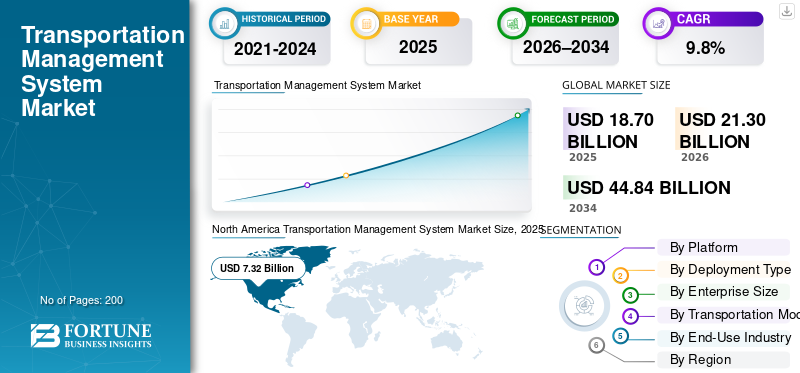
The global transportation management system market size was valued at USD 18.70 billion in 2025. The market is projected to grow from USD 21.30 billion in 2026 to USD 44.84 billion by 2034, exhibiting a CAGR of 9.8% during the forecast period. North America dominated the Transportation management system market with a market share of 39.14% in 2025.
The market represents software solutions and related services that enable organizations to plan, execute, monitor, and optimize the movement of goods across transport networks. A transportation management system (TMS) supports activities such as route optimization, freight auditing, shipment tracking, and real-time tracking, helping companies manage increasingly complex global supply chains. These platforms are widely used by manufacturers, retailers, distributors, and logistics operators to improve delivery performance and control transportation spend.
The transportation management system market is evolving rapidly due to the growing demand for end-to-end supply chain visibility and faster decision-making. Businesses are facing higher shipment volumes, shorter delivery timelines, and fluctuating fuel and freight costs. As a result, companies are increasingly adopting cloud-based transportation management systems to improve operational efficiency while remaining cost-effective. Advanced features such as predictive analytics, artificial intelligence (AI), machine learning, and automated carrier selection are becoming standard components of modern TMS platforms.
In the future, the adoption of cloud-based TMS is expected to accelerate further as enterprises seek scalable solutions that can integrate easily with enterprise resource planning (ERP) and warehouse systems. Capabilities such as dynamic pricing analysis, automated compliance checks, and intelligent load planning will help companies reduce costs and enhance customer satisfaction. Additionally, the rising focus on sustainability and emissions monitoring will drive TMS vendors to introduce greener routing and reporting tools.
The global transportation management system industry serves applications across retail distribution, manufacturing logistics, healthcare supply chains, and cross-border trade. Key players such as SAP SE, Blue Yonder, and Körber Supply Chain are investing in platform upgrades, analytics-driven modules, and strategic partnerships to expand their market share and strengthen their global presence.
Download Free sample to learn more about this report.
TRANSPORTATION MANAGEMENT SYSTEM MARKET KEY TAKEAWAYS
 Market Size & Forecast
- 2025 Market Size: USD 18.70 Billion
- 2026 Market Size: USD 21.30 Billion
- 2034 Forecast Market Size: USD 44.84 Billion
- CAGR: 9.8% from 2026–2034
 Market Share
- North America dominated the transportation management system market with a 39.14% share in 2025.
- The solutions segment held the largest market share in 2025.
- Cloud-based (SaaS) deployment dominated the market in 2025.
 Key Regional Highlights
North America
North America reached USD 7.32 billion in 2025, supported by strong digital adoption and advanced logistics networks.
Europe
Europe is expected to reach USD 5.53 billion in 2026, driven by logistics modernization and digital freight regulations.
Asia Pacific
Asia Pacific is projected to reach USD 6.14 billion in 2026, registering the fastest regional growth rate of 12.4%.
U.S.
The market was valued at approximately USD 6.25 billion in 2025, accounting for about 33.4% of global revenue.
Japan
The transportation management system market is expanding steadily, supported by logistics digitalization and supply chain optimization initiatives.
Read More

TRANSPORTATION MANAGEMENT SYSTEM MARKET TRENDS
Integration of AI and Predictive Analytics in Transportation Planning is a Key Market Trend
The integration of predictive analytics, artificial intelligence (AI), and machine learning is a key trend shaping the market. These technologies enable proactive decision-making, demand forecasting, and intelligent route optimization, improving operational resilience and service reliability.
- For instance, in November 2024, Oracle expanded AI-based logistics planning features within its transportation management solutions.
MARKET DYNAMICS
MARKET DRIVERS
Expansion of E-Commerce and Complex Transport Networks to Drive TMS Adoption
The rapid expansion of e-commerce and Omnichannel retail has significantly increased shipment volumes and delivery complexity. This trend drives the demand for transportation management systems that enable route optimization, shipment tracking, and real-time tracking across fragmented transport networks. Businesses rely on TMS platforms to manage high-frequency shipments efficiently and reduce costs while meeting customer delivery expectations.
- For instance, industry reports noted that integration complexity remains a key barrier for SMEs adopting enterprise logistics software.
MARKET RESTRAINTS
High Integration Complexity Limits Adoption Among Smaller Enterprises
Despite strong demand, complex system integration and data migration challenges can restrain the transportation management system market growth. Smaller organizations often struggle to integrate transportation management system TMS platforms with legacy ERP and warehouse systems, increasing implementation time and costs. These challenges may slow adoption, particularly in price-sensitive markets.
- For instance, the U.S. Census Bureau reports continued growth in e-commerce sales, reinforcing the need for digital transportation planning and execution tools.
MARKET OPPORTUNITIES
Rising Adoption of Cloud-Based TMS in Emerging Economies to Create New Market Opportunities
Emerging markets present strong opportunities due to the accelerating adoption of cloud-based TMS solutions. Cloud platforms offer scalable, cost-effective deployment models that support growing logistics needs without heavy infrastructure investment, enabling wider adoption across developing global supply chains.
- For instance, India’s National Logistics Policy, 2022, emphasizes digital platforms to improve freight efficiency and transparency.
MARKET CHALLENGES
Data Standardization Across Global Supply Chains to Pose Market Barrier
Managing inconsistent data formats across regions and carriers is a major challenge. Lack of standardization can reduce supply chain visibility and limit the effectiveness of real time tracking across complex global supply chains, impacting decision accuracy.
- For instance, The European Commission, 2025, highlights data harmonization challenges in cross-border freight digitization initiatives.
Download Free sample to learn more about this report.
Segmentation Analysis
By Platform
Solutions Segment Dominates due to Planning and Execution Capabilities
On the basis of the platform, the market is divided into solutions and services. The solutions segment dominates due to its direct impact on planning, execution, and analytics. TMS software enables automation, route optimization, and shipment tracking, making it central to logistics operations.
- For instance, in March 2024, SAP enhanced TMS solutions with AI-driven freight planning and analytics modules.
The services segment is expected to grow at a CAGR of 11.6% over the forecast period.
By Deployment Type
Cloud-based (SaaS) Segment Dominates due to Scalability and Cost Efficiency
On the basis of deployment type, the market is segmented into cloud-based (SaaS) and On-premise. Cloud-based transportation management systems dominate due to scalability, faster deployment, and lower upfront costs, supporting the adoption of cloud-based TMS globally.
- For instance, in June 2023, Blue Yonder expanded its cloud-based TMS with real-time shipment visibility features.
Cloud-Based (SaaS) is expected to grow at a CAGR of 10.5% over the forecast period.
By Enterprise Size
Large Enterprises Dominate due to Complex Global Logistics Operations
On the basis of enterprise size, the market is segmented into large enterprises and small & medium enterprises. Large enterprises dominate due to complex transport networks and high shipment volumes requiring advanced transportation management system TMS capabilities.
- For instance, in February 2024, Oracle upgraded enterprise TMS to support complex global logistics orchestration.
The small & medium enterprises segment is expected to grow at a CAGR of 10.2% over the forecast period.
By Transportation Mode
Roadways Segment Dominates due to High Freight Volumes and Last-Mile Dependence
On the basis of transportation mode, the market is segmented into roadways, railways, airways, seaways, and intermodal/multimodal. Road transportation remains the most widely used mode due to its flexibility, extensive network coverage, and suitability for short- and medium-distance shipments. The dominance of roadways is further reinforced by rising last-mile delivery demand and regional distribution activities.
- For instance, in October 2023, Trimble launched roadway-focused TMS tools for route optimization and carrier selection.
The airways segment is expected to grow at a CAGR of 10.6% over the forecast period.
By End-Use Industry
Retail and E-commerce Segment Dominates due to High Shipment Frequency
On the basis of end-use industry, the market is segmented into retail & e-commerce, manufacturing, automotive, food & beverages, healthcare & pharmaceuticals, and others. Retail & e-commerce dominate due to high shipment frequency and strong reliance on real-time tracking and analytics.
- For instance, in August 2023, Manhattan Associates released retail-focused TMS upgrades for Omnichannel fulfillment.
To know how our report can help streamline your business, Speak to Analyst
The retail & e-commerce segment is expected to grow at a CAGR of 11.8% over the forecast period.
Transportation Management System Market Regional Outlook
By geography, the global transportation management system market is categorized into North America, Europe, Asia Pacific, and Rest of the World.
North America Transportation Management System Market Size, 2025 (USD Billion)
To get more information on the regional analysis of this market, Download Free sample
North America held the dominant share in 2025, valuing at USD 7.32 billion, and also maintained its leading share in 2024, with USD 6.82 billion. The region dominates the market due to mature transport networks, high digital adoption, and strong presence of large logistics operators. Enterprises increasingly invest in transportation management system TMS platforms to achieve supply chain visibility, route optimization, and real-time tracking. The region benefits from early adoption of cloud-based TMS, advanced analytics, and integration with enterprise systems. In the U.S., strong e-commerce activity and complex interstate freight flows continue to drive demand and expanding market share.
- For instance, in April 2024, Oracle expanded its U.S. TMS capabilities to support real-time logistics orchestration.
U.S. Transportation Management System Market
Based on North America’s strong contribution and the U.S. dominance within the region, the U.S. market can be analytically approximated at around USD 6.25 billion, representing roughly 33.4% of the market.
Asia Pacific is projected to record a growth rate of 12.4% in the coming years, which is highest among all regions, and reach a valuation of USD 6.14 billion by 2026. Asia Pacific will record rapid growth driven by expanding e-commerce, manufacturing scale, and digital infrastructure investment. Enterprises increasingly deploy cloud-based transportation management systems to manage complex global supply chains and fragmented transport networks. Government logistics digitization programs accelerate adoption, positioning the region as the fastest-growing market globally today.
China Transportation Management System Market
China’s transportation management system market is projected to be one of the largest worldwide, with 2025 revenues estimated at around USD 2.01 billion, representing roughly 10.7% of global market.
India Transportation Management System Market
In India, the market in 2025 is estimated at around USD 0.56 billion, accounting for roughly 3.0% of global revenues.
Europe is estimated to reach USD 5.53 billion in 2026 and secure the position of the second-largest region in the market. Europe is expected to grow steadily as enterprises modernize logistics operations and comply with digital freight regulations. Cross-border trade complexity increases the demand for transportation management systems supporting shipment tracking and supply chain visibility. Western Europe leads adoption, while Eastern Europe shows faster growth as cloud-based transportation management systems gain traction among regional manufacturers and distributors across multiple industries.
Germany Transportation Management System Market
The market in Germany in 2025 is estimated at around USD 1.11 billion, accounting for roughly 5.9% of global transportation management system revenues.
U.K. Transportation Management System Market
The U.K.’s market in 2025 is estimated at around USD 0.91 billion, accounting for roughly 4.9% of global transportation management system revenues.
Rest of the World will grow gradually as trade corridors modernize and logistics digitalization improves. Adoption of transportation management system solutions remains selective but is rising among exporters and logistics operators. Investments in port connectivity, multimodal planning, and basic real time tracking capabilities support steady, long-term market expansion across regions.
COMPETITIVE LANDSCAPE
Key Industry Players
Key Players are Emphasizing on Partnerships to Improve Data Connectivity
The competitive landscape of the global market is characterized by continuous innovation, platform consolidation, and regional expansion. Leading vendors focus on enhancing transportation management system TMS capabilities through cloud-native architectures, advanced predictive analytics, embedded artificial intelligence (AI), and machine learning tools. These strategies allow vendors to differentiate their offerings while addressing the growing demand for agile and scalable logistics technology.
Major companies compete by offering integrated solutions that improve supply chain visibility, optimize transport networks, and support multimodal transportation planning. Strategic acquisitions are commonly used to expand functional depth, especially in areas such as real-time tracking, analytics, and last-mile delivery optimization. Vendors are also forming partnerships with carriers, technology providers, and logistics operators to improve data connectivity and global reach.
Another important strategy involves targeting industry-specific use cases. Vendors increasingly tailor solutions for retail, manufacturing, and e-commerce customers to strengthen customer retention and expand recurring revenue streams. The shift toward cloud based transportation management systems has intensified competition, as vendors compete on ease of deployment, pricing flexibility, and integration capabilities.
- For instance, in February 2024, SAP enhanced its transportation management platform with AI-driven insights to support real-time decision-making across global logistics operations.
LIST OF KEY Transportation Management System Companies Profiled
- SAP SE (Germany)
- Oracle Corporation (U.S.)
- Blue Yonder Group (U.S.)
- Manhattan Associates (U.S.)
- Descartes Systems Group (Canada)
- Trimble Inc. (U.S.)
- Infor (U.S.)
- MercuryGate (U.S.)
- e2open (U.S.)
- Körber Supply Chain (Germany)
KEY INDUSTRY DEVELOPMENTS
- September 2025: Blue Yonder enhanced its transportation management solution with cognitive intelligence to improve decision-making and logistics resilience.
- August 2025: WiseTech Global completed its acquisition of e2open, strengthening its position in transportation and supply chain execution software. The transaction expanded WiseTech’s customer base, global footprint, and functional coverage across transportation management, logistics orchestration, and connected trade workflows, enabling deeper integration across global supply chains.
- April 2025: SAP introduced new transportation management innovations, including generative AI features for freight planning and emissions-aware logistics.
- April 2025: Manhattan Associates was again recognized as a leader for transportation management systems, highlighting strength in cloud-native execution platforms.
- March 2025: Descartes Systems Group acquired 3GTMS (3G), a cloud-native transportation management system provider. The acquisition enhanced Descartes’ over-the-road transportation planning, rating, and optimization capabilities, particularly for North American shippers and logistics service providers, while reinforcing its SaaS-based strategy in transportation execution and logistics management.
- February 2025: Platform Science completed the acquisition of Trimble’s transportation telematics units, expanding connected vehicle and logistics technology capabilities.
- August 2024: Körber Supply Chain Software agreed to acquire MercuryGate, expanding its transportation management and multimodal optimization portfolio.
REPORT COVERAGE
The global transportation management system market analysis provides an in-depth study of market size & forecast by all the market segments included in the report. It includes details on the market dynamics and market trends expected to drive the market in the forecast period. It offers information on the technological advancements, new product launches, key industry developments, and details on partnerships, mergers & acquisitions. The research report also encompasses detailed competitive landscape with information on the market share and profiles of key operating players.
Request for Customization to gain extensive market insights.
Report Scope & Segmentation
|
ATTRIBUTE |
DETAILS |
|
Study Period |
2021-2034 |
|
Base Year |
2025 |
|
Estimated Year |
2026 |
|
Forecast Period |
2026-2034 |
|
Historical Period |
2021-2024 |
|
Growth Rate |
CAGR of 9.8% from 2026-2034 |
|
Unit |
Value (USD Billion) |
|
Segmentation |
By Platform, Deployment Type, Enterprise Size, Transportation Mode, End-Use Industry, and Region |
|
By Platform |
· Solutions · Services |
|
By Deployment Type |
· Cloud-Based (SaaS) · On-Premise |
|
By Enterprise Size |
· Large Enterprises · Small & Medium Enterprises |
|
By Transportation Mode |
· Roadways · Railways · Airways · Seaways · Intermodal/Multimodal |
|
By End-Use Industry |
· Retail & E-Commerce · Manufacturing · Automotive · Food & Beverages · Healthcare & Pharmaceuticals · Others |
|
By Geography |
· North America (By Platform, Deployment Type, Enterprise Size, Transportation Mode, End-Use Industry and Country) o U.S. o Canada o Mexico · Europe (By Platform, Deployment Type, Enterprise Size, Transportation Mode, End-Use Industry and Country) o Germany o U.K. o France o Rest of Europe · Asia Pacific (By Platform, Deployment Type, Enterprise Size, Transportation Mode, End-Use Industry, and Country) o China o India o Japan o South Korea o Rest of Asia Pacific · Rest of the World (By Platform, Deployment Type, Enterprise Size, Transportation Mode, End-Use Industry, and Country) |
Frequently Asked Questions
Fortune Business Insights says that the global market value stood at USD 18.70 billion in 2025 and is projected to reach USD 44.84 billion by 2034.
In 2025, the market value stood at USD 7.32 billion.
The market is expected to exhibit a CAGR of 9.8% during the forecast period (2026-2034).
The retail & e-commerce segment led the market by end-use industry.
Expansion of e-commerce and complex transport networks is driving the market.
SAP SE, Oracle, Blue Yonder and Manhattan Associates are some of the top players in the market.
North America dominated the market in 2025.



- 2021-2034
- 2025
- 2021-2024
- 200
-
(Offer valid till 30th Sep 2026)
Get 30-60 hrs Free Customization
Expand Regional and Country Coverage, Segments Analysis, Company Profiles, Competitive Benchmarking, and End-user Insights.




















-
US +1 833 909 2966 ( Toll Free )
-
Get In Touch With Us