Virtual Hospitals Market Size, Share & Industry Analysis, By Care Model (Hospital-at-Home and Virtual Ward and Virtual Bed), By Component (Platforms, Clinical Services, and Others), By Operating Model (Provider-operated, Co-managed, and Outsourced), By End User (Providers and Payers), and Regional Forecast, 2026-2034
 Download Free Sample
Virtual Hospitals Market Size and Future Outlook
 Listen to Audio Version
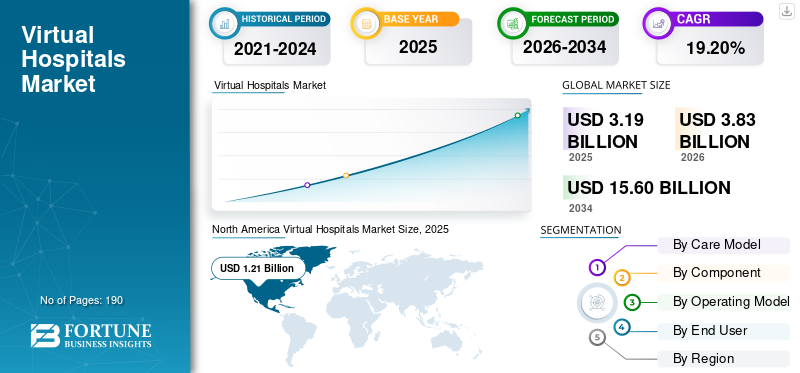
The global virtual hospitals market size was valued at USD 3.19 billion in 2025. The market is projected to grow from USD 3.83 billion in 2026 to USD 15.60 billion by 2034, exhibiting a CAGR of 19.20% during the forecast period. North America dominated the virtual hospitals market with a market share of 37.93% in 2025.
The global virtual hospitals market is poised for significant growth due to the increasing adoption of hospital-at-home programs, virtual wards, and digitally coordinated care models across healthcare systems. Virtual hospitals use remote patient monitoring devices, teleconsultation platforms, clinical command centers, and in-home healthcare services to deliver hospital-level treatment outside conventional facilities. These models are increasingly used to prevent avoidable admissions, support early discharge, and expand clinical capacity without adding physical hospital beds. Rising pressure on hospital infrastructure, shortages of healthcare professionals, increasing chronic disease prevalence, and growing demand for the market are encouraging healthcare providers to invest in virtual care capabilities. Continued integration of connected devices, real-time patient data, and centralized clinical monitoring is expected to support market growth.
- For instance, in July 2024, Doccla partnered with Ireland’s Health Service Executive to introduce virtual wards at St Vincent’s University Hospital and University Hospital Limerick. The initial program focused on cardiology and respiratory patients and used remote monitoring devices, software, and clinical support to provide hospital-level care at home. The partnership highlights the growing focus of healthcare systems on expanding virtual-care capacity, enabling earlier hospital discharge, and improving continuity of care outside traditional hospital settings.
Furthermore, key players, DispatchHealth Management, LLC, Huma Therapeutics Limited, Current Health, Inc., and Biofourmis, are actively participating in new product launches, strategic collaborations, acquisitions, and investment initiatives to expand their market presence.
Download Free sample to learn more about this report.
VIRTUAL HOSPITALS MARKET TRENDS
Increasing Integration of Remote Patient Monitoring into Acute-Care Pathways is a Prominent Trend
Healthcare providers are increasingly integrating remote patient monitoring into acute-care pathways to extend continuous clinical supervision beyond conventional hospital settings. Connected biosensors, wearable devices, and digital monitoring platforms allow clinical teams to track vital signs, receive alerts, and identify patient deterioration while individuals recover at home. This integration supports earlier discharge, reduces unnecessary inpatient stays, and improves coordination between hospital and home-based care teams. It also enables virtual hospitals to manage higher-acuity patients through standardized monitoring protocols and centralized clinical oversight. Growing interoperability between medical devices and hospital monitoring systems is expected to strengthen the adoption of remote healthcare delivery further.
- For instance, in April 2024, Koninklijke Philips N.V. entered into a strategic partnership with smartQare to integrate smartQare’s viQtor solution with the Koninklijke Philips’ clinical patient-monitoring platforms. The integrated solution combined wearable biosensors and a unified digital platform to support continuous monitoring before, during, and after hospitalization.
MARKET DYNAMICS
MARKET DRIVERS
Download Free sample to learn more about this report.
Hospital Capacity Pressure and Growing Need to Avoid Unnecessary Admissions
One of the key factors driving the global virtual hospitals market growth is rising capacity pressure on hospitals and the need to avoid unnecessary hospitalizations. Hospital-at-home programs and virtual wards allow clinically suitable patients to receive acute or post-acute care at home. These models help prevent avoidable admissions and enable earlier discharge, thereby making physical beds available for critically ill and high-acuity patients. Virtual hospitals also allow providers to increase treatment capacity without making large investments in new hospital infrastructure. As virtual healthcare systems continue to encounter seasonal demand, ageing populations, and workforce shortages, the need to improve bed utilization and reduce unnecessary hospital stays is expected to drive market growth.
- For instance, in February 2025, NHS England reported that virtual ward admissions across South East England exceeded 85,000 during 2024, representing an 18% increase compared with 2023. The region operated more than 2,000 virtual ward beds, enabling patients to receive hospital-standard treatment and monitoring at home while supporting faster discharge and reducing pressure on conventional hospital capacity. The development highlights the growing role of virtual hospitals in avoiding unnecessary admissions and improving the utilization of limited inpatient resources.
Market Drivers - Impact & CAGR Contribution (2026–2034)
| Rank | Market Drivers | Overall Impact Rank | CAGR Contribution (2026-2034) |
Impact: 2026-2028 | Impact: 2029-2031 | Impact: 2032-2034 |
|---|---|---|---|---|---|---|
| 1 | Hospital capacity pressure and admission avoidance | High | 7.20% | High | High | High |
| 2 | Reimbursement and policy support | High | 5.80% | Medium | High | High |
| 3 | Aging and chronic-complex patient populations | High | 5.10% | High | High | Medium |
| 4 | Workforce shortages and centralized clinical models | Medium-High | 4.50% | Medium | High | High |
| 5 | Better connected devices and platform integration | Medium | 3.80% | Medium | Medium | High |
| 6 | Others | Low | 2.50% | Low | Low | Medium |
| Total Gross Growth Contribution | 28.90% | |||||
Source: Fortune Business Insights
MARKET RESTRAINTS
Inconsistent Reimbursement Frameworks and Reliance on Temporary Policy Support to Limit Market Expansion
The absence of consistent and permanent reimbursement frameworks is limiting the large-scale adoption of virtual hospital models. Coverage and payment policies frequently differ across public insurers, private payers, care pathways, and geographic markets. These factors lead to vendors and providers to negotiate reimbursement arrangements separately. This fragmentation makes revenue forecasting difficult and prevents virtual hospitals from achieving the patient volumes required for operational efficiency. Dependence on temporary waivers, virtual care programs, and short-term policy extensions also discourages hospitals from investing in clinical teams, remote-monitoring infrastructure, logistics networks, and technology platforms.
- For instance, in December 2025, Inbound Health ceased operations after failing to secure additional funding. The company stated that regulatory uncertainty and the absence of a long-term extension of the U.S. Acute Hospital Care at Home waiver made it difficult to attract further capital. The closure demonstrates how temporary policy support and unpredictable reimbursement can discourage investment and threaten the financial sustainability of virtual hospital service providers.
Market Restraints - Impact & Negative CAGR Contribution (2026–2034)
| Rank | Market Restraints | Expected Impact on Market Growth | Negative CAGR Contribution (2026-2034) |
Impact: 2026-2028 | Impact: 2029-2031 | Impact: 2032-2034 |
|---|---|---|---|---|---|---|
| 1 | Fragmented reimbursement and temporary policy | High | 3.10% | High | High | Medium |
| 2 | Operational complexity and home suitability | Medium-High | 2.50% | High | Medium | Medium |
| 3 | Data security, interoperability and regulatory burden | Medium | 1.90% | Medium | Medium | Low |
| 4 | Others | Low | 1.10% | Low | Low | Low |
| Total Negative Growth Impact | 8.60% | |||||
Source: Fortune Business Insights
MARKET OPPORTUNITIES
Expansion into Specialty and High-Acuity Clinical Pathways to Broaden the Addressable Patient Base
Virtual hospital providers have a significant opportunity to expand into specialties such as oncology, pediatrics, infectious diseases, postoperative recovery, and maternity care, among other pathways. Developing condition-specific monitoring protocols can enable hospitals to manage more clinically complex patients safely outside conventional facilities. This expansion would increase the number of patients eligible for virtual care and improve the utilization of existing platforms, monitoring devices, and centralized clinical teams. Specialty pathways can also support earlier discharge, reduce repeated hospital visits, and improve continuity of care for patients requiring prolonged clinical supervision. As evidence and clinical confidence increase, the addition of new care pathways is expected to create recurring service revenue and support the wider adoption of virtual hospital models.
- For instance, in April 2025, Inhealthcare partnered with Leeds Children’s Hospital to launch one of the U.K.’s first virtual wards for pediatric oncology patients. The program enabled children undergoing cancer treatment to receive clinical monitoring and support at home.
MARKET CHALLENGES
Complex Operational Integration Across Virtual and In-Person Care Settings to Hamper Market Demand
Virtual hospitals require close coordination among remote clinical teams, hospital departments, community providers, home-visiting professionals, pharmacies, laboratories, and emergency services. Differences in clinical workflows, referral procedures, electronic health records, staffing structures, and escalation protocols can interrupt the movement of patients between virtual and facility-based care. Providers must also ensure that medicines, diagnostic tests, equipment, and in-person interventions reach patients within clinically appropriate timelines. Poor integration can increase staff workload, duplicate documentation, delay treatment, and create uncertainty regarding clinical responsibility. Consequently, healthcare systems may struggle to scale virtual hospital programs consistently across locations and clinical pathways.
- For instance, in February 2025, an NIHR-supported evaluation of the Northumbria Healthcare NHS Foundation Trust’s step-down virtual ward highlighted several implementation difficulties. The study identified clinician resistance, limited resources, geographic barriers to providing consistent care, difficulties integrating different IT systems, and the need for clearer governance structures.
These findings demonstrate that virtual hospital expansion involves complex operational change across technology, workforce, and care-delivery systems rather than the simple deployment of a remote-monitoring platform.
Segmentation Analysis
By Care Model
Hospital-at-Home Dominated Owing to Its Ability to Deliver Complete Acute Care
Based on care model, the market is categorized into hospital-at-home and virtual ward and virtual bed.
The hospital-at-home segment dominated the market as it enabled eligible patients to receive hospital-level acute care without occupying a conventional inpatient bed. The broader range of services increases the clinical and financial value generated per use case, benefiting patients. These programs also help hospitals avoid admissions, release beds, and increase treatment capacity without constructing additional facilities. Consequently, increasing pressure on hospital infrastructure and demand for patient-centered home care have supported the segment’s leading market position.
- For instance, in October 2024, Cleveland Clinic expanded its Hospital Care At Home program to Weston Hospital and Broward County, making acute care at home available across all its Florida hospitals. The program had supported more than 1,800 patients during its first 18 months and allowed most eligible patients to transfer directly from emergency departments.
The virtual ward and virtual bed segment is expected to grow at a CAGR of 20.76% over the forecast period.
To know how our report can help streamline your business, Speak to Analyst
By Component
Clinical Services Dominated Due to the Service-Intensive Nature of Virtual Hospital Delivery
Based on component, the market is segmented into platforms, clinical services, and others.
In 2025, the clinical services segment dominated the market. Virtual hospitals require continuous involvement of physicians, nurses, pharmacists, care coordinators, technicians, and home-visiting professionals. Services such as clinical assessment, treatment planning, medication management, chronic disease management, diagnostics, escalation support, and in-person interventions are provided throughout each use case and therefore generate recurring expenditure based on patient volume and care duration. As a result, the labour-intensive and multidisciplinary nature of virtual hospital programs has supported the segment’s dominant share.
- For instance, in March 2025, DispatchHealth merged with Medically Home to create an integrated provider of high-acuity medical care at home across 50 metropolitan areas. The combined model brought together clinical protocols, healthcare professionals, technology, logistics, and fulfilment of in-home clinical services for nearly 40 health-system partners. The development demonstrates the importance of comprehensive clinical-service capabilities in operating and scaling virtual hospital programs.
The platforms segment is projected to grow at a CAGR of 20.63% during the forecast period.
By Operating Model
Provider-Operated Models Dominated as Health Systems Retained Clinical and Operational Control
Based on operating model, the market is segmented into provider-operated, co-managed, and outsourced.
Based on the operating model, the provider-operated segment captured the market as hospitals and health systems prefer to retain control over patient selection, clinical governance, treatment protocols, staffing, and escalation decisions. Providers possess licensed clinical teams, electronic health records, laboratories, pharmacies, referral networks, and emergency-care infrastructure that can be extended into virtual care pathways. Operating the model internally also improves continuity between emergency departments, inpatient units, virtual command centres, and home-based teams. These factors reduce dependence on external organizations and allow providers to align virtual services with their existing quality, safety, and brand standards.
- For instance, in August 2024, Mayo Clinic expanded its Advanced Care at Home model as part of a wider ecosystem of virtual and decentralized care services. The program is supported by advanced practice providers, pharmacists, nurses, and a clinical command centre located on the Mayo campus.
The outsourced segment is projected to grow at a CAGR of 21.68% during the forecast period.
By End User
Providers Dominated Due to Direct Responsibility for Capacity, Care Delivery, and Patient Outcomes
Based on end user, the market is segmented into providers and payers.
In 2025, providers dominated the market as hospitals and healthcare systems directly experience bed shortages, emergency-department congestion, workforce pressure, delayed discharge, and avoidable readmissions. Virtual hospitals provide these organizations with an additional care-delivery channel through which they can manage patients without expanding physical inpatient capacity. Although payers support reimbursement and may encourage lower-cost care settings, providers remain the primary organizations implementing and operating virtual hospital pathways. The direct operational and clinical benefits received by hospitals have therefore resulted in their leading market share.
- For instance, in November 2024, MedStar Health partnered with DispatchHealth and expanded its presence to four hospitals. The program enables patients discharged from inpatient units and emergency departments to receive clinical assessments, laboratory testing, intravenous treatments, and care coordination at home.
The payers segment is projected to grow at a CAGR of 22.51% over the forecast period.
Virtual Hospitals Market Regional Outlook
By geography, the market is categorized into Europe, North America, Asia Pacific, Latin America, and the Middle East & Africa.
North America
North America Virtual Hospitals Market Size, 2025 (USD Billion)
To get more information on the regional analysis of this market, Download Free sample
North America held the dominant virtual hospitals market share in 2024 at USD 1.01 billion and maintained its leading position in 2025 at USD 1.21 billion. The market is growing due to sustained adoption of hospital-at-home programs by large health systems seeking to reduce inpatient admissions and improve bed utilization. Extended policy support for the U.S. Acute Hospital Care at Home waiver is also encouraging hospitals to continue investing in virtual-care infrastructure.
U.S. Virtual Hospitals Market
Given North America's substantial contribution and the U.S. dominance in the region, the market in U.S. is estimated at around USD 1.31 billion in 2026, accounting for roughly 34.21% of the global market.
Europe
Europe is projected to grow at a CAGR of 18.13% over the coming years, the second-highest among all regions, and reach a valuation of USD 1.16 billion by 2026. Growth is supported by government-backed virtual ward programs aimed at reducing emergency admissions, accelerating discharge, and easing pressure on hospital capacity.
U.K. Virtual Hospitals Market
The market in U.K. is estimated at USD 0.27 billion in 2026, accounting for roughly 7.16% of the global market.
Germany Virtual Hospitals Market
The market in Germany is projected to reach approximately USD 0.22 billion in 2026, equivalent to around 5.84% of the global market.
Asia Pacific
Asia Pacific is estimated to reach USD 0.84 billion in 2026 and secure third place in the market. The region is expanding due to large underserved populations, shortages of healthcare professionals, and the need to improve access across rural areas. Government telehealth frameworks, digital-health investment, and wider adoption of remote diagnostics are supporting regional market growth.
Japan Virtual Hospitals Market
Japan in 2026 is estimated at around USD 0.19 billion, accounting for approximately 4.92% of the global market.
China's Virtual Hospitals Market
The market in China is projected to be among the largest globally, with 2026 revenues estimated at around USD 0.25 billion, accounting for approximately 6.64% of global sales.
India Virtual Hospitals Market
The market in India is estimated at around USD 0.10 billion in 2026, accounting for roughly 2.69% of global revenue.
Latin America and the Middle East & Africa
The Latin America region is expected to witness moderate growth in this market during the forecast period and are estimated to reach a valuation of USD 0.23 billion in 2026. Growth is driven by the need to expand specialist access, reduce geographic inequalities, and improve the efficiency of fragmented healthcare systems. Regional digital-health programs and national telehealth investments are strengthening the infrastructure required for virtual-care delivery. In the Middle East & Africa, the GCC is set to reach USD 0.08 billion in 2026.
South Africa Virtual Hospitals Market
The market in South Africa is projected to reach approximately USD 0.03 billion by 2026, accounting for roughly 0.73% of global revenue.
COMPETITIVE LANDSCAPE
Key Industry Players
Strategic Partnerships and Platform Expansion By Key Companies to Strengthen Their Market Positions
The global virtual hospitals market is moderately competitive, with participation from established healthcare technology companies, enterprise virtual-care providers, remote-monitoring specialists, and hospital-at-home service operators. Major companies such as DispatchHealth Management, LLC, Huma Therapeutics Limited, Current Health, Inc., Biofourmis, Caregility, and Doccla Limited are focusing on virtual care platforms, remote clinical monitoring, care coordination, and hospital-to-home connectivity to strengthen their market positions. These companies are increasingly integrating virtual consultation, electronic health record connectivity, clinical dashboards, connected devices, workflow automation, and patient-support services into unified platforms. The availability of integrated technology and clinical-service capabilities is becoming important as health systems seek scalable virtual care solutions that can support multiple care pathways and settings.
- For instance, in August 2025, Doccla partnered with South West London Integrated Care Board to provide integrated virtual remote-monitoring services across virtual wards and care homes for two years. The collaboration intended to reduce pressure on hospitals, improve patient safety, and support the delivery of coordinated community-based care.
Several companies are adopting partnerships, platform launches, acquisitions, and service integration as key growth strategies to expand their market presence. Established healthcare technology companies are strengthening their competitive position by connecting virtual-care capabilities with existing monitoring systems and enterprise clinical infrastructure. At the same time, specialized companies are focusing on condition-specific pathways, hospital-at-home operations, remote patient monitoring, and managed clinical services. Competition is expected to intensify as healthcare providers increasingly demand interoperable, scalable, secure, and clinically validated solutions. Companies with strong health-system relationships, integrated clinical and operational capabilities, and demonstrated benefits in capacity management and patient outcomes are likely to gain a competitive advantage.
LIST OF KEY VIRTUAL HOSPITALS COMPANIES PROFILED
- DispatchHealth Management, LLC (U.S.)
- Huma Therapeutics Limited (U.K.)
- Current Health, Inc. (U.S.)
- Biofourmis (U.S.)
- Doccla Limited (U.K.)
- OMRON Healthcare Co., Ltd. (Netherlands)
- Caregility Corporation (U.S.)
- Contessa Health, Inc. (U.S.)
- Health Recovery Solutions (HRS) (U.S.)
- Inbound Health (U.S.)
- Graphnet Health Limited (U.K.)
- Koninklijke Philips N.V. (Netherlands)
- Teladoc Health, Inc. (U.S.)
KEY INDUSTRY DEVELOPMENTS
- July 2025: Medtronic collaborated with Koninklijke Philips N.V. The new strategic partnership included the integration of next-generation technologies from Medtronic into Philips’ monitoring solutions.
- March 2025: AvaSure acquired Nurse Disrupted, a nurse-founded virtual nursing platform designed to enhance care delivery across both hospital and home-based settings—the strategic acquisition reinforced the company’s commitment to clinically-driven innovation.
- February 2025: Caregility Corporation launched care coordination and ambient AI solutions at the Global Health Conference & Exhibition.
- February 2025: ai launched planned system-wide implementation at AdventHealth, a connected system of care with more than 50 hospital campuses in nine states. This collaboration provided an opportunity for the company to enhance its virtual care capabilities across more than 13,000 inpatient and emergency department beds.
- January 2025: Biofourmis collaborated with AdventHealth for a remote patient management (RPM) program in Central Florida to provide safe, whole-person care and a superior patient experience within their homes. As part of the collaboration, Biofourmis will help AdventHealth expand whole-person care into the home with the AdventHealth Hospital at Home program, where the company’s platform and remote clinical care team will support inpatient-level care for patients at home.
REPORT COVERAGE
The global virtual hospitals market report provides a detailed global virtual hospitals market analysis across key segments. It also examines key end users, including healthcare providers and payers, along with major care models such as hospital-at-home, virtual wards, and virtual beds. The study offers market insights across major regions, including North America, Europe, Asia Pacific, Latin America, and the Middle East & Africa, along with country-level assessments where applicable. The report further includes market dynamics, such as key growth drivers, restraints, challenges, trends, and opportunities, along with the competitive landscape, recent platform launches, partnerships, collaborations, acquisitions, and strategic developments by leading companies operating in the virtual hospital ecosystem.
Request for Customization to gain extensive market insights.
Report Scope & Segmentation
| ATTRIBUTE | DETAILS |
| Study Period | 2021-2034 |
| Base Year | 2025 |
| Estimated Year | 2026 |
| Forecast Period | 2026-2034 |
| Historical Period | 2021-2024 |
| Growth Rate | CAGR of 19.20% from 2026 to 2034 |
| Unit | Value (USD Billion) |
| Segmentation | By Care Model, Component, Operating Model, End User, and Region |
| By Care Model |
|
| By Component |
|
| By Operating Model |
|
| By End User |
|
| By Region |
|
Research Methodology
1. Bottom Up Approaches
Approach 1: Revenues and Market Share of Major Virtual Hospital Players
- Collection of Virtual Hospitals Market revenues from annual reports, SEC filings, investor presentations, earnings transcripts, company websites, press releases, funding documents, and acquisition disclosures.
- Analysis of major participants such as DispatchHealth/Medically Home, Huma, Current Health, Biofourmis/CopilotIQ, Doccla, Luscii, Contessa Health, Inbound Health, and Health Recovery Solutions.
- Identification of revenue generated from Hospital-at-Home platforms, Virtual Ward/Virtual Bed platforms, remote clinical services, command centers, implementation, integration, and program-management services.
- Estimation of company-level revenue using hospital deployments, monitored patients, patient days, virtual bed capacity, contract values, subscription fees, implementation charges, and clinical service fees.
- Addition of estimated revenues of private, regional, and smaller operators to calculate the global market.
Approach 2: Patient Episode and Virtual Bed-Day Utilization Analysis
- Collection of patients treated through Hospital-at-Home and Virtual Ward/Virtual Bed programs across major countries and regions.
- Classification of episodes into acute Hospital-at-Home, admission avoidance, early-supported discharge, post-acute virtual wards, and other eligible hospital-level pathways.
- Estimation of annual virtual care episodes using virtual bed capacity, occupancy, patient turnover, average length of stay, monitored patient days, and program utilization.
- Estimation of average revenue per patient episode covering platform fees, remote clinical staffing, monitoring, care coordination, implementation, diagnostics, and directly bundled support.
- Calculation of country-level market value by multiplying annual eligible virtual hospital episodes by average attributable revenue per episode.
- Adjustment for differences in clinical intensity, length of stay, reimbursement, technology adoption, operating model, and labor costs across countries.
- Aggregation of country-level values to estimate regional and global market size.
- Aggregation of product sales by Type, Product, Application, Patient Group, Route of Administration, Distribution Channel, country, region, and global market.
Approach 3: Hospital Adoption and Virtual Capacity Model
- Collection of the number of hospitals, health systems, integrated delivery networks, and payer organizations operating structured virtual hospital programs.
- Estimation of the percentage of eligible hospitals offering Hospital-at-Home or Virtual Ward/Virtual Bed services in each country.
- Assessment of average virtual beds per participating institution, occupancy, patient turnover, monitored patient days, and program maturity.
- Classification of programs into provider-operated, co-managed, and outsourced operating models.
- Estimation of annual expenditure per participating institution for platform licensing, implementation, integration, maintenance, remote clinical staffing, command-center services, and program management.
- Calculation of market value using participating institutions multiplied by average annual virtual hospital expenditure.
- Adjustment for hospital size, acute-care capacity, digital maturity, reimbursement availability, care infrastructure, and adoption stage.
- Country-level estimates are summed to arrive at regional and global market sizes.
2. Top Down Approaches
Approach 1: Healthcare Expenditure, Reimbursement and Addressable-Care Analysis
- Analysis of the parent addressable market using inpatient healthcare expenditure, hospital admissions, acute-care bed days, average length of stay, bed occupancy, and average cost per hospital episode.
- Identification of admissions and clinical pathways that can be safely managed through Hospital-at-Home or Virtual Ward/Virtual Bed models.
- Estimation of the proportion of inpatient episodes and bed days clinically eligible for virtual hospital delivery.
- Application of country-level virtual hospital adoption rates based on reimbursement coverage, provider participation, technology infrastructure, workforce availability, and patient acceptance.
- Estimation of the revenue attributable to platforms, clinical services, implementation, monitoring, and bundled support rather than the full value of the hospital episode.
- Separation of conventional inpatient revenue, pharmaceuticals, standalone devices, diagnostics, and unrelated home healthcare services.
- Aggregation of country-level estimates and reconciliation with company revenues, patient episodes, virtual capacity, and institutional deployment data.
- Country allocation based on treatment volumes, branded versus biosimilar penetration, patient affordability, public funding, and distribution-channel structure.
3. List of Key Sources
- Centers for Medicare & Medicaid Services, U.S. Department of Health and Human Services, FDA, NHS England, UK Department of Health and Social Care, European Commission, national health ministries, PMDA, MHLW, NMPA, China National Health Commission, CDSCO, National Health Authority of India, TGA, and Australian Department of Health and Aged Care.
Frequently Asked Questions
According to Fortune Business Insights, the global market value stood at USD 3.19 billion in 2025 and is projected to reach USD 15.60 billion by 2034.
In 2025, the market value stood at USD 1.21 billion.
The market is expected to grow at a CAGR of 19.20% over the forecast period of 2026-2034.
The hospital-at-home segment is expected to lead the market.
Hospital capacity pressure and admission avoidance are driving demand and driving global market growth.
DispatchHealth Management, LLC, Huma Therapeutics Limited, Current Health, Inc., and Biofourmis are among the major players in the global market.
North America dominated the market in 2025.



- 2021-2034
- 2025
- 2021-2024
- 190
Get 30-60 hrs Free Customization
Expand Regional and Country Coverage, Segments Analysis, Company Profiles, Competitive Benchmarking, and End-user Insights.













.webp)






Related Reports
-
US +1 833 909 2966 ( Toll Free )
-
Get In Touch With Us