Pharmaceutical Contract Packaging Market Size, Share & Industry Analysis, By Material (Plastic, Paper & Paperboard, Glass, Aluminum, and Others), By Product Type (Bottles, Vials & Ampoules, Blister Packs, Boxes & Cartons, Trays, and Others), By End Users (Pharmaceutical & Biotechnology Companies, Vaccine Manufacturers, and Others), and Regional Forecast, 2026-2034
 Download Free Sample
(Offer valid till 15th Oct 2026)

Pharmaceutical Contract Packaging Market Size and Future Outlook
 Listen to Audio Version
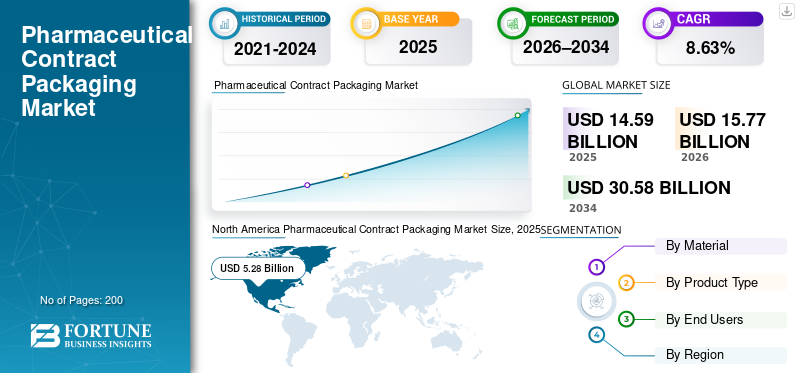
The global pharmaceutical contract packaging market size was valued at USD 14.59 billion in 2025 and is projected to grow from USD 15.77 billion in 2026 to USD 30.58 billion by 2034, exhibiting a CAGR of 8.63% during the forecast period. North America dominated the global pharmaceutical contract packaging market with a market share of 36.18% in 2025.
Pharmaceutical contract packaging includes outsourced packaging services offered by specialized third-party firms to manufacturers in the pharmaceutical and biopharmaceutical sectors in various dosage forms. The growing trend of pharmaceutical outsourcing, coupled with escalating regulatory complexities and the necessity for cost-effectiveness, is fueling the demand for contract packaging services. Drug manufacturers are in search of flexible, compliant, and scalable packaging solutions, allowing them to avoid the need for investment in internal infrastructure.
Furthermore, many key industry players, such as West Pharmaceutical Services, Inc., Nipro Corporation, and CCL Industries, are focusing on developing innovative products and conducting R&D activities.
Download Free sample to learn more about this report.
PHARMACEUTICAL CONTRACT PACKAGING MARKET KEY TAKEAWAYS
 Market Size & Forecast
- 2025 Market Size: USD 14.59 Billion
- 2026 Market Size: USD 15.77 Billion
- 2034 Forecast Market Size: USD 30.58 Billion
- CAGR: 8.63% from 2026–2034
 Market Share
- North America dominated the pharmaceutical contract packaging market with a 36.18% share in 2025.
- The plastic segment held the largest market share in 2025 due to its versatility, cost efficiency, and regulatory compliance.
- The bottles segment dominated the market in 2025 owing to its superior product protection, convenience, and wide applicability across pharmaceutical formulations.
 Key Regional Highlights
North America
North America remained the leading regional market, reaching USD 5.28 billion in 2025.
Asia Pacific
Asia Pacific accounted for USD 3.74 billion in 2025, driven by expanding pharmaceutical manufacturing, growing generics production.
Europe
Europe reached USD 1.96 billion in 2025 and is projected to grow at a CAGR of 8.28%.
U.S.
The market was valued at approximately USD 4.19 billion in 2025.
Japan
The market reached around USD 0.50 billion in 2025.
Read More

PHARMACEUTICAL CONTRACT PACKAGING MARKET TRENDS
Adoption of Advanced Serialization, Automation, and Smart Packaging Technologies is a Prominent Trend
The implementation of advanced serialization, automation, and smart packaging technologies increasingly influences the global market. Stringent track-and-trace regulations in the U.S., Europe, and certain regions of Asia are urging pharmaceutical companies to collaborate with contract packagers that provide comprehensive serialization, aggregation, and data management solutions. Automation is becoming more significant as providers allocate resources for high-speed packaging lines, robotics, and vision inspection systems. Moreover, smart packaging elements such as QR codes, NFC-enabled labels, and tamper-evident designs are being embraced to enhance supply-chain visibility and patient interaction.
Sustainability is also emerging as a crucial trend, with contract packagers progressively utilizing recyclable materials and lightweight formats. Collectively, these advancements are transforming contract packaging into a technology-driven, value-added service model.
Download Free sample to learn more about this report.
MARKET DYNAMICS
MARKET DRIVERS
Increasing Outsourcing to Improve Cost Efficiency and Operational Flexibility is Driving Market Growth
One of the key factors propelling the global market is the increasing inclination of pharmaceutical and biopharmaceutical manufacturers to outsource their packaging operations. As the costs associated with drug development continue to escalate and product lifecycles become shorter, companies are directing their internal resources towards core functions such as research, clinical development, and marketing.
Contract packagers offer specialized regulatory expertise, assisting pharmaceutical firms in navigating the intricate requirements of labeling, serialization, and compliance across various regions. Additionally, the need for a quicker time-to-market serves as another significant driver, as seasoned contract packaging partners can expedite product commercialization through efficient processes and established infrastructure. Collectively, these advantages position contract packaging as a vital strategic option rather than merely a cost-reduction tactic.
MARKET RESTRAINTS
High Regulatory Burden and Compliance-Related Operational Complexity Hampers Market Growth
Despite its potential for growth, the pharmaceutical contract packaging sector encounters considerable limitations due to the substantial regulatory demands linked to pharmaceutical packaging. Ensuring adherence to regulations across various regions heightens operational complexity and necessitates ongoing investment in quality management systems, audits, team member training, and documentation. Even slight discrepancies in labeling, packaging integrity, or data reporting can pose challenges.
Moreover, frequent updates to regulations and the evolution of compliance frameworks require continuous adjustments in processes and technological enhancements, thereby escalating operational expenses. This regulatory pressure serves as a constraint by elevating entry barriers, hindering expansion into new markets, and amplifying overall operational risks within the industry.
MARKET OPPORTUNITIES
Growing Demand for Biologics, Specialty Drugs, and Personalized Medicines Offers Potential Market Growth Opportunities
The swift expansion of biologics, specialty pharmaceuticals, and personalized medicines offers a considerable growth opportunity for the global market. These sophisticated therapies frequently entail intricate formulations, reduced batch sizes, and rigorous storage and handling requirements, which include cold-chain and sterile packaging solutions. Moreover, the increasing prevalence of orphan drugs and personalized treatments is heightening the demand for adaptable, small-scale, and tailored packaging solutions, which contract packagers are ideally equipped to deliver.
As pharmaceutical pipelines transition towards high-value, low-volume therapies, contract packaging providers that commit to specialized equipment, cold-chain logistics, and regulatory knowledge are poised for long-term growth and enhance strategic alliances with drug manufacturers.
MARKET CHALLENGES
Cost Pressures, Capacity Management, and Supply Chain Disruptions Pose a Critical Challenge to Market Growth
A significant challenge in the pharmaceutical contract packaging market growth is the need to manage cost pressures while ensuring high quality and adherence to regulatory standards. Rising labor expenses, escalating energy costs, and variable prices of packaging materials including plastics, paperboard, and aluminum have a direct effect on operating margins. Moreover, the competition among contract packaging providers is becoming more intense, exerting pressure on pricing and the need for differentiation.
Effectively addressing these challenges necessitates robust supplier relationships, operational flexibility, disruptions in supply chains, ongoing investment in technology, and the capability to consistently deliver quality in a highly regulated competitive landscape.
Segmentation Analysis
By Material
Versatility, Cost Efficiency, and Regulatory Compliance Drive the Dominance of Plastic Segment
Based on the material, the market is divided into plastic, paper & paperboard, glass, aluminum, and others.
The plastic segment is expected to account for the largest pharmaceutical contract packaging market share. The segment leads owing to its unparalleled blend of versatility, cost-effectiveness, and adherence to regulatory standards. Plastics are extensively utilized for both primary and secondary packaging of tablets, capsules, injectables, and liquid formulations.
Their lightweight characteristics lower transportation and storage expenses, while their high durability guarantees protection of products from moisture, light, and contamination. In summary, the integration of economic, functional, and regulatory benefits propels the extensive prevalence of plastic in the market.
The paper and paperboard segment is expected to grow at a CAGR of 8.74% over the forecast period.
By Product Type
Convenience, Protection, and Versatility Drive the Governance of Bottles Product Type
Based on product type, the market is segmented into bottles, vials & ampoules, blister packs, boxes & cartons, trays, and others.
In 2025, the bottles segment dominated the global market owing to its capacity to provide convenience, child resistance, safeguard products, and offer versatile applications across various drug forms. Bottles serve as a robust and dependable solution for packaging tablets, capsules, powders, and liquid formulations.
Their rigid design guarantees protection against physical damage, moisture, light, and contamination, which is essential for preserving drug stability and prolonging shelf life. A blend of protection, convenience, versatility, and ensuring compliance with regulations ensures that bottles continue to be the most prevalent packaging type, addressing the changing requirements of both manufacturers and patients.
The vials and ampoules segment is projected to grow at a CAGR of 8.71% over the forecast period.
By End Users
To know how our report can help streamline your business, Speak to Analyst
Pharmaceutical & Biotechnology Segment Leads Due to High Product Complexity, Regulatory Needs, and Outsourcing Trends
Based on the end users, the market is segmented into pharmaceutical & biotechnology companies, vaccine manufacturers, and others.
The pharmaceutical & biotechnology companies segment currently leads and is also expected to hold a dominant market share over the forecast period. The pharmaceutical and biotechnology sector leads primarily due to the intricate nature of their products, rigorous regulatory standards, and growing trend of outsourcing packaging functions.
Contract packaging companies provide the necessary expertise, technology, and infrastructure to comply with these requirements, thereby minimizing the risk of errors, pharmaceutical product recalls, or regulatory sanctions. Additionally, the increasing prevalence of biologics, specialty medications, and high-value drugs heightens the demand for advanced, small-batch, and patient-focused packaging solutions. In summary, the intricate nature of pharmaceutical and biotechnology products, coupled with stringent regulatory adherence and the operational advantages of outsourcing, propels this sector's leadership, establishing it as the largest and most rapidly expanding end-user category.
The vaccine manufacturers segment is projected to grow at a CAGR of 7.69% over the forecast period.
Pharmaceutical Contract Packaging Market Regional Outlook
By geography, the market is categorized into Europe, North America, Asia Pacific, Latin America, and the Middle East & Africa.
North America
North America Pharmaceutical Contract Packaging Market Size, 2025 (USD Billion)
To get more information on the regional analysis of this market, Download Free sample
North America held the dominant share in 2024, valued at USD 4.88 billion, and maintained its leading position in 2025, with a value of USD 5.28 billion. The market in North America is propelled by significant investments in pharmaceutical research and development, rigorous regulatory requirements, and the implementation of cutting-edge packaging technologies. Companies in the U.S. are progressively outsourcing their packaging processes to guarantee adherence to FDA regulations, serialization protocols, and anti-counterfeiting strategies.
U.S. Pharmaceutical Contract Packaging Market
Based on North America’s strong contribution and the U.S. dominance within the region, the U.S. market reached around USD 4.19 billion in 2025, accounting for roughly 28.70% of global sales. In the U.S., the market is driven by stringent FDA regulations, serialization requirements, and anti-counterfeiting measures. The substantial volume of biologics, specialty medications, and intricate therapies heightens the need for contract packaging services equipped with cutting-edge technology, regulatory knowledge, and effective supply-chain management, establishing the U.S. as a significant market on a global scale.
Asia Pacific
Asia Pacific reached USD 3.74 billion in 2025 and secured the position of the second-largest region in the market. In the region, India and China are both were valued at USD 1.00 billion and USD 1.20 billion, respectively, in 2025. The growth of the Asia Pacific market is driven by a swiftly expanding pharmaceutical manufacturing industry, increase in generics production, and rise in healthcare spending. Additionally, factors such as cost efficiency, availability of labor, and scalable infrastructure further contribute to the market operations in the region.
Japan Pharmaceutical Contract Packaging Market
The Japanese market in 2025 reached around USD 0.50 billion, accounting for roughly 3.42% of global market revenues. The growth of Japan's market is propelled by an aging demographic, increasing demand for specialized medications, and stringent regulations set by the Pharmaceuticals and Medical Devices Agency (PMDA). Pharmaceutical firms are progressively outsourcing their packaging processes to guarantee compliance, uphold product stability, and implement patient-focused packaging solutions, particularly for high-value biologics and generics.
China Pharmaceutical Contract Packaging Market
China’s market is projected to be one of the largest globally, with 2025 revenues being around USD 1.20 billion, representing roughly 8.19% of global market sales.
India Pharmaceutical Contract Packaging Market
The Indian market in 2025 reached USD 1.00 billion, accounting for roughly 6.86% of global revenue markets.
Europe
Europe is projected to grow at 8.28% over the coming years, the third-highest among regions, and reach a valuation of USD 1.96 billion by 2025. In Europe, adherence to EU directives, track-and-trace regulations, and initiatives aimed at patient safety are key factors influencing the contract packaging market. The significant presence of multinational pharmaceutical firms, coupled with an emphasis on sustainability, promotes the outsourcing of services to providers that deliver environmentally friendly packaging options and benefits in serialization and track and trace.
U.K Pharmaceutical Contract Packaging Market
The U.K. market in 2025 was valued at USD 0.37 billion, representing approximately 2.55% of global market revenues.
Germany Pharmaceutical Contract Packaging Market
Germany’s market reached USD 0.42 billion in 2025, equivalent to around 2.90% of global market sales.
Latin America and the Middle East & Africa
The Latin America and Middle East & Africa regions are expected to witness moderate growth in this market space during the forecast period. The Latin America market reached the valuation of USD 2.12 billion in 2025. In the Latin America region, the market is mainly propelled by the growth of local pharmaceutical production, the rising incidence of chronic diseases, and enhanced access to healthcare.
In the Middle East & Africa, South Africa is set to reach USD 0.41 billion in 2025. The Middle East & Africa market is propelled by the escalating demand for pharmaceuticals, heightened investments in healthcare infrastructure, and an increasing emphasis on regulatory compliance.
Saudi Arabia Pharmaceutical Contract Packaging Market
The Saudi Arabian market is projected to reach approximately USD 0.59 billion by 2025, accounting for roughly 4.02% of global revenues.
COMPETITIVE LANDSCAPE
Key Industry Players
Focus on Expanding Product Launch and Acquisitions by Key Players to Boost Their Market Positions
The global market has a semi-consolidated structure, with prominent players including West Pharmaceutical Services, Inc., Nipro Corporation, and CCL Industries. The significant market shares of these companies are due to numerous strategic initiatives, including collaborations among operating entities for advanced research.
- For instance, in October 2024, Nipro PharmaPackaging, a worldwide supplier of glass tubing, glass primary packaging, and medical devices, introduced its latest D2F (Direct-to-Fill) glass vials, which incorporate Stevanato Group’s EZ-fill technology, to provide a premium ready-to-use (RTU) solution. The D2F glass vials are thoroughly washed, depyrogenated, packaged in nest & tub formats, and sterilized, ensuring a reliable RTU solution. Pharmaceutical companies can seamlessly incorporate these vials into their aseptic fill-finish processes.
Other notable players in the global market include Sharp Services LLC, Gerresheimer AG, and Schott AG. These companies are expected to prioritize new product launches, strategic partnerships, and collaborations to increase their global market shares during the forecast period.
LIST OF KEY PHARMACEUTICAL CONTRACT PACKAGING COMPANIES PROFILED
- West Pharmaceutical Services, Inc. (U.S.)
- Nipro Corporation (Japan)
- CCL Industries (Canada)
- Sharp Services LLC (U.S.)
- Gerresheimer AG (Germany)
- Schott AG (Germany)
- Nelipak Healthcare (U.S.)
- Catalent Pharma Solutions (U.S.)
- AbbVie Contract Manufacturing (U.S.)
- AptarGroup Inc. (U.S.)
- PCI Pharma Services (U.S.)
- Adelphi Healthcare Packaging (U.K.)
- Daito Pharmaceutical Co., Ltd. (Japan)
- Tjoapack (Netherlands)
- Vetter Pharma International GmbH (Germany)
KEY INDUSTRY DEVELOPMENTS
- January 2026: SÜDPACK Medica has launched a new service called MedHub. With immediate effect, customers can easily place orders for high-quality, pre-made pouches available in standard sizes and specified batch quantities – via phone, email, or online. Produced in ISO-certified cleanrooms, the MedHub packaging solutions are consistently in stock and, naturally, meet the rigorous quality standards of the healthcare sector.
- January 2026: Vetter, a provider of pharmaceutical services specializing in the production of injectable medications, revealed its purpose to establish a new manufacturing facility in the Saarland area of Southwestern Germany. This development represents a crucial step in the company’s overarching global growth strategy. Concurrently, the firm has also initiated the construction of a new clinical production site in Des Plaines, Illinois, U.S.
- January 2026: Sharp invested over USD 23.8 million to enhance its injectable packaging, assembly, and cold-chain storage capabilities at its facilities located in Belgium, Hamont-Achel, and the Netherlands. This expansion accommodates various injectable formats and is part of a broader investment of USD 100 million which was announced in November 2025.
- December 2025: SteriPack, a global Contract Design and Manufacturing Organization (CDMO) serving the pharmaceutical and medical device sectors, has declared a change in its trading name to Ensera, indicating a strategic evolution in its identity and service portfolio. In conjunction with this change, its design consultancies, HS Design and Kinneir Dufort, operate under a single name: Ensera Design.
- February 2021: Sepha, located in Belfast, has introduced a contract packaging service to address the increasing demand for small batch drug production. Sepha's contract packaging division will function from a newly established packaging facility in Belfast, which is equipped with a variety of specialized blister packaging machinery. This facility will support a wide array of small-batch packaging projects, including cold-form and thermoform blisters, MAP packs, trays for medical devices, as well as packaging that is controlled for temperature and humidity.
REPORT COVERAGE
Request for Customization to gain extensive market insights.
Report Scope & Segmentation
|
ATTRIBUTE |
DETAILS |
|
Study Period |
2021-2034 |
|
Base Year |
2025 |
|
Estimated Year |
2026 |
|
Forecast Period |
2026-2034 |
|
Historical Period |
2021-2024 |
|
Growth Rate |
CAGR of 8.63% from 2026-2034 |
|
Unit |
Value (USD Billion) |
|
Segmentation |
By Material, Product Type, End Users, and Region |
|
By Material |
|
|
By Product Type |
|
|
By End Users |
|
|
By Region |
|
Frequently Asked Questions
According to Fortune Business Insights, the global market value stood at USD 14.59 billion in 2025 and is projected to reach USD 30.58 billion by 2034.
In 2025, the market value for North America stood at USD 5.28 billion.
The market is expected to grow at a CAGR of 8.63% over the forecast period.
By material, the plastic segment leads the market.
Increasing outsourcing to improve cost efficiency and operational flexibility is driving market growth.
West Pharmaceutical Services, Inc., Nipro Corporation, and CCL Industries are the major players in the global market.
North America dominated the market in 2025.



- 2021-2034
- 2025
- 2021-2024
- 200
-
(Offer valid till 15th Oct 2026)
Get 30-60 hrs Free Customization
Expand Regional and Country Coverage, Segments Analysis, Company Profiles, Competitive Benchmarking, and End-user Insights.







Related Reports
-
US +1 833 909 2966 ( Toll Free )
-
Get In Touch With Us