Conveyor Oven Market Size, Share & Industry Analysis, By Type (Electric, Gas, and Hybrid), By Belt Type (Stainless Steel, Teflon, and Mesh), By Heating Technology (Infrared, Convection, and Impingement), By End User (QSRs, Full-Service Restaurants, Food Processing & Manufacturing Facilities, and Others), and Regional Forecast, 2026-2034
 Download Free Sample
(Offer valid till 15th Aug 2026)
Conveyor Oven Market Size and Future Outlook
 Listen to Audio Version
The global conveyor oven market size reached USD 370 million in 2025. It is projected to grow from USD 379.81 million in 2026 to USD 499.47 million by 2034, exhibiting a CAGR of 3.48% over the forecast period. North America dominated the global conveyor oven market with a market share of 38.88% in 2025.
The industry is expanding at a stable growth rate led by its prominent application in the food services industry, including full-service restaurants, Quick Service Restaurants (QSRs), bakeries, pizza chains, cafes & bistros, and food processing facilities. These ovens are used for making bakery products, sandwiches, pizza baking, and other ready-to-eat foods, due to their ability to deliver uniform cooking with minimal labor intervention. Global expansion of the food industry, increased demand for labor-efficient and automated kitchen equipment. The growing number of QSR franchise and chains, post COVID transition toward high volume and standardized food preparation also drive market growth. For example, Domino’s, a global pizza-focused QSR alone operates 21,000 outlets globally, each mostly relying on conveyor ovens for daily operations- remarking the strong structural demand.
The global market is dominated by Illinois Tool Works (ITW), Alto-Shaam, Middleby Corporation, Welbilt (Ali Group), and RATIONAL AG. These players have a solid presence due to their strong brand recognition, diverse product offerings, and solid distribution network penetration. The primary strategies of these industry participants include product differentiation, collaborations and acquisition, and geographic expansion.
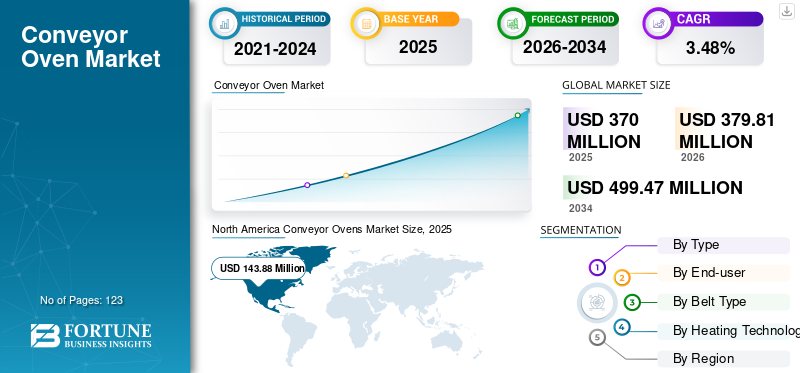
Download Free sample to learn more about this report.
Conveyor Oven Market Key Takeaways
 Global Market Size & Forecast
- 2025 Market Size: USD 370 million
- 2026 Market Size: USD 379.81 million
- 2034 Forecast Market Size: USD 499.47 million
- CAGR: 3.48% from 2026–2034
 Market Share
- North America dominated the conveyor oven market with a 38.88% share in 2025.
- The food processing & manufacturing facilities segment is expected to grow at a CAGR of 4.03% during the forecast period.
- The teflon segment is expected to record the fastest CAGR of 4.32% during the forecast period.
 Key Regional Highlights
North America
North America led the global market, reaching USD 0.14 billion in 2025.
Europe
Europe held a 26.46% market share with a valuation of USD 0.10 billion in 2025.
Asia Pacific
Asia Pacific secured the third-largest position, reaching USD 0.08 billion in 2025.
U.S.
The conveyor oven market reached approximately USD 0.13 billion in 2025, accounting for 34.97% of global revenue.
Japan
The conveyor oven market reached around USD 0.01 billion in 2025.
Read More

CONVEYOR OVEN MARKET TRENDS
Transition toward Advanced and Energy-Efficient Automated Kitchen Equipment
A key trend in the market is the rising adoption of smart and energy-efficient oven technologies that integrate programmable cooking settings, advanced controls, and enhanced insulation to lower energy utilization and improve cooking consistency. The rising demand for hybrid and electric conveyor ovens support sustainability goals and regulatory mandates, while cutting-edge features enable operational optimization and real-time monitoring. This trend is prominently strong among food processing outlets and QSR chains seeking standardization, improved kitchen efficiency and cost-efficient alternatives.
Download Free sample to learn more about this report.
MARKET DYNAMICS
Market Drivers
Rapid Expansion of Quick Service Restaurants’ to Drive Market Growth
The swift growth and extension of quick service restaurants is a primary factor leading the global conveyor oven market growth. These establishments demand convenient, high-speed, high-throughput, and scalable cooking solutions without compromising on quality and taste. Conveyor ovens enable QSRs to manage bulk order volumes while upholding food quality, particularly for pizza, sandwiches, and other bakery items. The increasing penetration of multinational and domestic QSR chains in developing economies, combined with rising demand for takeaway and at home delivery services, continues to bolster adoption of conveyor based ovens. This is applicable across commercial kitchens globally that drives overall market growth.
Growing Emphasis on Kitchen Automation and Labor Efficiency to Reduce Human Intervention
Rising operational costs and labor shortages are prompting foodservice operators to seek automated cooking machinery and equipment, generating demand for conveyor based ovens. These automated ovens not only shorten operational time, cooking cycles, but also reduce human intervention. They even ensure repeatable results and assist operators improve productivity, profitability and optimize staffing levels. Moreover, advancements in ventless designs and energy-efficient heating technologies permit conveyor based ovens to fit space-constrained modern kitchens or cloud kitchen concepts. This further reinforces their adoption across food processing and foodservice facilities.
Market Restraints
High Initial Capital Investment and Installation Constraints Obstruct Market Growth
Higher upfront costs and installation complications associated with these ovens stands as a key hurdle, especially for small and independent foodservice operators. Compared to traditional batch ovens, conveyor ovens require greater capital investment, along with additional expenses associated with ventilation systems, space requirements, and utility upgrades. These infrastructure and cost limitations often discourage adoption in limited-budget establishments, especially in emerging economies that restrict market penetration despite long-term operational efficiency benefits.
Market Opportunities
Rising Adoption of Electric Conveyor Ovens To Generate Sustainable Cooking Solutions
The growing demand for electric and ventless conveyor ovens presents a lucrative opportunity encouraged by rising stricter regulatory mandates and strong emphasis on sustainability initiatives. Moreover, the expansion of delivery-only formats and ghost kitchens are fostering the shift towards electric, ventless cooking solutions. These ovens consume less energy, eliminate the need for complex ventilation infrastructure, and enable rapid deployment by making them highly attractive alternatives for modern day kitchen environments that seek flexibility and compliance.
Market Challenges
Utility Infrastructure Dependence and Volatility in Energy Costs to Pose a Challenge
The global market faces a major challenge of fluctuating energy prices and irregular utility infrastructure reliance. Conveyor ovens work 24/7 and utilize electricity or gas significantly, making operating costs highly sensitive to energy price volatility. In regions with high utility tariffs or unstable power sources, foodservice operators may delay limit usage or equipment upgrades. This challenge intricates purchasing decisions, impacts long-term operating cost calculations, and hampers adoption in developing and cost-sensitive markets.
Segmentation Analysis
By Type
Electric Ovens to Dominate the Segment Growth as they are Easier to Install
Based on type, the market is divided into electric, gas, and hybrid.
The electric segment dominates the global conveyor oven market share. Electric ovens are easier to install compared to gas ovens, as they do not require complex gas pipelines, ventilation systems, or combustion safety measures. This makes them especially attractive for urban kitchens, food courts, malls, and cloud kitchens where infrastructure constraints are common.
The hybrid segment is expected to grow at the fastest CAGR during the forecast period.
To know how our report can help streamline your business, Speak to Analyst
By End-user
Increasing Demand for Continuous Cooking Process to Dominate QSRs Segment Growth
Based on end-user, the market is divided into QSRs, full-service restaurants, food processing & manufacturing facilities, and others.
The QSRs segment held the majority of market share in 2025. Conveyor ovens allow QSRs to cook large quantities of food, such as pizzas, sandwiches, wraps, and baked snacks at a consistent pace while maintaining uniform quality. This continuous cooking process supports peak-hour demand and minimizes customer wait times, which is critical for QSR success.
The food processing & manufacturing facilities segment is expected to grow at the second-fastest CAGR of 4.03% during the forecast period.
By Belt Type
Stainless Steel Dominates as it Withstand High Temperatures During Operations Dominating
Based on belt type, the market is divided into stainless steel, teflon, and mesh.
The stainless-steel segment led the market with a share of 57.98% in 2025. Steel belts can withstand continuous operation at very high temperatures without warping, cracking, or degrading. This makes them ideal for QSRs, pizzerias, bakeries, and industrial kitchens where conveyor-based ovens run for long hours every day.
The teflon segment is expected to grow at the fastest CAGR of 4.32% during the forecast period.
By Heating Technology
Impingement Technology Leads at it uses High-velocity Jets, Ideal for Restaurants
Based on heating technology, the market is subdivided into infrared, convection, and impingement.
The impingement segment accounted for the largest share of 52.01% in 2025. Impingement technology uses high-velocity jets of hot air directed onto the food surface, significantly reducing cooking time compared to conventional radiant or conduction heating. This makes impingement conveyor ovens ideal for restaurants.
The infrared segment is growing at a CAGR of 4.45% during the forecast period.
Conveyor Oven Market Regional Outlook
By region, the global market analysis is segmented into North America, Europe, Asia Pacific, South America, and the Middle East & Africa.
North America
North America Conveyor Ovens Market Size, 2025 (USD Million)
To get more information on the regional analysis of this market, Download Free sample
North America reached USD 0.14 billion by 2025 and is projected to record the highest growth rate of 3.00% in the coming years. Foodservice operators in North America are more willing to invest in advanced kitchen equipment that offers long-term efficiency gains, reliability, and standardization, even if the initial cost is higher which is driving regional market growth.
U.S. Conveyor Oven Market
Based on North America’s robust contribution, the U.S. market approximated around USD 0.13 billion in 2025, accounting for roughly 34.97% of global market.
Europe
Europe held the second-dominant share in 2025 at USD 0.10 billion with a market share of 26.46%. The region’s growth is led by rapid expansion of quick-service restaurants, bakeries, and convenience food outlets, growing demand for energy-efficient and high-throughput cooking solutions, coupled with rigid EU guidelines for energy and emission regulations.
U.K. Conveyor Oven Market
The U.K. market in 2025 hit USD 0.01 billion, representing roughly 3.13% of global revenues.
Germany Conveyor Oven Market
Germany’s conveyor oven market reached approximately USD 0.02 billion in 2025, equivalent to 4.67% of global revenues.
Asia Pacific
Asia Pacific achieved USD 0.08 billion in 2025 and secured third position in the market. In the region, India and China are both estimated to reach USD 0.03 billion each in 2025.
Japan Conveyor Oven Market
The Japanese market reached around USD 0.01 billion in 2025, accounting for roughly 1.81% of global revenues. Sharp rise in Quick-Service Restaurants (QSRs), fast-casual dining outlets, bakeries, and café chains, all of which rely heavily on high-throughput and consistent cooking equipment such as conveyor ovens drive the country’s growth.
China Conveyor Oven Market
China’s conveyor oven market in 2025 captured USD 0.03 billion, representing roughly 7.19% of global revenues.
India Conveyor Oven Market
The India conveyor oven market was valued at USD 0.03 billion in 2025, accounting for roughly 6.81% of global revenues.
South America and the Middle East & Africa
The South America and the Middle East & Africa regions are expected to witness moderate growth during the forecast period and reached USD 0.03 billion in 2025. As restaurants upgrade from traditional cooking methods to automated and energy-efficient equipment, conveyor-based ovens are increasingly preferred for their productivity and consistency benefits, thus fostering market growth. The UAE captured USD 0.01 billion in 2025.
South Africa Dispenser Market
The South Africa conveyor oven market achieved USD 0.01 billion in 2025, representing roughly 1.09% of global revenues.
Competitive Landscape
Key Market Players
Increased Investment in Advanced Product Innovation to Boost Market Growth
Nowadays, the increasing investment in advanced product innovation is significantly boosting the market growth for conveyor ovens by improving efficiency, performance, flexibility, and return on investment for foodservice operators. Additionally, manufacturers are developing energy efficient, technologically advanced conveyor ovens that address the evolving needs of modern commercial kitchens, making these systems more attractive to a wider range of end users.
List of Key Conveyor Oven Companies Profiled in the Report
- Middleby Corporation (U.S.)
- Welbilt Inc. (U.S.)
- XLT Ovens (U.S.)
- TurboChef Technologies (U.S.)
- Moretti Forni (Italy)
- Ovention (Hobart / ITW Food Equipment Group) (U.S.)
- Davron Technologies (U.S.)
- Picard Ovens (Canada)
- Mahan Oven & Engineering Co., Inc. (U.S.)
- Unox S.p.A. (Italy)
Key Industry Developments
- January 2025: Prática Products launched the FIT Express conveyor oven, which targets emerging markets with compact and cost-effective designs, optimized for small and mid-sized foodservice operators.
- May 2024: Unox introduced the Speed.Pro hybrid conveyor oven platform, combining impingement and convection technologies to deliver higher cooking flexibility and menu versatility.
- February 2024: Welbilt, via its Lincoln brand, launched the FastBake™ Impingement Conveyor Oven, focusing on reduced cook times, improved energy efficiency, and consistent food quality for QSR chains.
- November 2023: Moretti Forni launched the T Series conveyor ovens, emphasizing multi-zone temperature control and premium performance for artisan bakery and pizza operators.
- January 2023: TurboChef Technologies launched an upgraded High-Throughput Conveyor (HHC) oven platform, integrating smarter digital controls and increased production capacity to meet the demands of fast-paced QSR environments.
- May 2022: XLT Ovens introduced the XLT Edge Series conveyor ovens, designed to improve energy efficiency and offer modular, stackable configurations suited for both large restaurant chains and space-constrained kitchens.
- March 2022: Middleby Corporation, through its Lincoln and WOW! brands, launched the next-generation WOW! Conveyor Oven Series. The new series features faster cooking times, enhances impingement technology, and has more compact footprint for high-volume QSR operations.
REPORT COVERAGE
The conveyor oven market research report provides a comprehensive analysis, focusing on key elements such as major companies, regional and market segmentation, regional analysis, product launch, competition landscape, supply chain analysis, competitive dynamics, type, end-user, belt type, and heating technology. Additionally, it offers insights into market trends and highlights significant developments within the industry. Beyond these aspects, it also examines various factors that have contributed to market growth in recent years.
Request for Customization to gain extensive market insights.
Report Scope & Segmentation
|
ATTRIBUTE |
DETAILS |
|
Study Period |
2021-2034 |
|
Base Year |
2025 |
|
Estimated Year |
2026 |
|
Forecast Period |
2026-2034 |
|
Historical Period |
2021-2024 |
|
Growth Rate |
CAGR of 3.48% from 2026 to 2034 |
|
Unit |
Value (USD Million) |
|
Segmentation |
By Type · Electric · Gas · Hybrid By Belt Type · Stainless Steel · Teflon · Mesh By Heating Technology · Infrared · Convection · Impingement By End User · QSRs · Full-Service Restaurants · Food Processing & Manufacturing Facilities · Others By Region North America (By Type, End-user, Belt Type, Heating Technology, and Country) · U.S. (By Type) · Canada (By Type) · Mexico (By Type) Europe (By Type, End-user, Belt Type, Heating Technology, and Country) · Germany (By Type) · U.K. (By Type) · France (By Type) · Italy (By Type) · Spain (By Type) · Rest of Europe (By Type) Asia Pacific (By Type, End-user, Belt Type, Heating Technology, and Country) · China (By Type) · India (By Type) · Japan (By Type) · Australia (By Type) · Rest of Asia Pacific (By Type) South America (By Type, End-user, Belt Type, Heating Technology, and Country) · Brazil (By Type) · Argentina (By Type) · Rest of South America (By Type) Middle East and Africa (By Type, End-user, Belt Type, Heating Technology, and Country) · South Africa (By Type) · UAE (By Type) Rest of the Middle East & Africa (By Type) |
Frequently Asked Questions
Fortune Business Insights says that the global market size is anticipated to be USD 379.81 million in 2026 and record a valuation of USD 499.47 million by 2034.
As per Fortune Business Insights, the North America’s market value stood at USD 143.88 million in 2025.
The global market will exhibit a CAGR of 3.48% during the forecast period of 2026-2034.
By type, the electric segment is predicted to dominate the market during the forecast period.
The rapid expansion of Quick Service Restaurants (QSRs) and fast-casual dining format is a key factor driving the global market.
Middleby Corporation, Welbilt Inc, XLT Ovens, and TurboChef Technologies (U.S.) are some of the leading players globally.
North America dominated the global market in 2025 by holding the largest share.



- 2021-2034
- 2025
- 2021-2024
- 123
-
(Offer valid till 15th Aug 2026)
Get 30-60 hrs Free Customization
Expand Regional and Country Coverage, Segments Analysis, Company Profiles, Competitive Benchmarking, and End-user Insights.



















-
US +1 833 909 2966 ( Toll Free )
-
Get In Touch With Us