Hydrochloric Acid Market Size, Share & Industry Analysis, By Grade (By-product, Synthetic Grade, and Others), By End-Use Industry (Chemicals, Steel and Metallurgy, Oil and Gas, Water and Wastewater Treatment, and Others), and Regional Forecast, 2026-2034
 Download Free Sample
Hydrochloric Acid Market Overview
 Listen to Audio Version
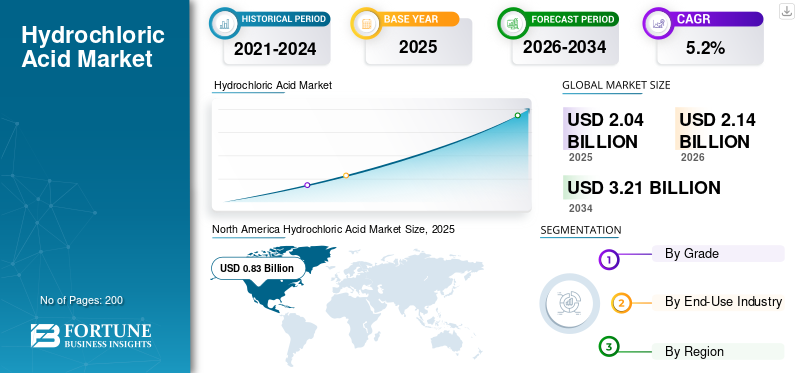
The global hydrochloric acid market size was valued at USD 2.04 billion in 2025. The market is projected to grow from USD 2.14 billion in 2026 to USD 3.21 billion by 2034, exhibiting a CAGR of 5.2% during the forecast period. North America dominated the hydrochloric acid market with a market share of 40.68% in 2025.
The market for hydrochloric acid is advancing steadily due to its critical role in fundamental chemical processing and industrial operations. Rising demand for efficient metal treatment, pH control, and chemical synthesis is supporting widespread adoption across steel manufacturing, oil and gas, water treatment, and food processing industries. Hydrochloric Acid (HCl) enables effective pickling of steel, regeneration of ion-exchange resins, and the production of key inorganic and organic compounds, making it indispensable to both upstream and downstream value chains. Increasing infrastructure development, expanding refining capacities, and growing emphasis on water purification and industrial cleaning processes are further driving the market growth.
Key companies such as Olin Corporation, Occidental Chemical Corporation, Westlake Corporation, Grasim Industries Limited, and INEOS are reinforcing their presence in the market by advancing product development, enhancing processing and manufacturing capacities, and strengthening their global supply.
Download Free sample to learn more about this report.
Hydrochloric Acid Market KEY TAKEAWAYS
 Market Size & Forecast
- 2025 Market Size: USD 2.04 Billion
- 2026 Market Size: USD 2.14 Billion
- 2034 Forecast Market Size: USD 3.21 Billion
- CAGR: 5.2% from 2026–2034
 Market Share
- North America dominated the hydrochloric acid market with a 40.68% share in 2025.
- The by-product segment holds the largest market share.
- The chemicals segment holds the largest market share.
 Key Regional Highlights
North America
North America accounted for USD 0.83 billion in 2025 and is projected to reach USD 0.87 billion in 2026.
Asia Pacific
Asia Pacific generated USD 0.20 billion in 2025, driven by chemical and steel production growth.
Europe
Europe reached USD 0.37 billion in 2025, driven by chemical manufacturing and industrial applications.
U.S.
The hydrochloric acid market was valued at USD 0.73 billion in 2025.
Japan
Strong chemical manufacturing, industrial processing, and water treatment demand support market growth.
Read More

HYDROCHLORIC ACID MARKET TRENDS
Rising Demand for Efficient Metal Processing and Pickling Applications is a Key Market Trend
A key trend in the market is the increasing demand for efficient metal processing, particularly in steel pickling operations. Industries such as construction, automotive, and heavy engineering rely heavily on treated steel surfaces to ensure product quality and durability. HCl is widely used to remove rust, scale, and impurities from steel, enabling smoother downstream processing and improved coating performance. As global steel production continues to expand alongside infrastructure and manufacturing growth, the need for reliable, cost-effective pickling solutions is growing.
- According to the U.S. Geological Survey (USGS), HCl is widely used in steel pickling operations to remove oxide scale from iron and steel surfaces, making it one of the most significant end-use applications directly tied to construction, automotive, and infrastructure development activities.
MARKET DYNAMICS
MARKET DRIVERS
Expanding Chemical Manufacturing Activities Driving Market Growth
The market is strongly driven by the increasing product use in the chemical industry, where it serves as a key raw material in a wide range of synthesis and processing applications. It is widely used in the production of inorganic compounds such as chlorides, as well as in organic chemical processes including vinyls, dyes, and pharmaceuticals, due to its high reactivity and effectiveness in pH control and neutralization. As global demand for chemicals continues to rise across sectors such as construction, plastics, healthcare, and agriculture, chemical production capacities are expanding, thereby driving the hydrochloric acid market growth.
- According to the U.S. Environmental Protection Agency (EPA), HCl is widely used in the production of organic and inorganic chemicals, metal processing, and pH control applications, confirming its critical role as a core input in the chemical manufacturing industry.
MARKET RESTRAINTS
Corrosive Nature and Handling Challenges Restraining Market Growth
The market faces constraints due to HCl's highly corrosive and hazardous nature, which creates significant challenges in storage, transportation, and handling. As a strong acid, it requires specialized materials, such as corrosion-resistant containers and lined storage tanks, and strict safety protocols to prevent leaks, exposure, and equipment damage. Industries that use HCl must invest in dedicated infrastructure, safety systems, and regulatory compliance measures, thereby increasing operational costs. Additionally, stringent environmental and workplace safety regulations governing the use and disposal of hazardous chemicals further limit flexibility in large-scale applications.
- According to the U.S. Occupational Safety and Health Administration (OSHA), HCl is classified as a highly corrosive substance that can cause severe skin burns and respiratory irritation, requiring strict handling procedures, protective equipment, and controlled storage conditions.
MARKET OPPORTUNITIES
Expansion of Water Treatment and Environmental Applications Creating Growth Opportunities
The market offers significant growth opportunities amid increasing focus on water treatment and environmental management across the industrial and municipal sectors. Hydrochloric acid is widely used for pH control, regeneration of ion exchange resins, and removal of impurities in water and wastewater treatment processes. As concerns over water scarcity, pollution control, and regulatory compliance continue to rise globally, governments and industries are investing heavily in water treatment infrastructure. This is driving higher demand for effective, reliable chemical solutions such as HCl.
- According to PubChem, HCl is widely used in water treatment, pH control, and chemical manufacturing processes, including neutralization and industrial purification.
Download Free sample to learn more about this report.
MARKET CHALLENGES
Environmental Regulations and Emission Control Challenges Impact Market Growth
The market faces challenges due to increasingly stringent environmental regulations associated with the production, storage, and use of HCl. Industrial processes involving HCl can generate acidic fumes and effluents that require proper treatment to prevent environmental contamination and health risks. Regulatory bodies across regions are enforcing strict limits on emissions, waste disposal, and chemical handling, compelling manufacturers to invest in advanced scrubbing systems, neutralization units, and compliance infrastructure.
- According to PubChem, HCl is a highly corrosive substance that releases irritating hydrogen chloride vapors, requiring controlled handling and ventilation systems during industrial use. This supports the need for strict emission control and regulatory compliance in manufacturing operations.
Segmentation Analysis
By Grade
Co-Product Availability from Chlor-Alkali Processes Supports the Dominance of the By-Product Segment
Based on grade, the market is segmented into by-product, synthetic grade, and others.
The by-product segment holds the largest hydrochloric acid market share, due to its extensive production as a secondary output in chlor-alkali and chlorination processes. HCl is commonly produced during the manufacture of chlorine, Vinyl Chloride Monomer (VCM), and other chlorinated compounds, making it readily available at a large scale without dedicated production costs. This cost advantage and consistent supply make by-product hydrochloric acid highly preferred across industries such as steel pickling, chemical processing, and water treatment. As global production of chlorine and related derivatives continues to grow, the by-product segment remains dominant due to its economic and supply-side advantages.
- According to Occidental Petroleum, HCl is primarily produced as a co-product of chlorination and chlor-alkali processes, particularly during the production of vinyl chloride and other chlorinated intermediates.
The synthetic grade segment is expected to grow at a CAGR of 5.5% over the forecast period.
By End-Use Industry
Extensive Use as a Core Raw Material Supports the Dominance of the Chemical Industry Segment
In terms of end-use Industry, the market is categorized into chemicals, steel and metallurgy, oil and gas, water and wastewater treatment, and others.
To know how our report can help streamline your business, Speak to Analyst
The chemicals segment holds the largest share of the market due to its widespread use as a fundamental raw material in numerous chemical synthesis and processing operations. HCl is widely used in the production of inorganic compounds, such as chlorides, and in organic chemical processes, including the production of vinyl chloride, dyes, and pharmaceuticals. Its strong acidic properties make it highly effective for pH control, neutralization, and catalytic reactions, enabling efficient large-scale manufacturing. The high volume consumption of HCL in integrated chemical complexes, where it is both produced and consumed within the same value chain, further strengthens its dominance.
- According to Lab Pro Inc., HCl is one of the most widely used industrial chemicals, accounting for approximately 30% of production and used in chemical manufacturing, including the production of vinyl chloride, bisphenol A, and various chlorinated intermediates.
The steel and metallurgy segment is expected to grow at a CAGR of 5.2% over the forecast period.
Hydrochloric Acid Market Regional Outlook
By geography, the market is categorized into North America, Europe, Asia Pacific, Latin America, and the Middle East & Africa.
North America Hydrochloric Acid Market Size, 2025 (USD Billion)
To get more information on the regional analysis of this market, Download Free sample
North America held the dominant position in the market in 2025, valued at USD 0.83 billion, and is expected to maintain its leading role in 2026, reaching USD 0.87 billion. The region’s leadership is supported by its highly developed chlor-alkali industry, strong integration of chemical manufacturing complexes, and large-scale production of chlorine and downstream derivatives, where HCl is generated and consumed. High demand from the chemical processing, steel pickling, oil & gas operations, and water treatment sectors significantly contributes to regional consumption.
U.S. Hydrochloric Acid Market
Based on North America’s strong contribution and the U.S. position as a leading chlor-alkali and chemical producer, the U.S. market was valued at USD 0.73 billion in 2025, accounting for approximately 88.7% of regional revenues. The country’s large-scale chemical manufacturing base, extensive product use in oil well acidizing, steel processing, and water treatment, along with its integrated production processes and systems, supports both domestic consumption and industrial-scale utilization.
To know how our report can help streamline your business, Speak to Analyst
Asia Pacific
Asia Pacific is a high-growth regional market with a valuation of USD 0.20 billion in 2025. Demand is driven by the region’s strong chemical manufacturing base, large-scale steel production, and expanding industrial activities across construction, automotive, and electronics sectors. HCl is widely used in steel pickling, chemical synthesis, and water treatment processes, all of which are growing rapidly as industrialization and infrastructure development continue.
China Hydrochloric Acid Market
The Chinese market in 2025 reached a valuation of USD 0.10 billion, accounting for approximately 53.6% of regional revenues. High demand is supported by the country’s position as a leading producer of chemicals and steel, with extensive product use in metal processing, chemical manufacturing, and industrial water treatment. China’s large-scale industrial base, strong domestic consumption, and continuous expansion of chemical production capacities contribute significantly to market expansion and regional dominance.
Europe
Europe is expected to demonstrate steady growth in the hydrochloric acid industry, reaching a valuation of USD 0.37 billion in 2025. The region’s development is supported by its well-established chemical industry, strong chlor-alkali production base, and advanced industrial infrastructure across Germany, France, and Italy. HCl is widely used in chemical synthesis, steel pickling, water treatment, and the pharmaceutical industry, all of which are integral to Europe’s industrial ecosystem.
Germany Hydrochloric Acid Market
Germany’s valuation reached USD 0.11 billion in 2025, accounting for approximately 29.6% of regional demand. Growth is driven by the country’s strong chemical manufacturing sector, along with its leadership in automotive, machinery, and industrial processing industries. Hydrochloric acid is extensively used in metal treatment, chemical production, and water treatment applications, supported by Germany’s advanced industrial capabilities and integrated production systems.
Latin America, and the Middle East, and Africa
Latin America and the Middle East & Africa are projected to experience steady market growth during the forecast period. The Latin America market reached a valuation of USD 0.27 billion in 2025, supported by expanding chemical manufacturing, rising steel production, and increasing demand for water treatment across the industrial and municipal sectors. The Middle East & Africa market was valued at USD 0.37 billion in 2025, driven by growth in oil and gas activities, chemical processing, and infrastructure development. HCl is widely used in oil well acidizing, metal processing, and pH control applications, all of which are expanding alongside industrialization and energy sector investments.
Brazil Hydrochloric Acid Market
The Brazilian market in 2025 was valued at USD 0.14 billion, accounting for approximately 52.5% of Latin America revenues. Demand is supported by the country’s growing chemical industry, expanding steel and metal processing activities, and increasing investments in water treatment infrastructure. Hydrochloric acid is widely used in chemical synthesis, steel pickling, and industrial cleaning applications, supported by Brazil’s strong industrial base and ongoing infrastructure development.
COMPETITIVE LANDSCAPE
Key Industry Players
High Capital Intensity and Integrated Production Structures Shape Market Competition
The market remains moderately consolidated, as large-scale hydrochloric acid production is closely linked to chlor-alkali operations and requires access to chlorine and hydrogen feedstocks, integrated chemical processing infrastructure, and efficient distribution networks. The need for continuous production systems, storage facilities, corrosion-resistant handling infrastructure, and regulatory compliance creates significant entry barriers for new participants.
Leading companies such as Olin Corporation, Occidental Chemical Corporation, Westlake Corporation, Grasim Industries Limited, and INEOS are expanding chlor-alkali capacity, optimizing by-product utilization, improving operational efficiency, and strengthening supply chain networks to maintain their competitive positions in the market.
LIST OF KEY HYDROCHLORIC ACID COMPANIES PROFILED
- Olin Corporation.(U.S.)
- Occidental Chemical Corporation (U.S.)
- Westlake Corporation (U.S.)
- Grasim Industries Limited. (India)
- Gujarat Alkalies and Chemicals Limited (India)
- Chemfab Alkalis Limited. (India)
- DCM SHRIRAM CHEMICALS (India)
- TGV SRAAC Ltd. (India)
- INEOS (U.K.)
- Vynova Group (Belgium)
KEY INDUSTRY DEVELOPMENTS
- November 2025: Olin Corporation entered a strategic partnership with Braskem to supply Ethylene Dichloride (EDC) under a long-term agreement aligned with Braskem’s transformation of its chlor-alkali and vinyl assets in Brazil, a development directly relevant to hydrochloric-acid-linked chlorinated value chains.
- February 2024: INEOS launched its Ultra Low Carbon Chlor-Alkali range, including caustic soda, caustic potash, and chlorine, with a stated carbon footprint reduction of up to 70% compared with industry averages.
- August 2022: Occidental Chemical Corporation (OxyChem) announced plans to modernize and expand its Battleground chlor-alkali plant in Houston, with completion expected in 2026.
REPORT COVERAGE
The global market analysis provides an in-depth study of the market size and forecast for all the market segments included in the report. It includes details on the market dynamics and market trends expected to drive the market over the forecast period. It offers information on technological advancements, new Grade launches, key industry developments, and details on partnerships, mergers, and acquisitions. The market research report also includes a detailed competitive landscape, including market share and profiles of key players.
Request for Customization to gain extensive market insights.
Report Scope & Segmentation
| ATTRIBUTE | DETAILS |
| Study Period | 2021-2034 |
| Base Year | 2025 |
| Estimated Year | 2026 |
| Forecast Period | 2026-2034 |
| Historical Period | 2021-2024 |
| Growth Rate | CAGR of 5.2% from 2026-2034 |
| Unit | Value (USD Billion) Volume (Kiloton) |
| Segmentation | By Grade, End-Use Industry, and Region |
| By Grade |
|
| By End-Use Industry |
|
| By Geography |
|
Frequently Asked Questions
Fortune Business Insights says that the global market size was valued at USD 2.04 billion in 2025 and is projected to reach USD 3.21 billion by 2034.
Recording a CAGR of 5.2%, the market is slated to exhibit steady growth during the forecast period.
The chemicals end-use industry segment is leading the market.
North America held the highest market share in 2025.
Expanding chemical manufacturing activities is the key factor driving the market.



- 2021-2034
- 2025
- 2021-2024
- 200
Get 30-60 hrs Free Customization
Expand Regional and Country Coverage, Segments Analysis, Company Profiles, Competitive Benchmarking, and End-user Insights.


















Related Reports
-
US +1 833 909 2966 ( Toll Free )
-
Get In Touch With Us