Hypochlorous Acid Market Size, Share & Industry Analysis, By Application (Healthcare & Wound/Skin Care, Food Processing & Agriculture, Water Treatment, Household & Institutional Cleaning, Industrial & Commercial Sanitation, and Others), and Regional Forecast, 2026-2034
 Download Free Sample
 Hypochlorous Acid Market Size and Future Outlook
 Listen to Audio Version
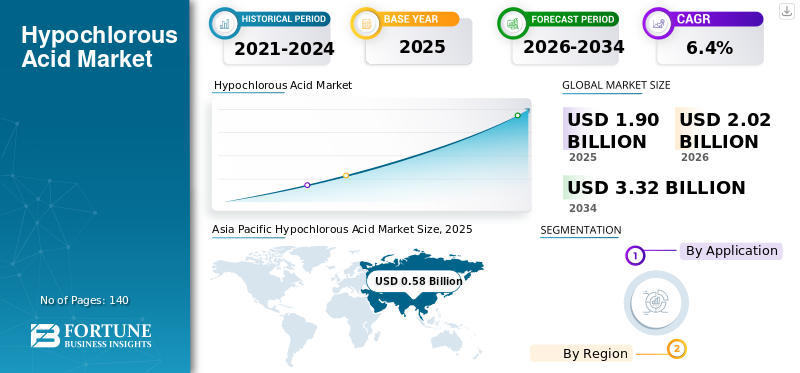
The global hypochlorous acid market size was valued at USD 1.90 billion in 2025. The market is projected to grow from USD 2.02 billion in 2026 to USD 3.32 billion by 2034, exhibiting a CAGR of 6.4% during the forecast period. Asia Pacific dominated the global hypochlorous acid market with a market share of 30.53% in 2025.
Hypochlorous acid (HOCI) is a reactive chlorine species that can be produced on-site through the electrochemical activation of brine, as well as manufactured as stabilized packaged solutions. In healthcare applications, HOCl solutions are commonly cited within the range of approximately 100-200 ppm of oxidative titratable chlorine; the WHO review acknowledges commercially available concentrations such as 0.05% (for injured skin) and 0.1% (for intact skin), and also references U.S.-approved wound-care solutions within the 100-200 ppm range. In food processing, the U.S. FDA environmental assessment for FCN 1811 describes the use of electrolytically generated HOCl as an antimicrobial intervention at a maximum of 60 ppm Free Available Chlorine (FAC) across multiple food categories.
Furthermore, the market is dominated by several major players, including Energenics Corporation, PathoSans, CleanSmart, Sonoma Pharmaceuticals, and Force of Nature, which are at the forefront. A broad portfolio, innovative product launches, and strong geographic presence expansion have supported the dominance of these companies in the global market.
Download Free sample to learn more about this report.
Hypochlorous Acid Market Key Takeaways
 Global Market Size & Forecast
- 2025 Market Size: USD 1.90 Billion
- 2026 Market Size: USD 2.02 Billion
- 2034 Forecast Market Size: USD 3.32 Billion
- CAGR: 6.40% from 2026–2034
 Market Share
- Asia Pacific dominated the hypochlorous acid market with a 30.53% share in 2025.
- The healthcare & wound/skin care segment held the largest market share in 2025.
- The food processing & agriculture segment accounted for a considerable market share in 2025.
 Key Regional Highlights
Asia Pacific
Asia Pacific led the market with a value of USD 0.58 billion in 2025.
North America
North America is projected to reach USD 0.78 billion by 2026.
Europe
Europe is projected to reach USD 0.47 billion by 2026, growing at a 5.4% CAGR.
U.S
The market is estimated to reach USD 0.67 billion by 2026.
Japan
The market is estimated to reach USD 0.13 billion by 2026.
Read More

HYPOCHLOROUS ACID MARKET TRENDS
On-site Generation and Chemical-Minimization Sanitation Programs to be a New Market Trend
A significant trend is the implementation of on-site hypochlorous acid generation systems that use salt and water (with electricity) to produce a ready-to-use sanitizer directly at the point of application. This approach minimizes the handling and storage of bulk oxidants and ensures a continuous supply in food processing facilities, retail food environments, and large-scale institutions. The United States Food and Drug Administration (FDA) Food Contact Notification (FCN) 1811 environmental assessment explicitly delineates the use of on-site electrolytic generation and the intended antimicrobial applications, such as water treatment, within processing plants, restaurants, and grocery stores.
Operationally, on-site production facilitates the implementation of make-and-use sanitation programs, enabling HOCl to be produced as needed and applied via spray, foam, or wash-water loops. This approach enhances site logistics and minimizes downtime associated with chemical deliveries. In high-throughput environments, economic factors are often influenced by the volume of water consumed (such as wash and rinse water) rather than the unit price per liter. Consequently, maintaining reliable concentration/ORP control and adherence to maintenance practices are essential for ensuring consistent effectiveness.
Download Free sample to learn more about this report.
MARKET DYNAMICS
MARKET DRIVERS
Integration of Hypochlorous Acid into Healthcare Practices to Drive Market Growth
The integration of hypochlorous acid into healthcare practices for wound and skin care is underpinned by its role as a tissue-compatible antiseptic. This framing is clinically significant as the trade-off between efficacy and tolerability is invariably central to wound management. In routine clinical practice, healthcare professionals and patients require antimicrobial control that does not exacerbate pain, dryness, or irritation, as such adverse effects can diminish adherence, particularly when cleansing procedures must be repeated over prolonged periods.
Hypochlorous acid is frequently marketed and utilized in low-concentration aqueous formulations for skin and wound cleansing. Its compatibility with living tissue facilitates its use alongside, or as an alternative to, more aggressive oxidizers or alcohol-based agents in protocols where patient comfort and the ability to perform repeated applications are paramount. Consequently, its adoption is often accelerated in scenarios where frequent cleansing and microbial load control are prioritized, such as in the management of chronic wounds, post-procedural skin care, and sensitive skin regions.
MARKET RESTRAINTS
Constraints Related to Stability and Shelf Life to Limit Market Growth
Constraints related to stability and shelf life limit the packaged use of HOCl due to its inherent chemical reactivity and decomposition pathways, which are accelerated by exposure to light, heat, metals, impurities, and pH variations. As concentrations vary, products may no longer meet specified performance claims, particularly in healthcare, food-contact, and institutional applications that demand consistent efficacy. This susceptibility necessitates strict supplier control over formulation, water quality, and storage conditions, often resulting in restricted geographic distribution, increased returns, and a shift toward on-site generation by customers. Manufacturers face higher packaging and validation costs, requiring opaque or UV-blocking containers, low-reactivity materials, and comprehensive testing to ensure shelf life and performance throughout distribution. These requirements contribute to elevated costs, delayed product launch timelines, and hindered adoption in price-sensitive markets where consumers prefer more stable disinfectants with cost effectiveness.
MARKET OPPORTUNITIES
Scaling Compliant On-Site HOCI Generation Systems to Create Lucrative Opportunities
Scaling compliant on-site HOCl generation systems, typically electrolyzed-water units utilizing salt, water, and electricity, enables facilities to produce substantial volumes of sanitizer “just in time." This capability is especially advantageous for high-throughput operations such as food processing plants, commercial kitchens, hospitals, and large public venues that require frequent, repeatable sanitation cycles. As chemistry is generated at the point of use, users can reduce reliance on packaged chemical deliveries, reduce storage and hazardous-handling requirements, and prevent product degradation associated with shelf life. Furthermore, such systems facilitate the standardization of concentration and dosing through automated controls.
As these systems are implemented across multiple wash lines or various locations within a facility, and are aligned with local compliance standards, such as equipment validation, monitoring logs, and operator standard operating procedures (SOPs), the economic benefits often become significantly more apparent. These benefits include a lower cost per liter of solution, reduced logistics and packaging expenses, decreased downtime due to stock-outs, and more predictable spending. Collectively, these advantages result in a lower total cost of ownership than the ongoing purchase of ready-to-use disinfectants for high-volume sanitation needs.
MARKET CHALLENGES
Claim Complexity and Fragmented Standards to Challenge Market Growth
The market for hypochlorous acid faces challenges related to claim confusion, such as HOCl versus hypochlorite and other chlorine species, as well as fragmented standards across regions, including biocidal, cosmetic, medical device, and disinfectant frameworks. These issues may complicate product positioning, documentation, and customer education, especially in the context of multi-region commercialization.
Operationally, on-site generation installations require maintenance, monitoring (e.g., concentration and ORP), and staff training to ensure ongoing effectiveness and regulatory compliance. In regulated environments, the obligation to document operational controls and verify performance may augment the overall program workload relative to traditional purchased chemicals.
Segmentation Analysis
By Application
To know how our report can help streamline your business, Speak to Analyst
Healthcare & Wound/Skin Care Segment Dominated as HOCl is Predominantly Marketed for Wound and Skin Antisepsis
In terms of application, the market is categorized into healthcare & wound/skin care, food processing & agriculture, water treatment, household & institutional cleaning, industrial & commercial sanitation, and others.
The healthcare & wound/skin care segment led the hypochlorous acid market share. Usage applications within the healthcare sector generally command higher blended pricing due to quality assurance measures, regulatory considerations, and channel diversification across clinics, pharmacies, and branded consumer products. HOCl is predominantly marketed for wound and skin antisepsis, where gentle tissue compatibility is considered essential, thereby supporting growing demand in higher-margin product formats. Moreover, this segment is anticipated to expand at an annual compound growth rate of 6.6% over the study period.
The household & institutional cleaning sector is experiencing substantial market growth. In domestic and institutional environments, the demand for hypochlorous acid is bolstered by an interest in low-odor, low-residue disinfecting sprays and surface sanitizers. This growth is frequently associated with product availability, retail penetration, and regulatory claims (where applicable), and is consistent across residences, educational institutions, workplaces, and public facilities. Moreover, this segment is anticipated to expand at an annual compound growth rate of 5.8% over the study period.
The food processing & agriculture sectors hold a considerable market share due to their use in wash and process water systems, including ice, across various categories. Regulatory clarity concerning electrolytically generated hypochlorous acid (e.g., FDA FCN 1811) facilitates its adoption in high-throughput settings where logistical simplification and residue considerations are paramount.
Hypochlorous Acid Market Regional Outlook
By geography, the market is categorized into North America, Europe, Asia Pacific, Latin America, and the Middle East & Africa.
Asia Pacific
Asia Pacific Hypochlorous Acid Market Size, 2025 (USD Billion)
To get more information on the regional analysis of this market, Download Free sample
In 2024, the Asia Pacific region held the largest market share at USD 0.54 billion and continued its leadership in 2025 with USD 0.58 billion. The region benefits from extensive food-processing capacity, significant facility sanitation requirements, and a rising consumer interest in skin-care mists and mild antimicrobials. Moreover, the growth of consumer skin-care and personal-care mists/sprays within a gentle antimicrobial positioning drives the regional hypochlorous acid market growth.
China Hypochlorous Acid Market
The China market in 2026 is estimated to be around USD 0.24 billion, accounting for roughly 11.8% of the global revenues. The demand for China is fueled by substantial food processing capacity and the necessity for facility sanitation, which underpin high-volume, on-site production models. Additionally, export-oriented hygiene and compliance standards encourage the use of validated antimicrobial interventions in food handling.
To know how our report can help streamline your business, Speak to Analyst
Japan Hypochlorous Acid Market
The Japanese market in 2026 is estimated to be around USD 0.13 billion, accounting for roughly 6.5% of the global revenues.
India Hypochlorous Acid Market
The Indian market in 2026 is estimated at around USD 0.09 billion, accounting for roughly 4.3% of global revenues.
Europe
Europe is expected to experience substantial market growth in the coming years. Over the forecast period, the European region is projected to grow at 5.4% and reach a valuation of USD 0.47 billion by 2026. Europe is primarily influenced by demand for healthcare, particularly in wound and skin care, alongside the increasing prominence of private-label cosmetics and the industrial hygiene sector. When HOCl is classified as either a medical product or a biocidal product, compliance pathways and labeling requirements play a crucial role in shaping commercialization strategies.
U.K. Hypochlorous Acid Market
The U.K. market in 2026 is estimated at around USD 0.09 billion, accounting for roughly 4.3% of global revenues.
Germany Hypochlorous Acid Market
Germany’s market in 2026 is estimated at around USD 0.09 billion, accounting for roughly 4.7% of global revenues.
North America
The North America hypochlorous acid market is expected to reach USD 0.78 billion by 2026. This region represents a high-value sector, underpinned by established wound-care and consumer skin-care channels, a sizable institutional cleaning infrastructure, and extensive utilization of EPA-registered disinfectants for hard-surface application. The Environmental Protection Agency (EPA) offers guidelines concerning the regulation and registration of surface disinfection products, thereby shaping market access for products bearing antimicrobial claims.
U.S. Hypochlorous Acid Market
Based on North America’s strong contribution and the U.S. dominance within the region, the U.S. market can be analytically approximated at around USD 0.67 billion in 2026, accounting for roughly 33.5% of global sales.
Latin America and the Middle East & Africa
Over the forecast period, it is anticipated that the Latin America and the Middle East & Africa regions will experience moderate growth within this market. The Latin America market is projected to reach USD 0.08 billion by 2026. Latin America and the Middle East & Africa are comparatively smaller markets but are expected to grow as institutional sanitation adoption increases, food export hygiene requirements become more stringent, and consumer HOCl product availability expands gradually.
GCC Hypochlorous Acid Market
The GCC market in 2026 is estimated at USD 0.03 billion, accounting for approximately 1.6% of global revenues.
COMPETITIVE LANDSCAPE
Key Industry Players
Regulatory Compliance, Stability Engineering, and On-Site System Deployment Capability are Core Differentiators
The market includes manufacturers specializing in healthcare applications of stabilized HOCl solutions, as well as providers of on-site generation systems for the food and facility sectors. Manufacturers such as Sonoma Pharmaceuticals emphasize their focus on stabilized HOCl products for wound- and skin-related applications. Providers of on-site systems highlight the continuous production of HOCl from salt and water at the point of use. Energenics Corporation, PathoSans, CleanSmart, Sonoma Pharmaceuticals, and Force of Nature are key players in the market.
LIST OF KEY HYPOCHLOROUS ACID COMPANIES PROFILED IN REPORT
- Energenics Corporation (U.S.)
- CleanSmart (U.S.)
- Force of Nature (U.S.)
- PathoSans (U.S.)
- Aquaox Solutions (U.S.)
- EWCO (U.S.)
- EcoloxTech (U.S.)
- Aqualution Systems (U.K.)
- Briotech / Brio Global (U.S.)
- Sonoma Pharmaceuticals (U.S.)
KEY INDUSTRY DEVELOPMENTS
- January 2024: Sonoma Pharmaceuticals announced the U.S. OTC launch of Lumacyn Clarifying Mist using stabilized HOCl, indicating continued product expansion into consumer skin-care formats.
- December 2020: Briotech announced manufacturing expansion and a move to an 82,000 sq. ft. facility to expand HOCl production and bottling capacity, citing increased demand and global deployment scale.
REPORT COVERAGE
The global hypochlorous acid market analysis provides an in-depth study of market size & forecast by all the market segments included in the report. It includes details on the market dynamics and market trends expected to drive the market during the forecast period. It offers information on technological advancements, new product launches, key industry developments, and partnerships, mergers & acquisitions. The market research report also includes a detailed competitive landscape, with market share and profiles of key operating players.
Request for Customization to gain extensive market insights.
Report Scope & Segmentation
|
ATTRIBUTE |
DETAILS |
|
Study Period |
2021-2034 |
|
Base Year |
2025 |
|
Estimated Year |
2026 |
|
Forecast Period |
2026-2034 |
|
Historical Period |
2021-2024 |
|
Growth Rate |
CAGR of 6.4% from 2026-2034 |
|
Unit |
Value (USD Billion) Volume (Kiloton) |
|
Segmentation |
By Application and Region |
|
By Application |
· Healthcare & Wound/Skin Care · Food Processing & Agriculture · Water Treatment · Industrial & Commercial Sanitation · Household & Institutional Cleaning · Others |
|
By Region |
· North America (By Application and Country) o U.S. (By Application) o Canada (By Application) · Europe (By Application, and Country/Sub-region) o Germany (By Application) o U.K. (By Application) o France (By Application) o Italy (By Application) o Rest of Europe (By Application) · Asia Pacific (By Application, and Country/Sub-region) o China (By Application) o Japan (By Application) o India (By Application) o South Korea (By Application) o Rest of Asia Pacific (By Application) · Latin America (By Application, and Country/Sub-region) o Brazil (By Application) o Mexico (By Application) o Rest of Latin America (By Application) · Middle East & Africa (By Application, and Country/Sub-region) o GCC (By Application) o South Africa (By Application) o Rest of the Middle East & Africa (By Application) |
Frequently Asked Questions
Fortune Business Insights says that the global market size was valued at USD 1.90 Billion in 2025 and is projected to reach USD 3.32 Billion by 2034.
Recording a CAGR of 6.4%, the market is slated to exhibit steady growth during the forecast period of 2026-2034.
The healthcare & wound/skin care application segment led the marker in 2025.
Asia Pacific held the highest market share in 2025.
Regulatory pathways for food-contact and public dining establishments are expanding to address the increasing sanitation demands and accelerate the adoption of hypochlorous acid.



- 2021-2034
- 2025
- 2021-2024
- 140
Get 30-60 hrs Free Customization
Expand Regional and Country Coverage, Segments Analysis, Company Profiles, Competitive Benchmarking, and End-user Insights.


















Related Reports
-
US +1 833 909 2966 ( Toll Free )
-
Get In Touch With Us