Smart Meter Market Size, Share & Industry Analysis, By Type (Smart Electric Meter, Smart Gas Meter, Smart Water Meter) By Technology (Automatic Meter Reading {AMR} and Advanced Meter Infrastructure), By Application (Residential, Commercial and Industrial), and Regional Forecast, 2026-2034
 Download Free Sample
Smart Meter Market Size and Industry Overview
 Listen to Audio Version
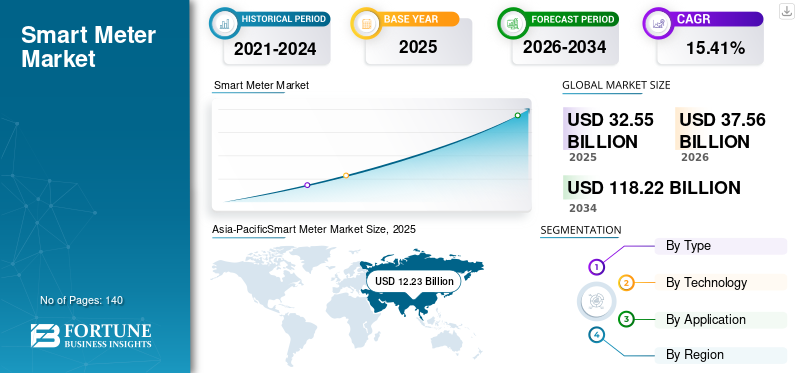
The global smart meter market size was valued at USD 32.55 billion in 2025 and is projected to grow from USD 37.56 billion in 2026 to USD 118.22 billion by 2034, exhibiting a CAGR of 15.41% during the forecast period. The growing demand for energy efficiency is driving the growth of the smart meter market. The Asia-Pacific smart meter market was valued at USD 12.23 billion in 2025. The Smart Meter Market in the U.S. is projected to grow significantly, reaching an estimated value of USD 10.22 billion by 2032.
As smart meters provide real-time data on energy usage, allowing users to make informed decisions on how to reduce their consumption. Smart meters are way more precise in terms of outputs as compared to the traditional meters being used for evaluating electricity, water, and gas consumption.
Download Free sample to learn more about this report.
SMART METER MARKET KEY TAKEAWAYS
 Market Size & Forecast
- 2025 Market Size: USD 32.55 billion
- 2026 Market Size: USD 37.56 billion
- 2034 Forecast Market Size: USD 118.22 billion
- CAGR: 15.41% from 2026–2034
 Market Share
- The Asia-Pacific smart meter market was valued at USD 12.23 billion in 2025.
- The introduction of renewable energy and construction of new electricity transmission grids will also help the market for electricity to rise.
- Construction of commercial offices and coming up of new small scale industries has driven installations.
 Key Regional Highlights
North America
The region is witnessing strong growth in smart meter installations due to increasing renewable energy generation, grid modernization projects, and expansion of transmission and distribution infrastructure.
Europe
Europe is experiencing steady market growth as countries continue to advance smart metering programs to improve energy efficiency, resource management, and utility operations.
Asia Pacific
Asia Pacific dominated the market and is expected to maintain its leadership position, driven by large-scale deployments of smart electricity, gas, and water meters across residential, commercial, and utility sectors.
U.S.
The country holds a significant share of the North American market, supported by extensive smart grid investments, advanced utility infrastructure, and widespread adoption of smart electricity meters.
Japan
Market growth is driven by ongoing grid modernization initiatives, increasing integration of renewable energy sources, and rising adoption of IoT-enabled energy management systems.
Read More

Smart Meter Market TRENDS
Modernization and Upgradation of Gridsto to Surge Installations
In recent years, rising population has surged the demand for energy across the globe. This has brought in other sources for power generation such as renewables and other new technologies such as CHP (combined heat and power plants) and district heating. These have created a demand for new grids and upgradation of the present ones. The increased customer base has forced utilities to adopt systems that ensure effective management of energy usage data.This is one of the leading trends that will positively drive the smart meter market as these meters serve many of the purposes required by the utilities and customers. For example, data storage for particular customers, automatic monthly billing, leak detections, economic benefits, and avoiding any unnecessary losses. Following this trend, the market is expected to witness healthy growth in the forth coming years.
Increasing Mobile Device Management Activities to Propel Market Growth
With the growing penetration of advanced systems in various fields, mobile device management activities have picked uppace across various markets. This trend is expected to be followed in this market as it brings in certain advantages for service providers and customers via the smart meter app that enables monitoring by customers. Also, increasing integration of Internet of Things (IoT) is enabling precise management of supply chains through algorithms that remove the need for any human interference. This reduces the chances of errors and malfunctioning.
Download Free sample to learn more about this report.
MARKET DRIVERS
Practices to Promote Sustainable Energy Management to Drive the Market
Looking at the increasing demand for energy along with depleting conventional sources of energy, governments of various countries are focusing on sustainable energy management. Along with other measures, these steps also involve smart metering. Reasons for this are the assistance of these meters in avoiding any wastage of energy, help in identifying the fault, and ensuring minimum time rectification. These meters also have the technology to notify the customer regarding its heavy usage and peak usage timings. The smart metering system has the capacity to map the energy usage throughout the supply chain and the ensuing hustle-free billing procedures. This has led to an increase in the number of service providers installing these systems, thereby driving the smart meter market.
Economical Advanatge And Smooth Billing Procedure To Propel The Market Growth
The meter acts as a feasible solution for utilities and customers. These meters offer advantages such as transparency during operation, precise billing, hastle free communication between service provider and end user and negligible maintenance. These also help in cost savings and energy savings for customer. In recent years the factor that has attracted numerous customers to install the meters, is the smooth billing procedure which can act as a catalyst to smart meter market growth.
MARKET RESTRAINT
High Capital and Lack of Knowledge Regarding the Advantages Can Hinder the Market Growth
Implementation of smart meter roll-out programs requires a huge investment in order to replace the current traditional meters with the smart ones, which have a higher cost. Also, the newly installed meters have to be equipped with mobile device management technology, which adds to the cost. Another critical factor is the lack of knowledge among customers regarding the operational advantages and cost savings offered over the installation of such advanced meters. These factors are expected to hamper the smart meter market growth during the given forecast period.
SEGMENTATION ANALYSIS
By Type Analysis
Growing Demand for Electricity to Surge Smart Electric Meter Installations
Based on type, the smart meter market is segmented into the smart electric meter, smart gas meter, and smart water meter. Electricity is one of the basic needs of today, and major countries have set targets to have 100% smart meters in their countries. This has led to smart meters segment dominating the market in recent years, and this trend is set to continue over the forecast period owing to rising population and urbanization that will further hike up the electricity demand in every country. The introduction of renewable energy and construction of new electricity transmission grids will also help the market for electricity to rise, according to the forecast.
By Technology Analysis
Operational Advantages Will Lead To Domination Of Advanced Metering Infrastructure
Based on technology, the smart meter market is segmented into auto meter reading and advanced metering infrastructure. Two way communication ability is the factor that separates advanced metering infrastructure from auto meter reading. This is bound to play an important role in coming years with utilities preferring their installation. Other operational advantages include accuracy, cost savings, and ease of communication in case of any malfunctioning.
By Application Analysis
To know how our report can help streamline your business, Speak to Analyst
Growing Number of Customers in Residential Sector Will Lead to Its Domination in the Market
In terms of application, the market is segmented into residential, commercial, and industrial. The residential sector will dominate the smart meter market as it holds the highest customer base in terms of electricity consumption and water consumption. Numerous steps are also being taken by governments to supply Liquified Petroleum Gas (LPG) through pipelines to residences, which will support the growth of the residential segment. The other factor responsible for the growth of the residential sector is urbanization, that has also led to market growth in commercial and industrial sector. Construction of commercial offices and coming up of new small scale industries has driven installations.
REGIONAL ANALYSIS
Asia-PacificSmart Meter Market Size, 2025 (USD Billion)
To get more information on the regional analysis of this market, Download Free sample
The smart meter market size in the Asia Pacific stood at USD 12.23 billion in 2018 and the region is expected to dominate the market. The market in the region is characterized by smart electric meter roll-outs, smart gas meters roll-outs, and smart water meter roll-outs to promote sustainable use of electricity, gas, and water, respectively. The region has witnessed the maximum hike in energy production using renewables in recent years that has led to the building of new grids along with new transmission and distribution lines. This has propelled smart meter installations in the region. Natural gas and water meters have a small presence as compared to electricity meters, but this share is expected to rise with the growing usage of IoT and mobile management of devices.
European countries such as the UK and Germany are focusing on smart metering, and in North America, the U.S. occupies a major smart meter market share. Latin America and the Middle East & Africa are expected to witness a healthy growth in installations of smart meters, that is currently having little penetration in both regions. Gulf Cooperation Council (GCC) countries, Brazil and Mexico are among the leading nations in rolling out installation plans.
KEY INDUSTRY PLAYERS
ABB, Siemens,and Landis + Gyr Are Among the Top Players to Propel the Market Fragmentation
The competitive landscape of the smart meter market depicts a monopoly dominated by ABB, Siemens, and Landis+Gyr. A wide reach in many parts of the world along with a diverse product portfolio are the prominent factors leading to their dominance in this market. Various advancements are still being brought by these players in order to improve the performance standards and to portray these meters as an economical source for evaluating energy consumption.
However, regional and domestic companies such as Kamsturp, Itron, Diehl, Aclara Technologies, Secure Meters Limited, Sensus, BMETER, Jabil, Honeywell, and ZENNER have entered the monopolistic market and are bringing in new smart metering technology and economical solutions. This is projected to positively impact the smart meter market growth as these companies are anticipated to gain share during the forecast period.
LIST OF KEY COMPANIES PROFILED:
- Siemens (Germany)
- ABB (Switzerland)
- Kamsturp (Denmark)
- Itron (US)
- Landis + Gyr (Switzerland)
- Badger Meter (US)
- Diehl (Germany)
- Secure Meter Limited(UK)
- Aclara Technologies (US)
- Sensus (US)
- BMETER (UK)
- Jabil(US)
- Honeywell (US)
- ZENNER (US)
KEY INDUSTRY DEVELOPMENTS:
- On April 20, 2021, Aclara Technologies LLC has announced the implementation of Aclara RF network service for end-to-end advanced metering infrastructure solutions by Austin Utilities. The utility selected the Aclara network due to service in all three types of meters, including electric, gas, and water distribution, with the lowest total cost of ownership.
- On June 16, 2021, Itron Inc. has achieved SAP certification for its interface software ISAIM 2.0 for Itron Enterprise Edition’s (IEE) Meter Data Management System (MDMS). The integration helps utilities to reduce the total cost of ownership and lower project implementation costs.
- In January 2020, Verizon and Honeywell collaborated to enable utilities to deploy LTE smart meters. The collaboration allows Honeywell to integrate Verizon’s managed connectivity LTE solutions into smart meters and develop the next evolution of the smart electric grid.
- On February 10, 2021, Karlshamn Energi AB chooses Kamsturp to supply smart meters for heat and water. The smart meters will be installed in Karlshamn, allowing automatic readings and finding leaks in the distribution network.
REPORT COVERAGE
The smart meter industry report provides a detailed analysis of the market and focuses on key aspects such as leading companies, product types, and leading applications of the product. Besides this, the report offers insights into the smart meter market trends and highlights key industry developments. In addition to the aforementioned factors, the report encompasses several factors that have contributed to the growth of the market over recent years.
Request for Customization to gain extensive market insights.
Report Scope & Segmentation
|
ATTRIBUTE |
DETAILS |
|
Study Period |
2021-2034 |
|
Base Year |
2025 |
|
Forecast Period |
2026-2034 |
|
Historical Period |
2021-2024 |
|
Unit |
Value (USD Billion) |
|
Segmentation |
By Type
|
|
By Technology
|
|
|
By Application
|
|
|
By Geography
|
Frequently Asked Questions
Fortune Business Insights says that the market size is valued at USD 37.56 billion in 2026, projected to reach USD 118.22 billion by 2034 at a CAGR of 15.41% during 2026–2034.
Growing at a CAGR of 15.41%, the market will exhibit healthy growth in the forecast period .
The residential segment is expected to be the leading segment in this market during the forecast period.
Upgradation of grids and introduction of renewables along with measures for sustainable management are fuelling the demand for these devices.
ABB, Siemens, and Landis Gyr are among the leading players in the global market.
Asia-Pacific dominated the market share in 2025.
Increasing penetration of mobile management of devices and IoT (Internet of Things) are opening new doors for market growth.


- 2021-2034
- 2025
- 2021-2024
- 140
Get 30-60 hrs Free Customization
Expand Regional and Country Coverage, Segments Analysis, Company Profiles, Competitive Benchmarking, and End-user Insights.










-
US +1 833 909 2966 ( Toll Free )
-
Get In Touch With Us