Smart TV Market Size, Share & Industry Analysis, By Resolution (HD/Full HD, 4K UHD, and 8K UHD), By Screen Size (Below 32 inches, 32 inches– 43 inches, 44 inches– 55 inches, 56 inches– 65 inches, and Above 65 inches), By Display Technology (LED, QLED, and Others), By Screen Shape (Flat and Curved), By End-user (Residential and Commercial), By Distribution Channel (Specialty Stores, Supermarkets & Hypermarkets, Online Stores, and Others), and Regional Forecast, 2026-2034
 Download Free Sample
(Offer valid till 30th Sep 2026)

Smart TV Market Overview
 Listen to Audio Version
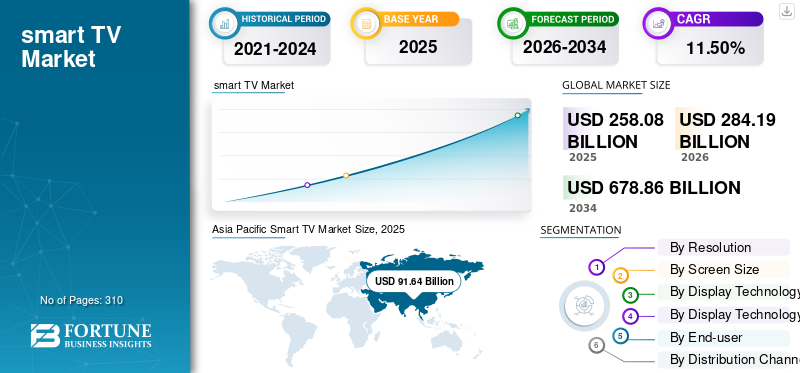
The global smart TV market size was valued at USD 258.08 billion in 2025. The market is projected to grow from USD 284.19 billion in 2026 to USD 678.86 billion by 2034, exhibiting a CAGR of 11.50% during the forecast period. Asia Pacific dominated the smart tv market with a market share of 35.51% in 2025.
A smart TV is a television with built-in internet connectivity and an operating system, allowing users to access streaming services, apps, web browsing, and smart home device integration without additional hardware. Recently, the rise of streaming services, which has shifted viewers from traditional cable to internet-based content, has contributed to the global market size.
Leading brands such as LG, Samsung, and Sony invest heavily in advanced display technologies, including OLED, QD-OLED, Mini LED, and 8K resolution, to offer superior picture quality. They pair these with AI-driven features that provide personalized content recommendations and enhanced picture/audio optimization, thereby improving the user experience and propelling the global market growth.
Download Free sample to learn more about this report.
Smart TV Market Key Takeaways
 Market Size & Forecast
- 2025 Market Size: USD 258.08 Billion
- 2026 Market Size: USD 284.19 Billion
- 2034 Forecast Market Size: USD 678.86 Billion
- CAGR: 11.50% from 2026–2034
 Market Share
- Asia Pacific dominated the smart TV market with a 35.51% share, generating USD 91.64 billion in 2025.
- The LED segment held the largest market share of 76.52% in 2025.
- The residential segment accounted for 75.31% of the global market share in 2025.
 Key Regional Highlights
Asia Pacific
Asia Pacific generated USD 91.64 billion in 2025 and is projected to reach USD 100.29 billion in 2026.
North America
North America reached USD 76.92 billion in 2025 and remains a major market due to high smart TV penetration.
Europe
Europe accounted for USD 61.31 billion in 2025, supported by widespread OTT adoption and strong demand for technology upgrades.
U.S.
The smart TV market reached USD 63.63 billion in 2025, driven by premium viewing demand.
Japan
The smart TV market reached USD 7.66 billion in 2025.
Read More

Smart TV Market Trends
Shift toward E-commerce and Direct-to-Consumer Sales to Aid Market Growth
E-commerce platforms provide consumers with easy access to a wide range of smart and advanced TV models from various brands, at different price points, and with diverse features that may not be available in traditional retail stores. This convenience encourages more purchases and broadens the consumer base. Furthermore, online sales channels enable manufacturers and retailers to offer competitive prices, discounts, and flexible financing options, such as zero-cost EMIs, making smart televisions more affordable, especially in price-sensitive markets. For instance, in June 2020, Samsung launched ‘The Frame 2020’ and 10 new smart television models on e-commerce platforms Flipkart, Amazon, and its official Samsung Shop in India. These included advanced features such as voice assistants, including Google Assistant, Amazon Alexa, and Bixby, as well as personalized content and productivity features.
Market Dynamics
Market Drivers
Download Free sample to learn more about this report.
Increasing Technological Advancements in terms of AI-integration and Application Features to Foster Market Growth
AI algorithms analyze viewer preferences, watch history, and behavior to deliver tailored content suggestions, making the viewing experience unique and engaging. This increases user satisfaction and encourages longer watch times, driving the demand for AI-enhanced smart televisions. Furthermore, AI integration enables smart televisions to act as a central hub for connected devices, allowing for seamless control of lights, speakers, and other devices. This interoperability increases the TV’s utility beyond entertainment, boosting smart TV market growth. For instance, in April 2025, Samsung introduced Vision AI across its Neo QLED 8K, Neo QLED 4K, OLED, QLED, and The Frame TV series. This AI-powered technology uses advanced processors, such as the NQ8 AI Gen3, to automatically optimize picture quality. It features AI Upscaling Pro, which enhances all content to 8K resolution, and OLED Glare-Free technology, which reduces reflections.
Market Restraints
Data Privacy and Cybersecurity Concerns to Limit Market Growth
Many consumers hesitate to fully embrace smart televisions due to concerns about unauthorized data collection and potential spying through built-in cameras and microphones. Smart and advanced TVs frequently collect and transmit user data, including viewing habits, to third parties without clear consent, undermining consumer trust and reducing purchase intent. Moreover, security flaws can allow hackers to gain unauthorized access to TV and connected home networks. The risk of intrusion into private life through surveillance or data theft discourages potential buyers, thereby limiting market growth.
Market Opportunities
Rise of Cloud Gaming Platforms to Support Market Expansion
Cloud gaming eliminates the need for costly consoles or gaming PCs, enabling users to stream games directly to TVs via platforms such as Microsoft’s Xbox Cloud Gaming, Nvidia GeForce Now, Google Stadia, and Sony PlayStation Now. Additionally, smart televisions are increasingly equipped with built-in cloud gaming apps or hubs, allowing consumers to access a wide range of games instantly without downloads or installations. For instance, in April 2023, Samsung collaborated with Xbox to open free-to-play gaming zones at the Microsoft Experience Centers in London and New York. These dedicated gaming areas feature numerous Samsung gaming screens, including 55-inch Neo QLED advanced TVs for cloud gaming via the Samsung Gaming Hub.
Market Challenges
Intense Competition to Challenge Key Players’ Business Revenue Growth
The market includes well-known global and local players (such as Samsung, LG, and Sony), platform-oriented players (such as TCL and Hisense), and various regional and white-label manufacturers. The challenges to enter the mid- and low-end segments are comparatively low due to the use of outsourced panel manufacturing and contract production strategies. This increases competition, especially in price-sensitive markets.
Segmentation Analysis
By Resolution
Increasing Demand for High Resolution to Boost 4K UHD Segment Growth
Based on resolution, the market is divided into HD/Full HD, 4K UHD, and 8K UHD.
The 4K UHD segment dominates the market owing to the globally surging demand for ultra-high resolution TVs. 4K UHD TVs deliver four times the resolution of Full HD, providing enhanced color accuracy, contrast, and sharpness. This superior image quality makes viewing more immersive and appealing, especially on larger screen sizes commonly preferred by consumers, thereby fostering segment growth.
The 8K UHD segment is expected to grow at the fastest CAGR of 13.15% during the forecast period.
To know how our report can help streamline your business, Speak to Analyst
By Screen Size
Comfortable Viewing Distance Feature to Boost 44"–55" Segment Growth
Based on screen size, the market is divided into the following categories: below 32", 32"– 43", 44"– 55", 56"– 65", and above 65".
The 44"–55" segment held the majority of the market, with a 35.91% share in 2025. The 44"–55" range strikes a balance between immersive viewing and comfortable viewing distances. It supports high resolutions, such as 4K UHD, allowing users to enjoy detailed, clear images without requiring very large rooms, thereby supporting the segment's growth.
The above 65" segment is expected to grow at the fastest CAGR of 13.60% during the forecast period.
By Display Technology
Balance between Affordability and Performance to Boost LED TVs Segment Growth
Based on display technology, the market is divided into LED, QLED, and others.
The LED segment held the majority of the market, with a 76.52% share in 2025. LED TVs offer a balance of affordability and performance. The production cost of LED panels is relatively low compared to OLED and other advanced display technologies, allowing manufacturers to price LED TVs competitively and appeal to a wide audience, thereby augmenting the segment's growth.
The QLED segment is expected to grow at the second fastest CAGR of 11.55% during the forecast period.
By Screen Shape
Surging Demand for Slim and Sleek TV Look to Boost Flat Segment Growth
Based on the screen shape, the market is divided into flat and curved.
The flat segment held the majority of the market, with a share of 84.75% in 2025. Flat screens easily fit into a variety of room layouts and interior designs. Their slim, sleek profile allows for mounting on walls or placement on stands without consuming excessive space, making them suitable for most homes. High-income household consumer demand for the slim and flat TVs to hang them on the wall mainly drives the considerable market share of this segment throughout the forecast period of 2026-2034. In addition, the consistent brand launches of high-definition flat TVs to create consumers’ family viewing environments is driving the segment growth.
The curved segment is expected to grow at the second fastest CAGR of 8.52% during the forecast period.
By End-user
Rising Demand for Streaming and Gaming on a Single Device to Propel Residential Segment Growth
Based on end-user, the market is divided into residential and commercial.
The residential segment led the global smart TV market share, with a 75.31% share in 2025. Modern households increasingly demand smart, advanced TVs for streaming, gaming, and high speed internet connectivity, making them central to daily entertainment and the digital lifestyle. Moreover, residential consumers increasingly seek large screens and high-definition displays to enhance their viewing experiences, thereby boosting product demand in this segment.
The commercial segment is expected to grow at the fastest CAGR of 11.75% during the forecast period.
By Distribution Channel
Availability of a Broad Range of Brands and Models to Boost the Specialty Stores Segment Growth
Based on distribution channel, the market is divided into specialty stores, supermarkets & hypermarkets, online stores, and others.
The specialty stores segment led the global market, accounting for 37.02% in 2025. Specialty stores often carry a broad range of brands and models, from entry-level to premium smart and advanced TVs, allowing consumers to explore diverse options under one roof. Moreover, these stores often offer additional services, such as installation, extended warranties, and after-sales support, which enhance the overall buying experience and fuel segment growth.
The online stores segment is expected to grow at the fastest rate of 12.50% during the forecast period.
Smart TV Market Regional Outlook
By region, the market is segmented into North America, Europe, Asia Pacific, South America, and the Middle East & Africa.
Asia Pacific
Asia Pacific Smart TV Market Size, 2025 (USD Billion)
To get more information on the regional analysis of this market, Download Free sample
Asia Pacific held the dominant share in 2025 with a value of USD 91.64 billion and is also anticipated to lead in 2026, with a value of USD 100.29 billion. Rising disposable incomes and improving living standards in countries such as China and India are driving higher consumer spending on premium electronics, including smart and advanced TVs, fueling strong product demand in the region.
Japan Smart TV Market
The Japanese market reached a value of around USD 7.66 billion in 2025, accounting for roughly 2.97% of the global product revenues. Expansion of OTT and streaming platforms support the demand for the product.
China Smart TV Market
The China market is projected to be one of the largest worldwide. Revenues in the country touched around USD 31.37 billion in 2025, representing roughly 12.16% of global product sales.
India Smart TV Market
The India market reached around USD 28.34 billion in 2025, accounting for roughly 10.98% of the global market revenues.
North America
North America is projected to grow at 29.81% during the forecast period. The region holds the second-largest position and reached a valuation of USD 76.92 billion in 2025. Residences in countries such as the U.S. and Canada have at least one smart TV. The increase in ownership is mainly due to replacements, as consumers seek larger screens and enhanced display technologies.
U.S. Smart TV Market
The U.S. market size reached USD 63.63 billion in 2025. The U.S. market accounted for around 24.66% of the global market sales in 2025.
Europe
The European market reached USD 61.31 billion in 2025, securing its position as the third-largest region. The market in Europe is matured and technologically advanced, characterized by widespread household penetration and significant demand driven by upgrades. The expansion of OTT platforms such as Netflix, Amazon Prime Video, and others has further strengthened the market's growth.
U.K. Smart TV Market
The U.K. market reached a value of around USD 9.90 billion in 2025, representing approximately 3.84% of global product revenues.
Germany Smart TV Market
The Germany market reached a value of approximately USD 11.69 billion in 2025, equivalent to around 4.53% of global product sales.
South America and the Middle East & Africa
The South America and the Middle East & Africa markets are expected to grow at a moderate rate over 2026 to 2034. The South America market reached a valuation of USD 15.90 billion in 2025. The rising demand for affordable smart televisions in mid-income segments within these regions significantly contributes to volume sales and market dominance, thereby fostering market growth. In the Middle East & African market, South Africa reached a market value of USD 3.03 billion in 2025.
UAE Smart TV Market
The UAE market reached approximately USD 1.84 billion in 2025, accounting for roughly 0.71% of the global market revenues.
Competitive Landscape
Key Market Players
Increase in Business Collaborations between TV Manufacturers and Tech Players to Foster Market Growth
Nowadays, collaborations between TV manufacturers and streaming service providers (e.g., Netflix, Amazon Prime, Disney+, YouTube) enhance access to diverse video-on-demand content, cater to consumer preferences, and drive the adoption of smart, advanced TVs. Furthermore, alliances between TV manufacturers and smart home technology companies, such as Amazon (Alexa), Google (Google Assistant), and Apple (Siri), enhance interoperability, making smart and advanced TVs central hubs of connected living. For instance, in 2024, Panasonic partnered with Amazon to incorporate Fire TV and Alexa voice control into its new lines of advanced TVs, enhancing user convenience and smart ecosystem integration.
List of Key Smart TV Companies Profiled
- Samsung Electronics Co., Ltd. (South Korea)
- LG Electronics Inc. (South Korea)
- TCL Technology Group Corp. (China)
- Hisense Group Co., Ltd. (China)
- Xiaomi Corporation (China)
- Sony Group Corporation (Japan)
- Panasonic Holdings Corporation (Japan)
- Sharp Corporation (Japan)
- Haier Smart Home Co., Ltd. (China)
- Toshiba Corporation (Japan)
Key Industry Developments
- May 2025: Samsung announced the rollout of its ultra-premium 2025 models, including the Neo QLED 4K, Neo QLED 8K, QLED, OLED, TVs, and The Frame lineup, which integrate Samsung Vision AI technology for an enhanced user experience.
- May 2025: Xiaomi introduced the QLED TV FX Pro and 4K TV FX series in India, featuring advanced audio-visual technology, HDR10+ support, and 30W Dolby Atmos speakers in 43-inch and 55-inch sizes.
- March 2025: Videotex, an Indian company manufacturing 4K QD Mini LED Smart televisions, introduced an ultra-high-definition model, setting a new benchmark in the premium TV segment.
- June 2024: Samsung launched the 2024 QLED 4K TV series in India with three sizes, 55”, 65”, and 75”, offering premium features such as HDR10+ and Dolby Digital Plus, available online via Samsung.com and Amazon.in.
- May 2024: Sony India launched the BRAVIA 2 Series featuring 4K Ultra HD LED display technology with Google TV integration, providing personalized access to streaming apps and live TV.
- February 2024: Reliance Jio launched JioTele OS. This smart and advanced TV operating system supports AI-driven recommendations and 4K content performance, aiming to expand AI integration in Indian smart televisions.
- January 2024: Panasonic collaborated with Amazon to integrate Fire TV and Alexa voice control into its smart TV lineup, improving user convenience and smart ecosystem integration.
REPORT COVERAGE
The market research report provides a comprehensive analysis, focusing on key elements such as major companies, regional and market segmentation, regional analysis, supply chain analysis, competitive dynamics, resolution, screen size, display technology, screen shape, end-user, and distribution channel. Additionally, it provides valuable insights into market trends and highlights key developments within the industry. Beyond these aspects, it also examines various factors that have contributed to market growth in recent years.
Request for Customization to gain extensive market insights.
Report Scope & Segmentation
| ATTRIBUTE | DETAILS |
| Study Period | 2021-2034 |
| Base Year | 2025 |
| Estimated Year | 2026 |
| Forecast Period | 2026-2034 |
| Historical Period | 2021-2024 |
| Growth Rate | CAGR of 11.50% from 2026 to 2034 |
| Unit | Value (USD Billion) |
|
Segmentation |
By Resolution
By Screen Size
By Display Technology
By Screen Shape
By End-user
By Distribution Channel
By Region
|
Frequently Asked Questions
Fortune Business Insights says that the global market size stood at USD 258.08 billion in 2025 and is anticipated to record a valuation of USD 678.86 billion by 2034.
Fortune Business Insights says that the Asia Pacific market value stood at USD 91.64 billion in 2025.
The global market will exhibit a CAGR of 11.50% during the forecast period of 2026-2034.
By resolution, the 4K UHD segment dominates the market.
The increasing technological advancements in terms of AI integration and application features is a key factor driving the global market.
LG Electronics, Samsung Electronics, and Sony are some of the leading players globally.
Asia Pacific dominated the global market in 2025.



- 2021-2034
- 2025
- 2021-2024
- 310
-
(Offer valid till 30th Sep 2026)
Get 30-60 hrs Free Customization
Expand Regional and Country Coverage, Segments Analysis, Company Profiles, Competitive Benchmarking, and End-user Insights.



















-
US +1 833 909 2966 ( Toll Free )
-
Get In Touch With Us