3D Concrete Printing Market Size, Share & Industry Analysis, By Product Type (Walls, Panels & Lintels, Floors & Roofs, Staircases, and Other Structural Components), By Printing Type (Gantry System, Robotic Arm System, and Others), By Construction Type (On-Site Construction and Off-Site/Prefabricated Construction), By End-User (Residential, Commercial, and Industrial), and Regional Forecast, 2026 – 2034
 Download Free Sample
3D Concrete Printing Market Size and Future Outlook
 Listen to Audio Version
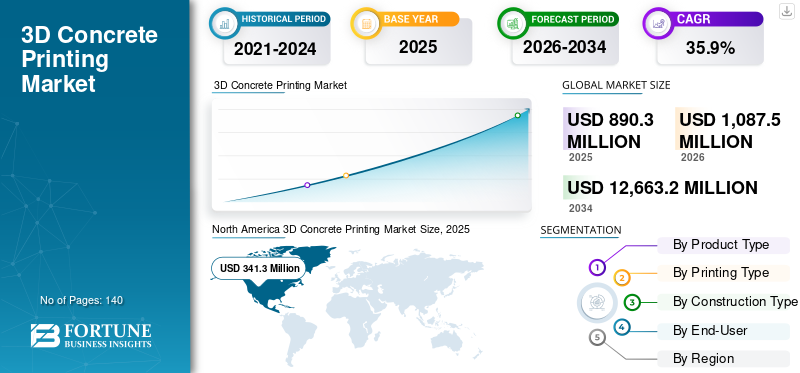
The global 3D concrete printing market size was valued at USD 890.3 million in 2025 and is projected to grow from USD 1,087.5 million in 2026 to USD 12,663.2 million by 2034, exhibiting a CAGR of 35.9% during the forecast period. North America dominated the 3D concrete printing market with a market share of 38.33% in 2025.
3D concrete printing is one of the most innovative additive construction technologies that utilizes robotic technology to develop buildings in layer-by-layer manner using a digitally controlled printer to construct structures by employing specially prepared concrete materials. 3D printing is emerging as a transformative construction technology that enhances structural integrity, reduces carbon footprints, and enables the construction of complex geometries, addressing key limitations associated with conventional construction methods.
As compared to the conventional construction processes where significant manual involvement is required along with the use of formworks, bricklaying, and various construction processes. 3D concrete printing technology allows automatic construction processes resulting in accelerated construction projects, minimum waste of materials, less dependence on labor, and enhanced flexibility in designs. The technology is increasingly used in construction projects for affordable housing, commercial constructions, large scale infrastructures, and disaster relief shelters owing to its potential to provide faster, cost-effective, and sustainable construction projects.
The growth of the market is mainly attributed to the increasing demand for rapid, scalable, and digitally based construction technologies for residential, commercial, and infrastructural sectors. Rapid urbanization, increasing need for affordable housing facilities, and growing investments in large scale infrastructures are motivating many developers and governments to opt for automation-based construction technologies which help to accelerate construction projects. The technology enables the rapid construction of buildings in layer-by-layer form through automated robotic systems, facilitating the efficient construction of houses and other infrastructural projects. 3D printing providers are offering these technologies by collaborating with construction companies for large-scale residential and non-residential developments.
- For instance, in April 2024, Walmart utilized 3D concrete printing technology provided by Alquist 3D for its commercial building expansion projects, including an approximately 8,000-square-foot expansion in Athens, Tennessee, intended to support Walmart’s online pickup and delivery operations in the U.S.
COBOD International A/S, ICON Technology Inc., Apis Cor, PERI 3D Construction, CyBe Construction, WASP Srl are the key players holding a significant share of the market. They are supported by the highly specialized expertise that they have in robotic construction, large scale additive manufacturing technology, concrete printing systems, and alliances formed with home builders, infrastructure firms, and state-funded construction initiatives. These players are consistently working toward improving the efficiency of automated construction processes, concrete printing material, design integration, and building technology to enhance their position in the market.
Download Free sample to learn more about this report.
3D Concrete Printing Market Key Takeaways
 Global Market Size & Forecast
- 2025 Market Size: USD 890.3 million
- 2026 Market Size: USD 1,087.5 million
- 2034 Forecast Market Size: USD 12,663.2 million
- CAGR: 35.9% from 2026–2034
 Market Share
- North America dominated the 3D concrete printing market with a 38.33% share in 2025.
- The walls segment accounted for the largest market share of 36.4% in 2025.
- The robot arm segment is projected to grow at the highest CAGR of 36.6% during the forecast period.
 Key Regional Highlights
North America
North America generated USD 341.3 million in revenue in 2025, leading the global market.
Asia Pacific
Asia Pacific is projected to generate USD 256.9 million in revenue in 2026, making it the fastest-growing regional market.
Europe
Europe is expected to witness steady growth, supported by increasing investments in sustainable construction and building innovation.
U.S.
The market is estimated to reach USD 333.1 million in 2026.
Japan
The market is estimated to reach USD 57.4 million in 2026.
Read More

3D CONCRETE PRINTING MARKET TRENDS
Increasing Shift toward Off-Site and Prefabricated 3D Printing
In recent times, there has been an observed move toward offsite and prefabrication methods of constructing structures from the market. The reason behind this development is the need for scaling up the manufacturing process, ensuring more control over quality, and the faster completion of projects. There is an observable increase in the use of robotic print systems within factory settings where modules such as wall structures, facades, stairs, utility modules, and other prefabricated modules of homes can be printed. This trend is increasingly becoming more popular in residential buildings, modular structures, hotels, military camps, data centers, and smart cities that require speedy delivery schedules and quality control. The concept of 3D concrete printing is becoming increasingly prevalent within the framework of the industrialized construction approach, where manufacturers are increasingly adopting a modular and manufacturing-based construction ecosystem.
MARKET DYNAMICS
MARKET DRIVERS
Download Free sample to learn more about this report.
Rising Adoption of Automated & Robotic Construction Technologies to Drive Market Growth
The 3D concrete printing market growth is increasingly being driven by the ongoing adoption of automation-driven construction methods to address labor shortages, rising labor costs, and project delays. Construction firms are incorporating robotics concrete depositing technologies along with BIM modeling, intelligent design optimization using artificial intelligence, and automated feeders into their projects. This trend has gained traction especially in areas with shortage of skilled labor such as North America, Europe and certain parts of Asia Pacific. Robotic construction systems have become sophisticated enough to print complete building walls and modular elements in hours rather than days. Thus, the successful deployment of robotic construction technologies across residential and non-residential projects is encouraging governments, developers, and contractors to increase investments in automated building solutions.
- For instance, in 2023, ICON partnered with Lennar Corporation using robotic Vulcan construction printer systems to develop a large-scale 3D-printed residential community at Wolf Ranch in Georgetown, Texas.
MARKET RESTRAINTS
High Initial Investment and Infrastructure Requirements to Limit Wider Adoption
The growth of the market is significantly constrained by the high upfront cost associated with 3D printing techniques. It requires substantial investment for specialized printing equipment, robotic systems, material delivery units, software platforms, and supporting infrastructure. Apart from the equipment expenses, there is also the cost involved in providing training to employees, digitizing design, preparing the sites, and formulating materials. This makes it quite expensive, especially for small- to medium-sized construction firms in developing countries that lack funds or means of accessing funds. There may also be the uncertainty of returns on investment, scalability of projects, and approval from the concerned authorities, all of which may lead to postponing decisions for the purchase of the equipment.
MARKET OPPORTUNITIES
Adoption of Off-Site Construction Methods to Create New Growth Avenues
The rapid adoption of modular, prefabricated and off-site construction techniques has emerged as one of the major growth opportunities for market players. Companies in the construction industry have been increasingly moving manufacturing operations out of the traditional on-site setting into more controlled factory setting to increase efficiency and productivity, speed up projects, deal with workforce shortage, and increase consistency. In such a scenario, 3D concrete printing presents itself as a high degree of automation that can manufacture wall panels, lintels, façade parts, staircases and many other structural items without any material wastage and dependency on traditional formworks.
The 3D printing process allows for manufacturing unique and custom-made structures which are difficult or expensive to make through traditional construction processes. In addition, as developers strive to accelerate their projects, lower costs and promote sustainable building practices, use of 3D printed prefabricated components is gradually catching on across residential, commercial, industrial, and infrastructure projects.
MARKET CHALLENGES
Shortage of Skilled Operators and Digital Construction Expertise to Create Challenges for Industry Expansion
The problem of unavailability of skilled operators and digital construction experts is a challenge for industry expansion given that it involves people who are knowledgeable about traditional construction practices while having experience with digital manufacturing techniques. It includes the use of robotics, automated processes of material management, BIM, CAD, and machine operation altogether. Thus, construction companies face difficulty recruiting specialists that can handle all the stages of digital construction. Training programs, certifications, and study materials on additive construction are yet to emerge and develop into a system that would allow the rapid growth of such specialists. The challenge is particularly pronounced in emerging markets where access to advanced digital construction education and automation expertise remains limited.
Segmentation Analysis
By Product Type
Walls Segment Led the Market as It Represents the Most Widely Deployed Product Type
By product type, the market is segmented into walls, panels & lintels, floors & roofs, staircases, and other structural components.
The walls segment held the largest market share, accounting for 36.4% in 2025, and is expected to grow at the fastest CAGR over the analysis period. The dominance is due to their simple geometry, easy automation, lack of need for formwork, and labor savings. In both residential and commercial construction, walls remain the key structural component suitable for printing. The efficiency offered by 3D printing technology to build walls in less time and with less material waste, alongside the saving of labor costs and design flexibility, also contributes significantly to the segment growth. It can be anticipated that the segment will continue to be the most commercially mature and widely utilized application for 3D concrete printing in the future.
The panels & lintels segment is anticipated to expand at a CAGR of 36.3% over the forecast period. These products are especially prominent in prefabricated and modular construction projects, where these are widely utilized in residences, businesses, schools, hospitals, and industries. This is mainly due to the growing trend of offsite construction practices that demand standardized, repeatable, and fast-to-install components of construction. Through 3D printing, panels and lintels can be created using less raw materials, less formworks, less labor costs, and flexible designs.
To know how our report can help streamline your business, Speak to Analyst
By Printing Type
Gantry Systems Segment Leads the Market Driven by their Deployment in the Production of Large Objects with Efficiency and Stability
By printing type, the market is segmented into gantry system, robotic arm system, and others.
The gantry systems segment holds the leading 3D concrete printing market share since these systems can produce large-size objects with precision, stability, and efficiency. They are especially useful when constructing homes, commercial buildings, and large scale infrastructure given that they allow one to quickly produce big pieces of walls and other architectural parts. Moreover, these systems are able to handle high throughput rates and they are easier to operate than other types of 3D concrete printers, which makes them especially popular for commercial construction purposes.
The robot arm segment is predicted to depict the highest CAGR of 36.6% over the forecast period due to its greater flexibility, capability of printing complicated structures, and increasing application in advanced architecture and customization in construction activities. The robot arm systems can be easily installed within confined construction areas and prefabrication centers due to their smaller footprints. With the rising need for custom-built buildings, modularity in construction parts, and sophisticated architectural construction projects, there has been an increasing inclination toward investments made by contractors and technology developers in using robot arm-based printing technologies.
Key companies in the market are investing and focusing on developing mobile robotic platforms, track-mounted robots, and sophisticated multi-axis printing technology that enable greater flexibility and automation capabilities in terms of design and mobility.
For instance, in 2024, Vertico introduced its Solo Robot, a standalone robotic-arm 3D concrete printing system designed for prefabrication, customized construction, and architectural applications. In the same year, XtreeE launched its xHead v4.0, an advanced robotic-compatible concrete printing head that offer excellent ergonomics, interoperability, precision, and material deposition performance.
By Construction Type
On-site printing Segment Dominated the Market Owing to its High Deployment
By construction type, the market is segmented into on-site construction and off-site/prefabricated construction.
In 2025, the on-site printing segment emerged as the leading construction type. The on-site printing has become the prevailing mode for 3D printing due to its ability to create buildings directly on site without needing any transportation process, ensuring that the greatest amount of savings are achieved in terms of costs and time during the process of additive construction. Many of the applications currently underway are centered around the building of houses or other structures for affordable housing initiatives or small commercial projects in which walls can be printed directly on site.
The off-site/prefabricated construction segment is the fastest growing segment and is projected to expand at a CAGR of approximately 36.8% over the forecast period. The increased need for prefabrication, modular buildings, and control systems that enhance the efficiency of manufacturing processes is evident. Off-site factories will allow manufacturers to produce wall, façade, bridges, and module building components in a controlled environment, minimizing the effects of weather conditions and variations in material on print quality. Industrialization, increase in labor efficiency, and rapid growth in cities has made contractors favor the use of prefabricated 3D-printed modules that can be moved from off-site factories to construction sites, creating more growth opportunities in printing for off-site/prefabricated construction.
By End-User
Residential Segment Leads the Market with Escalating Demand for Rapid Construction and Affordable Housing
By end-user, the market is segmented into residential, commercial, and industrial.
The residential segment holds the largest share of the market due to the growing demand for affordable housing, rapid construction solutions, and labor-efficient building methods. Housing projects represent the most commercial application of 3D concrete printing as the technology is particularly well-suited for constructing walls and low-rise residential structures. Residential buildings typically have simpler structural designs and lower regulatory complexity than commercial or industrial projects, making them easier to implement using current 3D printing technologies. The successful deployments of 3D-printed homes across the U.S., Europe, the Middle East, and Asia have further demonstrated the technology's feasibility, driving wider adoption within the residential sector.
The commercial segment is expected to register the highest CAGR of 36.7% during the forecast period owing to the increasing adoption of 3D printing for offices, retail facilities, hospitality buildings, educational institutions, and public infrastructure projects. The growing investments from real estate developers, construction firms, and governments in sustainable and digitally enabled construction methods are also accelerating adoption.
3D Concrete Printing Market Regional Outlook
By geography, the market is categorized into Europe, North America, Asia Pacific, South America, and the Middle East & Africa.
North America
North America 3D Concrete Printing Market Size, 2025 (USD Million)
To get more information on the regional analysis of this market, Download Free sample
North America led the market in 2025, generating a revenue of USD 341.3 million. The dominance is supported by increasing investments in construction automation, robust implementation of digital construction solutions, and the surging demand for sustainable and cost-effective construction processes. The high level of technological development within the region with presence of leading market players and investments in digital construction infrastructure make North America the most developed market.
U.S. 3D Concrete Printing Market
The U.S. is expected to dominate the market with an estimated revenue of about USD 333.1 million in 2026 and is expected to grow at the fastest rate over 2026-2034. With significant demand owing to housing shortages, rising construction labor costs, and commercialization of additive construction technologies, the U.S. is the largest and the most developed market for the 3D printing of concrete at the global level. The growth of the U.S. market is mainly attributed to high concentration of important participants in the industry, including ICON, SQ4D, Alquist 3D, and Azure Printed Homes. The large number of commercial 3D concrete print construction projects in the country further contributes to the growth of this market.
Europe
The Europe market is fueled by the region's increased focus in sustainable constructions, carbon footprint reduction, and building innovations. With the strict requirements in terms of environmental compliance and pressure to increase resource efficiency in construction, many players in the sector turn toward technologies that eliminate the possibility of waste and increase the efficient use of concrete. Additionally, there are several innovative leaders in the field operating in the region, such as COBOD International (Denmark), CyBe Construction (Netherlands), Vertico (Netherlands), XtreeE (France), and Constructions-3D (France) is further contributing to the region’s growth.
U.K. 3D Concrete Printing Market
The U.K. market is estimated to touch a value of around USD 69.9 million in 2026, representing roughly 6.43% of global sales.
Germany 3D Concrete Printing Market
The Germany market is projected to reach approximately USD 94.7 million in 2026, equivalent to around 48.70% of global sales.
Asia Pacific
Asia Pacific remains the significantly growing market, generating a revenue of USD 256.9 million in 2026 globally. Within the region, China and Japan are projected to reach approximately USD 78.1 million and USD 57.4 million, respectively by 2026. The Asia Pacific market is spurred by fast-paced urbanization, infrastructural investments, and increasing construction demand. The rapid growth in China, India, Japan, Singapore, and Australia brings along the massive development of residential areas and infrastructure, opening up room for the implementation of automated construction technologies.
China 3D Concrete Printing Market
The China market is projected to remain dominant in the Asia Pacific region, with 2026 revenues estimated at around USD 78.1 million, representing roughly 7.18% of global sales.
Japan 3D Concrete Printing Market
The Japan market is estimated to reach a valuation of around USD 57.4 million in 2026, accounting for roughly 5.28% of the global sales.
India 3D Concrete Printing Market
The India market is estimated to touch around USD 24.5 million in 2026, accounting for roughly 2.25% of global sales.
Middle East & Africa
The Middle East & Africa market is mainly motivated by the rising need for affordable housing and the demand to enhance construction efficiency to reduce costs. The increasing involvement of the government, non-governmental bodies, and the private sector on coming up with innovative ways of constructing houses will aid market growth.
GCC 3D Concrete Printing Market
The GCC market is projected to reach around USD 24.8 million in 2026, representing roughly 2.28% of the global sales.
South America
The South America market is mainly driven by the rising need for affordable housing and the demand to enhance construction efficiency to reduce costs. The increasing involvement of the government, non-governmental bodies, and the private sector on innovative ways of constructing houses will aid market expansion. For instance, in April 2026, South America recorded the first completion of 3D Printed Social Housing in La Union, Department of Antioquia, Colombia. Colombia’s “Cementos Argos” printed the walls using Cobod’s “Bod2” printer on behalf of the non-profit “Fundación Berta Martínez.”
Brazil 3D Concrete Printing Market
The Brazil market is projected to reach around USD 31.1 million in 2026, representing roughly 2.86% of the global sales.
COMPETITIVE LANDSCAPE
Key Industry Players
Competitive Advantage Driven by Construction Automation, Proprietary Printing Technology, and Scalable Project Execution
The market is moderately concentrated, with competitive position based on proprietary printing technology, scalability of construction execution, material science knowledge, and provision of an integrated, end-to-end construction solution. Key firms such as COBOD International A/S, ICON Technology Inc., SQ4D Inc., CyBe Construction B.V., Apis Cor Inc., and Alquist 3D have established strong market presence owing to advanced printer architecture, specialized concrete, and the successful execution of residential, commercial, and infrastructural projects.
Competitive differentiating factors include the integration of printing hardware, material feeders, software, and automation into construction solutions platforms. Given the demand for the rapid completion of projects, lesser dependency on labor, and enhanced design capability, competition in the market involves the adoption of next-generation technologies, such as robotized printing technology, construction printers that can be used as mobile units, artificial intelligence for monitoring prints, and high-quality printable concrete. In addition, competitive advantages are emerging due to large-scale project execution and approval from relevant authorities, as the industry moves from pilot projects to actual commercial implementation.
- For instance, in January 2025, COBOD International introduced the BOD3 construction printer, featuring an upgraded modular gantry architecture and integrated real-time monitoring capabilities. The solution has been designed to improve printing efficiency, scalability, and automation for large-scale residential, commercial, and infrastructure construction projects.
LIST OF KEY 3D CONCRETE PRINTING COMPANIES PROFILED
- COBOD International A/S (Denmark)
- ICON Technology, Inc. (U.S.)
- CyBe Construction B.V. (Netherlands)
- SQ4D Inc. (U.S.)
- Apis Cor Inc. (U.S.)
- Alquist 3D (U.S.)
- Constructions-3D SAS (France)
- Vertico B.V. (Netherlands)
- XtreeE SAS (France)
- Tvasta Manufacturing Solutions Pvt. Ltd. (India)
KEY INDUSTRY DEVELOPMENTS
- September 2025: Vertico B.V. extended the commercialization of its Robot-on-Track system, which combines a robotic arm system and linear tracks to enable the long-range printing of massive concrete architecture and industry constructions.
- April 2025: COBOD International A/S unveiled its upgraded version of BOD3 3D Construction Printer equipped with advanced modular gantry design, automatic material handling functions, and real-time monitoring features. These would make it more productive and scalable in large residential and commercial building construction projects.
- October 2024: COBOD International A/S rolled out its latest BOD3 3D Construction Printer with an extendible ground-mounted track system. This system would minimize the time required to set it up and allow it to print multiple buildings continuously.
- June 2024: XtreeE SAS unveiled its latest xHead v4.0 multi-material concrete printing head that would enhance its material placement capability and accuracy in large concrete 3D printing applications.
- March 2024: Vertico B.V. introduced its Solo Robot, a robotic arm-based 3D concrete printer, which is independent and offers enhanced flexibility and mobility of concrete printing.
REPORT COVERAGE
The global 3D concrete printing market analysis includes a comprehensive study of the market size and forecast by all the market segments included in the report. It includes details on the market dynamics and market trends expected to drive the market over the forecast period. It provides information on key aspects, including an overview of technological advancements, the regulatory environment, and product launches. Additionally, it details partnerships, mergers, acquisitions, key industry developments, and prevalence by key regions. The global market research report also provides an in-depth competitive landscape with information on the market share and profiles of key operating players.
Request for Customization to gain extensive market insights.
Report Scope & Segmentation
| ATTRIBUTE | DETAILS |
| Study Period | 2021-2034 |
| Base Year | 2025 |
| Estimated Year | 2026 |
| Forecast Period | 2026-2034 |
| Historical Period | 2021-2024 |
| Growth Rate | CAGR of 35.9% from 2026-2034 |
| Unit | Value (USD Million) |
| Segmentation | By Product Type, Printing Type, Construction Type, End-User, and Region |
| By Product Type |
|
| By Printing Type |
|
| By End-User |
|
| By Construction Type |
|
| By Region |
|
Frequently Asked Questions
According to Fortune Business Insights, the global market value stood at USD 890.3 million in 2025 and is projected to reach USD 12,663.2 million by 2034.
In 2025, the North America market value stood at USD 341.3 million.
The market is expected to exhibit a CAGR of 35.9% during the forecast period (2026-2034).
By end-user, the residential segment leads the market.
The rising adoption of automated and robotic construction technologies is significantly driving the growth of the market as contractors increasingly seek solutions to improve productivity, reduce labor dependency, and accelerate project completion expansion.
COBOD International A/S, ICON Technology, Inc., CyBe Construction B.V., and SQ4D Inc. are the top players in the market.
North America held the largest market share in 2025.


- 2021-2034
- 2025
- 2021-2024
- 140
Get 30-60 hrs Free Customization
Expand Regional and Country Coverage, Segments Analysis, Company Profiles, Competitive Benchmarking, and End-user Insights.














-
US +1 833 909 2966 ( Toll Free )
-
Get In Touch With Us