3D Printed Fashion Market Size, Share & Industry Analysis, By Product Type (Apparel & Garments, Footwear, Jewelry & Ornaments, and Eyewear), By Material Type (Polymers & Plastics, Metals & Alloys, and Composites), By Customization Level (Standardized, Design-Customized, and Fit-Personalized Products), By Price Range (Mass, Premium, and Luxury), By Purchaser Type (Individual Consumers, Fashion Brands & Retailers, and Entertainment Organizations), By Distribution Channel (Brand-Owned Stores, Multi-Brand Stores, Online Marketplaces, and Direct/Bulk Sales), and Regional Forecast, 2026-2034
 Download Free Sample
(Offer valid till 31st Oct 2026)

3D Printed Fashion Market Size and Future Outlook
 Listen to Audio Version
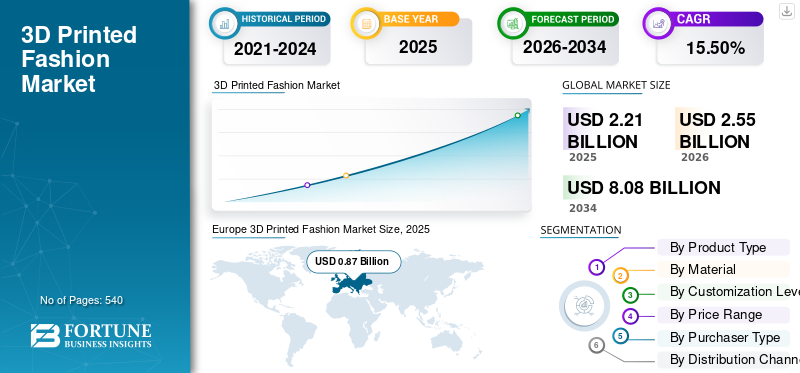
The global 3D printed fashion market size was valued at USD 2.21 billion in 2025. The market is projected to grow from USD 2.55 billion in 2026 to USD 8.08 billion by 2034, exhibiting a CAGR of 15.50% during the forecast period. Europe dominated the 3D printed fashion market with a market share of 39.36% in 2025.
A precise 3D model enables manufacturers to produce complex and customized fashion products. Advancements in 3D printing, printable polymers, body-scanning systems, and generative-design software are allowing manufacturers to produce personalized apparel & footwear with custom colors, patterns, and material usage. 3D printed fashion goods include apparel, footwear, jewelry, handbags, and others. The rising consumer demand for the limited-edition collection of 3D printed products with lightweight lattice structure is driving the global market growth. In addition, the increasing manufacturers’ focus on producing 3D products with recyclable and biodegradable materials to minimize environmental footprint is augmenting the global fashion industry expansion.
Prominent companies in the global market include Adidas AG, NIKE, Inc., PUMA SE, Under Armour, Inc., and ASICS Corporation.
Download Free sample to learn more about this report.
3D Printed Fashion Market Key Takeaways
 Global Market Size & Forecast
- 2025 Market Size: USD 2.21 billion
- 2026 Market Size: USD 2.55 billion
- 2034 Forecast Market Size: USD 8.08 billion
- CAGR: 15.50% from 2026–2034
 Market Share
- Europe dominated the 3D printed fashion market with a 39.36% share in 2025.
- Footwear held the largest share by product type at 48.70% in 2025.
- Polymers & plastics held the largest share by material type at 62.60% in 2025.
 Key Regional Highlights
Europe
Europe held the largest regional share at approximately 39.46% in 2025, with a market size of USD 0.87 billion.
Asia Pacific
Asia Pacific held a 26.43% share in 2025 and is projected to grow at the fastest CAGR of 17.68%.
North America
North America held a 25.84% share in 2025, with the market projected to reach USD 0.66 billion in 2026.
U.S.
U.S.: The market reached USD 0.41 billion in 2025, accounting for 19.69% of global sales.
Japan
Japan: The market reached USD 0.11 billion in 2025, accounting for approximately 4.77% of global revenues.
Read More

3D PRINTED FASHION MARKET TRENDS
Growing Popularity of 3D Clothing with Personalized Fitting to Favor Market Growth
Consumers increasingly seek footwear and garments that fit their individual body measurements. The growing number of fashion brands using foot, face, and body scans with 3D printing to produce products of custom shape, cushioning, support, and dimensions is augmenting the global market growth. In addition, advancements in the development of custom 3D fashion goods with improved comfort, reduced stress points, and lowered sizing problems are favoring the product demand globally. Furthermore, the growing number of customers using specialized 3D scanning apps to help brands model user torsos and design 3D printed clothing is driving global market expansion.
MARKET DYNAMICS
MARKET DRIVERS
Download Free sample to learn more about this report.
Emergence of Brands Strategic Partnerships with Designers and Technology Providers to Drive Market Growth
The growing number of fashion brands establishing partnerships with designers to procure 3D-printing capabilities and technology partners to source specialized 3D printers, materials, software, and product expertise is positively contributing to the global market growth. In addition, the growing number of brands, through such partnerships, launching limited editions of 3D-printed fashion products of distinctive designs with attractive media coverage and social media attention is encouraging fashionistas to invest in such products, driving the global 3D printed fashion market growth.
Market Drivers - Impact & CAGR Contribution (2026–2034)
| Rank | Market Drivers | Expected Impact on Market Growth | Estimated Gross Market Growth Contribution (USD Billion) | Impact: 2026-2028 | Impact: 2029-2031 | Impact: 2032-2034 |
|---|---|---|---|---|---|---|
| 1 | Rising demand for personalized designs and better-fitting fashion products is expected to drive the adoption of 3D-printed footwear, apparel, eyewear, and accessories. | High | 1.65 | High | High | High |
| 2 | The increasing commercialization of 3D-printed footwear and fashion accessories is expanding the availability of these products beyond prototypes and runway concepts. | High | 1.45 | Medium | High | High |
| 3 | Advances in printing speed, wearable materials, design software, and post-processing technologies are improving product quality and production scalability. | High | 1.25 | Medium | High | High |
| 4 | The expansion of on-demand and lower-waste manufacturing practices is encouraging fashion companies to use 3D printing for customized and small-batch production. | Medium | 1.05 | Medium | High | High |
| 5 | The growing number of designer collaborations, limited-edition collections, and technology partnerships is increasing consumer awareness and commercial interest. | Medium | 0.95 | Medium | Medium | High |
| 6 | Others (premiumization, online availability, social-media influence, rising disposable income, and expanding additive-manufacturing capacity are also supporting market growth, etc.) | Low | 0.75 | Low | Medium | Medium |
| Total Gross Growth Contribution | 7.1 | |||||
Source: Fortune Business Insights
Download Free sample For In-Depth Market Drivers & Impact Forecasts
MARKET RESTRAINTS
High Production Costs to Hamper Manufacturing Speed of 3D Printed Products and Restrain Mass-market Product Consumption
Manufacturing 3D printed products requires advanced machines, specialized materials, skilled labor, and additive finishing. The high cost involved in manufacturing such products is hampering the companies’ production speed and negatively impacting the product supply rate in the market. This aspect limits manufacturers from offering 3D printed products at mass-market prices, restraining their demand among price-sensitive consumers globally.
Market Restraints - Impact & Negative CAGR Contribution (2026–2034)
| Rank | Market Restraints | Expected Impact on Market Growth | Estimated Reduction in Market Size (USD Billion) | Impact: 2026-2028 | Impact: 2029-2031 | Impact: 2032-2034 |
|---|---|---|---|---|---|---|
| 1 | High production costs and slow manufacturing speeds make it difficult for companies to offer 3D-printed fashion products at mass-market prices. | High | -0.62 | High | High | Medium |
| 2 | Limited wearable-material choices, durability concerns, and extensive post-processing requirements restrict large-scale commercial production. | High | -0.43 | High | Medium | Medium |
| 3 | Low consumer awareness, uncertainty regarding product fit, and restricted return options for personalized products can discourage purchases. | Medium | -0.32 | Medium | Medium | Low |
| 4 | Others (intellectual-property risks, skilled-labor shortages, inconsistent output quality, machine downtime, and supply-chain disruptions may restrain market growth, etc.) | Low | -0.20 | Low | Low | Low |
| Total Market Reduction | -1.57 | |||||
Source: Fortune Business Insights
Download Free sample For In-Depth Market Restraints & Risk Analysis
MARKET OPPORTUNITIES
Rising Demand for 3D Printed Apparel with Specialized Characters among Consumers and Film Studios to Create Market Growth Opportunities
Consumers increasingly prefer custom 3D printed apparel, handbags, and shoes with film character-printed images, specialized logos, and animation design. Increasing brands' provision of such products is favoring the product demand globally. In addition, the growing number of brands partnering with film studios, theater companies, musicians, and performers to produce 3D products of distinctive costumes, jewelry, footwear, and accessories is creating newer market growth opportunities.
MARKET CHALLENGES
Significant Manufacturers’ Reliance on External Raw Material & Machinery Suppliers to Challenge their Business Profitability
3D-printed fashion manufacturers significantly rely on a limited number of qualified suppliers to source specialized powders, resins, flexible polymers, and other printable materials. Shortages in these supplies, delivery delays, quality inconsistency, and price increases could interrupt the manufacturers’ production processes, hampering global industry growth. In addition, significant manufacturers’ necessity of procuring advanced machines and tools from specialized vendors reduces sourcing flexibility and bargaining power, hampering business profitability.
Segmentation Analysis
By Product Type
Significant Demand for 3D Printed Shoes for Enhanced Performance Led to Dominance of Footwear Segment
By product type, the market is divided into apparel & garments, footwear, jewelry & ornaments, eyewear, bags & carrying accessories, and others.
The footwear segment accounted for the leading global 3D printed fashion market share of 48.70% in 2025. The segment is projected to grow at a CAGR of 15.29% from 2026 to 2034. 3D printing provides practical benefits for shoes, including targeted cushioning, lightweight construction, improved support, ventilation, and personalized fit, generating considerable consumer demand for 3D printed shoes globally. In addition, the growing number of fashion brands utilizing foot scans and digital design tools to adjust and produce 3D-printed shoes based on individuals’ measurements and performance needs is driving the segment’s growth.
To know how our report can help streamline your business, Speak to Analyst
The apparel & garments segment is projected to grow at the fastest CAGR of 17.69% during 2026-2034. The apparel & garments segment includes dresses, tops, skirts, jackets, costumes, decorative clothing panels, and other garments made fully or partly through 3D printing. The rising demand for custom apparel fashion items with complex textures, flexible structures, customized shapes, and limited edition pieces is driving the segment’s growth.
By Material Type
Polymers & Plastics Segment Dominated Owing to Significant Demand for Affordable Polymer-based 3D-printed Apparel and Footwear
Based on material type, the market is segmented into polymers & plastics, metals & alloys, composites, ceramics, bio-based & sustainable materials, and others.
The polymers & plastics segment exhibited a leading global market share of 62.60% in 2025. The segment is projected to grow at a CAGR of 15.34% from 2026 to 2034. Polymer-based 3D-printed products are relatively affordable, exhibit lightweight construction, and are compatible with widely used additive-manufacturing technologies, compared to products made of counterpart material types. Significant consumer demand for affordable polymer-based footwear and garments is generating considerable segmental revenues. In addition, increasing consumer accessibility to the polymer-based footwear made of complex lattice structures and customized designs is driving the segment’s growth.
The bio-based & sustainable materials segment is projected to grow at the fastest CAGR of 20.65% from 2026 to 2034. Bio-based & sustainable materials include recycled polymers, bio-derived plastics, reusable powders, biodegradable materials, and other printable inputs designed to reduce dependence on virgin fossil-based plastics. Increasing brands’ focus on producing products with environmentally friendly bio-based materials is driving this segment’s growth.
By Customization Level
Standardized Products Segment Led Market Due to its Affordability over Products of Counterpart Customization Levels
Based on customization level, the market is divided into standardized products, design-customized products, and fit-personalized products.
The standardized products segment exhibited a leading global market share of 54.80% in 2025. The segment is growing at a CAGR of 12.94% from 2026 to 2034. Standardized products use predefined designs and standard sizes, making it faster for manufacturers to produce such products than individually customized items. Significant consumer demand for such affordable products with limited 3D-printing customization is generating considerable segmental revenues. Standardized products do not require body scanning, individual design adjustments, or customer-specific production workflows, enabling delivery in shorter duration with consistent quality. The increasing replacement rate of such 3D-printed standardized products is augmenting the segment’s growth.
The fit-personalized products segment is projected to grow at the fastest CAGR of 20.49% during the forecast period of 2026-2034. The fit-personalized products segment includes 3D-printed footwear, garments, and eyewear produced according to an individual consumer’s foot, body, or facial measurements. The growing number of manufacturers utilizing digital scanning and design software to adjust product dimensions, cushioning, support, and shape for a more precise fit-personalized products is positively contributing to the segment’s growth.
By Price Range
Perfect Balance between Affordability, Customization, and Performance Led to Dominance of Premium Segment
Based on price range, the market is segmented into mass, premium, and luxury.
The premium segment exhibited a leading global market share of 45.90% in 2025. The segment is growing at a CAGR of 15.58% from 2026 to 2034. Products sold within the premium price segment provide a perfect balance of affordability, required customizable level, and performance, compared to products sold within other price ranges. This aspect primarily generates considerable revenues from the premium segment. In addition, the growing number of premium consumers investing in technologically advanced products with distinctive designs, limited-edition availability, improved performance, and customization is driving the segment’s growth.
The luxury segment is projected to grow at the fastest CAGR of 16.88% during the forecast period of 2026-2034. The growing number of high-income consumers seeking exclusive, made-to-order fashion products with personalized fit, intricate designs, advanced materials, and limited availability is driving this segment’s growth.
By Purchaser Type
Significant Purchases of 3D Printed Products for Personal Use among Individuals Led to Dominance of Individual Consumers Segment
Based on purchaser type, the market is divided into individual consumers, fashion brands & retailers, entertainment & performing arts organizations, educational & research institutions, and others.
The individual consumers segment exhibited a leading global market share of 68.70%. The segment is growing at a CAGR of 15.40% from 2026 to 2034. Significant purchases of 3D-printed fashion goods, including eyewear, apparel, footwear, jewelry, and accessories for personal use by individuals, generate considerable segmental revenues. In addition, the growing influence of recent 3D printing fashion from social media sites is encouraging fashionistas to purchase such products, driving the segment’s growth.
The entertainment & performing arts organizations segment is projected to grow at the fastest CAGR of 17.00% during the forecast period of 2026-2034. This segment includes film and television studios, theatre companies, dance groups, music performers, costume departments, event-production companies, and theme parks. Expanding infrastructure of such entertainment and performing art facilities requiring specialized 3D-printed suits for art performers is driving this segment’s growth.
By Distribution Channel
Broader Consumer Accessibility to a Broader Range of Branded 3D-printed Products Led to Dominance of Online Marketplaces Segment
Based on distribution channel, the market is divided into brand-owned physical stores, multi-brand & specialty stores, brand-owned websites, online marketplaces, direct & institutional sales, and others.
The online marketplaces segment exhibited a leading global market share of 27.80% in 2025. The segment is growing at the fastest CAGR of 17.82% from 2026 to 2034. Amazon, Etsy, and other specialized fashion marketplaces provide a wide variety of 3D-printed footwear, eyewear, apparel, jewelry, and accessories with product quality reviews and home delivery options from their portals. Greater consumer accessibility to the broader range of branded products at these marketplaces is generating considerable segmental revenues. In addition, the growing number of marketplaces offering products with digital payment systems, promotional offers, and international shipping options is positively contributing to the segment’s growth.
The brand-owned websites segment is projected to grow at the second-fastest CAGR of 17.22% during the forecast period. Consistent brand website launches of exclusive products, detailed product information through videos, virtual previews, and online customization tools, allowing buyers to select products based on designs, colors, materials, or sizes, are driving product sales globally.
3D Printed Fashion Market Regional Outlook
By region, the market is categorized into North America, Europe, Asia Pacific, South America, and the Middle East & Africa.
Europe
Europe 3D Printed Fashion Market Size, 2025 (USD Billion)
To get more information on the regional analysis of this market, Download Free sample
The European region exhibits a leading global market share during the forecast period (2026-2034). The European market size reached USD 0.87 billion in 2025, accounting for approximately 39.46% of the global product sales. The region’s market is projected to grow at 14.34% during 2026-2034. Greater concentration of independent fashion designers, advanced additive manufacturing facilities, and strong footprint of apparel & footwear manufacturing are generating considerable product revenues across the Western European region. In addition, an expanding base of fashion stores and online marketplaces offering quality 3D-printed footwear is driving the market growth across the region.
U.K. 3D Printed Fashion Market
The U.K.’s market reached USD 0.16 billion in 2025, representing approximately 7.04% of global sales.
Germany 3D Printed Fashion Market
Germany’s market reached USD 0.18 billion in 2025, equivalent to around 7.98% of global sales.
Asia Pacific
The Asia Pacific market is projected to grow at the fastest rate of 17.68% from 2026 to 2034. The region held a global market share of 26.43% and a market size of USD 0.58 billion in 2025. Rising demand for innovative fashion products, expanding additive manufacturing facilities, and increasing disposable spending of individual consumers are augmenting the market growth across China, Japan, South Korea, and Southeast Asia. In addition, increasing awareness regarding 3D-printed products and rising spending on print-on-demand apparel with 3D prints is driving the region’s market growth.
China 3D Printed Fashion Market
China’s market is projected to be one of the largest in the Asia Pacific, with revenues of USD 0.23 billion in 2025, representing roughly 10.26% of global product sales. Advancements in materials and design are driving the development of more comfortable, durable, and attractive 3D-printed fashion products in China.
India 3D Printed Fashion Market
The Indian market stood at USD 0.080 billion in 2025, accounting for roughly 3.60% of global market revenues. Advancements in 3D printing technologies are driving faster, more precise, and scalable production of customized fashion products over traditional methods of production across India. These advancements is positively contributing to the Indian market growth.
Japan 3D Printed Fashion Market
The Japanese market stood at USD 0.11 billion in 2025, accounting for roughly 4.77% of global revenues. The adoption of 3D printing in haute couture is driving demand for intricate, customized, and exclusive fashion designs across Japan.
North America
The North America region held the third-largest global market share of 25.84% in 2025. The North American market size is estimated to reach USD 0.66 billion by 2026. The market is projected to grow at 14.94% during 2026-2034. A greater consumer base, advanced additive manufacturing ecosystems, and significant demand for personalized and limited-edition products are generating considerable product revenues across the region. In addition, increasing brands’ collaborations with designers and entertainment centers to produce personalized costumes and dresses is driving the region’s market growth.
U.S. 3D Printed Fashion Market
The U.S. market size reached USD 0.41 billion in 2025. The U.S. market accounted for 19.69% of the global sales in 2025. Shifting American consumer preference toward buying garments with greater focus on aesthetic performance, eco-friendly shopping, and creator culture is driving U.S. market growth.
South America
The markets in South America and the Middle East & Africa are expected to grow at a moderate pace from 2026 to 2034. The South American market in 2025 reached a valuation of USD 0.086 billion. The growing number of international brands establishing partnerships with retailers and end-use customers is driving the product consumption rate across Brazil, Argentina, and Colombia. In addition, the growing number of consumers adopting 3D-printed smart jewelry and fitness bands that integrate into daily active lifestyles is driving South American market growth.
Middle East & Africa
The rising demand for 3D-printed products equipped with cutting-edge fabric technology and blended with traditional cultural elements in the design is driving market growth across the Middle Eastern region. In addition, increasing demand for 3D-printed intricate jewelry, footwear, and clothing equipped with wearable art pieces and cultural storytelling is driving African market growth.
UAE 3D Printed Fashion Market
The UAE reached a valuation of USD 0.026 billion in 2025. The growing potential of 3D printing is driving innovation and customization across the UAE fashion industry.
South Africa 3D Printed Fashion Market
The South African market reached USD 0.017 billion in 2025, accounting for roughly 0.76% of global market revenues. 3D printing is shaping the future of fashion through customization, innovative designs, and on-demand production across South Africa.
COMPETITIVE LANDSCAPE
Key Industry Players
Product Innovations, Strategic Partnerships, and Research to Help Key Players Maintain Market Position
The key players in the global market are Adidas AG, NIKE, Inc., PUMA SE, Under Armour, Inc., and ASICS Corporation. These players focus on product innovations, athlete-focused research, advanced materials, and performance-enhancing footwear & apparel production to drive their product sales. In addition, they focus on building market share by expanding their base through brand-owned outlets, websites, mobile applications, membership programs, and personalized digital experiences. These efforts help the companies maintain their market positions.
LIST OF KEY 3D PRINTED FASHION COMPANIES PROFILED IN REPORT
- Adidas AG (Germany)
- NIKE, Inc. (U.S.)
- PUMA SE (Germany)
- Under Armour, Inc. (U.S.)
- ASICS Corporation (Japan)
- New Balance Athletics, Inc. (U.S.)
- ECCO Sko A/S (Denmark)
- Skechers U.S.A., Inc. (U.S.)
- HUGO BOSS AG (Germany)
- Ermenegildo Zegna N.V. (Italy)
KEY INDUSTRY DEVELOPMENTS
- October 2025: Nike, Inc. launched 3D-printed Air Max 95000 and introduced Project Nectar, a specialized printing process to develop functional and visually distinctive footwear structures.
- June 2025: Adidas AG launched CLIMACOOL LACED to expand its fully printed footwear range with a more adjustable version of the original CLIMACOOL shoe.
- September 2024: Stratasys Ltd. launched TechStyle Fabric Alignment Station to improve the accuracy and efficiency of placing 3D-printed designs directly onto textiles and garments. The system expands the capabilities of the company’s J850 TechStyle solution by accurately aligning printed three-dimensional features with garment sections, pockets, patches, embroidered areas, and knitted structures.
- September 2024: Puma SE and A$AP Rocky collectively launched a limited edition of 3D footwear, apparel, and accessories collection.
- July 2024: Zellerfeld GmbH ended the beta phase of its 3D-printed footwear platform and opened it to independent designers. The platform allows designers to upload digital footwear models, offer them for sale, and use Zellerfeld’s infrastructure for on-demand manufacturing and order fulfilment.
REPORT COVERAGE
The global 3D printed fashion market analysis provides an in-depth study of market insights, size, and market forecasts by product type and all other key market segments included in the market report. In addition, the report provides details on the market outlook, market dynamics, and trends expected to drive the market during the forecast period. The market report includes information on technological advancements, new product launches, key product developments, partnerships, and mergers and acquisitions. The market research report also includes a detailed competitive landscape, with market share and profiles of key players.
Request for Customization to gain extensive market insights.
Report Scope & Segmentation
| ATTRIBUTE | DETAILS |
| Study Period | 2021-2034 |
| Base Year | 2025 |
| Estimated Year | 2026 |
| Forecast Period | 2026-2034 |
| Historical Period | 2021-2024 |
| Growth Rate | CAGR of 15.50% from 2026 to 2034 |
| Unit | Value (USD Billion) |
| Segmentation | By Product Type, Material Type, Customization Level, Price Range, Purchaser Type, Distribution Channel, and Region |
| By Product Type |
|
| By Material Type |
|
| By Customization Level |
|
| By Price Range |
|
| By Purchaser Type |
|
| By Distribution Channel |
|
| By Region |
|
Frequently Asked Questions
Fortune Business Insights says that the global market value stood at USD 2.21 billion in 2025 and is projected to reach USD 8.08 billion by 2034.
In 2025, the Europe’s market value stood at USD 0.87 billion.
At a CAGR of 15.50%, the global market is projected to grow from 2026 to 2034.
By product type, the footwear segment is projected to hold the leading global market share throughout the forecast period of 2026-2034.
The increasing number of brands' strategic partnerships with designers and technology providers is driving product demand and global market growth.
Adidas AG, NIKE, Inc., PUMA SE, Under Armour, Inc., and ASICS Corporation are the leading players in the market.
Europe dominated the market share in 2025.
The rising demand for 3D printed apparel with specialized characters among consumers and film studios is expected to create new market growth opportunities.



- 2021-2034
- 2025
- 2021-2024
- 540
-
(Offer valid till 31st Oct 2026)
Get 30-60 hrs Free Customization
Expand Regional and Country Coverage, Segments Analysis, Company Profiles, Competitive Benchmarking, and End-user Insights.



















Related Reports
-
US +1 833 909 2966 ( Toll Free )
-
Get In Touch With Us