 Download Free Sample



Get a Quote
Receive a tailored pricing based on your needs.
- Choose license type
- Multiple user options
- Custom scope & coverage
- Fast turnaround
"Designing Growth Strategies is in our DNA"
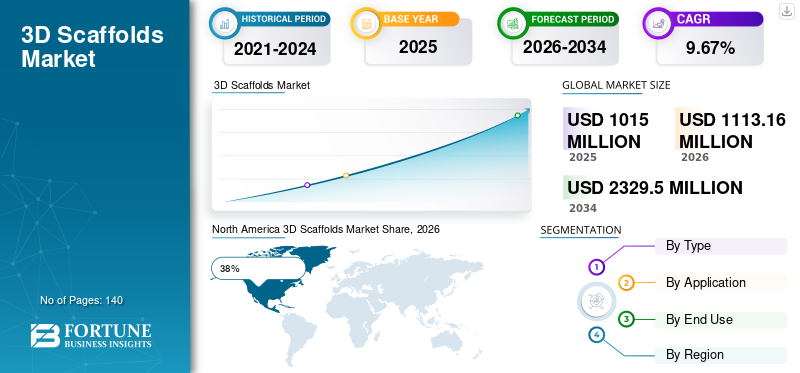
The 3D scaffolds market size was valued at USD 1015 Million in 2025. The market is projected to grow from USD 1113.16 Million in 2026 to USD 2329.5 Million by 2034, exhibiting a CAGR of 9.67% during the forecast period.

The 3D scaffolds market is experiencing strong expansion due to increasing adoption of advanced tissue engineering platforms, regenerative medicine technologies, and three-dimensional cell culture systems. 3D scaffolds are widely utilized to mimic extracellular matrices, enabling improved cell growth, differentiation, and tissue regeneration. The growing demand for biomaterials, organ reconstruction research, and personalized medicine solutions continues to support market penetration across pharmaceutical, biotechnology, and academic sectors. The 3D scaffolds market Report highlights rising investments in scaffold fabrication technologies, including electrospinning, bioprinting, and hydrogel-based structures. Furthermore, increasing collaborations between research institutes and biotechnology companies are strengthening innovation pipelines and accelerating commercialization opportunities across the global 3D Scaffolds Industry.
The United States remains the leading contributor to the North American 3D scaffolds market due to extensive biomedical research activities and the presence of advanced healthcare infrastructure. Academic institutions, biotechnology firms, and pharmaceutical manufacturers increasingly utilize scaffold-based platforms for stem cell research, drug screening, and regenerative medicine applications. Federal support for tissue engineering initiatives and growing demand for alternative organ regeneration technologies continue to support industry expansion.
The U.S. market benefits from a high concentration of research laboratories focused on biomaterials, nanotechnology, and cell therapy development. Continuous product launches, partnerships between universities and industry participants, and expanding clinical research activities are driving the adoption of innovative scaffold technologies throughout the country.
Download Free sample to learn more about this report.
 Global Market Size & Forecast
 Market Share
 Key Regional Highlights
North America
North America held the largest regional share at 38% in 2025, supported by advanced regenerative medicine research.
Europe
Europe accounted for 29% of the global market, driven by increasing adoption of tissue engineering technologies.
Asia-Pacific
Asia-Pacific represented 24% of the market, supported by expanding biotechnology and healthcare research activities.
U.S
The U.S. remains a major market, supported by strong pharmaceutical, biotechnology, and regenerative medicine research.
Japan
Japan accounted for 26% of the Asia-Pacific market, supported by advanced biotechnology and growing regenerative medicine applications.
Read More

The 3D scaffolds market analysis indicates a major shift toward bioactive and biodegradable scaffold materials that closely replicate natural tissue environments. Researchers are increasingly integrating collagen, gelatin, alginate, and synthetic polymers into scaffold structures to improve cell viability and biological performance. The growing popularity of patient-specific tissue engineering solutions has accelerated the use of customized scaffold manufacturing technologies.
Download Free sample to learn more about this report.
Another important trend shaping the 3D scaffolds market growth is the integration of artificial intelligence, additive manufacturing, and 3D bioprinting. Companies are developing highly precise scaffold architectures capable of supporting complex tissue regeneration. Demand for scaffold-based cancer models is also increasing because pharmaceutical companies require realistic testing environments for drug discovery. The emergence of smart biomaterials with controlled degradation rates and enhanced mechanical properties is creating new opportunities for manufacturers operating in the 3D scaffolds market research report landscape.
Rising Demand for Regenerative Medicine and Tissue Engineering
The primary growth driver in the 3D scaffolds market is the expanding demand for regenerative medicine solutions. Healthcare providers and research organizations are actively exploring alternatives to traditional transplantation procedures due to increasing cases of chronic diseases, orthopedic disorders, and tissue damage. Three-dimensional scaffolds provide structural support that facilitates cellular attachment, proliferation, and differentiation, making them critical components in regenerative therapies.
Growing investments in stem cell research further support market demand. Pharmaceutical and biotechnology companies are increasingly adopting scaffold technologies to create realistic tissue models for drug testing and disease research. The development of advanced biomaterials capable of replicating natural extracellular matrices has enhanced scaffold performance, resulting in broader commercial adoption. The 3D scaffolds industry analysis also highlights increasing government funding for tissue engineering research programs, which continues to stimulate product innovation and market expansion across developed and emerging economies.
High Manufacturing Complexity and Development Costs
One of the major restraints affecting the 3D scaffolds market is the significant cost associated with scaffold development and production. Manufacturing high-quality scaffolds requires specialized biomaterials, sophisticated fabrication equipment, and strict quality control processes. These requirements increase operational expenses and create barriers for smaller market participants.
Regulatory compliance also contributes to market limitations. Scaffold products intended for clinical applications must undergo extensive testing to demonstrate safety, biocompatibility, and efficacy. Such processes often require substantial investments and lengthy approval timelines. Additionally, customization requirements for patient-specific scaffold solutions can increase production complexity. The need for skilled personnel, advanced research facilities, and continuous innovation creates financial challenges for many organizations operating within the 3D scaffolds market Outlook framework.
Expansion of Personalized Medicine Applications
Personalized medicine is creating substantial opportunities within the 3D scaffolds market. Healthcare providers increasingly seek treatment approaches tailored to individual patient characteristics, creating demand for customized scaffold structures. Advances in 3D printing technologies allow manufacturers to produce scaffolds with specific geometries, porosity levels, and mechanical properties that match patient requirements.
The growing use of scaffold-based tissue models in precision drug development is further strengthening market prospects. Pharmaceutical companies utilize these models to evaluate therapeutic responses in highly controlled environments. Increasing interest in organ-on-chip technologies, bioprinting platforms, and next-generation regenerative therapies presents significant opportunities for manufacturers. The 3D scaffolds market forecast suggests that continuous improvements in biomaterials science and digital manufacturing will enable broader commercialization of personalized scaffold solutions across healthcare and research sectors.
Technical Limitations in Large-Scale Tissue Regeneration
A major challenge facing the 3D scaffolds market involves achieving successful large-scale tissue regeneration. Although scaffold technologies have demonstrated strong performance in laboratory environments, translating these outcomes into complex clinical applications remains difficult. Maintaining vascularization, nutrient transport, and long-term tissue functionality within engineered constructs presents ongoing technical challenges.
Material selection also remains a critical concern. Researchers must balance biocompatibility, mechanical strength, biodegradability, and manufacturing feasibility when designing scaffold systems. Inconsistent cellular responses across different scaffold materials can impact treatment effectiveness. Additionally, scalability issues associated with commercial production may limit widespread adoption. Overcoming these technical barriers will require continued investment in research, advanced manufacturing technologies, and interdisciplinary collaboration throughout the 3D Scaffolds Industry Report ecosystem.
Synthetic scaffolds account for approximately 64% of the global 3D scaffolds market share. These scaffolds are manufactured using materials such as polylactic acid, polycaprolactone, and polyethylene glycol. Their popularity stems from excellent reproducibility, controlled degradation rates, and customizable mechanical properties. Pharmaceutical and biotechnology companies widely utilize synthetic scaffolds for drug discovery, toxicology testing, and tissue engineering applications.
The segment continues to benefit from advances in polymer engineering and additive manufacturing. Researchers can design highly specific pore structures and surface characteristics to optimize cellular interactions. Synthetic scaffolds also offer superior scalability for commercial production, making them attractive for large-volume manufacturing environments. The 3D scaffolds market insights indicate that demand for synthetic scaffold solutions will remain strong due to their versatility and compatibility with emerging regenerative medicine technologies.
To know how our report can help streamline your business, Speak to Analyst
Tissue Engineering & Regenerative Medicine represents approximately 52% of the global 3D scaffolds market share, making it the dominant application segment. Scaffold technologies provide essential structural frameworks that support tissue formation and cellular organization. Increasing demand for regenerative solutions addressing orthopedic injuries, cardiovascular disorders, and organ repair is driving segment growth.
Healthcare providers and research institutions are actively exploring scaffold-based approaches to reduce dependence on donor organs and traditional transplantation procedures. Continuous innovation in biodegradable materials, bioactive compounds, and 3D bioprinting technologies has significantly improved scaffold performance. The segment also benefits from growing clinical research activities focused on tissue replacement therapies, making it a major contributor to overall 3D scaffolds market growth.
Stem Cell Research accounts for approximately 48% of the 3D scaffolds market share. Researchers increasingly rely on scaffold systems to create physiologically relevant environments that support stem cell proliferation and differentiation. These platforms enable more accurate studies of cellular behavior compared with conventional two-dimensional culture systems.
The expanding use of stem cells in disease modeling, drug screening, and regenerative medicine continues to drive demand for advanced scaffold technologies. Pharmaceutical companies are integrating scaffold-based cell culture platforms into research workflows to improve predictive accuracy during drug development. Improvements in biomaterial composition, pore architecture, and scaffold functionality are enhancing research outcomes and creating additional opportunities within the Stem Cell Research segment of the 3D scaffolds market analysis.
Pharmaceutical and biotechnology companies represent the largest end-user segment in the 3D scaffolds market, accounting for approximately 46% market share. These organizations extensively utilize 3D scaffolds for drug discovery, toxicity testing, cancer research, and regenerative medicine development. Compared with traditional two-dimensional cell culture methods, scaffold-based platforms provide a more realistic cellular microenvironment, allowing researchers to obtain accurate biological responses during preclinical studies.
The increasing focus on personalized medicine and biologic drug development is driving adoption among pharmaceutical manufacturers. Companies are integrating advanced scaffold systems into research workflows to improve drug screening efficiency and reduce failures during later stages of development. The growing demand for tissue-engineered models, organoid research, and stem cell-based therapeutic programs continues to strengthen the role of pharmaceutical and biotechnology companies within the 3D scaffolds market.
North America 3D Scaffolds Market Share, 2026 (%)
To get more information on the regional analysis of this market, Download Free sample
North America holds approximately 38% of the global 3D scaffolds market share. The region benefits from advanced healthcare infrastructure, strong research funding, and widespread adoption of regenerative medicine technologies. Major biotechnology companies and academic research centers actively invest in scaffold innovation, supporting continuous product development and commercialization activities.
The regional market is further strengthened by increasing demand for tissue engineering solutions, growing stem cell research programs, and expanding pharmaceutical applications. Collaborative initiatives between industry participants and research institutions continue to accelerate technology advancements. North America remains a central hub for scaffold manufacturing, clinical research, and biomaterials development, supporting long-term market expansion.
Europe accounts for nearly 29% of the global 3D scaffolds market share. The region benefits from strong biomedical research capabilities, advanced healthcare systems, and increasing investment in tissue engineering projects. Regulatory support for regenerative medicine and growing collaboration among universities, hospitals, and biotechnology firms contribute to market development.
European manufacturers are focusing on innovative biomaterials, bioprinting technologies, and sustainable scaffold production methods. Demand remains particularly strong in orthopedic, dental, and wound healing applications. Continuous advancements in cell therapy and personalized medicine further support adoption across the European healthcare ecosystem.
Germany represents approximately 28% of the European 3D scaffolds market. The country maintains a strong position due to its advanced biotechnology sector, extensive research infrastructure, and high investment in biomedical innovation. Universities and research institutes actively engage in scaffold development projects focused on tissue regeneration, bone reconstruction, and stem cell applications.
German manufacturers emphasize precision engineering and high-quality biomaterial production. Strong collaboration between industrial companies and healthcare organizations supports the commercialization of advanced scaffold technologies. Demand for regenerative medicine solutions continues to increase across orthopedic, dental, and pharmaceutical sectors. The country's commitment to scientific excellence and technology transfer strengthens its influence within the broader European 3D Scaffolds Industry.
The United Kingdom accounts for approximately 22% of the European 3D scaffolds market. Growth is supported by a robust life sciences sector and increasing investments in regenerative medicine research. Academic institutions across the country are actively developing next-generation scaffold technologies for tissue engineering and personalized healthcare applications.
The presence of innovative biotechnology companies contributes to rapid product development and commercialization activities. Growing utilization of scaffold platforms for disease modeling, drug discovery, and stem cell research supports demand across pharmaceutical and research sectors. Strategic government initiatives encouraging biomedical innovation continue to strengthen the United Kingdom's position in the global 3D scaffolds market Outlook.
Asia-Pacific holds approximately 24% of the global 3D scaffolds market share. Rapid expansion of healthcare infrastructure, increasing research funding, and growing awareness of regenerative medicine technologies contribute to regional growth. Countries across the region are investing heavily in biotechnology innovation and advanced manufacturing capabilities.
Demand for scaffold technologies is increasing across pharmaceutical, academic, and clinical research sectors. The region benefits from a large patient population, rising healthcare expenditure, and expanding biomedical research activities. Technological advancements in bioprinting and biomaterials development continue to strengthen Asia-Pacific's role within the global 3D scaffolds market forecast.
Japan represents approximately 26% of the Asia-Pacific 3D scaffolds market. The country's advanced healthcare system and strong focus on regenerative medicine support widespread adoption of scaffold technologies. Research institutions and biotechnology companies actively invest in tissue engineering solutions targeting age-related disorders and chronic diseases.
Japanese manufacturers emphasize precision biomaterials, advanced cell culture platforms, and innovative scaffold fabrication techniques. Government support for regenerative medicine initiatives has accelerated commercialization efforts and clinical research activities. Demand remains particularly strong in stem cell applications, orthopedic reconstruction, and pharmaceutical testing environments.
China accounts for approximately 34% of the Asia-Pacific 3D scaffolds market. Rapid expansion of biotechnology research, increasing healthcare investments, and strong government support for life sciences innovation drive market growth. Universities, hospitals, and pharmaceutical companies are actively adopting scaffold technologies for tissue engineering and regenerative medicine projects.
The country benefits from large-scale manufacturing capabilities and growing expertise in biomaterials development. Increasing demand for advanced healthcare solutions and expanding research infrastructure continue to strengthen China's position in the global 3D scaffolds industry analysis. Investments in 3D bioprinting and personalized medicine further support long-term market opportunities.
The Rest of World region holds approximately 9% of the global 3D scaffolds market share. Growth is supported by increasing awareness of regenerative medicine technologies and gradual expansion of healthcare infrastructure across Latin America, the Middle East, and Africa. Research institutions in these regions are beginning to adopt scaffold platforms for biomedical studies and tissue engineering applications.
Government initiatives focused on healthcare modernization and biotechnology development are creating new growth opportunities. International partnerships with established market participants help facilitate technology transfer and knowledge sharing. While adoption remains comparatively lower than in developed regions, rising investments in research capabilities continue to support market expansion across emerging economies.
Investment activity within the 3D scaffolds market continues to increase as healthcare organizations seek advanced regenerative medicine solutions. Venture capital firms, biotechnology investors, and strategic corporate partners are directing resources toward scaffold manufacturing technologies, biomaterials development, and tissue engineering platforms. Growing demand for realistic cell culture systems and organ regeneration research is attracting substantial funding across both developed and emerging markets.
Significant opportunities exist in personalized medicine, bioprinting, and stem cell therapy applications. Investors are particularly interested in companies developing biodegradable scaffold materials and customized manufacturing solutions. Expanding collaborations between pharmaceutical firms and research institutions are creating additional commercialization pathways. The 3D scaffolds market Opportunities landscape remains highly attractive due to continuous innovation, increasing clinical applications, and rising adoption across pharmaceutical research environments.
Innovation remains a defining characteristic of the 3D scaffolds market. Manufacturers are developing next-generation scaffold materials with enhanced biocompatibility, mechanical strength, and degradation control. Advanced hydrogel systems, nanofiber structures, and composite biomaterials are increasingly entering the market to address complex tissue engineering requirements.
Recent product development efforts focus heavily on 3D bioprinting compatibility and patient-specific applications. Companies are introducing scaffolds capable of supporting vascularization, controlled drug delivery, and multifunctional tissue regeneration. Integration of artificial intelligence into scaffold design processes is improving structural optimization and production efficiency. Continuous innovation across biomaterials science and digital manufacturing technologies is strengthening competitive differentiation throughout the 3D Scaffolds Industry Report ecosystem.
The 3D scaffolds market research report provides comprehensive evaluation of industry trends, technological advancements, competitive dynamics, and application developments. The report examines key growth factors influencing scaffold adoption across tissue engineering, regenerative medicine, and stem cell research sectors. Detailed analysis of biomaterial innovations, manufacturing technologies, and commercialization strategies is included to support strategic decision-making.
Request for Customization to gain extensive market insights.
The report also evaluates market segmentation by type, application, and region, providing insights into demand patterns and emerging opportunities. Competitive benchmarking of leading companies, investment trends, product development activities, and regulatory considerations are assessed. The scope further includes regional market outlooks, technological innovations, and future opportunities influencing the global 3D scaffolds market Outlook.
Fortune Business Insights says that the global market value stood at USD 1,015 million in 2025 and is projected to reach USD 2,329.5 million by 2034.
The market is expected to exhibit a CAGR of 9.67% during the forecast period of 2026-2034.
Tissue Engineering & Regenerative Medicine was the leading application segment, accounting for approximately 52% of the market, driven by rising demand for regenerative solutions and tissue replacement therapies.
Key players include Merck KGaA, CellSystems, Thermo Fisher Scientific, Inc., Femtika, Gelatex Technologies, and ReproCELL Inc.
Major trends include growing adoption of bioactive and biodegradable scaffold materials and increasing integration of AI, additive manufacturing, and 3D bioprinting. North America led the market with approximately 38% share.


(Offer valid till 31st Oct 2026)
Get 30-60 hrs Free Customization
Expand Regional and Country Coverage, Segments Analysis, Company Profiles, Competitive Benchmarking, and End-user Insights.













.webp)






Get In Touch With Us
US +1 833 909 2966 ( Toll Free )
Receive a tailored pricing based on your needs.
Discuss your questions with our industry experts.
Have questions? Get quick answers before you purchase.

